occam
Health Warn
- License — License: MIT
- Description — Repository has a description
- Active repo — Last push 0 days ago
- Low visibility — Only 7 GitHub stars
Code Pass
- Code scan — Scanned 12 files during light audit, no dangerous patterns found
Permissions Pass
- Permissions — No dangerous permissions requested
No AI report is available for this listing yet.
Occam's razor for Claude Code: a 30-line rule set that halved the cost per task on Opus 5.5 and Sonnet 5.5 at effort max and passed more tests than without it. Benchmark and raw data included.
Occam
Deutsch · Video comparison · Install · Reproduce
Build less. Work lean. Talk less.
Occam is a 30-line rule set for coding agents: prefer existing code and standard tools, read only what matters, and keep output concise. It ships as a Claude Code plugin; the rules are also tested in Codex.
Sol 6.1 max, Fast: 8.3% fewer total tokens with Occam on the black-hole task. All three animations pass the browser checks. In the separate Claude coding benchmarks, Occam reduced task cost by 51% on Opus 5.5 max and 55% on Sonnet 5.5 max, while passing at least as many tests.
Black-hole benchmark: Sol 6.1 max
One prompt, three fresh Docker containers. Each setup creates one offline HTML animation with a black shadow, glowing accretion disk, curved light above and below it, visible motion, and Pause/Resume/Restart controls. The model is gpt-6.1-sol, reasoning max, with Fast explicitly requested in every arm.
Base → Occam → Ponytail 4.10, left to right. Ten seconds at 30 fps; the same browser, viewport, software renderer, and animation clock.
https://github.com/user-attachments/assets/e4cbba37-8562-4835-a1bf-18c8d86d133d
Watch/download the original MP4 · Still image at 5 seconds
In the still, Occam's disk forms a broad raised arc above the shadow and a curved band below it. Compare the shape, texture, and motion of all three results in the video.
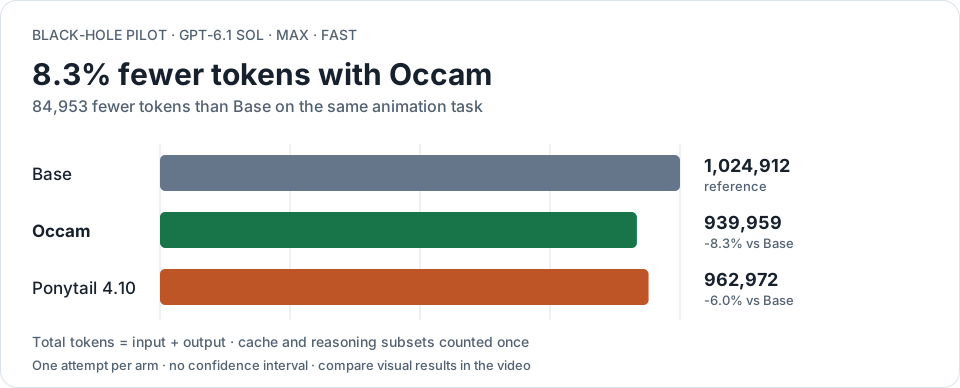
| Setup | Total tokens | Change vs. Base | Generation time | Browser checks |
|---|---|---|---|---|
| Base | 1,024,912 | — | 11.56 min | Pass |
| Occam full | 939,959 | −8.3% | 8.82 min | Pass |
| Ponytail 4.10 full | 962,972 | −6.0% | 8.29 min | Pass |
Occam uses 84,953 fewer tokens than Base and 2.4% fewer than Ponytail. Original HTML files and full measurements · Prompt, scoring, and reproduction.
How to interpret this: one attempt per setup on one visual task, with no confidence interval. Tokens are input + output; cached input and reasoning are included once. This is a token comparison, not a dollar-cost estimate. Fast is verified in the invocation and model catalog; the CLI does not expose the server's served tier. Visual quality can be compared in the video; an independent visual score is still pending.
Claude coding benchmarks
Five rounds, three models, 18 tasks per setup in each round. Claude loads the actual plugins; hidden tests check the resulting code. Cost changes are geometric means of matched task ratios.
| Model | Effort | Occam vs. no plugin | Ponytail vs. no plugin | Tests passed / 18 Base · Occam · Ponytail |
|---|---|---|---|---|
| Opus 5.5 | max | −51% | −26% | 16 · 18 · 18 |
| Sonnet 5.5 | max | −55% | −9% ¹ | 16 · 17 · 17 |
| Opus 5.5 | medium | −11% | +11% | 17 · 18 · 18 |
| Sonnet 5.5 | medium | −3% ¹ | +26% | 16 · 18 · 18 |
| Haiku 4.5 | — | −2% ¹ | +30% | 10 · 13 · 10 |
¹ The 95% confidence interval includes zero. Small changes are not established savings. Cost here is the list-price estimate reported by Claude Code, including thinking and cache. These tasks differ from the visual Codex pilot.
Cost chart, methods, confidence intervals, and raw data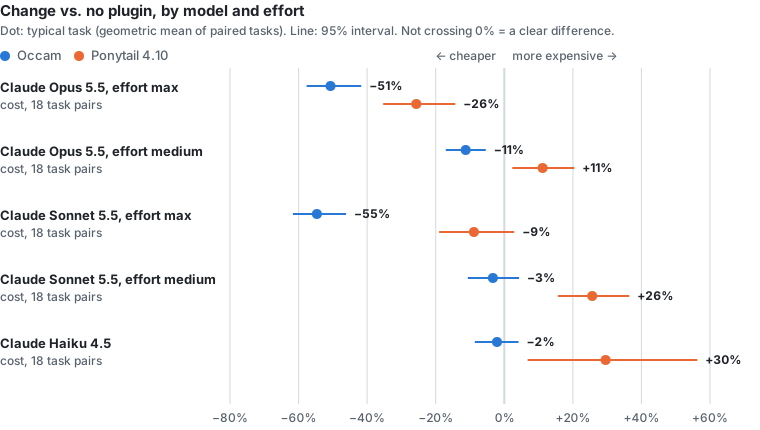
Detailed results and all raw data. The nine seeded scenarios cover root-cause repair, a code question, a CLI feature, CSV analysis, fixture generation, a procedural texture, path-traversal security, refactoring, and a targeted large-file edit. Every arm receives the same fixtures in an isolated workspace. Verifier reference checks and held-out Opus tasks are documented in the report.
Rebuild the chart without model calls:
python bench/chart.py assets
Install
In Claude Code:
/plugin marketplace add quisbaum-prog/occam
/plugin install occam@occam
If Ponytail is already installed, remove it first with /plugin uninstall ponytail@ponytail so both rule sets do not load into the same session. To try a local clone: claude --plugin-dir ./plugin.
The plugin uses POSIX sh hooks. SessionStart supplies the full rules; SubagentStart supplies a short version. No Node or Python is needed for these hooks. The Codex benchmark passes the frozen full rule text as developer instructions.
For plain chat, use preferences.txt in your preferences, or the chat skill for on-demand use.
Use
| Command | Effect |
|---|---|
/occam:occam full |
All rules; default |
/occam:occam lite |
Work lean and talk less; build as usual |
/occam:occam off |
Disable Occam for this session |
/occam:audit 7 |
Review the last seven days of Claude Code token usage |
Set the default for new Claude sessions in ~/.claude/settings.json: "env": {"OCCAM_LEVEL": "lite"} (full, lite, or off). The audit also runs directly: python plugin/tools/audit.py --days 30. It reads local Claude transcripts and reports token costs, repeated context, and large tool outputs.
The rules
The complete text lives in rules.md.
- Build less: prefer what already exists, standard tools, and minimal code; generate repeated structures; fix shared causes.
- Work lean: locate before reading, batch independent calls, keep tool output small, and verify the change.
- Talk less: concise, useful results without routine narration.
- Never cut: understanding, security, accessibility, validation, data-loss handling, or anything explicitly requested.
The benchmarks support savings on these tasks. They do not establish that every model, project, long conversation, or aesthetic result improves. Use the audit and repeated tests to measure your own work.
Reproduce the visual benchmark
With Docker running and Codex signed in:
cd bench/black-hole
python bench.py build
python bench.py run --model gpt-6.1-sol --effort max --service-tier fast --repetitions 1
This starts three independent model runs. Use --dry-run to inspect the plan, or --repetitions 3 for nine runs. Full setup and evaluation guide.
Credits and support
Ponytail by Dietrich Gebert inspired the rule-injection approach and the preference for existing tools. The comparison includes its frozen 4.10 rules.
Occam is free under the MIT license. Sponsor the project to support further benchmark runs.
Reviews (0)
Sign in to leave a review.
Leave a reviewNo results found