code
Health Warn
- License — License: MIT
- Description — Repository has a description
- Active repo — Last push 0 days ago
- Low visibility — Only 6 GitHub stars
Code Warn
- process.env — Environment variable access in assets/bridge/qcode-bridge.mjs
Permissions Pass
- Permissions — No dangerous permissions requested
No AI report is available for this listing yet.
Run Claude Code, opencode, Gemini CLI and Codex side by side in Podman or Docker containers, with tabs, from one terminal app.
qcode
Run Claude Code, opencode, Gemini CLI and Codex side by side in Podman or Docker containers, with tabs like a browser, from one terminal app.
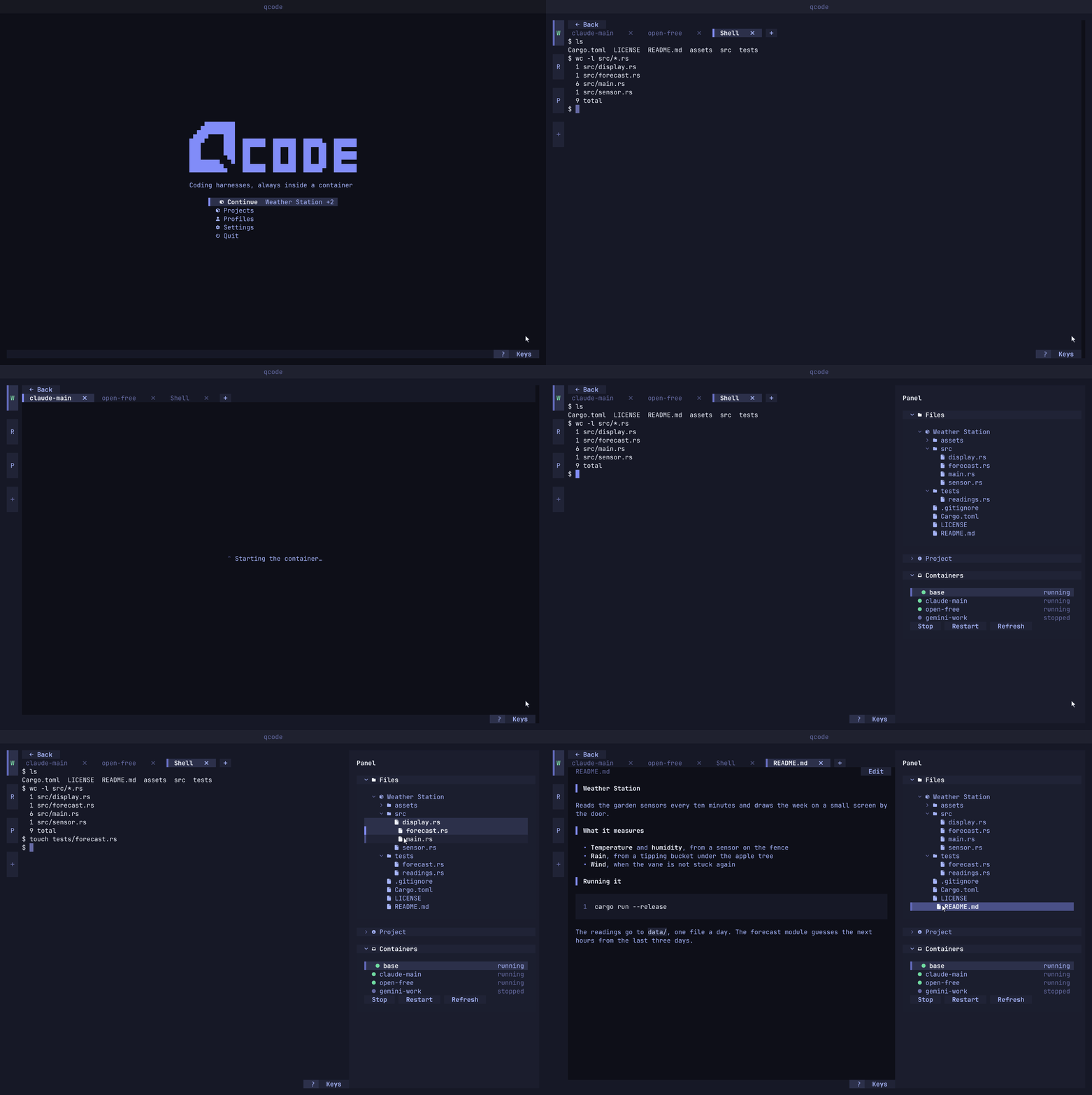
quvyta-code runs coding harnesses inside containers, from the terminal. You set up a
profile once, sign it in, and from then on open that harness in any of your projects in a few
seconds, moving between harnesses and shells the way you move between tabs. Nothing the harness
runs ever runs on your machine itself. qcode is part of the Quvyta family of terminal
applications, is built on quvyta-framework and is open
source under the MIT licence.
Beta. qcode is new. It works on Linux with both Podman and Docker, but the interface, the
files it writes and the way it names images and containers may still change between releases.
Please report anything that looks wrong at https://github.com/quvyta/code/issues.
What it does
- Harnesses in containers. Each harness runs in a container of its own, built from an image
made for it. The container sees the project folder and, if you allow it, the project's assets
folder and the network. Because the container is what keeps the work apart from your machine,
the harness is set up to work without stopping to ask for permission. - Profiles. A profile is one harness with its settings: which harness, how much of qcode's
recommended configuration goes into the image, what it signs in with and what its containers
may reach. Building a profile builds its image; the build can be stopped at any time and a
half-made image is removed. - Signing in once. A profile signs in through the harness's own sign-in flow, run in a
terminal inside a container. qcode then checks that the login file is really there before it
keeps it. Each project that uses the profile gets its own copy of the login, so chat history,
memory and settings never leak from one project into another. A copy can be refreshed from the
profile later, and the profile can be signed out. - Projects. A project starts empty, from a copy of a folder, or from a git address (the clone
runs inside a container, so git does not have to be installed on your machine). The project
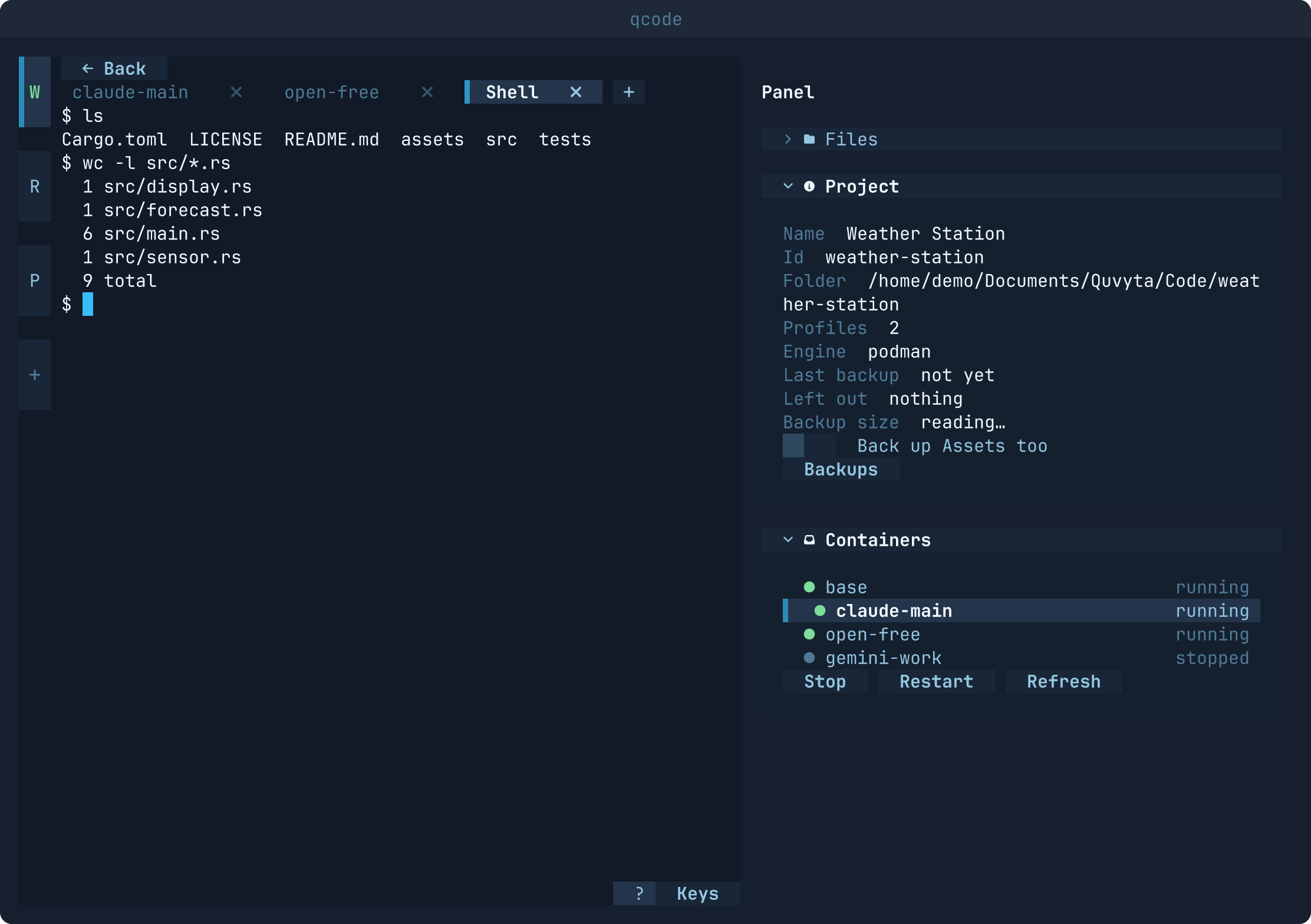
screen has tabs for shells, harnesses and files, and a side panel with the project's files, its
details and its containers, which can be stopped and restarted from there. - Built-in apps. A file opened from the file tree opens in a tab of its own, in the project's
base container, so nothing is installed on your machine for it. See Built-in apps. - Containers stop when you are done. When the last QCode closes, the containers it started
are stopped, and an optional background service does the same after a crash. See
When QCode closes. - Podman or Docker. Either engine works. qcode finds it, tells you when it is missing or not
running, and shows the command that installs or starts it. It never installs anything and never
raises its own rights.
The harnesses qcode knows today:
| Harness | Account types |
|---|---|
| Claude Code | subscription, API key |
| opencode | free models, subscription, API key |
| Gemini CLI | API key |
| Codex CLI | subscription, API key |
Google closed Gemini CLI's "Login with Google" to personal accounts (Code Assist for
individuals, Google AI Pro and Ultra) on 18 June 2026, so a new Gemini CLI profile signs in with
an API key. A profile made earlier with a Google sign-in still loads, with a note saying so: that
sign-in keeps working for Gemini Code Assist Standard and Enterprise.
Each harness is installed from its own published package when a profile's image is built; qcode
does not ship or change any of them. The interface follows your system language (English and
Turkish are included) and uses the family's themes, icons, keys and mouse behaviour.
Why qcode, and what else there is
qcode is an everyday place to work with several harnesses, not a security product. What it adds
is the whole working surface around the containers: profiles you sign in once, a login copy per
project, tabs, going back to an earlier conversation, a file tree and the containers' state in
one screen. Other good tools solve neighbouring problems:
| Tool | What it does | How qcode differs |
|---|---|---|
Docker Sandboxes (docker sandbox) |
Runs harnesses in Docker's microVMs | Its isolation is stronger than a container's; it needs Docker Desktop and is a command-line tool, without tabs, a project screen or a list of earlier conversations |
| Dagger container-use | Gives each task of a harness its own container and git branch, over MCP | A base for running tasks in parallel, with no interface of its own; needs Dagger and git |
| Dev containers | The route the Claude Code documentation suggests | Tied to an editor such as VS Code and set up by hand for each project |
| claude-squad and similar | Several harnesses side by side with tmux and git worktrees | No container: the harness still runs on your machine |
| Single-image scripts (claudebox and others) | One harness in one Docker image | No interface, profiles, per-project logins or conversations to go back to |
If what you need is the strongest possible wall between a harness and your machine, a microVM is
the better tool. If you want to use several harnesses every day without handing them your
machine, qcode is made for that.
What the container protects, and what it does not
The harnesses run in an unattended mode, without asking before each command, because the
container is what keeps them away from your machine. It helps to know exactly where that wall is.
The container keeps the harness away from:
- your home folder, your other projects and every file qcode did not mount: a container sees
only its project'sProject/folder, itsAssets/folder (read-only unless the profile allows
writing) and its own home; - other projects' logins and conversations: each project has its own copy of a profile's home;
- the container engine itself: its socket is never mounted, containers are not privileged, and
processes inside run as your own user id, never as root on your machine.
It does not protect:
- the project folder. The harness can change or delete anything in
Project/, and it is
mounted straight from your disk. Keep your work in git and push it somewhere. - your data from leaving over the network. A profile with network access (the default) can
send anything it can read, the project included, anywhere. A profile can be set to have no
network, but most harnesses need it to reach their model. - the logins. A profile's login lives in the engine's volumes. Anyone who can use your
container engine can read them. - against the engine or the kernel. A container shares your machine's kernel; a flaw there
or in the engine is a way out that a virtual machine would not have.
No telemetry
qcode itself sends nothing anywhere: it has no network code and no network library, collects no
statistics and checks for no updates. The only network traffic it causes goes through your
container engine: building images (the base image and the harness packages), cloning a project
from a git address, and whatever the harnesses do inside their containers. The harnesses keep
their own behaviour, including any telemetry of their own; their documentation says what that is.
Screens


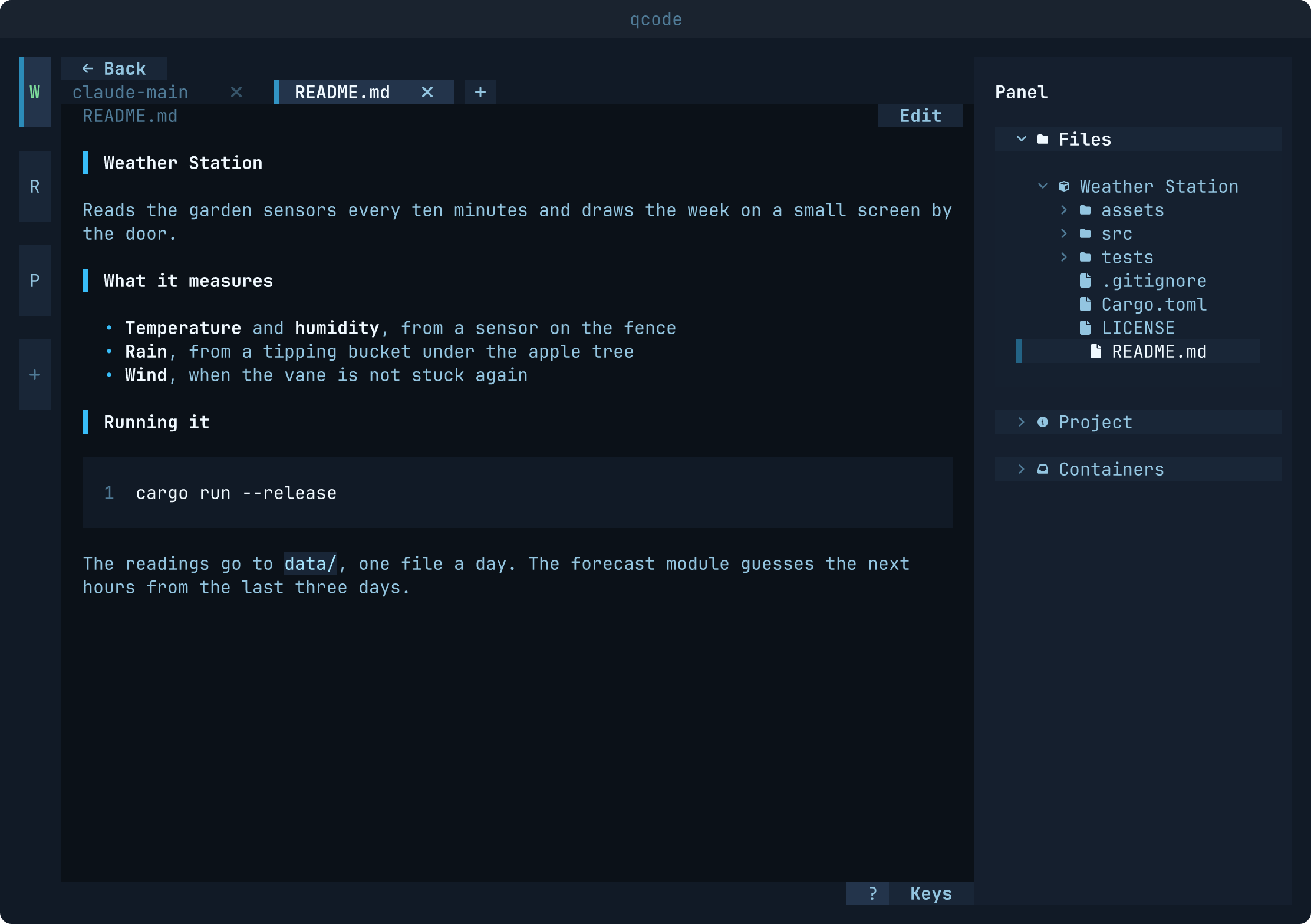
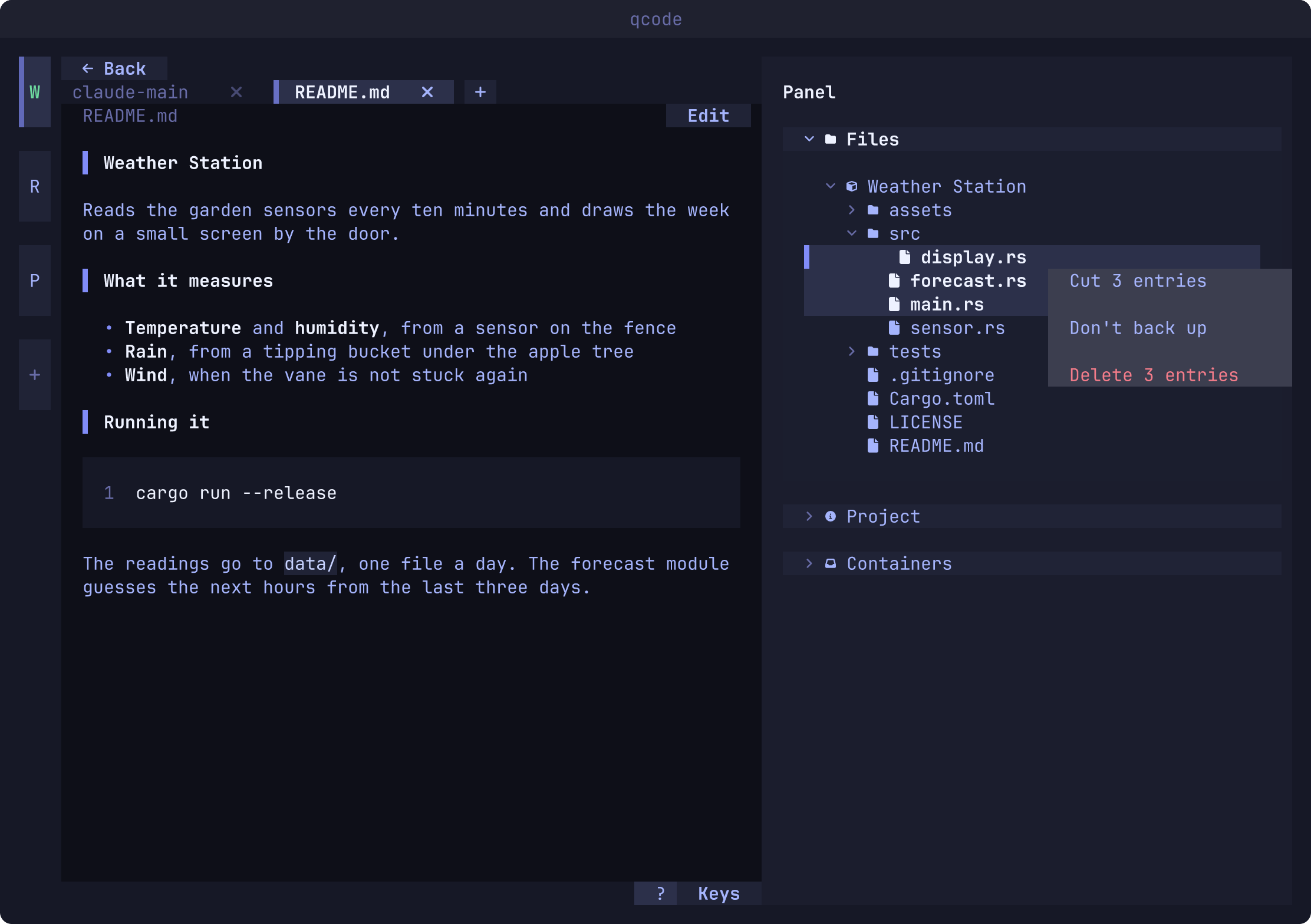
Requirements
- A container engine: Podman (recommended: rootless,
with no background service) or Docker with its daemon
running. - An account with the harness you want to use: a subscription or an API key from its provider.
- Disk space and a network connection for the first images. The base image is Debian with
Node.js; each profile adds its harness on top of it. - Rust 1.95 or later to install from source.
qcode is developed and tested on Linux. The paths, engine checks and container settings for macOS
and Windows are written in, but have not yet been tried on those systems.
Install
curl -fsSL https://raw.githubusercontent.com/quvyta/quvyta/main/install.sh | sh -s -- code
Or with Cargo:
cargo install quvyta-code
qcode
If the shell cannot find qcode, add ~/.cargo/bin to your PATH (fish: fish_add_path ~/.cargo/bin).
The program is installed as qcode and also as quvyta-code.
Using it
- Setup. The first time qcode opens it asks three things: the language, the container engine
and where the workspace folder goes. It checks each answer before going on, and checks them
again every time it starts. - A profile. Open Profiles and make a new profile: pick the harness, the template, the
account type and the permissions, then build the image. When it is built, sign in in the
terminal that opens and press I have signed in. - A project. Open Projects and make a new project, empty, from a folder or from a git
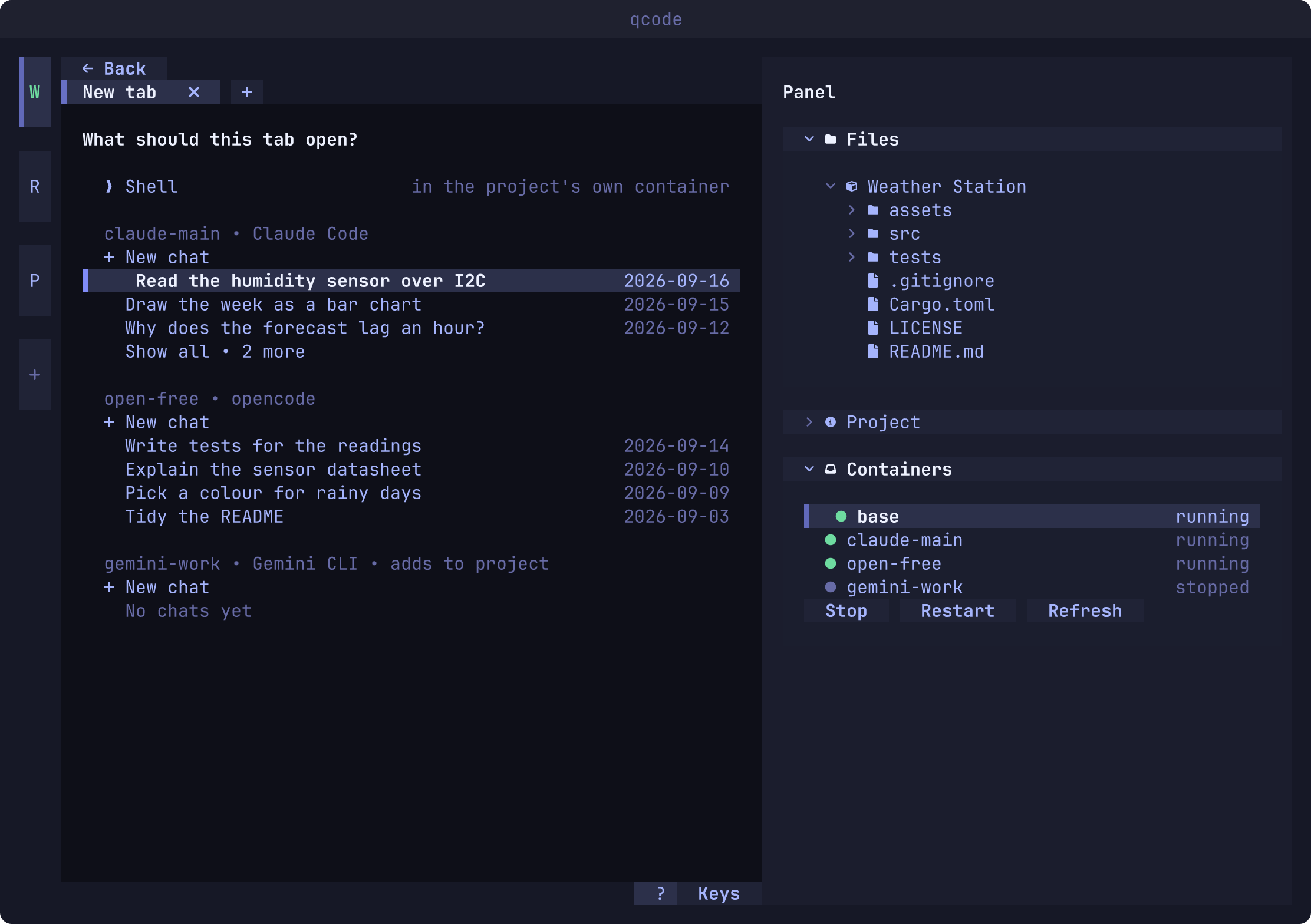
address. - Tabs. In the project, the
+after the last tab (orctrl+t) opens a new tab at once.
It lists the shell of the project's own container and, for every profile, New chat and
the profile's latest conversations in this project, newest first, with when each was last
used. Choosing a conversation opens the harness on it again, where it left off; Claude Code,
opencode, Gemini CLI and Codex CLI all resume a conversation this way. A profile the project
does not have yet is added to it the moment you open it, and is written into the project'sproject.qcode. With no profile at all, the list offers New profile, which leads to the
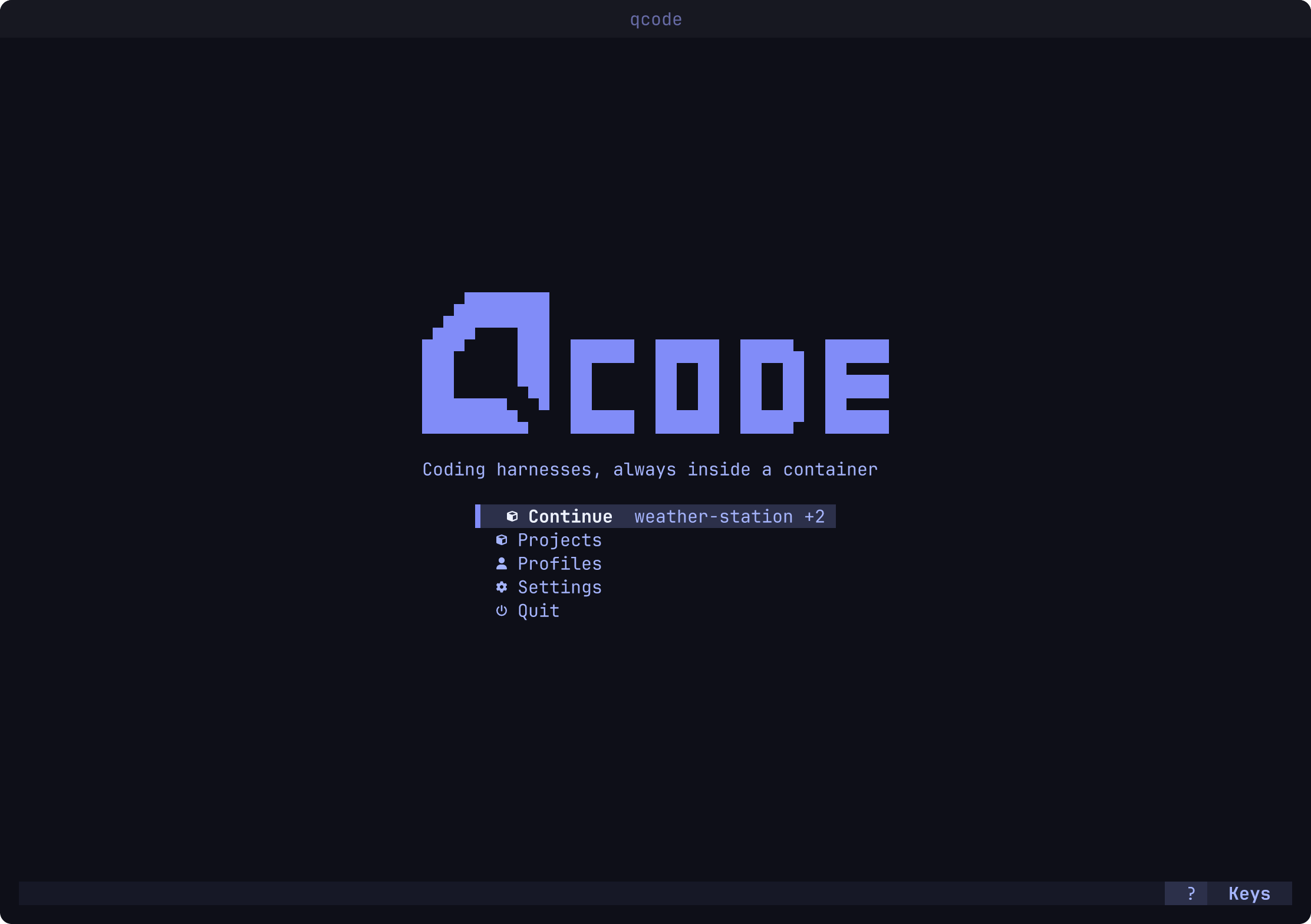
profiles screen. - Continue. The rail on the left holds the projects you have open, like the windows of a
browser:+at its end adds another one, and each can be closed. Continue on the home
screen brings back the open projects with their tabs as you left them, even after qcode was
closed; a tab's container starts when you first switch to that tab.
| Key | What it does |
|---|---|
← → (or h l) |
Move between tabs, while the tab strip has the keyboard |
ctrl+shift+← ctrl+shift+→ |
Move the open tab left or right |
ctrl+t |
Open a new tab |
ctrl+w |
Close the tab |
ctrl+alt+space |
Inside a harness or shell tab: leave it for the tab strip. Anywhere else on the project screen: go back into the open tab's terminal |
alt+b |
Show or hide the side panel |
tab shift+tab |
Move to the next or previous control; shift+tab also leaves a terminal |
ctrl+p |
Command palette |
esc |
Leave the screen that is open |
? or f1 |
The list of every key |
ctrl+q |
Quit |
In the file tree of the side panel:
| Key | What it does |
|---|---|
↑ ↓ |
Move between entries |
→ (or l) |
Open a folder, or step into it when it is open |
← (or h) |
Close a folder, or step up to the folder above |
enter |
Open a folder, or open a file in a tab |
space |
Add the entry to the selection, or take it out |
shift+↑ shift+↓ |
Select a range of entries |
shift+f10 or the menu key |
The entry's context menu |
While a harness or shell tab has the keyboard, keys go to it, esc and ? included; f1, alt+b, ctrl+alt+space, shift+tab and ctrl+q still reach qcode. The mouse reaches a harness that uses it.
Built-in apps
Every project has one small container of its own, the base container, which is also where the
shell tab runs. It starts the first time something needs it, so a session that opens no shell and
no file starts nothing. A file chosen in the file tree (enter or a click) opens in a new
tab named after the file; choosing it again goes back to that tab.
| File | Opens in |
|---|---|
Text: txt, source code, configuration and data files, and files such as README, LICENSE, Makefile or Dockerfile |
The editor chosen in Settings, Built-in apps: nano (the default) or vim. When the editor exits, the tab offers to open the file again |
Markdown: md, markdown |
qcode itself, as a formatted page with no container at all. Edit above the page opens the same file in the editor |
Pictures: png, jpg, jpeg, gif, webp |
chafa, which draws the picture in the tab with full colour. Redraw draws it again at the tab's new size |
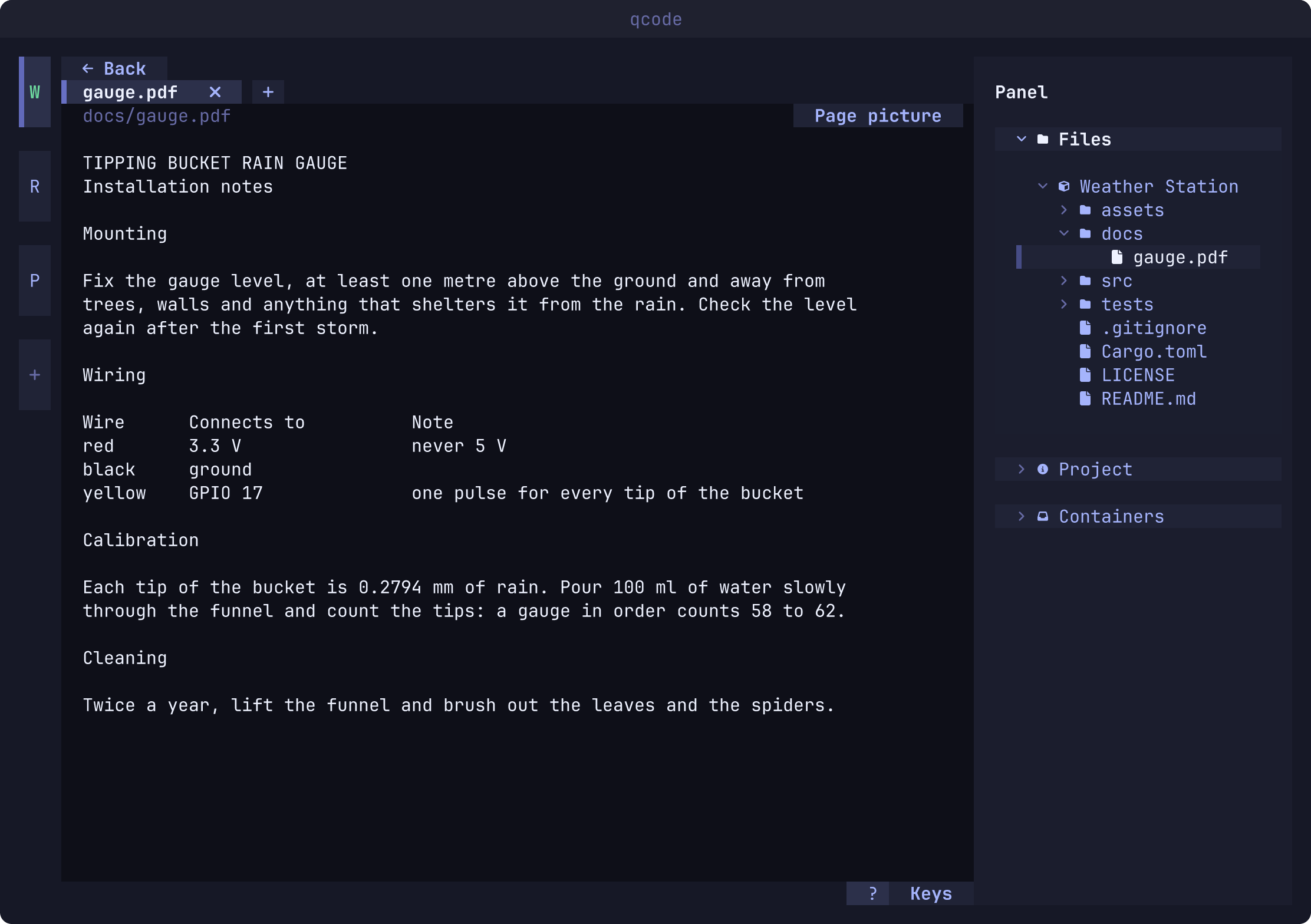
PDF: pdf |
Its text, taken out by pdftotext and shown by qcode like a document. Page picture draws a page with chafa, and Previous and Next walk through the pages; Text goes back. A PDF with no text, such as a scan, opens on its first page picture |
Word and OpenDocument text: docx, odt |
Its text, taken out by docx2txt or odt2txt and shown by qcode like a document |
Sound: mp3, ogg, oga, opus, flac, wav |
sox, which plays it in the tab and shows how far it has got; Play again plays it once more. m4a and aac are not supported |
A sound does not play in the base container. Each time it plays, qcode starts a container of its
own for it, which sees the project read-only, has no network and reaches only this machine's
sound server (PulseAudio, or PipeWire through its PulseAudio socket). On a machine with no such
server, which includes macOS and Windows, the tab shows the sound's details (length, rate,
channels) instead. If no container should ever reach the sound server, set Sounds to
Details only in Settings, Built-in apps: every sound then shows its details and
nothing plays. The default is Play.
Other kinds of files (spreadsheets, presentations, archives) have no app yet; choosing one says
so. The base image also carries unzip, zip, xz, bzip2 and 7z, ready in the shell tab.
Every program runs inside the container, on the file's path there, and is handed that path as one
word, never through a shell. Open file tabs come back with Continue like any other tab; a file
that has gone since is reported in its tab.
Desktop harnesses
Most harnesses draw in the tab's terminal. One does not: Antigravity IDE is a desktop
application, and qcode runs it the same way it runs the others — in a container, on your project
and nothing else — except that its window opens on your own screen instead of in a tab.
A profile for it is made like any other, in Profiles. The image is built on qcode's base image
and downloads the application from Google's own address while it builds; nothing of the
application is carried inside qcode. That download is about 230 MiB and the finished image about
1.4 GiB, so it is much larger than a command-line harness's, and the application uses well over a
gigabyte of memory while its window is open. The version is fixed in qcode, so updating the
application means building the image again.
The tab is one line of status with two things you can do to the window:
| The tab says | What it means |
|---|---|
| Opening the window… | The container is starting. The first time takes a few seconds longer |
| Window open | The window is on your screen. Bring to front asks it to show itself, Close the window closes it |
| Window closed | It is not open. Open the window opens it again. Nothing was lost: the settings, the history and the sign-in are in the project's home volume |
| The window did not open | Why, in the engine's own words |
The window is a container's, which is what makes it worth having and also where its limits come
from:
- It needs Wayland. The container is given the one socket file of your compositor and nothing
else that lives beside it — not the engine's own socket, not the session bus, not the keyring.
Because it is that one file, a compositor that restarts cuts an open window off; opening the tab
again is the way back. X11 is not offered: there every program on the screen could read this
one's windows and keypresses. - Graphics. If your machine has
/dev/dri, the container is given it and the application may
use the card; without it, and on cards the application does not trust, it draws in software,
which works and is not noticeably slower in the editor. NVIDIA's closed driver is not supported
yet. - The application's own sandbox stays on. qcode never passes
--no-sandbox. Podman needs
nothing extra for that. Docker's default seccomp profile refuses the calls the sandbox is built
from, so qcode hands docker a profile of its own: docker's default plusclone,setnsandunshare. It is inassets/seccomp/desktop.jsonwith a comment saying what it costs. - No sign-in yet. The application cannot be used without a Google account, and signing in
means a browser and a port that qcode does not yet carry between your machine and the container.
The window will ask you to sign in and there is currently no way to complete it. Everything
else — that the window opens, keeps its settings, and closes cleanly — works. - A profile with the network off makes no sense here. The application does all its work on its
maker's servers; the tab says so if you try.
Closing the tab closes the window and removes its container; closing the window ends the
container, which the tab notices and offers to open again. qcode quitting stops any open window,
like every other container it started. A container left over from a crash is found by name the
next time and either taken over, if its window is still up, or cleared away.
File manager
The file tree of the side panel is also a file manager. It works on the project's own folder
directly on your machine, so it needs no container and works with no engine running.
- Context menu. Right-click an entry, or select it and press
shift+f10or the menu key. On a
folder: New file, New folder, Rename, Cut, Paste here (once something is cut)
and Delete. On a file: Rename, Cut and Delete. The first row of the tree is the
project folder itself; its menu has New file, New folder, Paste here and Refresh.
With several entries selected, the menu cuts or deletes all of them. Folders and files also
offer Don't back up (or Back up again), and files Earlier versions; see
Backups. - Names are asked for in a small dialog and checked as you type: not empty, no
/, not.or.., and not a name the folder already has. A rename opens with the name before its extension
selected. - Moving is Cut, then Paste here on the folder it goes to. A cut entry is drawn faded
until it is pasted;escor Cancel the move in the menu lets it stay. A folder cannot go
into itself, and nothing is ever written over: when the target already has that name, nothing
moves and the reason is shown. - Deleting asks first and cannot be undone; for a folder the question says that everything in
it goes too. - Several entries.
ctrl+click adds or removes an entry,shift+click selects a range, andshiftwith the arrow keys extends it;spaceadds or removes the entry under the cursor andescgoes back to one. Cut, paste, delete and dragging act on all of them. - Dragging entries onto a folder, or onto the project folder's row, moves them there.
- Live. The tree follows the disk: the folders on screen are watched, and when something
changes in one, by qcode, a harness or any other program, only that folder is read again.
Nothing is read on a timer. Where the system has no watch to give (so far, anywhere but Linux),
the tree is read again after qcode's own changes, when you come back to the screen, and on
Refresh.
A link inside the project is handled as an entry of its own: deleting or moving it touches the
link, never what it points to.
Backups
qcode keeps copies of every open project's Project/ folder in Backup/, next to it in the
project's own folder, so the backup moves and is copied with the project.
- How often. Every 15 minutes while the project is open, once more when you close it from the
rail, and once more when qcode quits. Settings, Back up open projects chooses Off,
5 min, 15 min or 1 hour. A round in which nothing changed writes nothing. - How. Each backup is a git commit in
Backup/Project.git, made by git in a short-lived
container of the base image, so nothing runs on your machine and your machine needs no git.
Your own repository insideProject/, if you have one, is never touched, and what your.gitignoreleaves out stays out. - Leaving things out. Right-click a folder or a file in the file tree and choose
Don't back up; Back up again takes it back in. The list is kept inproject.qcode.
Left-out entries are drawn faded with a coloured icon, and the Project part of the side panel
names them. - Assets.
Assets/is left out unless you turn on Back up Assets too in the Project
part of the side panel. It is then backed up in every round intoBackup/Assets.git, apart
from the project, and the choice is kept inproject.qcode. - Conversations. Each round also backs up the conversations of every profile whose tab was
open since the round before, each profile intoBackup/Conversations/<profile>.git. Only the
harness's conversation files are taken, never its login. opencode keeps its conversations in a
database, so they are backed up only while its container is stopped: when qcode quits and
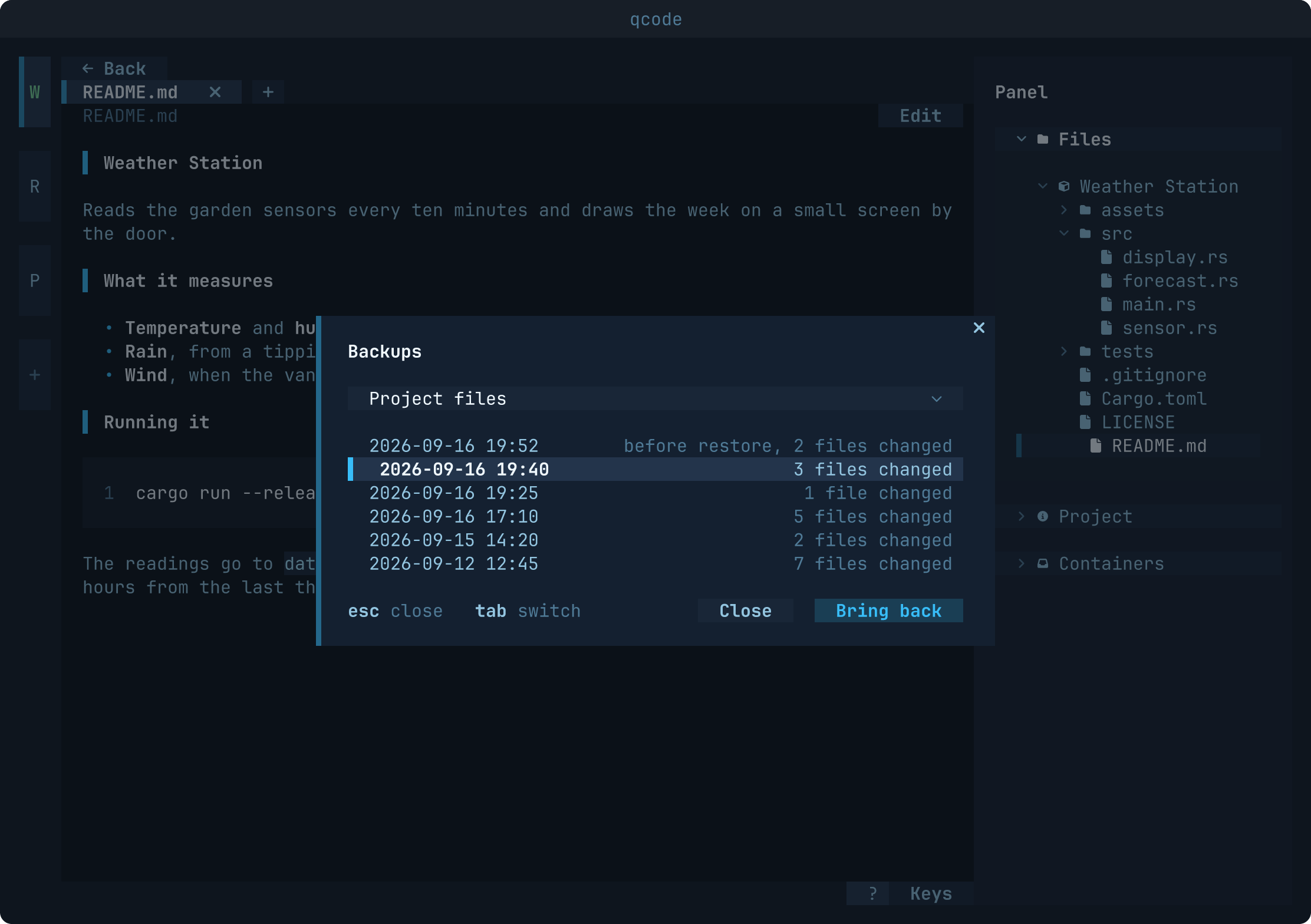
stops it. - Bringing things back. Backups in the Project part of the side panel lists every
backup with its time and how many files it changed; choose one to bring the project back to it.
Earlier versions in a file's menu does the same for that one file. The choice at the top of
the list switches it to the assets, when they are backed up, or to a profile's conversations.
qcode asks first, then backs up how things are now, so bringing something back can be undone
the same way. Nothing is deleted: a file made after that backup stays where it is.
Conversations are brought back only while the profile's container is stopped; if it runs, qcode
offers to stop it first. - What it is for. A backup protects against a wrong delete, a change that breaks things or a
harness scattering files. It sits on the same disk as the project, so it does not protect
against losing the disk.
The Project part of the side panel also shows when the last backup was made and how muchBackup/ holds. If a backup fails, qcode says so once for that project, not at every round.
Tabs talking to each other
The agents in a project's harness tabs can hand each other work: the one in a Claude Code tab can
ask the one in a Codex tab to write a test, and hear back. qcode gives every harness two tools for
this, list_tabs and send_message, through a small MCP server it registers in each harness's
own settings, next to anything you added there. The server runs inside the container and talks
to qcode through a socket in the project's Containers/MCP/ folder, so it works in a profile
without the network too.
Three rules hold for every message:
- You approve the first one. The first message from one tab to another asks you, with the
message shown. Your answer holds for those two tabs, in that direction, until qcode closes, and
is never written to disk. Esc denies. - A tab without the network never sends to a tab with it. The second tab could carry out what
it is given, which is what taking the network away was meant to prevent. The other way round is
allowed. - Loops stop. An exchange between tabs ends after 6 messages, and one tab sends at most 5
messages a minute. The sending agent is told why its message was refused.
A message that is taken waits in the tab it was sent to, on a line that says who sent it; Read
shows it and Discard throws it away. qcode does not type it into the receiving harness's
prompt yet: that needs the terminal to paste the way the harness expects, which comes with the
next release of the framework qcode is built on. Until then the receiving agent starts on it
only when you pass it on.
When QCode closes
Settings, When QCode closes decides what the containers QCode started do once no QCode is
open any more: Stop (the default) or Keep running. Stopped containers are not removed;
the same container starts again the next time it is needed. Only containers QCode itself started
are ever stopped; one you run by hand, or another program's, is never touched.
Several QCodes can be open at once. When the last one closes normally, it stops the containers
itself and says which on the terminal it was started from.
The background service covers what a normal close cannot: a QCode that crashed or whose
terminal was killed. It is optional, and Settings, Background service installs and removes
it. On Linux it is a systemd user path unit that watches the list of the containers QCode
started; on macOS it is a launchd job that watches the same file. It runs only when that list
changes, then waits, without polling and without using the processor, until no QCode is open,
applies the setting, and exits. On a day QCode is never opened it never runs.
On Windows there is no background service, and the last QCode to close cannot tell it is the last,
so the containers keep running; Settings says so.
Where things live
| What | Where |
|---|---|
| Settings | code.conf in the Quvyta folder of the platform's configuration folder: ~/.config/quvyta/code.conf on Linux, ~/Library/Application Support/Quvyta/code.conf on macOS, %APPDATA%\Quvyta\code.conf on Windows. Settings from before (~/.config/quvyta/code/settings.toml) move there once, at start |
| Open projects and tabs | session.toml in the platform's data folder, ~/.local/share/quvyta/code on Linux |
| Containers QCode started | containers.toml in the same data folder, with instances.lock, which every open QCode holds |
| Background service | ~/.config/systemd/user/qcode-reaper.service and qcode-reaper.path on Linux, ~/Library/LaunchAgents/io.quvyta.code.reaper.plist on macOS, while it is installed |
| Workspace | Quvyta/Code in your Documents folder by default (~/Documents/Quvyta/Code, or ~/Belgeler/Quvyta/Code where the desktop names it so), or the folder you chose; a folder chosen before stays where it is |
| Profiles | Profiles/<profile>.toml in the workspace |
| Projects | Projects/<project>/ in the workspace: project.qcode, the code in Project/, your material in Assets/ |
| Tabs talking to each other | Projects/<project>/Containers/MCP/ in the workspace: the server the harnesses start and, while the project is open, the socket qcode listens on; each harness's own settings in qcode-home-<project>-<profile> hold the entry qcode |
| Backups | Projects/<project>/Backup/ in the workspace: Project.git, the backups of Project/; Assets.git, those of Assets/ when it is backed up; Conversations/<profile>.git, each profile's conversations; and the lock files that keep two QCodes from backing up the same thing at once |
| Images | qcode/base and qcode/profile/<profile>, in the engine |
| Logins | engine volumes: qcode-cred-<profile> for the profile, qcode-home-<project>-<profile> for each project's copy |
Files are plain TOML. A file qcode cannot read is reported with its line and column instead of
stopping the program, and a broken project stays on the list so it can be repaired.
Building from source
The toolchain is pinned by rust-toolchain.toml.
git clone https://github.com/quvyta/code
cd code
cargo run --bin qcode
cargo test needs no container engine. The tests that build images and run containers are
ignored by default; run them with a working engine:
QCODE_CONTAINER_TESTS=1 cargo test -- --ignored
Before your first commit, enable the checks (formatting, clippy, tests and docs):
git config core.hooksPath .githooks
CONTRIBUTING.md says more about tests and pull requests, and
CHANGELOG.md lists what changed in each release.
Licence
MIT. See LICENSE.
Reviews (0)
Sign in to leave a review.
Leave a reviewNo results found