ForgeDock
Health Warn
- License — License: AGPL-3.0
- Description — Repository has a description
- Active repo — Last push 0 days ago
- Low visibility — Only 5 GitHub stars
Code Fail
- execSync — Synchronous shell command execution in bin/forgedock.mjs
- process.env — Environment variable access in bin/forgedock.mjs
- process.env — Environment variable access in bin/init-enrich-api.mjs
- network request — Outbound network request in bin/init-enrich-api.mjs
Permissions Pass
- Permissions — No dangerous permissions requested
No AI report is available for this listing yet.
GitHub as a knowledge graph for AI agents. Autonomous dev pipeline for Claude Code - investigate, build, review, merge. Issue in, PR out.

ForgeDock
Give Claude Code a memory that survives every session.
ForgeDock turns GitHub into a persistent knowledge graph for AI agents. Every pipeline stage writes structured annotations to issues and PRs — so the next agent always knows what happened, why the code looks this way, and what to do next.






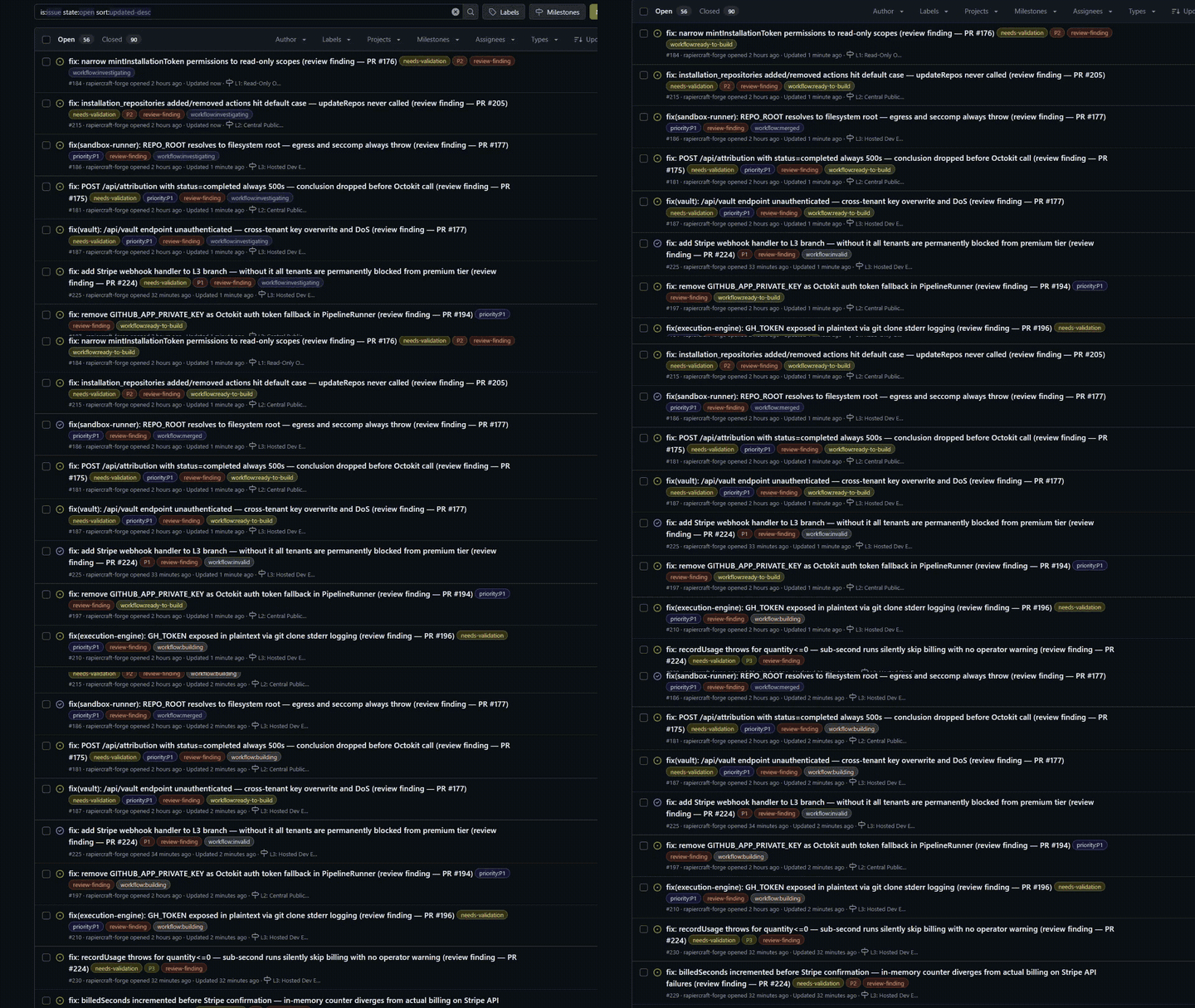
15+ issues orchestrated in parallel — investigated, built, reviewed, and shipped autonomously.
Why ForgeDock
AI coding agents forget everything between sessions. They re-investigate the same bugs, miss context from past PRs, and make mistakes that were already caught and fixed last week. There's no institutional memory.
ForgeDock fixes this by using GitHub itself as the memory layer. Every pipeline stage writes structured FORGE: annotations to issues and PRs. Every downstream agent reads them. When a new session starts — even after compaction — the agent queries GitHub and picks up exactly where the last one left off.
The result: agents that follow structured data instead of guessing.
What You Get
| Capability | How it works |
|---|---|
| Full-lifecycle automation | /work-on #42 — investigates the issue, architects a fix, builds it, runs quality gates, opens a PR, and reviews it. You click merge. |
| Persistent agent memory | Structured FORGE: annotations on GitHub issues/PRs survive compaction and session boundaries. Agents never start blind. |
| 9 specialist review agents | Security, billing, database, concurrency, auth, frontend, API, performance, infrastructure — every PR gets domain-expert review. |
| Cross-issue knowledge graph | Agent fixing issue #43 reads the investigation from #42 and applies the known pattern — no re-investigation. |
| Self-improving pipeline | False positive rate dropped from 44% to under 10% through automated feedback loops. |
| Parallel orchestration | /orchestrate decomposes milestones into waves and runs /work-on on each in parallel. |
Install
Requirements: Node.js 18+ and Claude Code
# Install pipeline commands (symlinks into ~/.claude/commands/)
npx forgedock

# Generate config for your repo
npx forgedock init
That's it. Open Claude Code in your project and run /work-on #42.
Claude Code Plugin Marketplace (v2.1.143+):
/plugin marketplace add RapierCraftStudios/ForgeDock
/plugin install forgedock@forgedock
CLI commands:
npx forgedock update       # Pull latest commands
npx forgedock uninstall    # Remove all ForgeDock commands from ~/.claude/commands/
npx forgedock help         # Show all available commands
AI-powered setup (inside Claude Code):
/forgedock-init # Guided config walkthrough — scans your repo, queries GitHub, auto-fills forge.yaml
How It Works
Issue → Investigate → Architect → Build → Quality Gate → Review → Merge
              ↓            ↓         ↓          ↓            ↓
        writes to     reads from  reads from  reads from   writes to
         GitHub        GitHub      GitHub      GitHub       GitHub
Each stage writes a structured annotation (<!-- FORGE:INVESTIGATOR -->, <!-- FORGE:CONTRACT -->, etc.) to the GitHub issue or PR. Each downstream stage reads what came before. The gh CLI is the query interface.
| Stage | What it does |
|---|---|
| Investigate | Traces root cause via git blame, related issues/PRs. Writes verdict, affected files, severity. |
| Context | Surfaces historical bugs and known pitfalls from the same module. Institutional memory. |
| Architect | Produces ordered implementation plan with exact file/function/line targets. |
| Build | Writes code, creates branch, makes commits. Follows the architect's plan. |
| Quality Gate | 14+ domain-specific checks (security, auth, DB, concurrency, etc.) |
| Review | 9 specialist agents review the PR diff with confidence-rated findings. |
| Close | Records full audit trail as FORGE:TRAJECTORY. |
Labels track workflow state (workflow:investigating, workflow:building, workflow:in-review, workflow:merged). The pipeline resumes from whatever state GitHub says it's in — restart-safe by design.
Issue #42: "POST /api/payments returns 500 for free-tier users."
FORGE:INVESTIGATOR  →  Traced bug to commit e8f21a3 (PR #38). Payment validation
                        assumed all users have a billing profile — free-tier users don't.

FORGE:CONTEXT       →  Surfaced 2 historical bugs in the same module:
                        #29 (nil-check on subscription lookup) and
                        #34 (billing profile race condition). Known pitfall:
                        don't skip audit log write on early returns.

FORGE:ARCHITECT     →  2-file fix: nil-check in payment validator,
                        free-tier guard in the API router.

FORGE:BUILDER       →  Branch fix/payment-validation-free-tier-42, 2 files changed.

FORGE:REVIEW        →  4 review agents, 0 findings, auto-merged to staging.
The context phase caught the audit log pitfall from issue #34 — a completely different bug, months earlier, in the same module. That's institutional memory at work.
Commands
| Command | What it does |
|---|---|
/work-on #N |
Full issue lifecycle: investigate → build → review → merge |
/issue |
Create a pipeline-ready GitHub issue |
/orchestrate |
Parallel execution across a milestone's issues |
/review-pr |
PR review with 9 domain-specialist agents |
/quality-gate |
Pre-commit checks across 14+ domains |
/milestone |
Plan and ship milestones |
/deploy-info |
Staging vs main diff with risk assessment |
/review-pr-staging |
Staging-to-main review gate |
/rollback |
Automated revert PR for production incidents |
/incident-response |
P0 coordination: hotfix, timeline, postmortem |
/autopilot |
Autonomous improvement: recon → triage → fix |
/pipeline-health |
Self-analysis and prompt tuning |
/security-audit |
4-phase security posture audit |
/qa-sweep |
Full platform QA via browser automation |
/analytics |
Pull metrics from GSC, Clarity, Umami, Stripe |
/cleanup |
Sweep stale issues, branches, worktrees |
Uninstall
npx forgedock uninstall
This removes all ForgeDock command symlinks from ~/.claude/commands/. Your forge.yaml config and any FORGE: annotations on GitHub issues/PRs are left untouched.
To also remove the npm cache:
npx forgedock uninstall
npm cache clean --force
Documentation
- Getting Started in 5 Minutes — install, configure, first pipeline run
- How the Knowledge Graph Works — FORGE annotations, context relay, compaction resilience
- ForgeDock vs. Manual Workflows — structured pipelines vs. ad-hoc prompting
- FORGE Annotation Protocol — open standard spec for AI context passing
- Command Reference — all 25+ commands with usage and examples
Show Your Support
Add a badge to your README:
[](https://github.com/RapierCraftStudios/ForgeDock)

Contributing
PRs welcome. Every change goes through a PR, tested against 3+ scenarios, using conventional commits (fix(command):, feat(command):, refactor(command):).
License
AGPL-3.0 — free to use, modify, and distribute. If you modify ForgeDock and offer it as a service, you must open-source your modifications under the same license.
Built by RapierCraft Studios
Reviews (0)
Sign in to leave a review.
Leave a reviewNo results found