easyIDE
Health Warn
- License — License: AGPL-3.0
- Description — Repository has a description
- Active repo — Last push 0 days ago
- Low visibility — Only 6 GitHub stars
Code Pass
- Code scan — Scanned 12 files during light audit, no dangerous patterns found
Permissions Pass
- Permissions — No dangerous permissions requested
No AI report is available for this listing yet.
easyIDE: a free, open-source IDE and code editor for Android tablets and phones, with a real Ubuntu Linux terminal, git and language servers. On-device, offline, no root.
easyIDE
A real IDE and code editor for Android tablets, with a real Linux userland.
Native editor, file tree and an Ubuntu terminal -- all on the device, offline, no root.





Website · Download · What works · Not yet · Privacy · Build · Community · Contributing
Not a snippet editor, and not a remote-desktop client into someone else's server. You get a
native editor, a file tree, and a terminal running Ubuntu, all on the device.
Beta:
v0.2.0-beta.8. arm64 and x86_64, Android 8.0+ (minSdk 26). Expect rough edges and
report them as issues, or tell us in the
Telegram group.
Tour
Watch
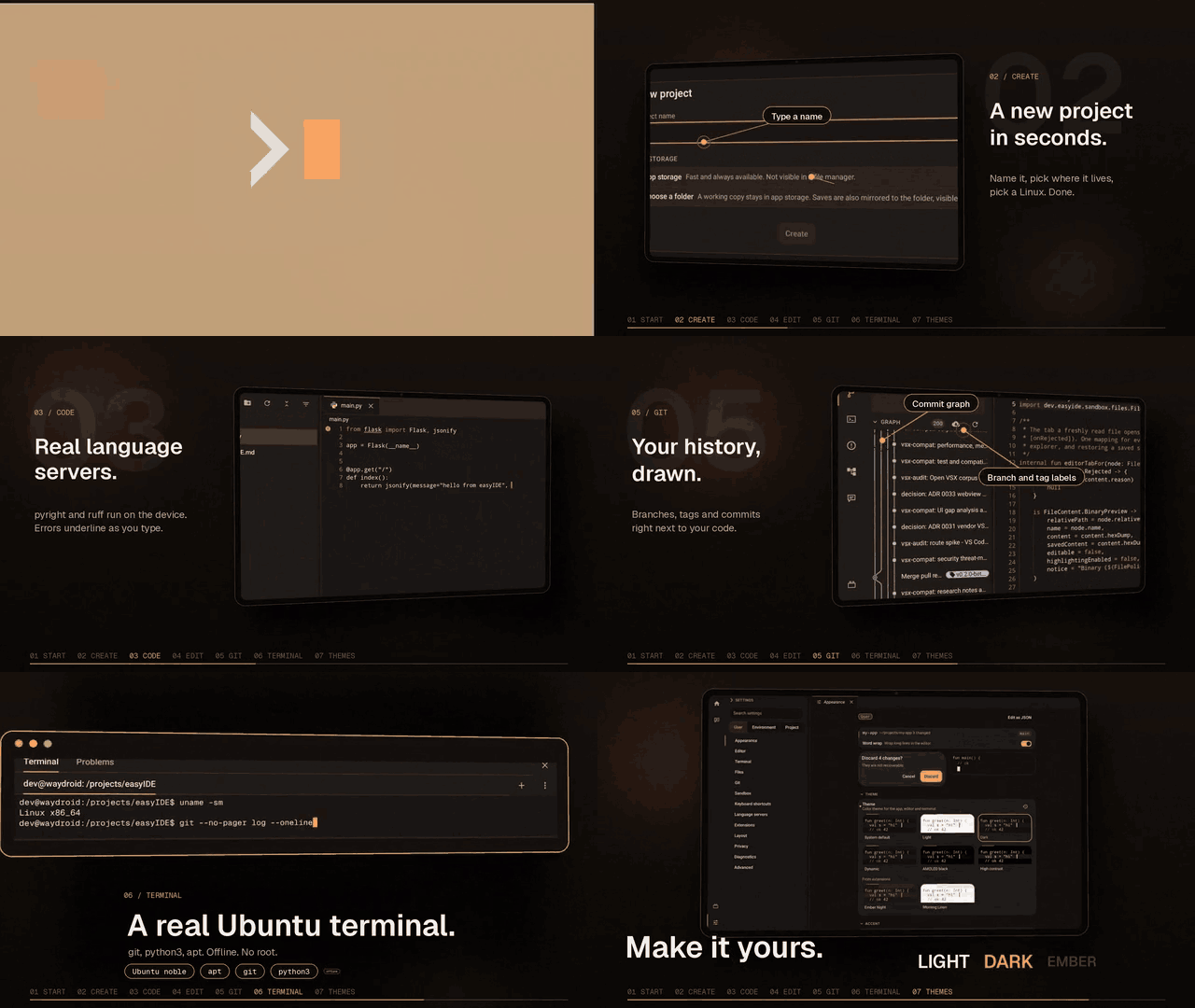
Play the full 54-second film with sound (1920x1080, H.264 + AAC, 28 MB).
The preview above loops six moments from it: the logo hit, creating a project, typing code,
scrolling the git graph, the terminal and a live theme switch.
Screenshots
Captured from v0.2.0-beta.8 in Waydroid (Android 13, x86_64) at a 2560x1600 tablet resolution in
the Ember Night theme. Full-size images are in docs/media/screenshots/.
Start a project
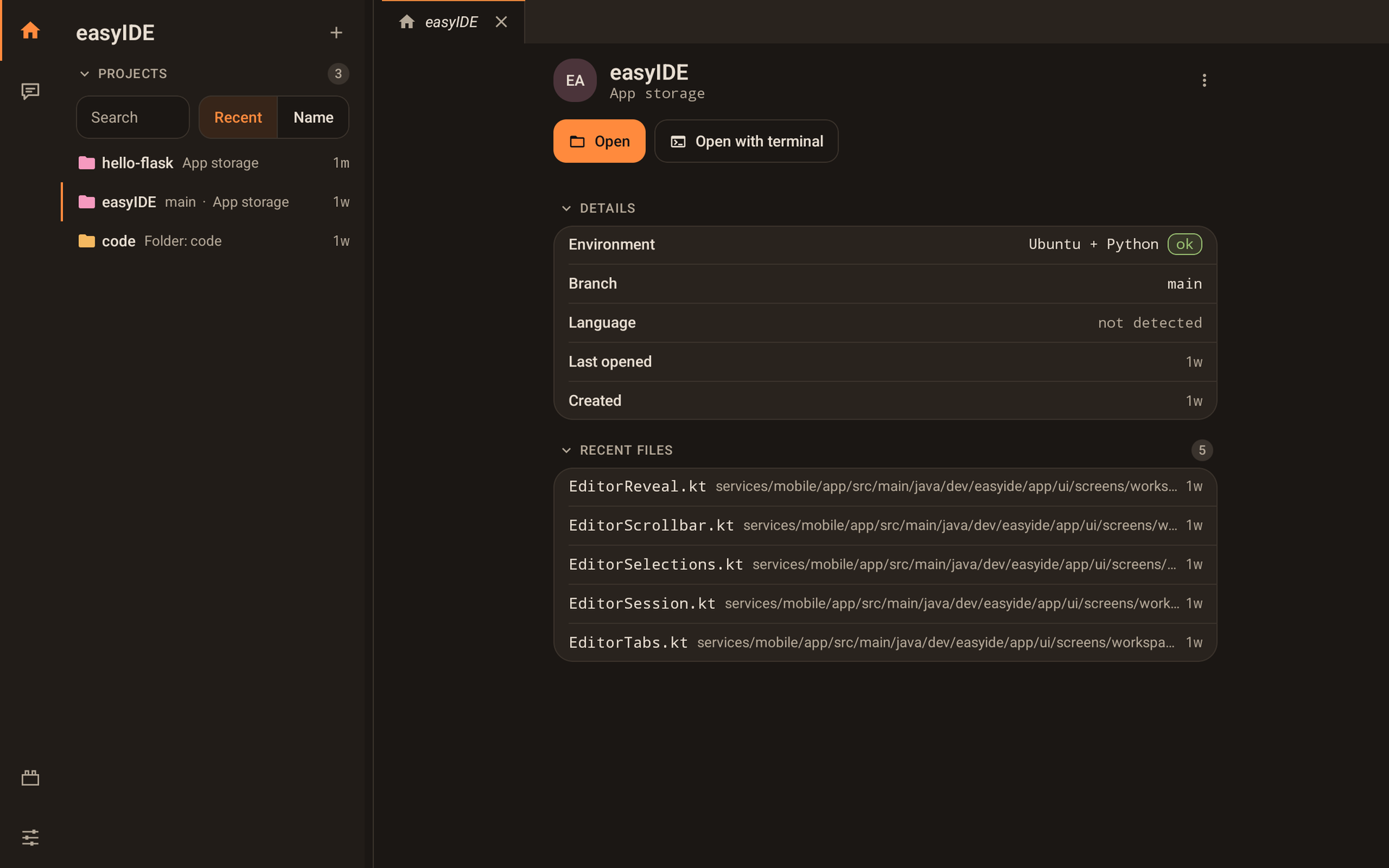
| Projects home | New project |
|---|---|
 |
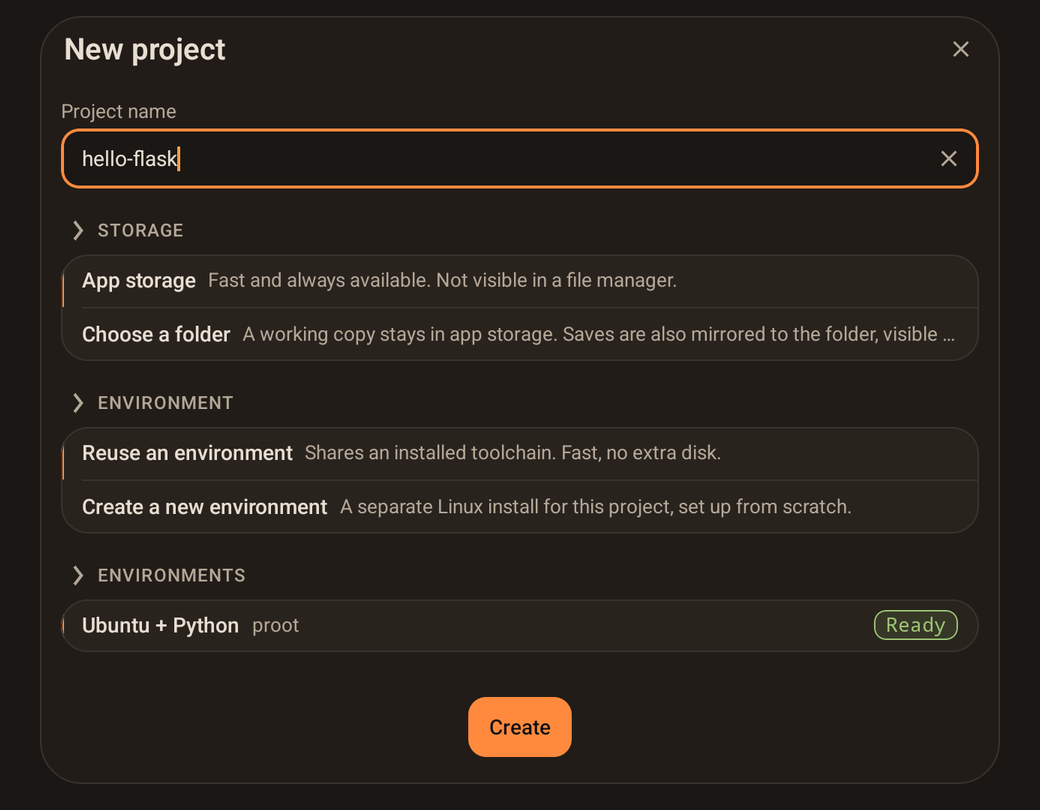 |
| Recent projects with branch, environment and recent files. | Name it, choose storage, choose a Linux environment. |
Write code
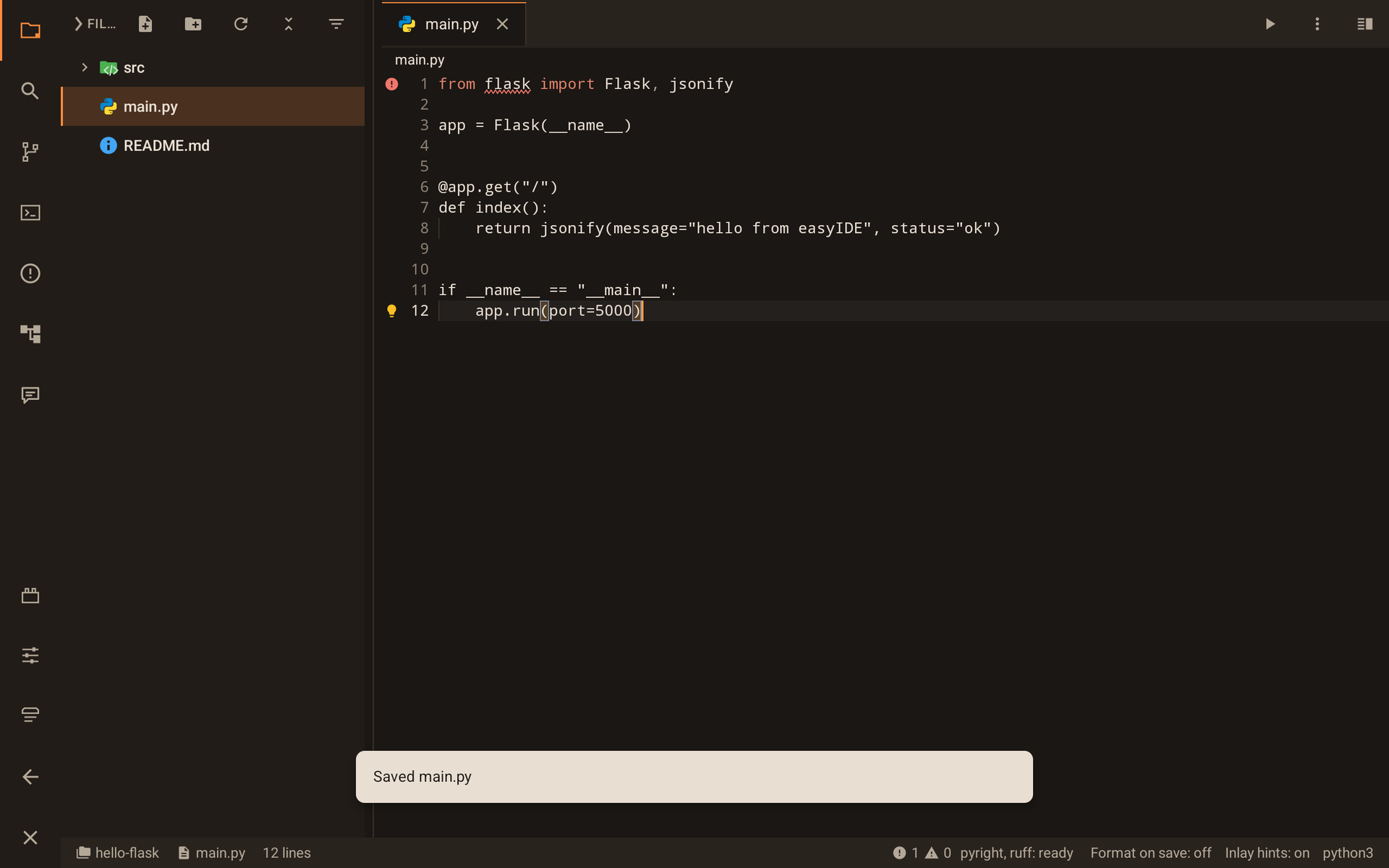
| Python with language servers | Editor and file tree |
|---|---|
 |
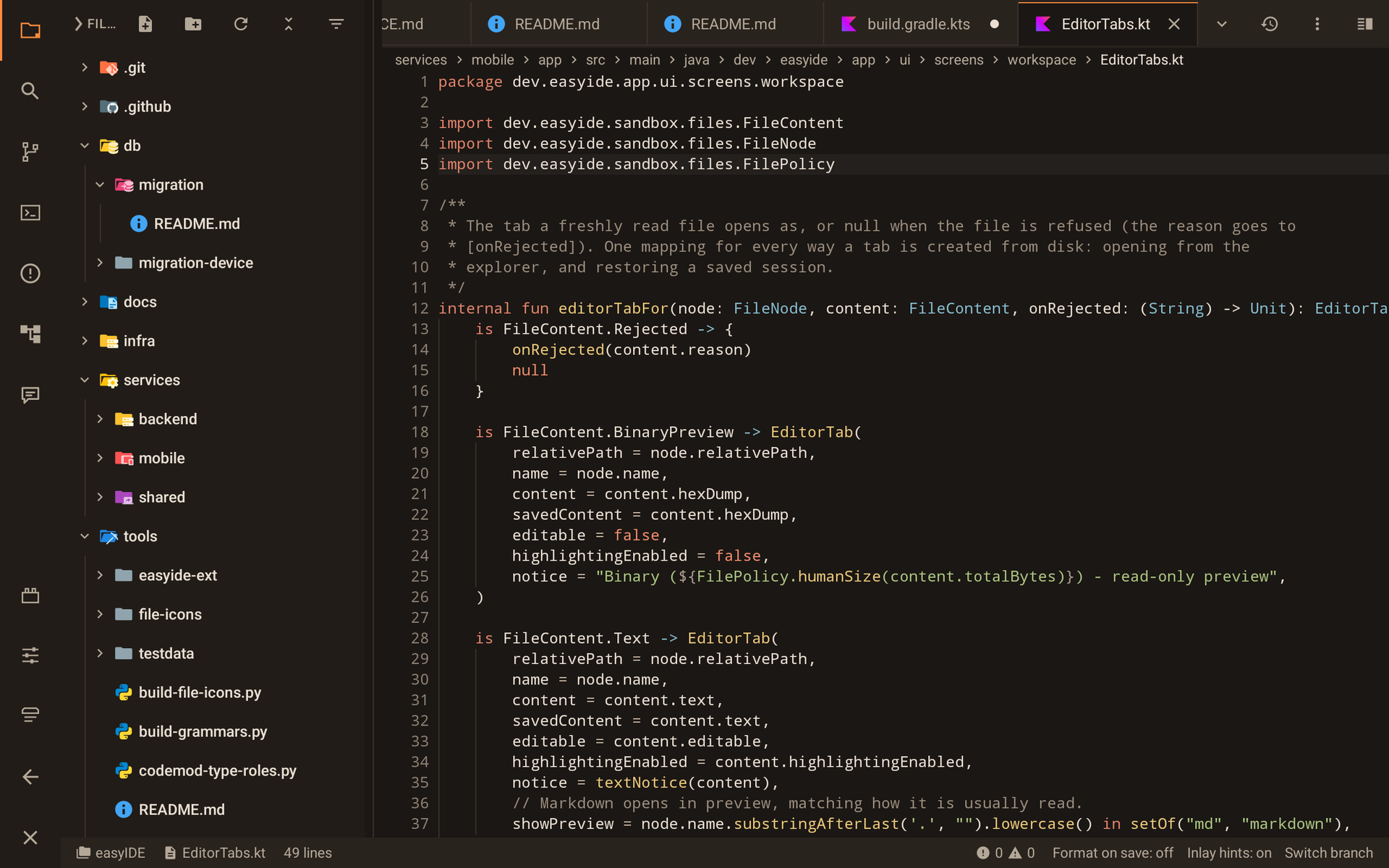 |
| pyright and ruff run on the device. | Tabs, breadcrumbs, a real file tree, syntax colours. |
Ship it
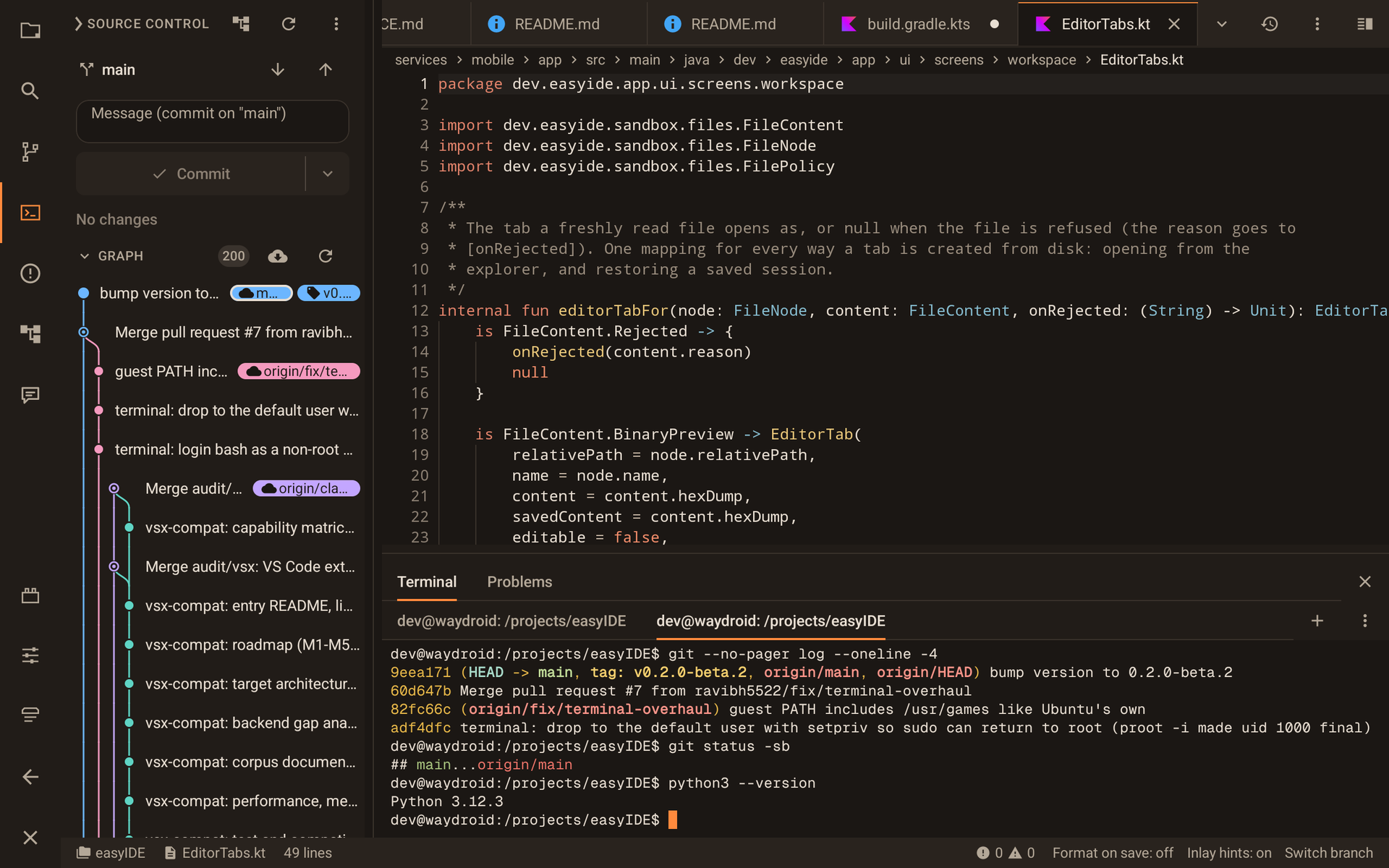
| Git and terminal | Extensions |
|---|---|
 |
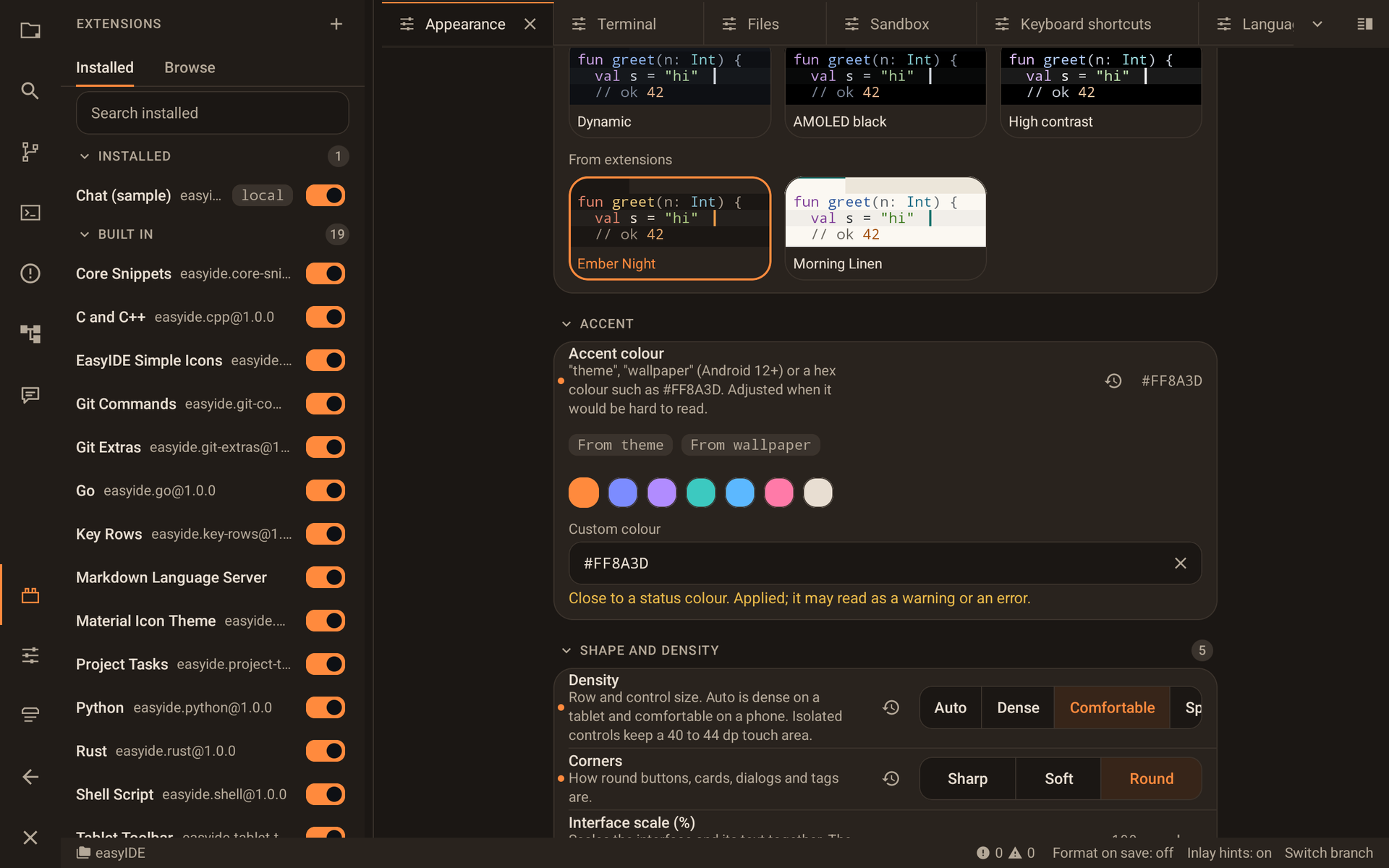 |
| The commit graph next to an Ubuntu shell. | 19 built-in extensions, toggled per user. |
Make it yours
| Appearance |
|---|
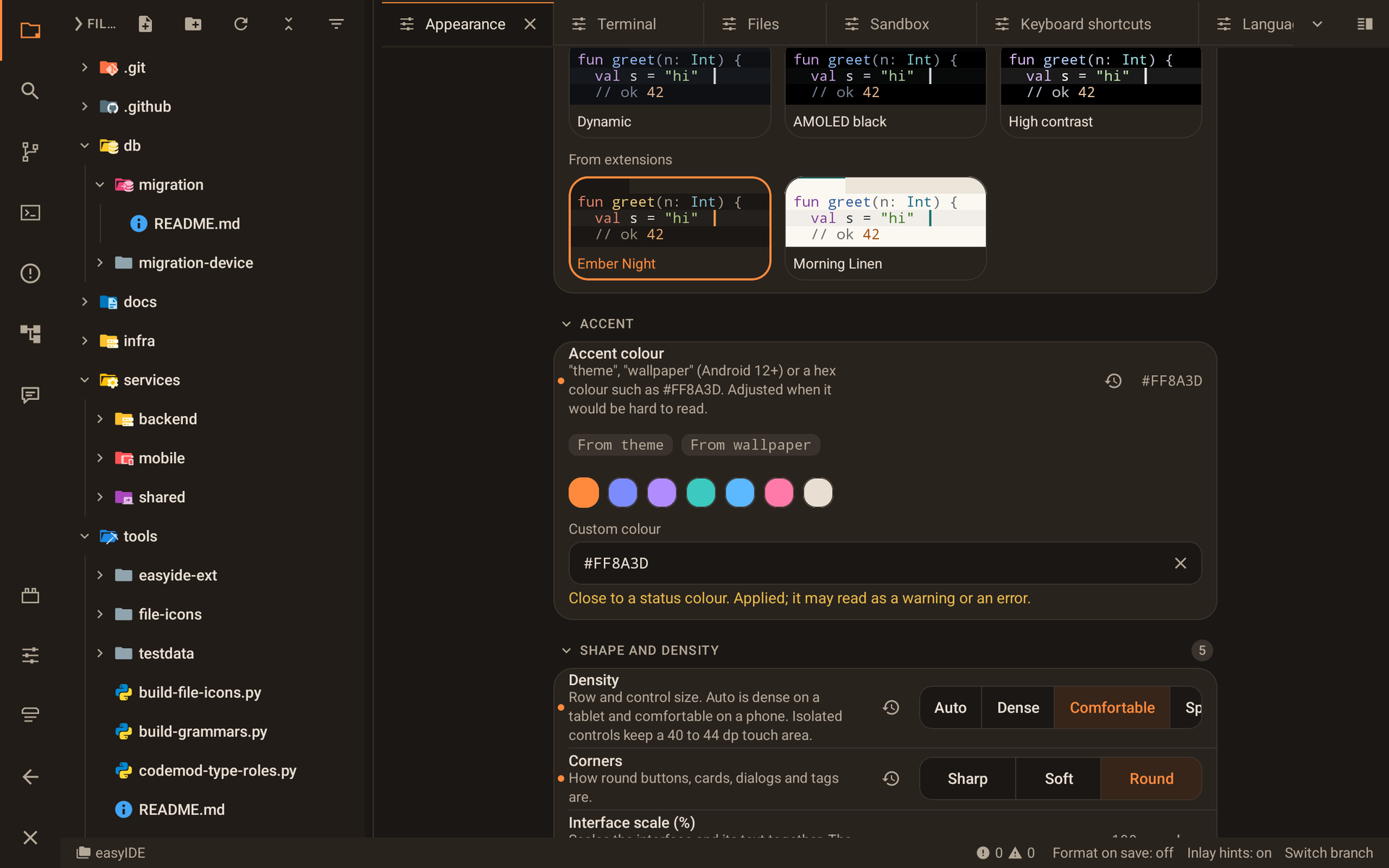 |
| Themes, accent colour, density and fonts. |
A short film cut to a 120 BPM beat: every scene starts on a bar line (2 s), so cuts, callouts and
the screen shake on each hit land on the beat. Checked with ffprobe (1620 frames, 54.0 s, audio
mean -14.7 dB, peak -2.2 dB, no clipping) and by pulling frames from every scene.
| Time | Scene | What moves |
|---|---|---|
| 0:00 | Cold open | "your tablet has the screen. the keyboard. the battery." typed live, "but nothing to build with." struck out, the logo slams in on the beat |
| 0:08 | 01 Start | the home screen flies in on a tilted tablet; callouts on recent projects and the environment |
| 0:12 | 02 Create | a real screen recording of making a project, cropped onto the dialog |
| 0:20 | 03 Code | Python typed in character by character, pyright diagnostics called out |
| 0:26 | 04 Edit | a real recording scrolling the Kotlin editor next to the file tree |
| 0:30 | 05 Git | a real recording scrolling the commit graph, branch and tag labels called out |
| 0:36 | 06 Terminal | a real recording of uname -sm, git log and python3 in a floating terminal card |
| 0:42 | 07 Themes | a real theme switch, Ember to Light to Dark to Ember, with a word slam on each switch |
| 0:48 | Outro | three tablets fan out; "Code anywhere." with the download and chat links |
The soundtrack is original and synthesized from oscillators and noise (no samples). Regenerate
everything after editing the storyboard in tools/tour/scenes.py:python3 tools/make-tour-audio.py && python3 tools/make-tour-video.py. Asset index:
docs/media/README.md.
Download
| Channel | What it is | Get it |
|---|---|---|
| Stable beta | Tagged builds, installs as dev.easyide.app |
Latest release |
| Canary | Newest build, installs alongside stable as easyIDE Canary | canary release |
Download the .apk from the release page, allow installs from your browser or file manager, and
open it. Each release lists a SHA-256 you can check. A new build installs over the previous one
and keeps your projects.
Community
Join the discussion on Telegram.

That is the place for questions, ideas, tablet-specific quirks, "does this work on my device?",
early looks at what is coming, and general chat with the people building and using easyIDE.
A bug you can reproduce, or a feature you want tracked, belongs in a
GitHub issue so it does not get lost in the scroll.

What works today
Everything in this list has been executed on real hardware (Xiaomi Pad 6, Android 13, arm64,
SELinux enforcing) or in a Waydroid container (Android 13, x86_64) -- not just compiled.
Per-component detail and evidence lives in the tracker.md files under docs/.
- A real Linux sandbox. Ubuntu
nobleprovisioned into app-private storage via
PRoot, no root needed.whoami->root,apt-get updatefetches,apt-get install gitcompletes,dpkg --auditcomes back clean. - Environment presets -- bare Ubuntu, build tools, Node.js, or Python -- sharing one cached
base tarball (decision 0007). - A real PTY terminal. Full-screen ncurses programs run:
cmatrixwas installed withapt-getand rendered its animation live, then^Crestored the shell with scrollback
intact. An Esc/Ctrl accessory row sits above the soft keyboard for the keys a touch
keyboard hides. - A streaming, interactive terminal. Output arrives as it is produced (~60 ms batches, so a
long build never looks frozen), stdin stays open so commands that prompt actually work, and\ris handled as overwrite so progress bars collapse instead of flooding the scrollback.
Multiple tabs,^C, command history, and an accessory key row for the shell symbols a soft
keyboard buries two menus deep. - A native IDE shell (decision 0006):
activity rail, lazy-expanding file explorer, tabbed editor with a line-number gutter, and a
status bar -- operating on real files. Saves survive a full app restart. - Syntax highlighting for 229 languages using the same TextMate grammars VS Code uses,
bundled in the APK (1.35 MB) so it works offline with no download. All 229 grammars are
verified to compile, and the tokenizer is a real scope-aware parser --#includeis a
preprocessor directive in C,//is a division operator in Python. - Markdown preview with headings, lists, blockquotes, fenced code, tappable links, and
mermaid diagrams rendered offline from a bundled copy of mermaid. - Projects and environments as separate things: environments are shareable and projects
bind into them (decision 0005). - Link a real folder on internal storage or an SD card through SAF, so your code is not
trapped in app-private storage. - A VS Code-shaped workspace. Dense, VS Code-style chrome that adapts from a phone (bottom
navigation) to a tablet (activity rail, side bar, bottom panel, secondary panel): editor
groups with split view, breadcrumbs, real file-type icons (Material Icon Theme, swappable), an
optional full-screen mode with no system bars, and three density levels. - Language servers. A built-in LSP client runs servers inside the sandbox: completion,
signature help, hover, diagnostics, code actions, rename, formatting, go-to-definition,
references, symbols, inlay hints, code lens, semantic tokens and folding. Language packs
(Python with Ruff, TypeScript, Web, Rust, Go, C/C++, YAML, Markdown, Shell) install their own
server on demand. Any stdio server can be added through an extension manifest. - Extensions. Declarative
.easyextpacks contribute languages, grammars, themes, icon
themes, snippets, keybindings, commands, toolbar keys, settings, panels and language servers,
with capability disclosure at install (docs/extension-sdk/). A VS Code
icon-theme.vsixfrom Open VSX installs as is. - Source control. JGit-backed: stage, unstage and discard per file, a changes tree, a commit
split button with amend, and a VS Code-style history graph with branch and tag chips and a
commit context menu (cherry-pick, tag, checkout, compare). Changes made by the terminal show
up as well. Repositories it creates are read correctly by realgit. - Themes and settings. Material 3 themes, a settings screen generated from a schema, and
honouring of the system reduce-motion setting.
What is not there yet
Stated plainly, because a README that oversells is worse than one that is short:
- VS Code extensions that run code (GitLens, the Claude Code extension and so on) do not
run. Only declarative packs and icon themes install. A Node extension host in the sandbox is
designed (decision 0030), not built. - The Claude Code CLI is not wired up. Installing and verifying it inside the sandbox is
planned, not done. - Git over the network is lightly tested. Push, pull and sync exist but have had little
device testing; there is no merge editor. Commits use a placeholder identity until you set
one. - No debugger and no notebooks.
- No credential helper, no tmux session persistence, no ssh-agent.
- The chroot+BusyBox backend for rooted devices builds its argv but has never been executed.
- No checksum verification on the downloaded rootfs tarball.
The sandbox is not a security boundary
PRoot and chroot+BusyBox are single-tenant, trust-the-code-you-run models. They exist to give
you a working Linux userland on Android, not to isolate one project from another or to
contain hostile code. Do not treat them as a sandbox in the security sense. The reasoning is in
decision 0002.
How it works
PRoot ships as libproot.so in jniLibs -- which is what makes it executable under enforcing
SELinux on a modern Android. On first run the app downloads an ubuntu-base tarball and
extracts it (gzip + tar, including pax extended headers and GNU long names, with a tar-slip
guard) into app-private storage. Commands run through SandboxShell, which spawns PRoot with--link2symlink -H -L (dpkg backs files up with hard links, and Android denies link(2) in app
data) and a cleared process environment, so the Android app's own vars cannot leak into the
guest. Projects live deliberately outside every rootfs, so an environment can be deleted
without taking your code with it.
Full architecture: docs/sandbox-runtime/arch.md.
Repo layout
docs/            architecture + trackers per feature, ADRs, weekly change log
  media/           screenshots, tour film, source screen recordings
services/
  mobile/        the Android app
    app/           Compose UI, ViewModels, navigation, theming
    sandbox-runtime/  environment model, persistence, PRoot/chroot launchers, terminal
  shared/        cross-service contracts
  backend/       intentionally empty -- there is no server component yet
db/              backend and on-device (Room) migrations
tools/           dev/build scripts, never shipped (includes the tour-film generator)
infra/           intentionally empty -- CI/deploy config, when there is any
Build
cd services/mobile
./gradlew :app:assembleDebug     # local development
./gradlew :app:assembleCanary    # tip of main, installs alongside a stable build
./gradlew :app:assembleRelease   # stable
Canary builds use applicationId dev.easyide.app.canary and are labelled easyIDE
Canary, so you can run the tip of main on the same tablet as a build you rely on.
Every push to main publishes one to the rollingcanary release; taggingv* cuts a stable one. Channels, versioning and signing secrets:
infra/README.md.
Needs a full JDK 17+, not a JRE -- javac must be on the toolchain. If the system Java is a
JRE, pass one for the invocation: JAVA_HOME=/path/to/jdk ./gradlew :app:assembleDebug.
local.properties (holding sdk.dir) is gitignored; recreate it on a fresh clone.
Building against Gradle 9.7.0, AGP 9.3.1, Kotlin 2.4.10, compileSdk/targetSdk 37.
More detail, including AGP 9.x gotchas: services/mobile/README.md.
Docs
| docs/sandbox-runtime/ | Linux sandbox, terminal, git, session persistence |
| docs/ui-shell/ | Screens, navigation, stage system, editor/terminal UX |
| docs/design-system/ | Themes, color tokens, icons, motion, responsive layout |
| docs/telemetry/ | Analytics, crash reporting, push, and the consent gate |
| docs/decision/ | ADRs -- the major, hard-to-reverse choices and why |
| docs/chainlog/ | Append-only weekly log of what changed |
Privacy and telemetry
The first time you open easyIDE (a new install, or the first launch after upgrading tov0.2.0-beta.4) it asks you to agree to technical diagnostics. This is required to use the app.
- Collected: device details (model, Android version, CPU), app version, which features are
used and whether actions succeeded, app errors and crash logs, app start and screen timings,
and a registration for release-announcement notifications. - Never collected: your name, phone number, contacts or accounts, anything about your other
apps, and your files, project names, code, commands or terminal output. - Provider: Firebase, kept behind a small provider-neutral module so it can be replaced
(decision 0031). Firebase
Analytics is proprietary Google software; the rest of easyIDE is AGPL-3.0. - Turn it off any time in Settings > Privacy. That stops collection and deletes the
announcement registration. A build made without a Firebase config file collects nothing.
License
easyIDE is free software, licensed under the GNU Affero General Public License v3.0.
You may use, study, modify and redistribute it, for any purpose, provided that distributed
copies and derivative works are also released under the AGPL with their source. Unlike the plain
GPL, the AGPL also covers software run as a network service: if you modify easyIDE and let others
interact with it over a network, you must offer them your modified source.
Third-party components
easyIDE's own license does not cover what it bundles. Two of those carry their own copyleft
terms: PRoot is GPL-2.0-or-later and
talloc is LGPL-3.0-or-later, both shipped inside the APK. PRoot is run as a separate
process rather than linked. Anyone who receives the APK is owed the corresponding source for both. Every bundled
component, its license, and where that license was verified from is listed in
NOTICE.md.
The Claude Code CLI is Anthropic's commercial software and is not redistributed here.
Install it yourself under your own account.
Contributing
easyIDE is built in the open, and help is genuinely welcome, from a typo fix to a whole
feature. You do not need to be an Android expert to be useful.
Ways to help
- Try it and tell us what broke. A beta lives on real devices, and yours is one we have not
seen. Say which tablet, which Android version and what you did; a screenshot or the crash
report from Settings > Diagnostics makes it fixable. - Test on hardware we lack. Most testing so far is one Xiaomi Pad 6 and a Waydroid container,
so reports from other tablets, other Android versions and a rooted device are worth a lot. - Fix a bug or pick up a gap from What is not there yet, or from the
open issues. - Write an extension or a language pack. Declarative
.easyextpacks are the easiest way to
add a language server, theme or snippet set; start at docs/extension-sdk/. - Improve the docs. If something confused you, it will confuse the next person too.
- Talk it through first. For anything large, say hello in the
Telegram group or open an issue before you start, so nobody
builds the same thing twice.
How to send a change
- Fork the repo and branch from
main. - Keep the change focused on one thing, and build it (
./gradlew :app:assembleDebug). - Open a pull request that says what changed and why.
A few ground rules
- Opening a pull request accepts the CLA in CONTRIBUTING.md. Nothing to
sign or email; the PR is the acceptance, and you keep your own copyright. - Please do not paste in third-party code. Propose it as a dependency instead, with its
license and maintenance status checked against the upstream repo or official docs (not from
memory). It then gets recorded in NOTICE.md. - Follow the house style: files stay under 600 lines, no hardcoded colors, strings or
keybindings, error handling only at real boundaries, an abstraction only at its third use, and
the sandbox is never described as security isolation. Non-trivial changes get a
chainlog entry, and hard-to-reverse choices get an ADR.
The full list is in CONTRIBUTING.md. - Say what you verified. If you could not run it (no tablet, no emulator), write that in the
pull request instead of reporting success. An honest "untested" is more useful than a
confident guess.
Security issues: please do not open a public issue. Email [email protected] and allow
time for a fix before disclosing.
Reviews (0)
Sign in to leave a review.
Leave a reviewNo results found