Memory-Recall
Health Warn
- License — License: Apache-2.0
- Description — Repository has a description
- Active repo — Last push 0 days ago
- Low visibility — Only 6 GitHub stars
Code Warn
- fs module — File system access in .github/workflows/npm-publish.yml
Permissions Pass
- Permissions — No dangerous permissions requested
No AI report is available for this listing yet.
Local-first repo memory and context for coding agents.
Memory Recall
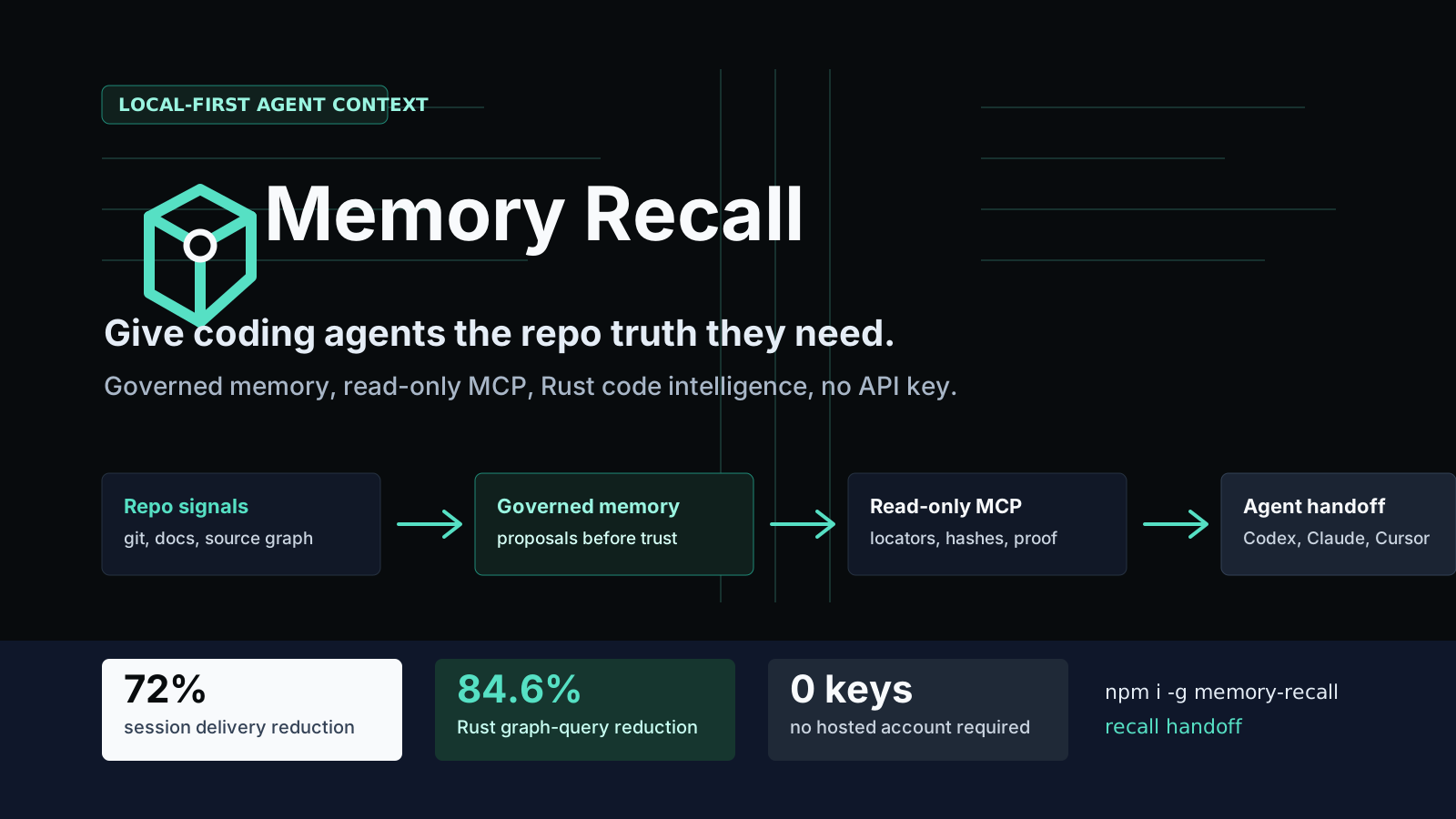





Local repo memory and context for Codex, Claude Code, Cursor, and other coding agents.
Governed SQLite memory. Read-only MCP. Rust code intelligence. No hosted account. No model API key.
Memory Recall turns a repository into a governed context source. New agent
sessions get reviewed repo facts, changed-file impact, required local reads,
and proof of what was sent instead of a giant pasted transcript.
npm install -g memory-recall
recall setup
recall handoff
Why Developers Use It
| Need | What Memory Recall gives you |
|---|---|
| New agent session | A compact handoff with required local reads, changed-file coverage, hashes, and MCP proof. |
| Repo memory | SQLite/FTS5 facts that start as proposals and become ACTIVE only after review. |
| Fast local code intelligence | Rust ingest and graph/search paths for local repo analysis, with no hosted service required. |
| Long context pressure | Repeat MCP pulls use cursors and deltas instead of resending the same profile. |
| Trust | Dry-run first, confirm-gated writes, local-only storage, and no automatic transcript import. |
| Codebase context | Source graph hints, locator-only context packs, and manifest-backed selection. |
Five-Minute Path
# Install the CLI.
npm install -g memory-recall

# Bootstrap local files and run the handoff verification gate.
recall setup
recall verify

# Preview local agent setup. This writes nothing.
recall connect codex --dry-run --format json
recall mcp install --client claude-code --dry-run --format json

# Build governed memory proposals. Facts are not trusted until reviewed.
recall memory ingest --root . --sqlite .local/memory.sqlite --format json
recall memory review --root . --sqlite .local/memory.sqlite --format summary

# Produce the compact handoff for the next coding agent.
recall handoff
The default path is local and explicit: no hosted account, no model API key, no
silent memory capture, and no automatic permanent memory.
Manual MCP install flow: run the mcp install --client claude-code --dry-run --format json
preview, review it, then run the printed --apply --confirm <fingerprint>
command only when the fingerprint matches. The installed server does not import harness history, enable write tools, call cloud/model APIs, or claim provider billing-token savings.
Documentation
Verified Numbers
These are local measurements from this repository. They are delivery-token
estimates and correctness checks, not provider billing claims.
| Test | Result | Command |
|---|---|---|
| Session delta delivery | 72% fewer delivered tokens, 100% correct | recall bench session --read-only --root . --format json |
| Rust graph-query evaluation | 84.6% fewer delivered tokens, 62.5% fewer tool calls | node scripts/rust-eval.mjs |
| Current fact recall with stale facts present | 100% correct, 100% clean | recall bench temporal --read-only --root . --format json |
| Real repo QA after governed ingest | 12/12 answered | recall bench realqa --read-only --root . --format json |
| LoCoMo retrieval coverage | 78% evidence-any recall, 84.79% fewer delivered tokens | recall bench locomo --read-only --root . --dataset /path/to/locomo10.json --limit 48 --budget 4096 --format json |
| Source graph stats summary | 99.87% smaller than full graph JSON, locator-only hotspots | recall graph stats --root . --format summary |
| Practical context-pack report | 84.35% smaller than practical baseline | npm run token-saver |
Memory Recall is strongest when context changes over time, handoffs repeat, and
the next agent needs reviewed local truth. It is not a hosted memory API,
semantic embedding service, graph database, or billing-meter replacement.
The LoCoMo number is model-free retrieval coverage, not official generative QA
F1; the command does not call a model API.
How It Compares
| Category | Usually strong at | Memory Recall position |
|---|---|---|
| Hosted memory APIs | Cross-app memory, cloud connectors, managed retrieval | Better when a hosted memory backend is desired. Memory Recall is better for local-first repo handoff with no API key. |
| Persistent agent memory frameworks | Long-term personalization and retrieval across products | Stronger as general memory layers. Memory Recall is narrower: repo-scoped, proposal-gated, and inspectable. |
| Temporal graph memory | Changing facts, provenance, entity relationships | Memory Recall has local temporal facts and supersession, but does not claim a full temporal graph database. |
| Code graph MCP tools | Static code graph search and token-heavy repo compression | Memory Recall combines code locators with governed memory, handoff manifests, MCP proof, and local UX. |
| IDE indexing | Smooth editor-native search | Memory Recall is more explicit: it shows what was selected, excluded, pinned, and delivered. |
What Works Now
- Dependency-free Node.js 22 bootstrap with no paid service, database server, or
model API required. - Native SQLite/FTS5 governed memory with temporal facts, supersession, entity
edges, proposal queue, explicit approve/reject, and no hard delete. - Read-only
recall mcp serverexposingmemory.recall,context.profile, andcontext.packover local stdio with active facts separated from proposals. - Persisted MCP cursors and
sincedeltas so repeated reads send only changed
current truth, including after restart. - Preview-then-confirm install paths for Claude Code, Cursor, and Codex with
explicit project root and project SQLite memory path. - Local
/memorycockpit over the loopback Control API with temporal facts,
proposal counts, MCP delivery stats, and confirm-gated approvals. - Rust workspace for local ingest, governed graph/search, wiki, MCP, and the
graph-query evaluation path. Rust source ships in the npm package; build
output stays out of the tarball. - Deterministic local benches for temporal correctness, session delta delivery,
and real repo question answering.
Safety Model
Memory Recall is built around explicit authority:
- memory ingest creates proposals, not trusted facts;
- active memory requires review and approval;
- rejections and supersessions are recorded, not silently deleted;
- MCP resources are read-only by default;
- setup and connect commands support dry-run previews;
- local storage remains local unless you intentionally move it;
- external adapters stay disabled until reviewed, pinned, licensed, and tested.
See Security model, fork policy,
and integration policy
for the deeper boundary rules.
What Is Not Claimed
Production PostgreSQL repositories, production authentication, hosted embeddings,
vector databases, hosted memory sync, write-capable MCP tools, automatic harness
history import, real social connectors, hardened sandboxes, signed Agent Pack
distribution, and a production frontend framework are not claimed.
PROJECT_STATUS.json is the machine-readable source for current capability
status and limitations.
Useful Commands
recall setup
recall verify
recall connect codex --dry-run --format json
recall mcp install --client claude-code --dry-run --format json
recall memory ingest --root . --sqlite .local/memory.sqlite --format json
recall memory review --root . --sqlite .local/memory.sqlite --format summary
recall memory refine --read-only --root . --sqlite .local/memory.sqlite --format json
recall token-saver
recall graph stats --root . --format summary
recall graph search --root . --query "auth workflow" --format summary
recall graph trace --root . --symbol runAuthWorkflow --format summary
recall context handoff --read-only --from codex --root . --objective "Prepare handoff" --step "select next agent context" --target codex --format summary
recall handoff
For source checkouts, use npm run recall -- <command> instead of the globalrecall binary.
npm run recall -- memory refine --read-only --root . --sqlite .local/memory.sqlite --target-active-facts 200 --format json
npm run recall -- context handoff --read-only --from codex --root . --objective "Prepare handoff" --step "select next agent context" --target codex --changed apps/web/app.js --format json
Repository Map
| Path | Purpose |
|---|---|
apps/ |
Local web and CLI interfaces |
services/ |
Application services and Control API |
packages/ |
Provider-neutral domain packages, schemas, Agent Packs, and replay logic |
providers/native/ |
Local baseline provider implementations |
rust/ |
Local ingest, graph/search, wiki, and MCP workspace |
docs/usage/ |
User-facing install, setup, memory, MCP, security, and measurement docs |
evals/ |
Deterministic regression datasets |
tests/ |
Node test suite and release checks |
See REPOSITORY_MAP.md for ownership and dependency
boundaries.
Status
Development kit: 1.0.5.
| Surface | Status |
|---|---|
| Source checkout | Local-ready reference path |
| npm package | Published as memory-recall |
| CLI | recall primary, oaf compatibility alias |
| Marketplace / plugin registry | Manifest prepared; not submitted |
| Client hooks | Opt-in Codex/Claude connect writer; dry-run/manual fallback |
Run npm run status for the checked-in task state. Runnpm run task -- <OAF-ID> only when status names a next task.
Contributing
Read CONTRIBUTING.md, SECURITY.md, and
CODE_OF_CONDUCT.md. Keep changes evidence-backed, local by
default, and honest about what is implemented versus planned.
Reviews (0)
Sign in to leave a review.
Leave a reviewNo results found