bearing
Health Warn
- License — License: ISC
- Description — Repository has a description
- Active repo — Last push 0 days ago
- Low visibility — Only 5 GitHub stars
Code Fail
- execSync — Synchronous shell command execution in bundle/.bearing/lib/agent-brief.mjs
Permissions Pass
- Permissions — No dangerous permissions requested
No AI report is available for this listing yet.
An intel layer for AI coding agents that assumes its own rules might be wrong — and keeps the evidence. Authoritative north-stars the agent must cite, a task-core written before compaction eats it, review by an expert in YOUR domain, and an installer that verifies its own claims instead of printing success. Claude Code, Cursor, Zed, Codex.
bearing
An intel layer for AI coding agents.
Your tests catch code that breaks. Nothing catches an agent that has drifted about what the code means.



Claude Code · Cursor · Zed · Codex
npx bearing
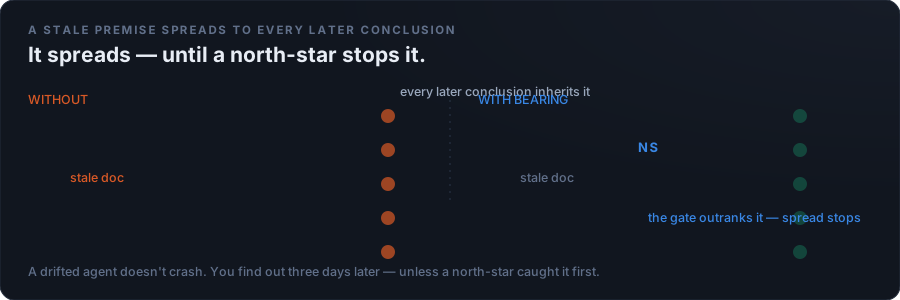
A drifted agent doesn't crash. It reads a doc you abandoned in March, re-proposes the feature you already measured and killed, and writes a convincing paragraph about it. You nod. You find out three days later.
That failure has a name — losing your bearings.

What you get
Six independent modules. Pick any combination — each works alone, none depends on another.
| ⚑ North-stars | Numbered, authoritative claims about what your project is. Outranks every other doc, re-injected as the session runs. |
| 💾 Task-core | A dense save-state of the current task, written before compaction drops the detail. |
| 🔬 Microscope | A panel of lens agents that reviews as an expert in your domain — and must survive its own refutation pass. |
| 🙋 Consult | Asks you about what it can't find — which reading you meant, what a user should see — and decides the rest itself. Confirms before anything irreversible. |
| 🐜 Minions | Wide mechanical work split across cheap anchored subagents that return citations, not opinions. They gather; your agent concludes. |
| 🕸 GitNexus | Hard gates that redirect symbol greps to a real code graph. Requires the GitNexus MCP server. |
And one thing that isn't a module: the agent files bug reports against its own tooling, and the kit will tell you when its own gates are the problem. → the receipts
Install
npx bearing                                    # interactive — explains each module
npx bearing install . --runtime claude --features northstars,taskcore
--runtime claude · cursor · zed · codex · all · --features northstars · taskcore · microscope · consult · minions · gitnexus · all
Then restart your IDE. Enforcement needs tool-interception hooks, and only some runtimes expose them:
| Claude Code | Cursor | Zed | Codex | |
|---|---|---|---|---|
| North-stars — loaded as authority | ✅ | ✅ | ✅ | ✅ |
| North-stars — re-anchored mid-session | ✅ | — | — | — |
| Task-core — survives compaction | ✅ | — | — | — |
| Microscope — domain-expert review | ✅ | ✅ | ✅ | — |
| Consult — ask vs decide | ✅ | ✅ | ✅ | — |
| Minions — anchored fan-out | ✅ | — | — | — |
| GitNexus — hard gates | ✅ | ✅ | — | — |
🥷 Stealth — for repos that aren't yours to change
npx bearing install . --stealth
A normal install is a team decision: it commits hooks, skills, a contract and npm scripts, and
everyone who pulls gets them. That's right for a repo you own and wrong for one you contribute to.
Stealth makes one promise, and it's testable: git status is exactly as clean after the install
as it was before. No tracked file is modified — not .gitignore, not package.json, notCLAUDE.md. Ignores go in .git/info/exclude, which is per-clone and itself untracked, so the
rules can't travel. The contract is delivered by the session hook instead of a file.
Where a runtime has no per-user channel, bearing says so instead of writing the file anyway. It also
refuses to convert a repo where bearing is already committed — un-tracking it for your whole team
is a deliberate, visible act, not something an install flag should do behind your back.
Two things to know: the exclusions live in the clone, so a re-clone doesn't carry the install — run
it again. And uninstall empties only the block it wrote.
⚑ North-stars
Docs rot. Comments lie. The agent's own inference fills the gaps.
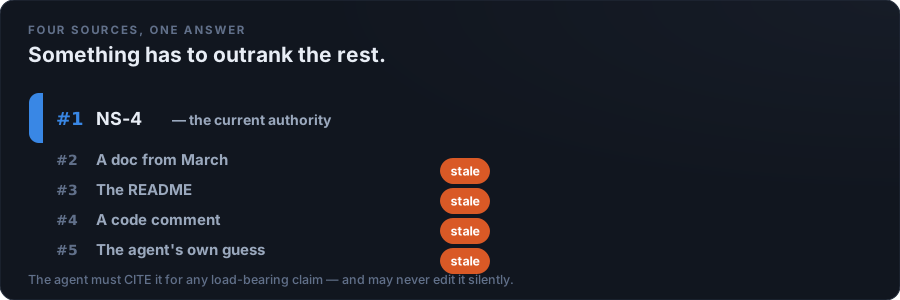
Write them as claims a conclusion could actually violate:
- **NS-4** — Win-rate is NEVER a ranker. Only net expectancy is a profitability claim.
- **NS-9** — REJECTED: averaging into a losing position. Measured: adds fill only on the
             weaker cases. Don't re-propose without new evidence.
"Be careful with risk" can't be violated, so it can't catch anything. Falsifiable or it's decoration.
The graveyard stops ideas respawning six months later. If the agent can't cite a north-star for a load-bearing claim, it says so — that's your drift alarm.
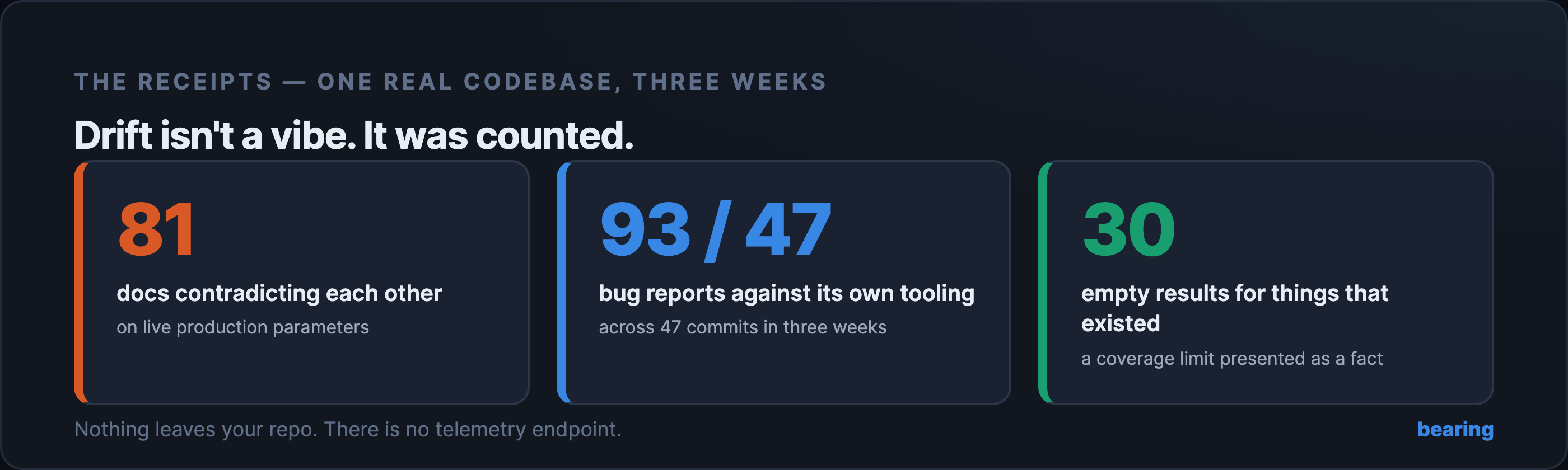
Built for a codebase where 81 documents had come to contradict each other on live production parameters.
🥇 Gold practices — the half that isn't yours
North-stars say what your project is. .bearing/gold-practices.md ships with bearing and says how
the work is done anywhere — numbered GP-#, cited the same way, and outranked by your NS-#
whenever they disagree.
Every rule has a scar, and a rule without one is not in the file. Nothing about writing tests or
naming things — you already do that. These are the mistakes that got made anyway, by a careful
agent, on this codebase:
GP-3 — Test at the seam the bug lives at. A unit test that passes an argument the real pipeline
never produces is green and dead. Scar: a context-window fix tested asresolve(300_000, undefined)
while the shipped config always passed a number — so the fix could not run, and did not, for two
releases.
Nineteen of them, and two computed guards keep the list honest: every rule must carry a scar, and
every GP-# cited anywhere must still exist. The second caught a dangling citation within minutes of
being written.
💾 Task-core
Long sessions get compacted. The transcript is summarized and thrown away.
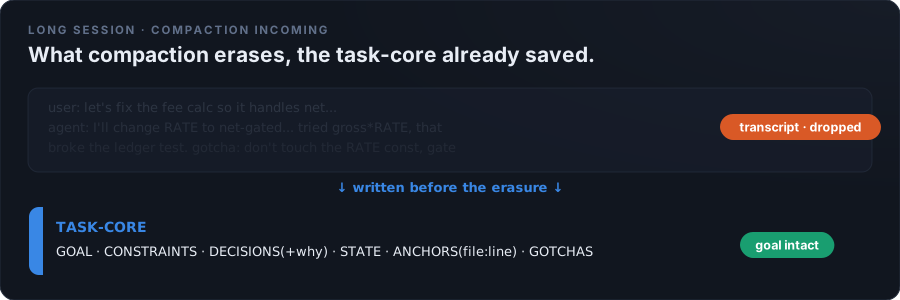
Written before the summary lands — by then the detail is already gone. The trigger is how much work is unsaved (edits since the last write), not a context percentage: the window isn't knowable at runtime, and what makes a compaction expensive is unwritten decisions, not fullness.
It stores what a summary reliably loses: GOAL · CONSTRAINTS · DECISIONS(+why) · STATE · ANCHORS(file:line) · GOTCHAS. GOTCHAS is the underrated one — the approaches you already tried that failed, so the agent doesn't cheerfully re-attempt them.
🔬 Microscope
Most review asks "is this code correct?" — a question a linter can ask.
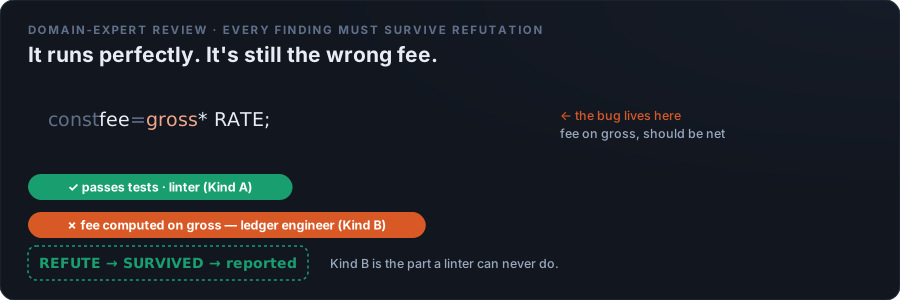
It maps your change into slices and spawns one lens agent per slice — in parallel where your runtime supports it — each carrying the same pinned persona, resolved from your repo at install and stored in .bearing/domain.json. A trading repo is reviewed by a quant trader; a payments repo by a ledger engineer. Pinned, so wave 2 can't quietly become a different expert than wave 1.
Kind B is the part a linter can never do. It asks why does this exist?, is this the wrong abstraction? — and catches semantic wrongness: "this fee is computed on gross, should be net." Code that runs perfectly and is still wrong.
Then every finding has to survive an adversarial pass that tries to refute it. What can't be defended never reaches you.
🙋 Consult
Agents interrupt you for the wrong things, and go quiet for the wrong things.
Permission to rename a file; silence while they invent a business rule. Consult is the judgment that separates the two, for a senior engineer who does not want to be asked about naming.
The test that does most of the work: is the answer discoverable in the repo? Code, tests, config, git history, north-stars — then it goes and finds it, because asking is offloading. If it exists only in your head — which of two readings you meant, which tradeoff you prefer, what a user should actually see — no amount of reading produces it. That is the question.
And when it does ask: closed options, the tradeoff, a recommendation, and what it will do without an answer. Never "shall I proceed?" — that is not a question, it is accountability being handed back to you.
One-way doors are a different act. Deleting data, force-pushing, publishing, migrating — it confirms, even when the right answer is obvious, because irreversible is the reason, not ambiguity. Reversible work needs no permission.
Then the part that compounds: an answer that is a RULE gets proposed as a north-star. Not every answer — a rule constrains future work, an instance doesn't. Ask once, write it down, never ask again.
🐜 Minions
Your agent can already spawn subagents. It doesn't know when it should.
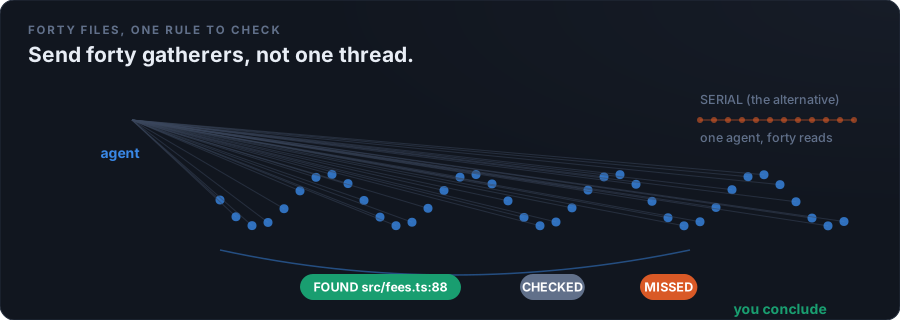
So it grinds through forty files serially — or samples five and generalises. Minions is that missing judgment: fan out when the work is bounded, verifiable, independent and wide (3+ units), and don't when the judgment itself is the work.
Each subagent carries the same north-stars and pinned persona, and returns evidence in a fixed shape:
FOUND    src/fees.ts:88 — const fee = gross * RATE
CHECKED  rg "\* RATE" src/ --type ts
MISSED   dynamic dispatch in src/plugins/ — could not resolve
Minions gather. Your agent concludes — they do minimal or zero reasoning. A subagent that returns a verdict puts a cheaper model's summary between the evidence and your decision, which is the drift this whole tool exists to prevent.
That CHECKED/FOUND split is load-bearing: CHECKED filled and FOUND empty means it looked and there was nothing. Both empty means it never understood the task. In prose those are the same sentence.
🕸 GitNexus
Grepping a symbol gives 40 text matches and no structure.
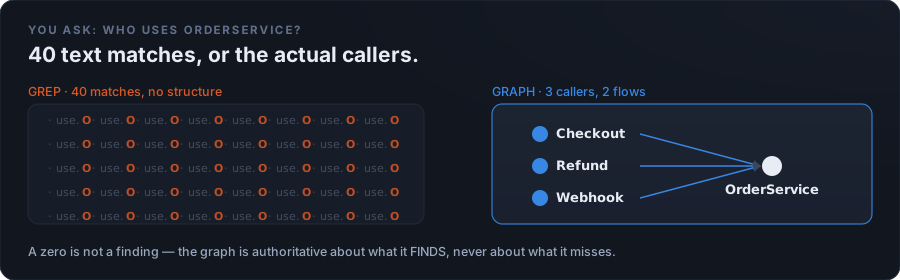
Two gates: a stale index blocks until refreshed, and so does working-tree drift — edit files and queries hold until you re-index, because the graph would otherwise answer about code you already changed.
A coverage limit presented as a fact is the failure this is built to survive. impact can return zero callers for a function wired to a live route, because calls through factories and DI seams don't always resolve. So the contract is asymmetric, and the agent is told so:
A positive result is strong evidence. A zero is not a finding. Never conclude "dead code" from an empty graph result — confirm it classically and say which check you ran.
When impact grades a change risk: LOW but resolved no callers, the kit says so before you edit. It warns rather than blocks — re-running returns the same empty answer.
🤖 CI
A sticky PR comment, not a merge gate: blast radius per changed symbol, affected flows, security-sensitive paths, import cycles. It never fails your build — the graph can't distinguish "nothing calls this" from "I couldn't resolve the callers", and a hard block on that fails honest PRs. GITNEXUS_CI_MODE=block is opt-in.
It tells you when it's the problem
Every enforcement tool believes its own rules are correct. This one assumes they might not be, and keeps the evidence.
npm run bearing:fallback -- "impact returned 0 callers for OrderService but grep finds 3"
The reason is captured with the graph state that produced it — version, node/edge counts, indexed commit. Not "the graph was wrong once", but this query, on this index, at this commit.
One real project accumulated 93 reports across 47 commits in three weeks. Read together they stopped being complaints and became a diagnosis: 30 were empty results for things that demonstrably existed. That corpus is what the rules above are calibrated against.
The gates get measured too — bearing:scorecard reports whether enforcement is earning its keep, and refuses to draw the conclusion for you:
⚠ Enforcement is 49% of graph interaction: 57 redirects vs 60 graph calls.
Nothing leaves your repo. There is no telemetry endpoint.
A tool that can block your work should be able to show you when it was wrong to.
Commands
npx bearing install <repo> [--runtime ...] [--features ...] [--mcp http|stdio|<port>] [--stealth]
npx bearing update <repo>       # keeps your module + transport choices
npx bearing uninstall <repo>    # restores what it overwrote
With the GitNexus module: bearing:northstars · bearing:health · bearing:refresh · bearing:fallback-log · bearing:scorecard · bearing:verify
Requirements: Node ≥ 22.9.0 · a git repo · macOS, Linux, Windows or WSL · (GitNexus module only) the GitNexus MCP server.
Quickstart · Skills · Architecture · Zed + local models · Changelog · Releases
License
ISC
Reviews (0)
Sign in to leave a review.
Leave a reviewNo results found