Sephera
Health Pass
- License — License: GPL-3.0
- Description — Repository has a description
- Active repo — Last push 0 days ago
- Community trust — 70 GitHub stars
Code Pass
- Code scan — Scanned 12 files during light audit, no dangerous patterns found
Permissions Pass
- Permissions — No dangerous permissions requested
This is a local-first CLI tool and MCP server built in Rust. It analyzes codebases to generate structural metrics and creates compressed, deterministic context bundles designed specifically for LLMs and AI-assisted workflows.
Security Assessment
Overall risk: Low. The tool operates entirely as a local utility and does not request any dangerous system permissions. A light code scan of its files found no dangerous patterns, malicious code, or hardcoded secrets. Because it is designed to read local codebases, it will naturally access your source code, but it does not appear to execute arbitrary shell commands or make external network requests. Its MCP server simply runs locally over standard input/output (stdio) to integrate with clients like Claude Desktop or Cursor.
Quality Assessment
The project is active and well-maintained, with its most recent push happening today. It enjoys a solid level of community trust with 70 GitHub stars and has clear, professional documentation. The code is openly licensed under GPL-3.0. However, it is worth noting that the current release line is in a pre-1.0 state (v0.4.0), meaning users should anticipate potential breaking changes in future updates as the tool matures.
Verdict
Safe to use.
Fast local-first Rust CLI for codebase metrics, AST-compressed LLM context bundles, and built-in MCP server.
Sephera



Sephera is a local-first Rust CLI for two jobs that are usually split across separate tools: repository metrics and deterministic context export.
Documentation: https://sephera.vercel.app
Current release line: v0.4.0 (pre-1.0).
Sephera currently focuses on three practical commands:
loc: fast, language-aware line counting across project treescontext: deterministic Markdown or JSON bundles with AST compression, focus paths, and Git diff awarenessmcp: built-in MCP server for direct AI agent integration
It is intentionally narrow in scope. Sephera does not try to be an agent runtime, a hosted service, or a provider-specific AI wrapper.
Why Sephera
Most codebase tooling falls into one of two buckets:
- metrics tools that tell you how large a repository is
- AI helpers that try to ingest too much code at once
Sephera sits between those extremes. It gives you reliable structural signals from the repository, then turns those signals into focused context that is easier for both humans and LLMs to work with.
Why not cloc or tokei?
If you only need line counts, cloc and tokei are excellent tools and already solve that job well.
Sephera is useful when you need more than raw totals:
locis only one half of the workflowcontextturns repository structure into deterministic Markdown or JSON bundles.sephera.tomllets teams keep shared context defaults in the repository- focus paths and approximate token budgets make output more practical for LLM use
The goal is not to replace every code metrics tool. The goal is to pair trustworthy repository signals with context export that is actually usable in modern review and AI-assisted workflows.
AST Compression
Sephera can compress source files using Tree-sitter to extract only structural information—function signatures, type definitions, imports, and trait declarations—while replacing implementation bodies with { ... }.
This typically reduces token usage by 50-70% without losing the API surface or architectural overview of the codebase.
Supported languages: Rust, Python, TypeScript, JavaScript, Go, Java, C++, C.
sephera context --path . --compress signatures --budget 64k
sephera context --path . --compress skeleton
MCP Server
Sephera includes a built-in MCP (Model Context Protocol) server that exposes loc and context as tools over stdio transport.
This allows AI agents such as Claude Desktop, Cursor, and other MCP-compatible clients to call Sephera directly without shell wrappers.
sephera mcp
Example MCP client configuration (Claude Desktop):
{
  "mcpServers": {
    "sephera": {
      "command": "sephera",
      "args": ["mcp"]
    }
  }
}
Key Features
- Fast
locanalysis with per-language totals, terminal table output, and elapsed-time reporting - Deterministic
contextpacks with focus-path prioritization, Git diff awareness, approximate token budgeting, and export to Markdown or JSON - Tree-sitter AST compression for context excerpts (signatures, skeleton modes) with 50-70% token reduction
- Built-in MCP server for direct AI agent integration over stdio
- Repo-level
contextdefaults and named profiles through.sephera.toml, with CLI flags overriding config - Generated built-in language metadata sourced from
config/languages.yml - Byte-oriented scanning with newline portability for
LF,CRLF, and classicCR - Reproducible benchmark harness, regression suites, and fuzz targets for stability work
Common Uses
- Inspect a repository before refactoring or reviewing changes
- Build a review pack from
HEAD~1,origin/master, or your current working tree - Build a focused context bundle for ChatGPT, Claude, Gemini, or internal tooling
- Prepare a structured handoff for another engineer or agent
- Export machine-readable context for downstream automation
- Reduce context token usage with AST compression while preserving API surface
- Connect AI agents directly to Sephera through the MCP server
Install
Install the published CLI from crates.io:
cargo install sephera
If you do not want a local Rust toolchain, download a prebuilt archive from GitHub Releases. Release assets ship as zipped or tarball binaries for the mainstream desktop targets supported by the release workflow.
If you are working from source instead, see the contributor workflow in the docs.
Quick Start
The examples below assume a sephera binary is available on your PATH.
Count lines of code in the current repository:
sephera loc --path .
Compress context excerpts to reduce token usage:
sephera context --path . --compress signatures --budget 64k
Start MCP server for AI agent integration:
sephera mcp
Build a focused context pack and export it to JSON:
sephera context --path . --focus crates/sephera_core --format json --output reports/context.json
Build a review-focused pack from Git changes:
sephera context --path . --diff HEAD~1 --budget 32k
List the profiles available for the current repository:
sephera context --path . --list-profiles
Configure repo-level defaults for context:
[context]
focus = ["crates/sephera_core"]
budget = "64k"
compress = "signatures"
format = "markdown"
output = "reports/context.md"

[profiles.review.context]
diff = "origin/master"
focus = ["crates/sephera_core", "crates/sephera_cli"]
budget = "32k"
output = "reports/review.md"
The configuration model is documented in more detail on the docs site, including discovery rules, precedence, path resolution, field-by-field behavior for [context], and named profiles under [profiles.<name>.context].
Terminal Demos
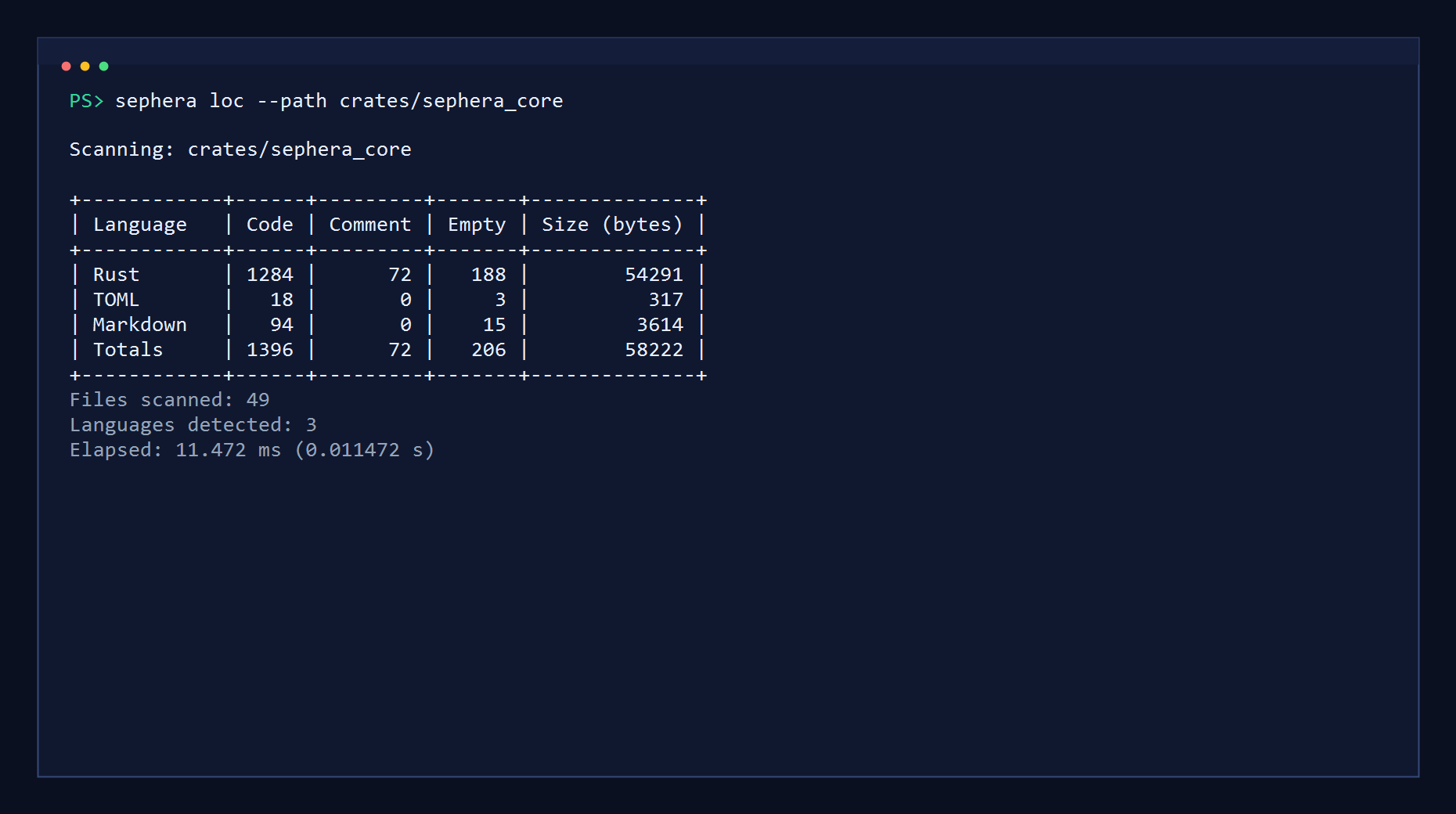
loc produces a fast, readable terminal summary for project trees:
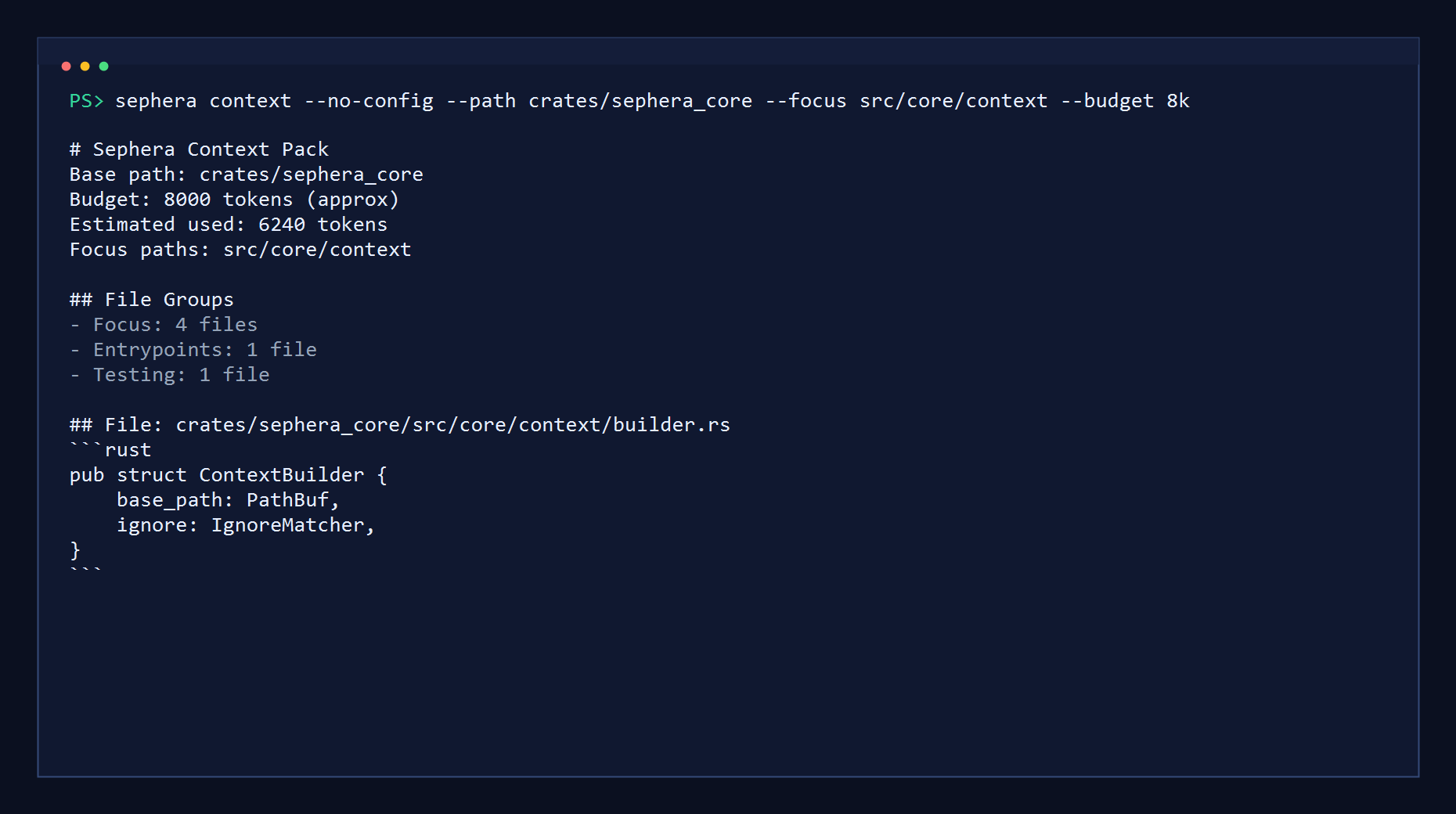
context builds a structured pack that can be exported for people or tooling:
Benchmarks
The benchmark harness is Rust-only and measures the local CLI over deterministic datasets.
- Default datasets:
small,medium,large - Optional datasets:
repo,extra-large extra-largetargets roughly 2 GiB of generated source data and is intended as a manual stress benchmark
Useful commands:
python benchmarks/run.py
python benchmarks/run.py --datasets repo small medium large
python benchmarks/run.py --datasets extra-large --warmup 0 --runs 1
Benchmark methodology, dataset policy, and caveats are documented in benchmarks/README.md and on the docs site.
Documentation
Public documentation: https://sephera.vercel.app
Docs source lives in docs/, built as a static Astro Starlight site.
Useful local docs commands:
npm run docs:dev
npm run docs:build
npm run docs:preview
Workspace Layout
crates/sephera_cli: CLI argument parsing, command dispatch, config resolution, and output renderingcrates/sephera_core: shared analysis engine, traversal, ignore matching,loc, andcontextcrates/sephera_mcp: MCP server implementation (Model Context Protocol)crates/sephera_tools: explicit code generation and synthetic benchmark corpus generationconfig/languages.yml: editable source of truth for built-in language metadatabenchmarks/: benchmark harness, generated corpora, reports, and methodology notesdocs/: public documentation sitefuzz/: fuzz targets, seed corpora, and workflow documentation
Development Checks
cargo fmt --all --check
cargo clippy --workspace --all-targets --all-features -- -D warnings
cargo test --workspace
npm run pyright
License
This repository is distributed under the GNU General Public License v3.0. See LICENSE for the full text.
Reviews (0)
Sign in to leave a review.
Leave a reviewNo results found