ContextAnalyzerTerminal
Health Warn
- License — License: MIT
- Description — Repository has a description
- Active repo — Last push 0 days ago
- Low visibility — Only 5 GitHub stars
Code Pass
- Code scan — Scanned 12 files during light audit, no dangerous patterns found
Permissions Pass
- Permissions — No dangerous permissions requested
This tool hooks into Claude Code sessions to track token costs on a per-tool-call basis. It builds rolling baselines, detects cost anomalies, and optionally uses a lightweight LLM to explain why specific actions consumed significant context.
Security Assessment
Overall risk: Low. The code scan of 12 files found no dangerous patterns, hardcoded secrets, or requests for risky permissions. However, by design, the tool intercepts your Claude Code session data to analyze token usage. If you enable the optional LLM root-cause classifier, it will make network requests to an external API (specifically Anthropic's Haiku model) to analyze anomalies. It also supports outbound webhooks for Slack or Discord notifications. No suspicious shell execution is present beyond the standard tracking hooks.
Quality Assessment
This is a relatively new and niche project, evidenced by a low community footprint of only 5 GitHub stars. Despite the low visibility, the repository is under active development (last updated today), uses the permissive MIT license, and provides clear documentation. The inclusion of continuous integration (CI) and a modern Python setup indicates the developer follows standard, high-quality coding practices.
Verdict
Safe to use. The codebase is clean, readable, and transparent, making it a helpful utility for developers wanting to monitor and optimize their Claude Code context limits. Just be mindful of the external API calls if you choose to enable the classifier extra.
CAT - Per-tool-call context window analyzer for Claude Code
Know exactly which tool call ate your context window.


CAT hooks into your Claude Code sessions and tracks token cost per tool call -- not just per session. It builds rolling baselines, flags anomalies, and uses an LLM to explain why something was expensive.
Install
git clone https://github.com/roeimichael/ContextAnalyzerTerminal.git
cd ContextAnalyzerTerminal
uv sync

# Optional: enable LLM root-cause classifier (uses Haiku, ~$0.0001/event)
uv sync --extra classifier
Requires: Python 3.11+ and uv
Setup & Run
# Install hooks into Claude Code (also writes default config)
context-analyzer-tool install

# Start the collector (keep running in a terminal)
context-analyzer-tool serve

# Open the dashboard
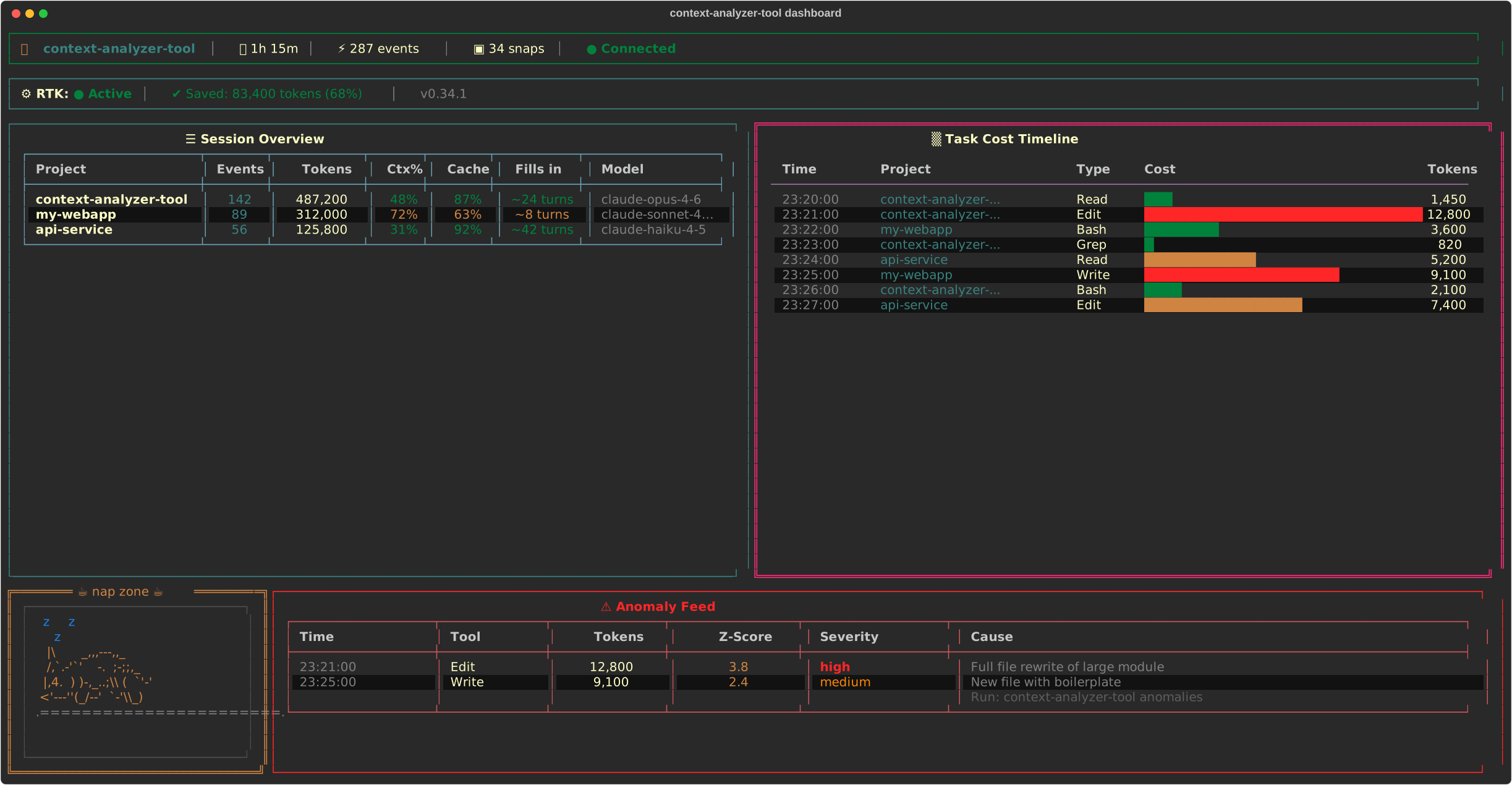
context-analyzer-tool dashboard
That's it. Use Claude Code normally -- CAT tracks everything in the background.
What You Get
| Feature | What it does |
|---|---|
| Per-tool-call tracking | See exactly how many tokens each Read, Bash, Grep, etc. costs |
| Rolling baselines | Learns normal cost per task type using Welford's algorithm |
| Anomaly detection | Flags tool calls that exceed baseline by configurable Z-score |
| Root-cause analysis | Haiku classifier explains why in plain language |
| Context cost breakdown | See fresh-session vs current overhead ratio |
| Live dashboard | Rich TUI with sessions, cost timeline, and anomaly feed |
| Notifications | Statusline badges, system alerts, Slack/Discord webhooks |
| Multi-session | Tracks concurrent Claude Code sessions independently |

CLI Reference
context-analyzer-tool install         Install hooks into Claude Code
context-analyzer-tool uninstall       Remove hooks from Claude Code
context-analyzer-tool serve           Start the collector server
context-analyzer-tool dashboard       Launch the live TUI dashboard
context-analyzer-tool status          View active sessions and recent tasks
context-analyzer-tool anomalies       List recent anomalies with root causes
context-analyzer-tool context-cost    Show context cost breakdown
context-analyzer-tool health          Collector health check
context-analyzer-tool rtk-status      Show RTK integration status and savings
context-analyzer-tool prune           Clean up old data
context-analyzer-tool clear           Clear all stored data and start fresh
Configuration
Config lives at ~/.context-analyzer-tool/config.toml (created automatically on first install). Every setting can be overridden with environment variables using the CAT_ prefix.
[collector]
host = "127.0.0.1"
port = 7821

[anomaly]
z_score_threshold = 2.0      # Std devs above mean to flag
min_sample_count = 5          # Data points before detection kicks in
cooldown_seconds = 60         # Debounce duplicate alerts

[classifier]
enabled = true                # Requires: uv sync --extra classifier
model = "claude-haiku-4-5-20251001"

[notifications]
statusline = true             # Badge in Claude Code statusline
system_notification = true    # OS notifications (macOS/Linux)
in_session_alert = true       # In-session alert messages
webhook_url = ""              # Slack/Discord webhook
Environment variable overrides:
CAT_COLLECTOR_PORT=8080
CAT_ANOMALY_Z_SCORE_THRESHOLD=3.0
CAT_CLASSIFIER_ENABLED=false
How It Works
Claude Code hooks don't include token counts. CAT correlates two data streams:
- Hook events (PostToolUse, SubagentStop, Stop, etc.) carry tool metadata
- Statusline snapshots provide real-time token counts
The delta engine matches them by session ID + timestamps to compute per-call costs. Anomalies are detected via Z-score over a rolling 20-sample window per task type, then classified by Haiku.
Hooks + Statusline --> Collector --> Delta Engine --> Anomaly Detection --> Classifier --> Notifications
                                        |
                                    SQLite DB
                                        |
                                    Dashboard
Development
uv sync --all-extras          # Install with dev + classifier deps
uv run pytest tests/ -v       # Run full test suite
uv run ruff check src tests   # Lint
uv run pyright                # Type check (strict mode)
See CONTRIBUTING.md for guidelines and areas where help is welcome.
Tech Stack
FastAPI + Uvicorn (async collector) -- SQLite + aiosqlite (persistence) -- Pydantic (validation) -- Typer + Rich (CLI/TUI) -- Anthropic SDK (optional classifier)
License
Reviews (0)
Sign in to leave a review.
Leave a reviewNo results found