engram
Health Warn
- License — License: MIT
- Description — Repository has a description
- Active repo — Last push 0 days ago
- Low visibility — Only 6 GitHub stars
Code Warn
- network request — Outbound network request in app/(app)/connect/page.tsx
- process.env — Environment variable access in app/(app)/layout.tsx
- process.env — Environment variable access in app/(app)/page.tsx
- network request — Outbound network request in app/(app)/page.tsx
- network request — Outbound network request in app/(app)/settings/page.tsx
- network request — Outbound network request in app/(app)/workspaces/page.tsx
Permissions Pass
- Permissions — No dangerous permissions requested
No AI report is available for this listing yet.
Self-hosted MCP server + dashboard giving Claude Code, Cursor & Hermes agents shared long-term memory over a git-backed markdown vault. Agent-native, Obsidian-compatible second brain — markdown RAG, no vector DB.

Engram
The second brain your AI agents read and write.
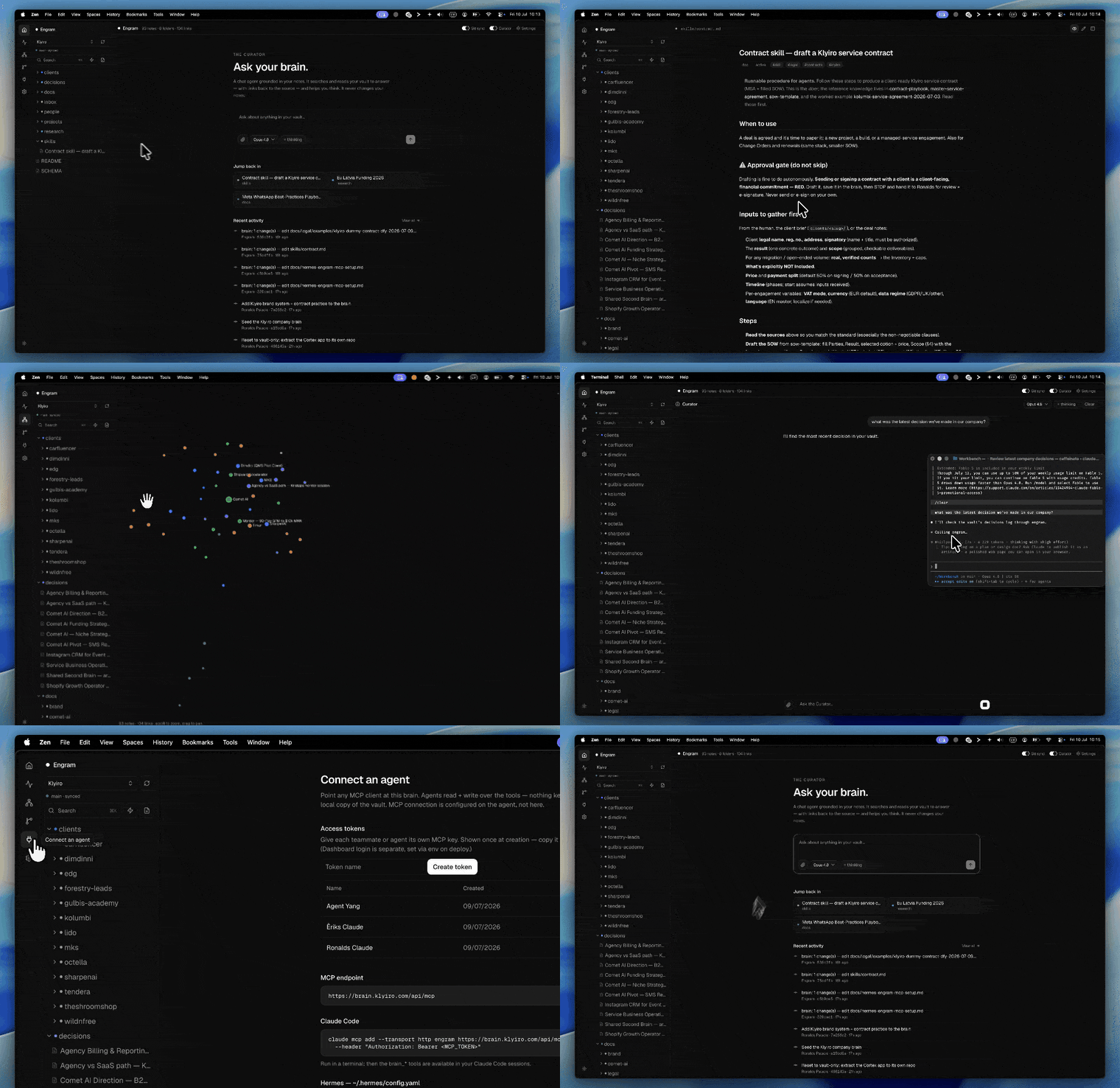
▶ Watch the full-length video (real-time, full quality)
Engram is a self-hosted MCP server + dashboard that gives Claude Code, Cursor, Hermes, and any
Model Context Protocol agent shared, long-term memory they read
and write — over a plain, git-backed folder of markdown you own. Built for the case a single
agent's memory never hits: a team running several agents against one brain.
Autonomous agents forget everything between sessions — and worse, they can't tell what they remember
is still true. An agent pulls an old README, a retired price, an API doc you changed months ago, and
quotes it with full confidence, because keyword and vector search both rank by resemblance, not truth.
Engram makes "is this still true" a first-class, written property: mark a fact superseded or
expired and search withholds it — and tells the agent what it skipped and why. Per-agent read/write
tokens and a git audit trail of who-wrote-what keep it sane when the writers are a fleet, not just you.
Unlike a headless memory store, you can watch it happen. A fast dashboard lets you search your
brain, see exactly what every agent and teammate changed (with per-file diffs), jump back into
recent notes, and curate it all — while agents read and write the same vault over one MCP endpoint. No
database: your .md files are the source of truth, git is the durable store, and an in-memory index
powers full-text search + a wikilink knowledge graph.



Opinionated about how it stores memory — git-backed markdown, no database, agents write (not
just read), self-hosted. Unopinionated about what you keep in it — any markdown vault, any folder
structure, any MCP client. Point it at a fresh repo or your existing Obsidian vault: no import
step, no lock-in.
What it's for
- Shared memory for a team running multiple agents — one vault, many agents reading and writing
concurrently, with per-agent read/write tokens and a git audit trail of who changed what. - Memory that knows what's still true — retire a price, a term, or a changed API doc and your agents
stop quoting it; they're told what they skipped and why. The failure a single agent's memory never fixes. - Long-term memory for Claude Code and other coding agents — stop re-explaining your project every session.
- A self-hosted, Obsidian-compatible second brain exposed over MCP — your notes, your server, your git repo.
- Memory you can see, not a black box — a dashboard to search, watch (with diffs), and curate what your agents remember.
- Markdown RAG without the vector database — full-text search + a link graph over human-readable files.
Features
- MCP server — 15
brain_*tools over one bearer-authenticated HTTP endpoint (POST /api/mcp,
streamable HTTP JSON-RPC). Connect any MCP client to a single URL. Per-agent token scopes:
a read-only token never even sees the write tools. - Human dashboard — a search-first home, file tree, note viewer with Obsidian callouts,
wikilinks, and backlinks, Preview / Edit / Split editor with autosave, ⌘K search + in-page keyboard
navigation, "jump back in" recents, and a force-directed knowledge graph. - Authority-aware search — ranking knows relevance, not truth, so a superseded note repeats your
query words as often as the live one. Every hit carries an authority (authoritative→current
→provisional→superseded→archived) derived from the note's folder and frontmatter — so your
agents quote the locked doc, not the dead one. Markdown RAG that won't hand back yesterday's answer. - Temporal validity + explainable rejection — mark a fact
superseded_byanother note or give it avalid_untildate, and search withholds it by default (even if it'slocked) — then hands the
agent anexcludedlist of what it skipped, each with a reason ("expired 2026-06-01"). One atomicbrain_supersederetires the old fact and links the new one in a single commit, so add-and-retire
can't drift apart. This is the difference between an agent that remembers and one that knows what's
still true. - Audit trail + access control — every write is attributed in git to the token or human that
made it, with expandable per-file diffs in the activity feed. Give an agent a read-only token
and it never even sees the write tools; a write token can create, edit, move, and archive. - The Curator (optional) — Engram's built-in agent harness over your vault. Chat with your
notes (grounded answers, wikilink citations). Or handbrain_capturea rough dump — a meeting note, a
voice transcript — and an agentic loop searches what already exists, then files, merges, or archives
and returns a manifest of what it touched. It reads before it overwrites and never deletes. Opus /
Sonnet / Haiku, your key. - Markdown-native — plain
.md+ YAML frontmatter +[[wikilinks]]. Drop in an existing
Obsidian vault and it just works. - Git-backed — optional auto commit + push of every change. Full history, no lock-in, your data
lives in your repo. - No database — files are the source of truth; an in-memory MiniSearch index + a ported wikilink
graph power search and backlinks. Nothing to provision. - Multi-workspace — connect multiple vault repos (URL + token or GitHub OAuth), rename, switch the
active one, or remove them — all from the UI. - Self-hosted — one Docker container. Railway / Render / Fly / any host with a volume.
Not serverless (it needs a persistent volume, a file watcher, and a long-running index). - Team auth — Google SSO + email allowlist for the dashboard; per-agent bearer tokens — or OAuth
for Claude.ai custom connectors — for MCP, created/revoked in the UI. Secrets encrypted at rest. - Runtime config — toggle git-sync and the Curator right from the home; manage commit author, keys,
and OAuth in Settings — no redeploy.
Works with
Any client that speaks the Model Context Protocol — one endpoint, bearer-token auth. Most-used first:
- Claude Code — Anthropic's agentic coding CLI
- Codex — OpenAI's coding agent (CLI + IDE)
- Hermes — always-on autonomous agent runtime
- openclaw — open-source coding agent
- Cursor — AI code editor
- Cline — VS Code agent
- Windsurf — agentic IDE
- Claude Desktop — Anthropic's desktop app
- …and any other MCP client — Continue, Goose, Zed, Amp, and the rest
If it speaks MCP, it can read and write Engram as shared memory.
Quick start
bun install
bun dev            # http://localhost:3000 — runs against ./sample-vault
Point it at your own vault:
VAULT_DIR=/path/to/your/obsidian-or-markdown/vault bun dev
Two ways to run it
Hosted mode (team): the dashboard + HTTP MCP server above — self-host it once, many agents and
teammates connect overPOST /api/mcp. This is the main mode.Local mode (stdio): a plain stdio MCP server over a folder, no HTTP/auth/git — for a single
machine, Claude Desktop / Cursor, or a registry's Docker introspection:bun run mcp:stdio /path/to/your/vault # defaults to ./sample-vaultSame
brain_*tools. Image:Dockerfile.mcp(CMD ["bun", "scripts/mcp-stdio.ts"]).
MCP tools
Agents only ever see the active vault — no repo, workspace, or GitHub tools are exposed.
A read-scope token sees only the read tools. brain_capture appears only when the Curator is full.
| Tools | |
|---|---|
| Read | brain_search · brain_read · brain_list · brain_recent · brain_tree · brain_backlinks · brain_graph · brain_schema |
Write (needs a write-scope token) |
brain_write · brain_edit · brain_append · brain_move · brain_supersede · brain_create_folder · brain_delete |
Connect an agent (the dashboard → Connect page shows the exact command + token):
claude mcp add --transport http engram https://<host>/api/mcp \
  --header "Authorization: Bearer <token>"
Deploy
Runs anywhere you can run a Docker container with a persistent volume — Railway, Render, Fly, or your
own box. Serverless (Vercel) won't work: Engram holds a volume, a file watcher, and an in-memory
index that a serverless function can't keep alive.
- Deploy this repo (root
Dockerfile), mount a volume at/data, setENGRAM_DATA_DIR=/data. - Connect your vault repo(s) in the dashboard (Workspaces) — by URL + token, or GitHub OAuth.
- Sign in with Google, create MCP tokens on the Connect page, point your agents at the URL.
Most runtime config (git-sync, AI capture, GitHub OAuth, app name) is editable in the Settings
page — only auth/infra bootstrap vars live on the host. Full setup: DEPLOY.md.
- Railway: New Project → Deploy from GitHub repo → add a Volume at
/data. - Render: one-click via the bundled
render.yaml(Docker + a/datadisk).
FAQ
How do I give Claude Code long-term memory?
Deploy Engram, connect a markdown vault, and claude mcp add the endpoint. The brain_* tools let
Claude Code search, read, and write persistent notes across sessions.
Can multiple AI agents share one knowledge base?
Yes. Every agent points at the same MCP URL and reads/writes the same active vault — that's the point.
Give each agent its own bearer token, read or write — a read-only token can't mutate your notes.
How do I stop an agent from quoting outdated facts?
Retire the fact and search stops surfacing it. When a value changes, call brain_supersede(old, new) —
one atomic commit marks the old note superseded_by the new one, and it's withheld from search by
default (even if it's locked). Or set valid_until: 2026-12-31 on a note and it self-expires.
Retired matches don't vanish silently: brain_search returns them in an excluded list with a
reason ("expired 2026-06-01"), so the agent can say what it ignored and why instead of quoting it.
How do I know what an agent changed?
Every write is committed to git attributed to the token or human behind it, and the dashboard's
activity feed shows per-file diffs — a built-in audit trail for autonomous agents.
Does it work with my Obsidian vault?
Yes. It reads plain markdown with frontmatter and [[wikilinks]], and renders Obsidian-style callouts
and backlinks. No import step.
Do I need a vector database?
No. Engram uses full-text search (MiniSearch) plus a wikilink graph over human-readable markdown —
no embeddings service, no vector store to run.
Can I chat with my notes?
Yes — enable the optional Curator, a chat agent that searches and reads your vault to answer with
wikilink citations (Opus / Sonnet / Haiku). It's read-only in chat, so it helps you think without
changing anything, and it runs on your own Anthropic key.
Can I see what my agents changed?
Yes — the Activity view reads your vault's git history and shows every change (agents and teammates
alike), expandable to per-file diffs. Since it's just git, you get the full audit trail for free.
Is my data locked in?
No. It's just .md files in a git repo you own. Turn Engram off and you still have every note and its
full history.
Where does it run / is it self-hosted?
You host it. One Docker container on Railway / Render / Fly / any VM with a volume. Your keys, your data.
Stack
Next.js 16 (App Router) · React 19 · TypeScript · Tailwind v4 · shadcn/ui · bun · MiniSearch ·
d3-force · MCP SDK. MIT licensed.
Keywords: MCP server · Model Context Protocol · second brain for AI agents · agent memory ·
long-term memory for Claude Code · shared memory for AI agents · self-hosted knowledge base ·
Obsidian-compatible · markdown · knowledge graph · wikilinks · PKM · Zettelkasten · git-backed notes ·
Hermes agent memory · Cursor memory · RAG without a vector database · chat with your markdown notes ·
git-backed agent activity feed · audit trail for AI agents · authority-aware search · read-only vs
write MCP tokens · agent access control · self-organizing notes · agentic note capture · AI that files
your notes · temporal validity · stale memory · agents quoting outdated facts · supersede · note expiry ·
shared memory for a team of agents · Basic Memory alternative · mem0 alternative.
Reviews (0)
Sign in to leave a review.
Leave a reviewNo results found