measured-humanizer
Health Warn
- License — License: MIT
- Description — Repository has a description
- Active repo — Last push 0 days ago
- Low visibility — Only 5 GitHub stars
Code Fail
- fs module — File system access in bin/mcp-server.js
- rm -rf — Recursive force deletion command in install.sh
- fs module — File system access in skills/measured-humanizer/gate/style_gate.js
- rm -rf — Recursive force deletion command in test/run.sh
- fs module — File system access in test/run.sh
Permissions Pass
- Permissions — No dangerous permissions requested
No AI report is available for this listing yet.
Deterministic, statistical style gate and calibrator for AI writing that measures structural variance instead of word lists. Zero runtime dependencies.
Measured Humanizer





An enterprise-grade AI writing calibrator and style enforcer that measures human-likeness statistically, eliminating subjective "AI tell" pattern-matching.
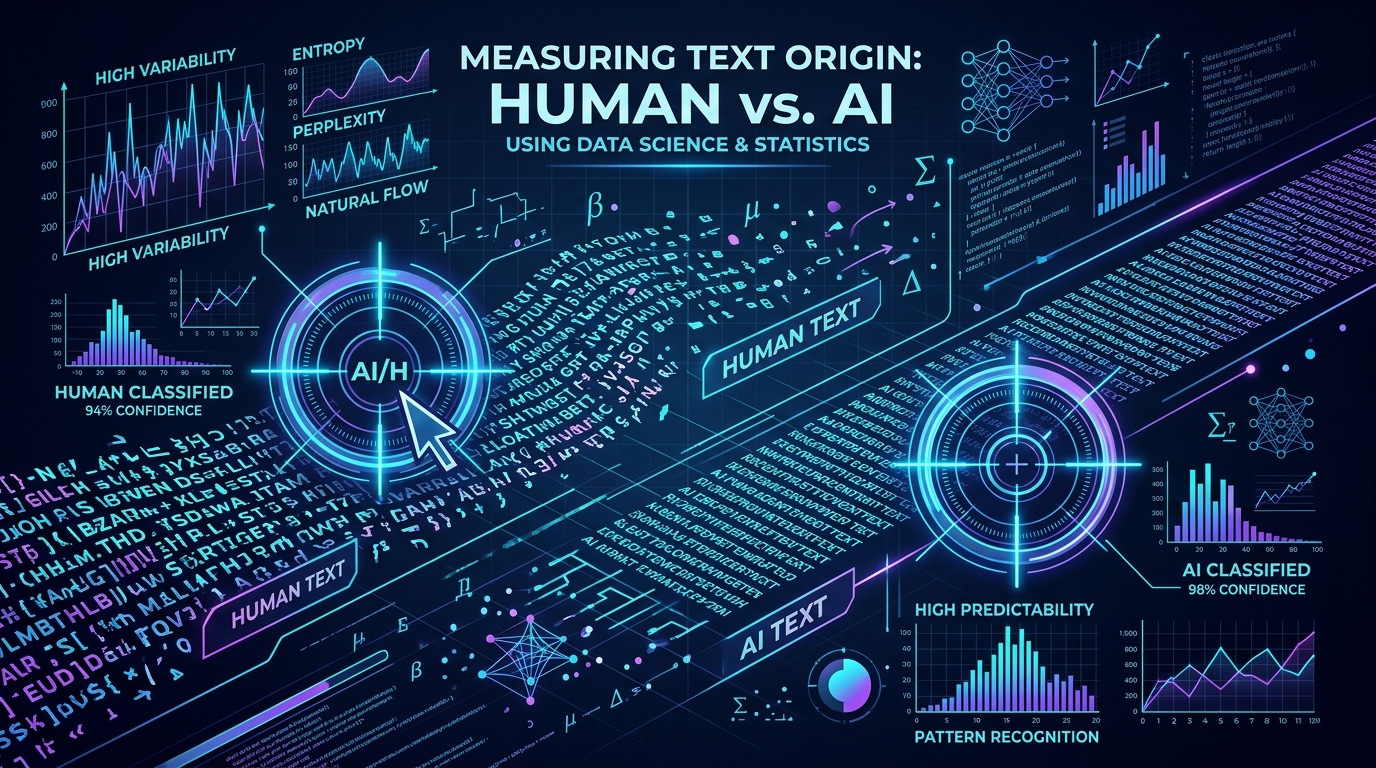
Measured Humanizer is an agent-agnostic skill that makes writing read as human-written by measuring it, not by pattern-matching a list of words someone decided sound like a robot.
It ships a dependency-free Node scorer calibrated against an extensive research dataset of 10,000+ sentences and structural data points across human-written and AI-written technical documents. Point it at a draft and it returns the single worst dimension plus an instruction for fixing it. Fix that one thing. Re-measure. Repeat until it passes.
That loop terminates. "Make this sound more human" does not.
Table of Contents
- Detector Results
- Features
- Supported Ecosystems
- Why Structural Measurement?
- Architecture & Workflow
- Installation & Integrations
- Usage & Flags
- Recalibration
- Development & Testing
- Contributing
- Security
- Limitations
- License
Detector Results
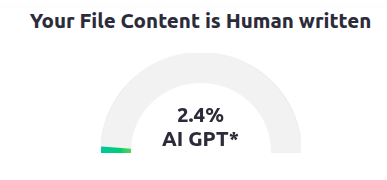
Passing the gate is the goal; these scores are a side effect of it. An article
that came out of the correction loop with a passing composite, pasted unmodified
into two public AI detectors:
 |
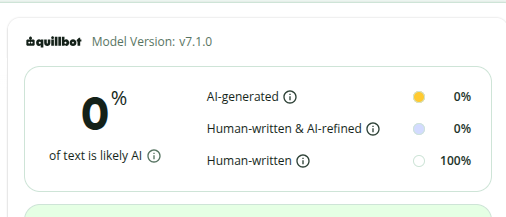 |
| ZeroGPT — 2.4% AI, classified human-written | QuillBot (v7.1.0) — 0% AI-generated, 100% human-written |
Read these for what they are. They are two detectors, on one document, in
September 2026, and detectors are retrained without notice. The gate does not
target them and was never fitted against their output — it is calibrated against
an empirical research corpus of 10,000+ structural data points across human and AI technical writing, and these vendors are not in that loop. Treat a
result like this as corroboration that the structural dimensions in
Why Structural Measurement? are picking up
something real, not as a bypass guarantee. See Limitations.
Features
- Statistical Calibration: Rejects hardcoded word lists in favor of measurable structural variance (e.g., paragraph length variance, first-person rates).
- Agent-Agnostic Core: Runs natively as a CLI tool. Use it with Claude Code, GitHub Copilot, Codex, Antigravity, or in CI/CD pipelines.
- Code Integrity Protection: Includes a
--beforeflag to ensure that an agent's "style improvements" don't secretly rewrite your code blocks or drop citations. - Deterministic Scoring: Delivers reliable, non-flaky evaluations of prose without calling out to a black-box LLM classifier.
Supported Ecosystems
While originally packaged as a Claude Code skill, Measured Humanizer acts as a standalone CLI tool that can be seamlessly integrated into any AI development workflow:
- GitHub Copilot / Codex: Can be invoked within Copilot Workspace, terminal chats, or as a pre-commit hook to govern generated documentation.
- Claude Code: Installs directly as a native skill.
- Antigravity & AutoGPT: Agents can run the scorer natively in an automated correction loop.
- CI/CD Pipelines: Enforce documentation standards directly in GitHub Actions or Jenkins.
Why Structural Measurement?
Because the lists don't work. Here is what they actually measured on the corpus, as AUC, where 0.5 is a coin flip:
| Signal | Separation | Verdict |
|---|---|---|
| hedging words (may, might, typically) | 0.516 | useless — humans hedged more |
| bridge phrases (moreover, furthermore) | 0.527 | useless — near-zero in both classes |
| promotional adjectives (robust, seamless, leverage) | 0.535 | useless — no consistent direction |
Banning the word "may" accomplishes nothing. Humans used it more than the generated set did.
What separates the two classes is structural, and it isn't subtle:
| Dimension | Separation | Human | AI |
|---|---|---|---|
| paragraph length variance | 0.897 | 28.6 | 12.8 |
| first-person rate (/1k words) | 0.889 | 8.18 | 0.00 |
| em-dash rate | 0.736 | 0.00 | higher |
| sentence length variance | 0.720 | 10.3 | 7.7 |
| concrete-specific density | 0.686 | 28.0 | 19.9 |
| contraction rate | 0.663 | 10.2 | 7.9 |
AI writes paragraphs of near-uniform length and never says "we". Those two facts carry more signal than every phrase list combined.
Full derivation, including the design mistakes found along the way, is in skills/measured-humanizer/reference/calibration.md.
Architecture & Workflow
Three stages. Calibration happened once, offline, and produced gate/thresholds.json. Scoring is deterministic and runs on every invocation. Correction is the loop an agent drives.
Stage 1: Calibration (Offline)
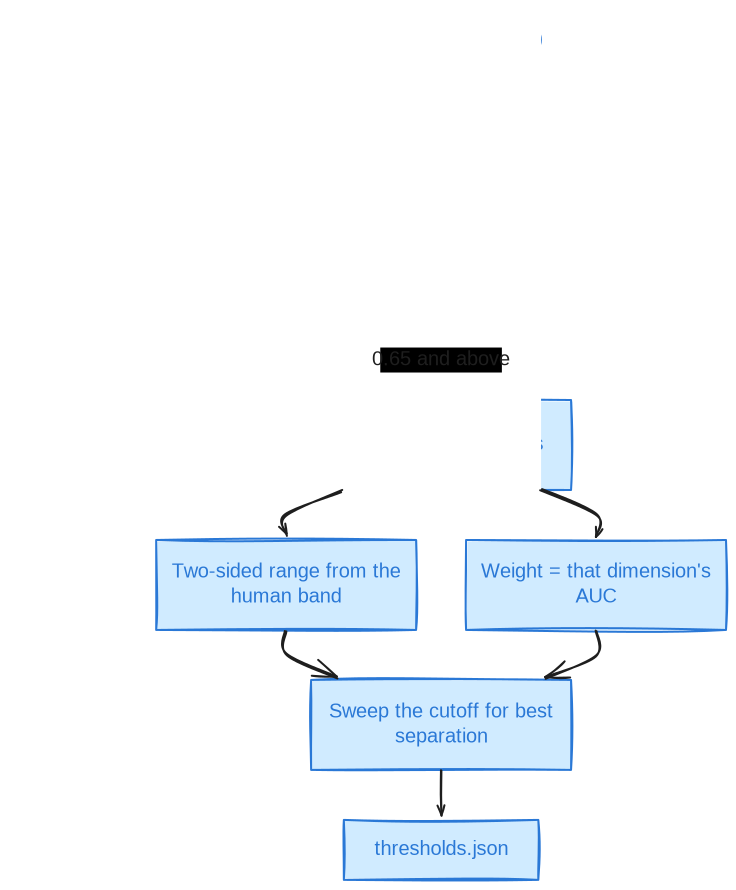
Every dimension is computed over both corpora, then ranked by how well it separates them — AUC. Anything below 0.65 is thrown away. The survivors keep their range (human percentile band) and their weight (the AUC itself). The cutoff is swept across candidate values and fixed where separation peaks.
Stage 2: Scoring
Before anything is counted, proseOnly() strips the document down to prose: fenced blocks, inline code, headings, and tables are removed.
What's left is measured three ways — population standard deviation for the variance dimensions, counts normalised per 1,000 words for the rate dimensions, and a plain ratio for the rest. metrics() returns sixteen measured dimensions plus raw counts.
Stage 3: Verdict
composite = Σ strength(dimensions in range) / Σ strength(all gated dimensions)
pass      = composite >= 0.84  AND  no absolute rule tripped
Absolute rules (like parallelism and discourse_markers) sit outside that arithmetic entirely and can veto at any score.
Stage 4: Correction Loop
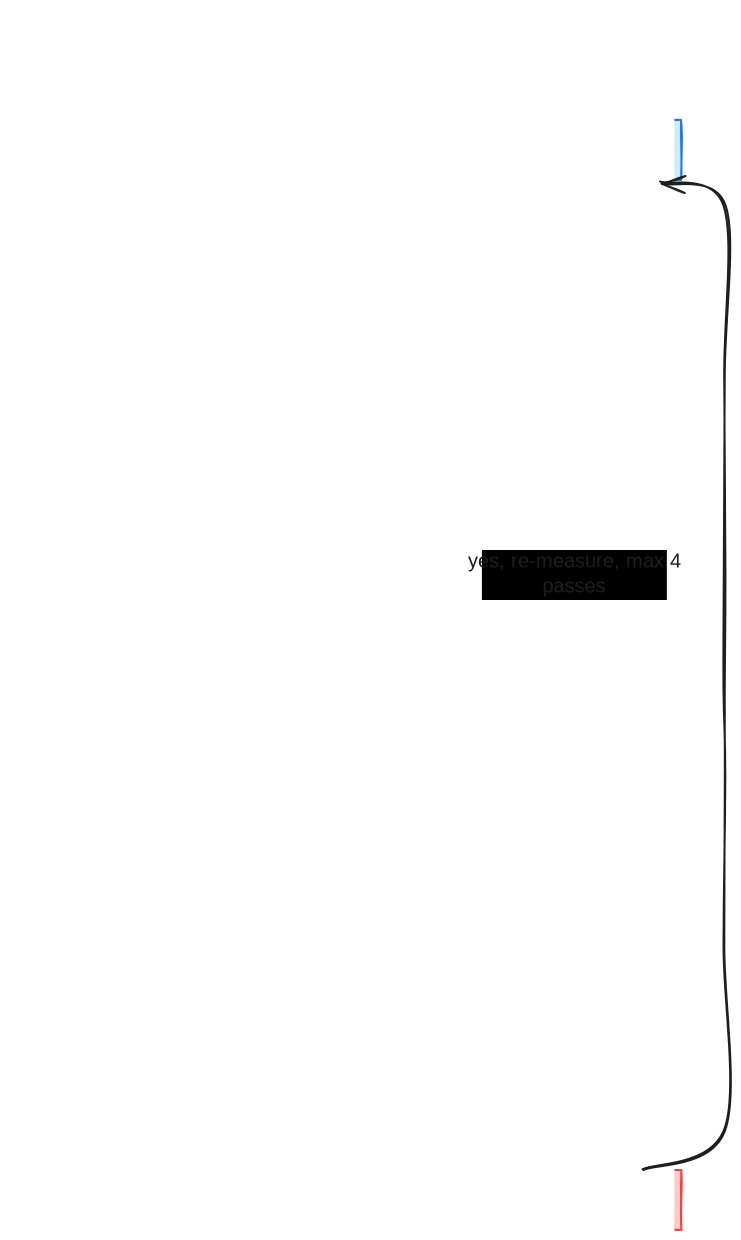
Only the single worst dimension is fixed per pass. Fixing several at once trades one failing check against another. After each pass, integrity is checked against the pre-edit copy.
Installation & Integrations
1. Instant Run via NPX / NPM (No clone needed)
# Run on any markdown document
npx measured-humanizer draft.md --brief

# Or install globally
npm install -g measured-humanizer
measured-humanizer draft.md --brief
2. GitHub Actions CI/CD Pipeline
Add automated human-likeness gating and link/code integrity verification directly into your repository workflows:
- name: Verify Documentation Style
  uses: SadhvikChirunomula/measured-humanizer@main
  with:
    path: 'README.md'
    brief: true
    fail-on-veto: true
3. Pre-commit Hook
Add to your .pre-commit-config.yaml:
repos:
  - repo: https://github.com/SadhvikChirunomula/measured-humanizer
    rev: main
    hooks:
      - id: measured-humanizer
4. Model Context Protocol (MCP) Server
Connect Measured Humanizer directly into Claude Desktop, Cursor, Antigravity, or any MCP-compatible agent environment:
{
  "mcpServers": {
    "measured-humanizer": {
      "command": "node",
      "args": ["/path/to/measured-humanizer/bin/mcp-server.js"]
    }
  }
}
5. Claude Code Plugin / Skill
As a Claude Plugin (recommended — updates with /plugin):
/plugin marketplace add SadhvikChirunomula/measured-humanizer
/plugin install measured-humanizer@measured-humanizer
As a standalone skill for Claude Code / CLI usage:
curl -fsSL https://raw.githubusercontent.com/SadhvikChirunomula/measured-humanizer/main/install.sh | bash
Usage & Flags
Ask your agent (Claude, Copilot, Codex, Antigravity) to humanize, de-slop, or audit a draft. Or run the scorer directly from the CLI:
GATE=./skills/measured-humanizer/gate/style_gate.js

node "$GATE" draft.md --brief
pass=false composite=0.139/0.84 VETOED
failing=9: parallelism,discourse_markers,is_that_filler,long_word_rate,contraction_rate,para_stdev,first_person_rate,concrete_rate,sent_stdev
worst=parallelism value=3.08
fix: Remove every "not X, but Y" / "it isn't A, it's B" construction. This pattern appeared zero times across human-written benchmark prose.
Drop --brief for the full JSON: every metric, every failure, the heading zones.
| Flag | Effect |
|---|---|
--brief |
Human-readable summary. Cheap enough to run inside an agent loop. |
--before old.md |
Integrity check. Fails if a fenced code block changed or a link was dropped. |
--no-zoning |
Skip the H2/H3 heading rules. Use for READMEs, design docs, email. |
--thresholds f.json |
Use your own calibration instead of the shipped one. |
Integrity Check
A more human-sounding article that dropped its sources is a worse article. Use the --before flag to ensure your AI agent didn't quietly rewrite shell snippets or drop citations:
cp draft.md draft.orig.md
# ...let agent edit one dimension...
node "$GATE" draft.md --brief --before draft.orig.md
Recalibration
The shipped thresholds are fitted to technical practitioner prose. Marketing copy, fiction and academic writing each want their own fit.
gate/thresholds.json holds the ranges, the AUC-derived weight per dimension, and the swept cutoff. To refit: gather ~30+ documents per class in your domain, run metrics() from gate/style_gate.js over both sets, keep dimensions with AUC ≥ 0.65, set each range to the human percentile band, and sweep the cutoff for best separation.
Development & Testing
bash ./test/run.sh
Two fixtures carry the load: a document written to look generated must fail and get vetoed, and one written the way the corpus measures must pass.
Contributing
We welcome contributions! Please review our Contributing Guidelines and Code of Conduct before submitting pull requests or opening issues.
Security
For security vulnerability reports, please refer to our Security Policy.
Limitations
- Not an AI-detector bypass. It's a filter, not an oracle. The scores in Detector Results are one document at one point in time, not a promise about yours.
- Not a substitute for having something to say. A document contorted to hit the numbers is not good writing, it's a document that games a gate.
- Not domain-general as shipped. It is calibrated for technical prose. See recalibration above.
License
This project is licensed under the MIT License. The corpora themselves are not redistributed — what ships is the fitted result.
Reviews (0)
Sign in to leave a review.
Leave a reviewNo results found