chronicler
Health Pass
- License — License: NOASSERTION
- Description — Repository has a description
- Active repo — Last push 0 days ago
- Community trust — 12 GitHub stars
Code Pass
- Code scan — Scanned 8 files during light audit, no dangerous patterns found
Permissions Pass
- Permissions — No dangerous permissions requested
No AI report is available for this listing yet.
D&D 5e Compatible AI Role Playing Game
chronicler
An AI Dungeon Master that remembers.
"I see you've found the Shadowfell Codex. Most visitors are drawn to the prettier volumes."
A knowing smile crosses her weathered features. "That particular tome has been the subject of much... debate among our scholars."
A solo tabletop RPG with a replaceable AI backend. Use Anthropic, OpenAI,
OpenRouter, local Ollama, or another OpenAI-compatible server. You play; the AI
runs the world — narrating scenes, voicing NPCs, rolling dice, and tracking the
consequences of your choices across sessions.
The rules engine, tools, memory, and save format are model-provider independent.
Only inference crosses the provider boundary, and you choose whether that stays
local or uses a cloud service.
Quick Start
git clone https://github.com/SamuelSchlesinger/chronicler.git
cd chronicler

# Local Ollama; defaults to qwen3.6:35b-a3b:
cargo run -p chronicler -- --local

# Or OpenRouter/Kimi K3:
export OPENROUTER_API_KEY=your_key_here
cargo run -p chronicler
--local uses Ollama at http://localhost:11434/v1 and defaults toqwen3.6:35b-a3b. It needs a running Ollama service and an installed model, but
no API key. Override it with --local MODEL.
Provider configuration
| Provider | Select with | Credential | Default narrative / fast model |
|---|---|---|---|
| OpenRouter | CHRONICLER_PROVIDER=openrouter |
OPENROUTER_API_KEY |
moonshotai/kimi-k3 / same |
| Anthropic | CHRONICLER_PROVIDER=anthropic |
ANTHROPIC_API_KEY |
claude-sonnet-4-6 / claude-haiku-4-5-20251001 |
| OpenAI | CHRONICLER_PROVIDER=openai |
OPENAI_API_KEY |
gpt-5.6-sol / gpt-5.6-luna |
| Ollama | --local [MODEL] or CHRONICLER_PROVIDER=local |
none | qwen3.6:35b-a3b / same |
If CHRONICLER_PROVIDER is omitted, Chronicler selects the first configured
credential in this order: OpenRouter, Anthropic, then OpenAI. This is startup
selection, not runtime fallback. Override models with CHRONICLER_MODEL andCHRONICLER_FAST_MODEL; provider-specific variables are documented in
.env.example.
For another OpenAI-compatible server, set CHRONICLER_PROVIDER=openai,OPENAI_BASE_URL, and OPENAI_MODEL. A custom endpoint does not require an
API key unless that server enforces one.
Credentials are not stored in saves or logged. They are sent only in the
selected provider's authentication header to its configured base URL. Ollama
traffic stays on localhost unless you explicitly override OLLAMA_BASE_URL.
See Model Providers for complete configuration,
custom-endpoint requirements, provider switching, and live smoke tests.
One game, interchangeable backends
The game core sees the same normalized messages, streaming events, and tool
calls regardless of provider. Native Anthropic requests and OpenAI-compatible
requests are translated inside chronicler-llm; no provider-specific payloads
leak into the rules engine or save format.
That means you can play locally with Qwen, switch to Kimi K3 through
OpenRouter, or resume the same save with an Anthropic or OpenAI model. The
selected model must support function/tool calling—plain text completion alone
is not enough to run the DM's mechanical tools.
What Makes It Different
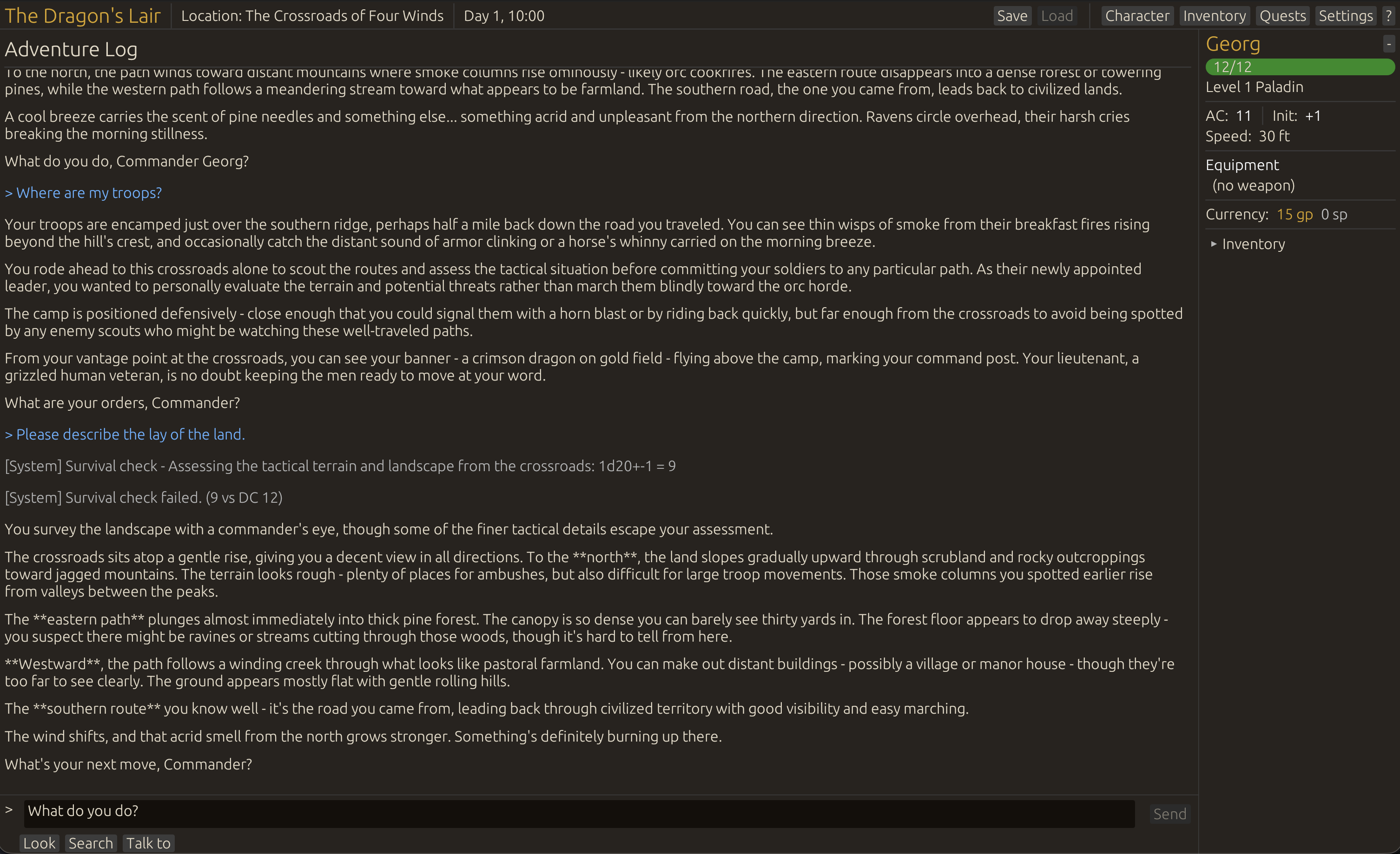
The AI plays by the rules. Skill checks, saving throws, combat, conditions, death saves — mechanically resolved, not handwaved. The AI expresses intent; a rules engine validates the effects.
Your choices persist. Spare the bandit? He might return. Offend the merchant? She remembers. A persistent story memory with importance decay ensures consequences resurface naturally — even across sessions.
It acts, not asks. No "which enemy do you attack?" The DM reads the situation and moves the story forward. Consequence triggers and state inference run in the background, keeping the world consistent without breaking flow.
See It In Action
| The Goblin Ambush | A dwarf fighter springs a trap. Death saves ensue. |
| The Wizard's Bargain | An elf wizard seeks forbidden knowledge in ancient archives. |
Agentic Innovations
This isn't just a game — it's an experiment in storytelling agent design. The AI DM demonstrates several techniques for building agents that maintain long-term coherence while staying creative.
Multi-Model Architecture
Each configuration supplies a main model and a background model. They may be
different models or the same one:
| Task | Model | Why |
|---|---|---|
| Narrative generation | Provider main model | Creative, expressive, handles complex roleplay |
| Relevance checking | Provider fast model | Runs every turn to check story triggers |
| State inference | Provider fast model | Detects implied changes the main model didn't record |
This keeps costs low while maintaining quality where it matters.
Intent/Effect Separation
The AI doesn't mutate game state directly. It expresses intents ("attack the goblin"), and a rules engine produces validated effects ("8 damage, goblin HP reduced to 3").
AI: "I swing my axe at the goblin!"
    ↓
Intent: Attack { target: "goblin", weapon: "greataxe" }
    ↓
Rules Engine validates, rolls dice, applies modifiers
    ↓
Effect: Damage { target: "goblin", amount: 8, type: "slashing" }
    ↓
World state updates atomically
This prevents the AI from "hallucinating" impossible game states while preserving narrative freedom.
Persistent Story Memory
LLMs forget. After ~20 exchanges, early details fall out of context. The DM maintains a structured story memory that persists across sessions:
remember_fact(
  subject: "Mira",
  category: "secret",
  fact: "She's the one who poisoned the well, but blames the herbalist",
  importance: 0.9,
  related_entities: ["Riverside", "Old Thomas"]
)
Facts decay 2% per turn — recent events and dramatic moments stay relevant; minor details fade. When you mention "Mira" 50 turns later, her secrets resurface automatically.
Consequence Seeds
The DM can plant deferred narrative triggers that bloom when conditions are met:
register_consequence(
  trigger: "player mentions the missing children to a local",
  consequence: "The blacksmith overhears and becomes hostile — his son is among the missing",
  severity: "major"
)
The configured fast model checks every player action against pending consequences using semantic matching — not keywords. This enables:
- Revenge plots — spare the bandit, he returns
- Reputation cascades — help the village, merchants offer discounts
- Ticking clocks — ignore the cultists too long, the ritual completes
Post-Narrative State Inference
The DM writes "She smiles warmly and thanks you for saving her shop." But did it call update_npc(disposition="friendly")? Often not.
After each response, a secondary model analyzes the narrative and infers state changes with confidence scores. High-confidence changes (>0.8) are applied automatically:
Narrative: "Captain Voss storms out, muttering about incompetent adventurers"
Inferred: location="outside", disposition="hostile" (confidence: 0.92)
Applied: ✓
This closes the "narrative-state gap" that plagues most AI game masters.
Proactive World Design
When entering a new location, the DM doesn't improvise from nothing. It designs the environment before describing it:
- NPCs with goals, secrets, and routines
- Relationships between characters (rivals, lovers, debts owed)
- Scheduled events that happen with or without the player
- Consequence seeds for player interactions
The tavern feels alive because it is modeled — the nervous woman by the door has a reason to watch it.
Architecture
chronicler         Bevy + egui desktop app
    |
chronicler-core    Game engine, rules, AI DM, persistence
    |
chronicler-llm     Provider-neutral API + Anthropic/OpenAI-compatible transports
How the AI Dungeon Master Works — detailed technical deep-dive.
Development
cargo build --workspace
cargo test --workspace
Requires Rust plus either a configured cloud provider or a local Ollama model. Runs on macOS, Linux, and Windows.
License
CC BY-NC 4.0 — free for non-commercial use.
D&D mechanics from SRD 5.2 (CC BY 4.0, Wizards of the Coast).
Reviews (0)
Sign in to leave a review.
Leave a reviewNo results found