mcp-server-powerpoint
Health Warn
- License — License: MIT
- Description — Repository has a description
- Active repo — Last push 0 days ago
- Low visibility — Only 5 GitHub stars
Code Pass
- Code scan — Scanned 12 files during light audit, no dangerous patterns found
Permissions Pass
- Permissions — No dangerous permissions requested
No AI report is available for this listing yet.
PowerPoint MCP Server & CLI - 18 tools, ~98 operations for AI-powered PowerPoint automation via COM API
PowerPointMcp — MCP Server & CLI for Microsoft PowerPoint






Automate PowerPoint with AI — a Model Context Protocol server and CLI
for live, real-time PowerPoint automation through conversational AI. Sibling project to
mcp-server-excel, following the same layered
architecture: ComInterop → Core → CLI / MCP Server.
MCP Server for PowerPoint enables AI assistants (GitHub Copilot, Claude, ChatGPT) to build and
edit real .pptx presentations through natural language — slides, shapes, text, tables, charts,
speaker notes, and layouts — no VBA or PowerPoint object-model knowledge required.
🛡️ Live COM automation, not file parsing — Most PowerPoint MCP servers manipulate .pptx
files offline with libraries like python-pptx, or use agent-run scripts with LibreOffice-rendered
thumbnails. This project instead drives a live, real PowerPoint desktop instance viaMicrosoft.Office.Interop.PowerPoint — the official Primary Interop Assembly. That means
true-fidelity rendering, compatibility with an already-open deck, and zero risk of producing a.pptx that PowerPoint itself can't open, because PowerPoint is the one writing it.
🖼️ Export-to-verify — the core differentiator. After any visual edit, export the slide (or the
whole deck) to an image with export(action="export-slide-to-image", ...) /export(action="export-all-slides-to-images", ...) and let a
vision-capable AI assistant see the result — catching overlapping shapes, text overflow, and
layout regressions that text-only automation simply cannot detect.
Technical Requirements:
- ⚠️ Windows Only — COM interop is Windows-specific
- ⚠️ PowerPoint Required — Microsoft PowerPoint 2016 or later must be installed
- ⚠️ Desktop Environment — controls a real PowerPoint process (not for server-side processing)
[!TIP]
Also automating spreadsheets? Check out Excel MCP Server —
the sister project, built the same way.
🎯 What You Can Do
13 MCP tools with 132 operations across 13 domains:
- 🗂️ Presentation (12 ops) — create, open, save, close, list sessions, apply a
.potx/.pptx
template's masters/theme/layouts, read the current theme name, read/write built-in and custom
document properties - 📑 Slide (14 ops) — add, count, delete, duplicate, reorder, per-slide background color, sections
- ▭ Shape (36 ops) — rectangles, text boxes, auto shapes, lines, connectors, fill/line/shadow,
rotation, flip, z-order, grouping, naming, alt text - ✏️ TextFrame (17 ops) — text, font size/name/color, bold, italic, underline, alignment, bullets
- 📊 Table (12 ops) — add, cell text, insert/delete rows & columns, cell fill/border, merge cells
- 🗣️ Notes (2 ops) — set/get speaker notes
- 🖼️ Layout (2 ops) — set/get slide layout
- 🎭 Master (8 ops) — slide master title/body placeholder fonts, background color
- 🎬 Animation (5 ops) — shape entrance/emphasis/exit effects, slide transitions
- 🖼️ Image (5 ops) — insert and adjust pictures (brightness, contrast, recolor)
- 📈 Chart (10 ops) — add chart, multi-series data, titles, axis titles, legend
- 🔀 SmartArt (7 ops) — insert and edit SmartArt diagrams
- 🖼️ Export (2 ops) — export a slide, or all slides, to images for visual verification
Every domain is exposed as a single action-dispatch tool (e.g. shape, table, chart,presentation) with an action parameter selecting the specific operation — keeping the tool
list small for AI assistants while still exposing every operation.
📚 Complete Feature Reference → — detailed
documentation of every tool and operation
💬 Example Prompts
Build a deck from scratch:
- "Create a new presentation with a title slide and three content slides about our Q3 results,
then export it as images so I can see it."
Tables & charts:
- "Add a 4x3 table summarizing this data, then add a bar chart next to it."
Formatting & shapes:
- "Make the title bold and blue, and move the logo to the top-right corner."
Speaker notes:
- "Write speaker notes for each slide summarizing the key talking point."
Templates & themes:
- "Apply our corporate template to this deck without losing any of the slide content."
Visual verification:
- "Export slide 3 as an image and tell me if the chart overlaps the text box."
👥 Who Should Use This?
Perfect for:
- ✅ AI assistants and coding agents that need to build or edit
.pptxdecks - ✅ Anyone automating repetitive slide-deck workflows (reports, status decks, templates)
- ✅ Teams that want export-to-verify visual checks on every automated edit
Not suitable for:
- ❌ Server-side/headless processing (this drives a real desktop PowerPoint process)
- ❌ Linux/macOS users (Windows + PowerPoint installation required)
🚀 Quick Start
| Platform | Installation |
|---|---|
| VS Code | Install Extension (one-click, recommended) |
| Claude Desktop | Download .mcpb from latest release |
| Any MCP Client | Download mcp-powerpoint.exe from latest release and add to PATH |
| Details | 📖 Full Installation Guide → |
⚠️ Important: Close any open instances of the target file before automating it — the server
needs exclusive access to the presentation while it's driving PowerPoint.
🔧 CLI vs MCP Server
This project provides both a CLI and an MCP Server interface. Choose based on your use case:
| Interface | Best For | Why |
|---|---|---|
CLI (pptcli / powerpointcli.exe) |
Coding agents (Copilot, Cursor, Windsurf) + scripting | Single tool, no large schemas — better for cost-sensitive, high-throughput automation. |
MCP Server (mcp-powerpoint) |
Conversational AI (Claude Desktop, VS Code Chat) | Rich tool discovery, persistent session. Better for interactive, exploratory workflows. |
Manual installation:
# Primary: Download standalone executables from latest release (no .NET runtime required)
# https://github.com/sbroenne/mcp-server-powerpoint/releases/latest
# - PowerPointMcp-MCP-Server-{version}-windows.zip → extract mcp-powerpoint.exe
# - PowerPointMcp-CLI-{version}-windows.zip → extract powerpointcli.exe

# Secondary: Install via .NET tool (requires .NET 10 runtime)
dotnet tool install --global Sbroenne.PowerPointMcp.McpServer
dotnet tool install --global Sbroenne.PowerPointMcp.CLI

# After installing either way, auto-configure your coding agents:
npx add-mcp "mcp-powerpoint" --name powerpoint-mcp
# Optional: Install the agent skill for better AI guidance
npx skills add sbroenne/mcp-server-powerpoint --skill powerpoint-mcp
💡 The VS Code extension installs this skill automatically. Manual
npx skills addis for other
MCP clients (Claude Code, Cursor, Windsurf, etc.).
⚙️ How It Works - COM Automation & Unified Service Architecture
PowerPointMcp uses Windows COM automation to control the actual PowerPoint application (not
just .pptx files).
The MCP Server and CLI are two equal, first-class entry points. Each hosts its own
PowerPointMcp Service that manages presentation sessions — the MCP Server runs it
in-process (direct calls, no pipe), while the CLI uses a background daemon over a named
pipe so sessions persist across CLI invocations:
┌──────────────────────┐        ┌──────────────────────┐
│  MCP Server          │        │  CLI (pptcli)        │
│  (AI assistants)     │        │  (coding agents)     │
└──────────┬───────────┘        └──────────┬───────────┘
           │ in-process                     │ named pipe →
           │ (direct calls)                 │ background daemon
           ▼                                ▼
┌──────────────────────┐        ┌──────────────────────┐
│  PowerPointMcp       │        │  PowerPointMcp       │
│  Service             │        │  Service             │
│  (session mgmt)      │        │  (daemon; sessions   │
│                      │        │   persist across     │
│                      │        │   CLI invocations)   │
└──────────┬───────────┘        └──────────┬───────────┘
           ▼                                ▼
      Core Commands                    Core Commands
           ▼                                ▼
┌──────────────────────┐        ┌──────────────────────┐
│  PowerPoint COM API  │        │  PowerPoint COM API  │
│  (PowerPoint.        │        │  (PowerPoint.        │
│   Application)       │        │   Application)       │
└──────────────────────┘        └──────────────────────┘
Both entry points share the same Core Commands codebase, so every operation behaves identically.
They are separate processes, though: each runs its own PowerPointMcp Service and its own
PowerPoint instance, and they do not share live sessions with each other.
Key Benefits:
- ✅ Two equal entry points — every operation works identically through the MCP Server and
the CLI - ✅ Persistent CLI sessions — the CLI daemon keeps presentations open across multiple
pptclicalls, so scripts don't re-open files each time - ✅ In-process MCP calls — the MCP Server runs the service in-process (no pipe) for
low-latency automation - ✅ Real PowerPoint automation — drives the actual
PowerPoint.Applicationvia COM, not just
file parsing - ✅ Export-to-verify — close the loop on every visual change with a real rendered image
⭐ GitHub Star History
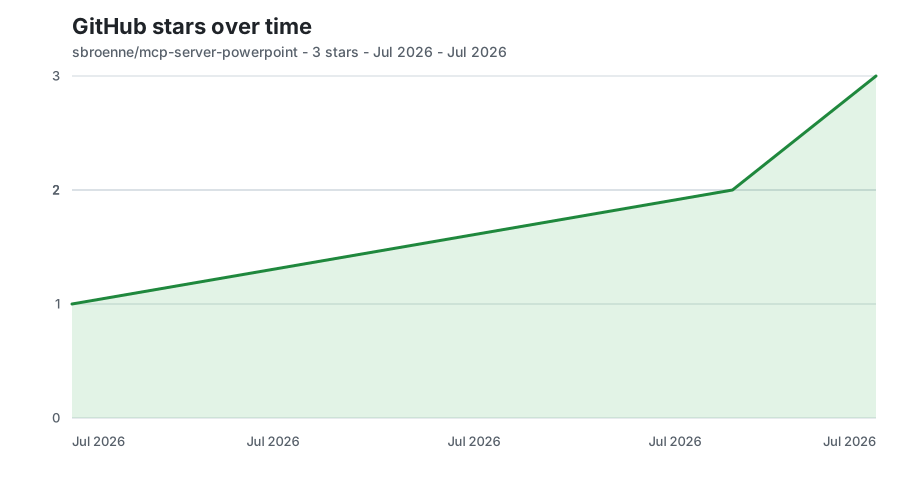
Updated daily from GitHub's stargazer data.
📋 Additional Information
📚 MCP Server Guide → | CLI Guide → | Agent Skills →
📖 Complete Feature Reference •
Installation Guide •
Changelog •
Contributing •
Security •
Privacy
License: MIT License — see LICENSE
Built With: This entire project was developed using GitHub Copilot AI assistance.
Acknowledgments:
- Microsoft PowerPoint Team — for comprehensive COM automation APIs
- Model Context Protocol community — for the AI integration standard
- mcp-server-excel — the sibling project this
architecture and tooling is ported from
Related Projects
Other projects by the author:
- Excel MCP Server — AI-powered Excel automation via Power Query,
DAX, VBA, and PivotTables - Windows MCP Server — AI-powered Windows automation via MCP
- OBS Studio MCP Server — AI-powered OBS Studio
automation - pytest-skill-engineering — LLM-powered
testing framework for AI agents
Reviews (0)
Sign in to leave a review.
Leave a reviewNo results found