exodus-ia-firewall
Health Warn
- License — License: Apache-2.0
- Description — Repository has a description
- Active repo — Last push 0 days ago
- Low visibility — Only 5 GitHub stars
Code Pass
- Code scan — Scanned 12 files during light audit, no dangerous patterns found
Permissions Pass
- Permissions — No dangerous permissions requested
No AI report is available for this listing yet.
🛡️ Local privacy firewall for AI coding agents — masks API keys & personal data before they reach the cloud, then restores them transparently.
🛡️ Exodus — the privacy firewall for AI coding agents
Claude Code and Codex ship your prompts to the cloud — and sometimes your API keys,
credit cards and personal data go along for the ride. Exodus masks them before they
leave your machine and restores them in the reply, so your tools never notice.





🌐 English (primary) · Español
🧪 Public beta. The local proxy (Part 1) works today — that's exactly what the demo
below shows, and what the test suite covers. Running it sealed inside an Intel SGX enclave
with verifiable attestation (Part 2) is built and runs in simulation; real-silicon
validation is in progress — seedocs/RUN-ON-SGX.md. Bug reports and
feedback are very welcome — open an issue.

Real session, no edits: the reply comes back intact — but the cloud only ever saw
⟪EXODUS:anthropic_key:1⟫. Reproduce it yourself from docs/demo/.
⚠️ Honest scope (read this first)
Exodus is harm reduction, not invisibility. It does not sell an impossible promise.
- The model runs on the provider's servers, so your prompt must reach them for the
AI to answer. Exodus does not make your message invisible — it removes the sensitive
parts before they travel. - It masks what it can recognize: secrets with a known signature (
sk-ant-…,AKIA…,
JWTs…) and structured PII that validates (credit cards via Luhn, IBAN via mod-97,
DNI/NIE, SSN). A random string with no signature is not detectable as a secret. - It does not hide your identity/metadata — the provider still knows it's your account.
- The optional local-model layer is lossy: it strips identifiers from free text,
but the general meaning still leaves the machine. - GUI consumer apps (Claude Desktop, ChatGPT app) are out of scope — Exodus protects
the agentic / API loop (CLIs, SDKs), the high-risk surface where an agent autonomously
ships your code and secrets to the cloud.
Full, formal threat model: docs/threat-model.md. Read it before
trusting Exodus with anything.
How it works
flowchart LR
    subgraph machine["🖥️ Your machine"]
        client["Claude Code / Codex<br>*_BASE_URL → localhost"]
        exodus["🛡️ Exodus<br>detect → policy → mask"]
        vault[("in-memory vault<br>real values never leave")]
    end
    subgraph cloud["☁️ Cloud"]
        api["api.anthropic.com<br>api.openai.com"]
    end
    client -- "request (plaintext)" --> exodus
    exodus -- "request (masked ⟪EXODUS:kind:N⟫)" --> api
    api -- "response (masked)" --> exodus
    exodus -- "response (restored)" --> client
    exodus <-.-> vault
Your client honors a base-URL env var (ANTHROPIC_BASE_URL, OPENAI_BASE_URL). Point it at
Exodus. Exodus scans each request, replaces detected secrets/PII with reversible placeholders
(⟪EXODUS:kind:N⟫), forwards the cleaned request, and restores the originals in the response.
Diagrams: docs/ARQUITECTURA.md.
Install
Requires Python ≥ 3.11.
git clone <repo-url> exodus && cd exodus
python -m venv .venv && source .venv/bin/activate
pip install -e .                 # core firewall — zero model, zero Ollama
pip install -e ".[local]"        # optional: embedded local model (free-text layer)
How to use
1 · Start Exodus
exodus serve # listens on http://127.0.0.1:8787
2a · Claude Code (Anthropic)
In the terminal where you launch Claude Code — export first, then launch:
export ANTHROPIC_BASE_URL=http://127.0.0.1:8787
claude
The WITH EXODUS status indicator means you're protected.
2b · Codex (OpenAI)
Mode matters: Codex has two authentication modes.
- OAuth login (
codex login) — Codex connects directly to OpenAI with its own tokens;OPENAI_BASE_URLis ignored. Exodus cannot intercept this mode (same design limitation as GUI desktop apps).- API key mode — Codex respects
OPENAI_BASE_URLand routes through Exodus. Requires a key from platform.openai.com/api-keys.
To use Exodus with Codex in API key mode:
# Terminal 1 — start Exodus pointing at OpenAI
EXODUS_UPSTREAM=https://api.openai.com EXODUS_PORT=8788 exodus serve

# Terminal 2 — launch Codex with your platform.openai.com key
export OPENAI_API_KEY=sk-...your-key...
export OPENAI_BASE_URL=http://127.0.0.1:8788/v1
codex
3 · See what actually left your machine
exodus audit # kinds + actions that were masked — never the values
Opt-in debug (full plaintext of your own traffic; off by default, git-ignored):
EXODUS_INSPECT=on exodus serve
What it detects
Secrets — always masked:
Anthropic · OpenAI (+ sk-proj-) · AWS · Google (API + OAuth) · GitHub (token / PAT / OAuth)
· Slack (token + webhook) · Stripe · SendGrid · npm · JWT · PEM private keys · generic Bearer
· DB connection URIs with credentials.
Structured PII — validated, masked by default:
credit cards (Luhn) · IBAN (mod-97) · Spanish DNI / NIE · US SSN.
Lower-sensitivity PII — detected, opt-in:
email · IPv4 · international phone.
Free text (names, addresses, sensitive prose — any language) → the optional local model
below. Regex can't scale to every country and language; the model is the multilingual answer.
You own the policy: edit src/exodus/policy/policy.example.yaml
to set each kind's action (forward / pseudonymize / block). Fail-closed by default —
an unknown kind is treated as a secret.
Proof it works
A built-in self-test runs a fake sample of every detector kind through the real
pipeline and verifies three things: the kind is detected, its value never appears in the
outgoing request, and the local vault restores the original bytes exactly.
exodus selftest

Every value is synthetic (documented test tokens, reserved-for-docs identifiers). The same
matrix runs in the test suite, so adding a detector without coverage fails the tests.
Optional local model
For sensitive content with no signature, Exodus runs a small model embedded in-process
(llama.cpp + a GGUF — no Ollama daemon) to classify and abstract it. Off by default; the
core firewall works without it.
pip install -e ".[local]"
EXODUS_LOCAL_MODEL=on exodus serve   # downloads a small multilingual model once, then offline
Backend is pluggable: EXODUS_LOCAL_BACKEND=embedded (default) or ollama.
Example — the model strips identifiers, keeps the gist:
in:  Patient John Smith, 47, record #55231, 12 Oak St, Madrid, has asthma.
out: Patient has asthma.
Configuration
Copy .env.example → .env. Key variables:
| Variable | Purpose |
|---|---|
EXODUS_UPSTREAM |
provider API to forward to (Anthropic default; https://api.openai.com for Codex) |
EXODUS_HOST / EXODUS_PORT |
where Exodus listens (default 127.0.0.1:8787) |
EXODUS_POLICY_FILE |
your policy YAML |
EXODUS_LOCAL_MODEL / EXODUS_LOCAL_BACKEND |
enable + choose the local-model backend |
EXODUS_INSPECT |
debug log of your own traffic (full plaintext; off by default) |
Tests
pip install -e ".[dev]" && pytest # 73 passing
Run it inside a TEE (Gramine / Intel SGX)
The vault can be protected even from the machine's root user by running Exodus inside
an SGX enclave via Gramine — no code changes, one manifest:
gramine-manifest -Darch_libdir=/lib/x86_64-linux-gnu exodus.manifest.template exodus.manifest
gramine-direct exodus              # simulation, any x86_64 Linux
exodus verify --allow-simulated    # attestation handshake (nonce → report → verdict)
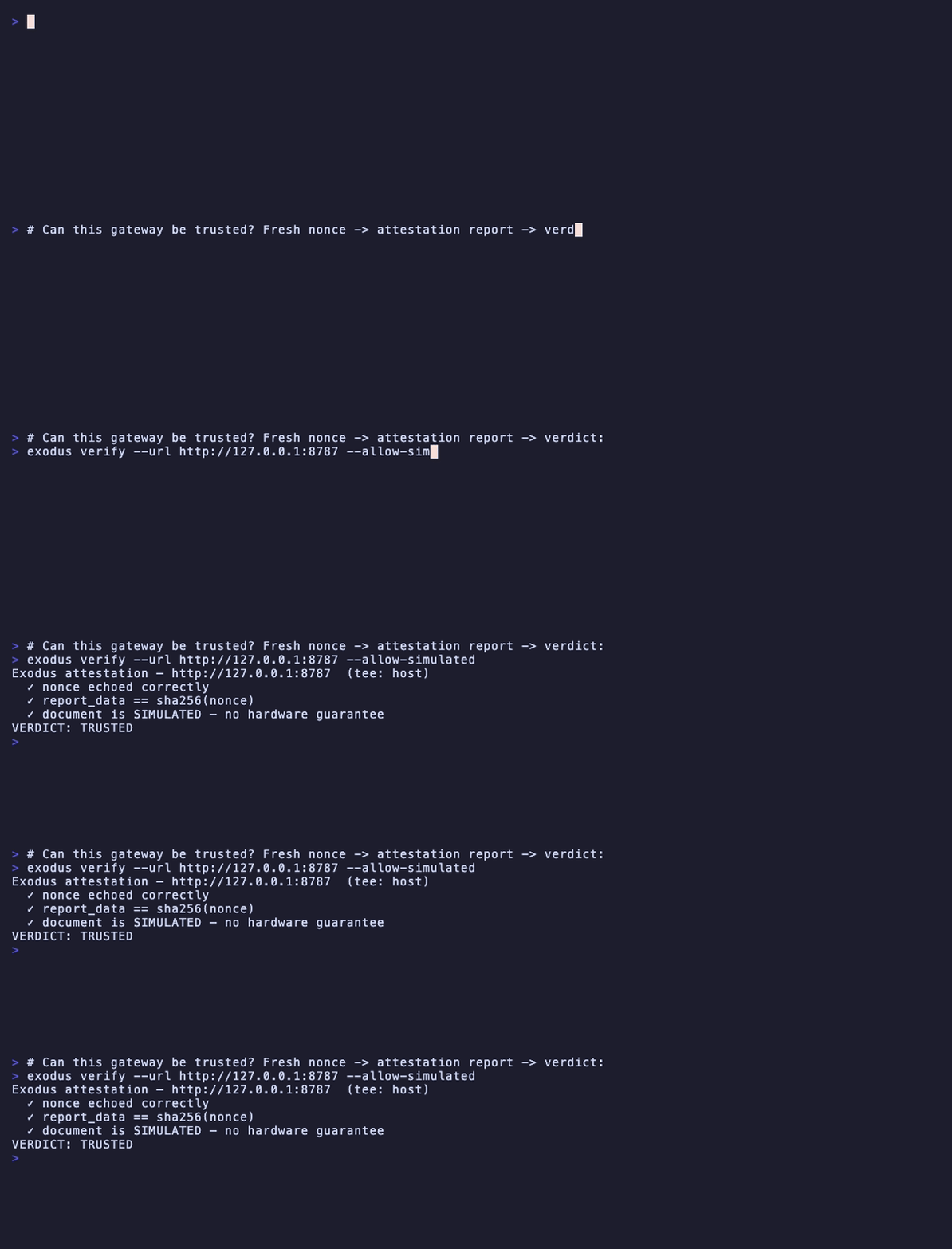
On SGX hardware the same manifest runs with gramine-sgx and /_exodus/attest returns a
hardware quote; exodus verify --mrenclave <hex> pins the exact build. Details, honest
scope and limits: docs/TEE.md.
MCP server (agent integration)
Exodus speaks the Model Context Protocol: any MCP
client (Claude Code, Claude Desktop, custom agents) can use the firewall as a set of tools.
claude mcp add exodus -- exodus mcp # register with Claude Code
| Tool | What it does |
|---|---|
exodus_mask |
mask secrets/PII in a text before it travels anywhere |
exodus_verify |
attestation handshake against a running proxy — can this gateway be trusted? |
exodus_audit |
what has been masked so far (kinds and counts, never the values) |
The interesting one is exodus_verify: it gives agents a primitive to check the
privacy gateway before routing secrets through it — nonce freshness, attestation
binding, TLS channel binding and MRENCLAVE pinning, straight from the agent loop
(see docs/TEE.md).
Where Exodus fits (honest positioning)
Sensitivity-aware cloud/edge routing is an active research area (PRISM, PrivacyPAD,
Privacy Guard — see paper/references.bib), mostly on generic
prompts. Exodus's contribution is an engineering artifact: an open-source implementation
that brings these ideas to the agentic coding loop (tool-use, file edits, SSE streaming),
with a reversible vault, an honest threat model, and a self-contained local model. Seepaper/.
Project layout & roadmap
Structure: docs/ESTRUCTURA.md · Roadmap: docs/ROADMAP.md
· Contributing: CONTRIBUTING.md
License
Apache-2.0 © 2026 Francesco Catania (@sekaibuilder). See LICENSE.
Apache-2.0 is permissive (free for any use, including commercial) and adds an explicit patent
grant — a good fit for security and attestation code.
Disclaimer
Exodus is a harm-reduction tool, not a guarantee of anonymity. It reduces the sensitive
data that reaches third-party servers; it does not make you invisible. Do not feed it secrets
you cannot afford to leak on the assumption that it is infallible.
Reviews (0)
Sign in to leave a review.
Leave a reviewNo results found