kival
Health Warn
- License — License: Apache-2.0
- Description — Repository has a description
- Active repo — Last push 0 days ago
- Low visibility — Only 6 GitHub stars
Code Pass
- Code scan — Scanned 12 files during light audit, no dangerous patterns found
Permissions Pass
- Permissions — No dangerous permissions requested
No AI report is available for this listing yet.
Self-hosted collaborative knowledge system for organizations.

Self-hosted collaborative knowledge system for organizations



Overview · Setup · Resources · SDKs · Community · Contributing
Overview
Kival is Selemis's self-hosted collaborative knowledge system for organizations.
Organizations constantly produce messages, documents, decisions, and records, yet the understanding that connects them is easily lost. Sources become detached from conclusions, decisions outlive their reasoning, and knowledge fragments across tools or leaves with the people who carried it.
Kival gives people and agents a shared place to deliberately create, edit, discuss, connect, version, and govern knowledge. History, relationships, discussions, authorship, and provenance remain connected as that knowledge develops, preserving the context needed to understand how something came to be and build on it over time.
- Shared knowledge: people and agents work against the same organizational knowledge rather than maintaining separate copies of context.
- Continuity: history, relationships, discussions, and provenance remain connected as knowledge develops, preserving how it came to be rather than only its latest state.
- Deliberate authorship: knowledge is explicitly created and maintained as organizational work, with clear authorship, access, and governance.
- Durable context: knowledge remains understandable even as the people, agents, models, applications, and tools around it change.
- Self-hosted ownership: the organization retains control over the knowledge and infrastructure on which its work depends.
Setup
Installation
Install kivalup from the latest stable release:
curl --proto '=https' --tlsv1.2 -fsSL \
  https://github.com/selemis-com/kival/releases/latest/download/install | bash
Then run:
kivalup
If your shell has not picked up the updated PATH yet, use $HOME/.kival/bin/kivalup or start a new shell.
To build and run Kival from source, see the development setup.
Supported platforms
Prebuilt releases are available for Linux x86_64 and ARM64, macOS on Apple Silicon, and Windows through WSL.
Native Windows and Intel Mac releases are not currently provided.
Quick start
Start PostgreSQL in the background with persistent local storage:
docker run -d \
  --name kival-postgres \
  -e POSTGRES_USER=kival \
  -e POSTGRES_PASSWORD=kival \
  -e POSTGRES_DB=kival \
  -p 5432:5432 \
  -v kival-postgres-data:/var/lib/postgresql \
  postgres:18
Point Kival at the database and start the server:
export DATABASE_URL=postgres://kival:kival@localhost:5432/kival
kivald serve
In another terminal, bootstrap the first global administrator:
export DATABASE_URL=postgres://kival:kival@localhost:5432/kival
kivald admin bootstrap \
  --username admin \
  --display-name "Admin"
The command prints a one-time enrollment link. Open it in your browser to register a passkey and complete the initial administrator setup.
Kival is now available at http://localhost:3000.
Create a workspace
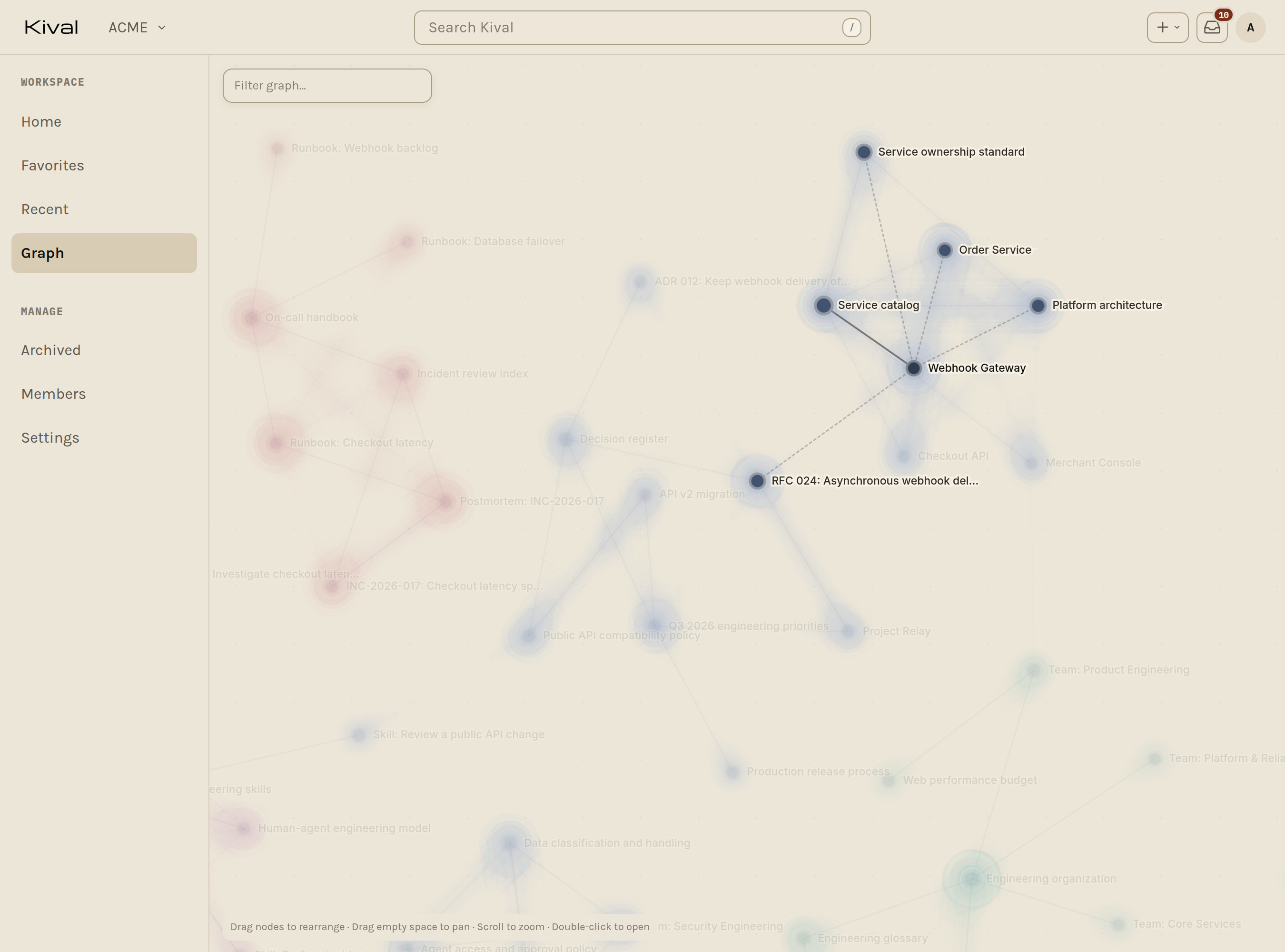
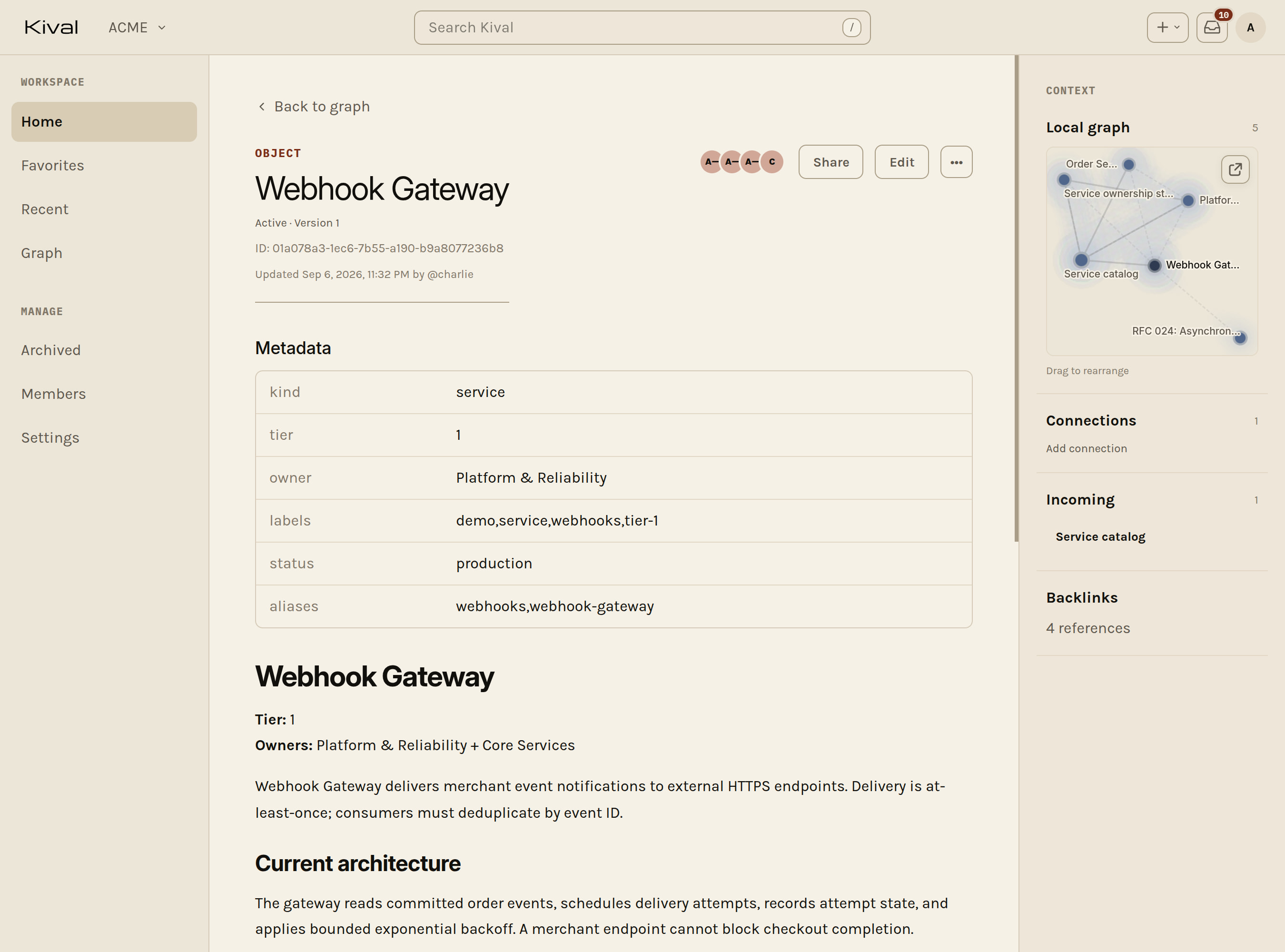
Create a workspace from the web application, or explore Kival using the built-in fictional ACME workspace:
kivald admin workspaces create --name "ACME" --demo acme
The demo includes connected documents, discussions, access boundaries, history, and shared agent skills for exploring Kival before adding your own knowledge.
[!IMPORTANT]
The ACME workspace is intended for exploration and evaluation only. Do not use it as the basis for a production workspace or build real organizational knowledge on top of it.
Configure CLI access
From the web application, create an API key for the administrator and allow it access to the workspace.
Then configure the local CLI:
export KIVAL_API_KEY=<API_KEY>
Verify the CLI is authenticated and can access the workspace:
kival whoami
kival workspaces list
Explore with an agent
Agents can use the same CLI and access model to inspect existing knowledge, follow relationships, and contribute new material.
Trace a decision and its supporting context
Use the Kival CLI to explore the ACME workspace. Find an important decision, explain what was decided and why, trace the supporting knowledge that led to it, and include links to the relevant Kival objects.
Synthesize project state into new knowledge
Use the Kival CLI to inspect Project Relay and RFC 024. Create a new object titled "Project Relay rollout review" summarizing the current rollout state, remaining risks, and next decision point, then link it to the relevant existing Kival objects. Show me what you created and include links to the objects you used.
Turn operational history into follow-up knowledge
Use the Kival CLI to find a recent ACME incident and its related runbook. Create a short follow-up object with the key operational lesson and recommended next action, link it to both the incident and runbook, and include links to the resulting Kival objects.
Resources
The Kival resources cover how Kival works, how to use it, how to connect it to other systems, and how to run it in production.
Understand Kival
Use Kival
- Creating and organizing knowledge
- Search and navigation
- Discussions and collaboration
- Working with others
- Practical workflows
- Using Kival with agents
Connect Kival
Deployment & administration
SDKs
Kival provides official SDKs for Rust and TypeScript:
Both use scoped API keys and expose the same underlying system as the CLI.
They are intended for applications, integrations, automation, and agents that need programmatic access to Kival.
Sponsors
Kival is developed and maintained by Selemis.
Sponsorship supports the continued development and long-term maintenance of Kival. Organizations interested in sponsoring the project can contact [email protected].
Community
Join the conversation in GitHub Discussions to ask questions, share ideas, and discuss how Kival is being used.
Contributing
See the Contributing Guide for information on reporting bugs, proposing features, and contributing to Kival.
At this time, we do not accept pull requests or other code contributions from external contributors.
Security Policy
If you believe you have found a security vulnerability, please do not report it through GitHub Issues.
See the Security Policy for reporting instructions.
License
Licensed under either of Apache License, Version 2.0 or MIT license at your option.
This software includes third-party components subject to separate license terms. See THIRD_PARTY_NOTICES.md.
Unless you explicitly state otherwise, any contribution intentionally submitted for inclusion in this project by you, as defined in the Apache-2.0 license, shall be dual licensed as above, without any additional terms or conditions.
Reviews (0)
Sign in to leave a review.
Leave a reviewNo results found