semlith
Health Warn
- License — License: Apache-2.0
- Description — Repository has a description
- Active repo — Last push 0 days ago
- Low visibility — Only 5 GitHub stars
Code Fail
- rm -rf — Recursive force deletion command in .github/changes-test.sh
- rm -rf — Recursive force deletion command in .github/smoke.sh
- rm -rf — Recursive force deletion command in .github/verify-tag-test.sh
Permissions Pass
- Permissions — No dangerous permissions requested
No AI report is available for this listing yet.
A fast local vector store and code graph for AI agents — index your files once, keep it current as you save, and answer questions across all of it in milliseconds without leaving the machine.

Semlith
A local vector store and code graph for AI agents, on your own machine.
Install · Quick start · Agents ·
Portal · Benchmarks · Docs
Install (macOS and Linux; Windows and other routes below):
curl --proto '=https' --tlsv1.2 -fsSL https://raw.githubusercontent.com/semlith/semlith/main/install.sh | sh
Then, in any folder of code or documents:
semlith index .                      # one store; the embedding model downloads once
semlith search "where is retry backoff handled"
semlith doctor                       # every agent client found, registered and reachable
Benchmarks: SWE-bench, CodeRAG-Bench, agents on Opus, and PDF, Office and
EPUB documents, each number with the command that reproduces it, on the
scorecard page.
Index your code and documents once, keep the index current as you save, and
answer an agent's questions in milliseconds — without anything leaving the
machine.






Why Semlith
An agent working in a large codebase either reads too much, which is slow and
expensive, or guesses which file to open, which is often wrong. What it needs is
the few spans that answer the question. Semlith finds them.
- Hybrid search. Every query runs against a vector index (meaning) and a
keyword index (exact names), and the two rankings are fused. How does retry
backoff work andEMBED_BATCHboth land on the right chunk. - A code graph built on the same pass. Definitions become nodes; calls,
imports and re-exports become edges, each labelled with how well it is
supported. Ask what calls a function, what breaks if it changes, or how two
symbols connect. - Always current. A watcher re-embeds a file when you save it. There is no
build step and nothing to go stale against your working tree. - Local by design. No API keys, no network at query time until you connect
a cloud org, a portal bound to127.0.0.1only. Model weights and
acceleration packs are the only downloads, each pinned by digest. - Made for agents. An MCP server with sixteen tools, registered in your
agent clients by one command, and a ledger of every retrieval with the tokens
it saved. - More than code. PDFs, Office documents, notebooks and Markdown are read
as text; images are searchable by what they show.
Install
One command, no Rust toolchain needed.
macOS and Linux
curl --proto '=https' --tlsv1.2 -fsSL https://raw.githubusercontent.com/semlith/semlith/main/install.sh | sh
Windows
irm https://raw.githubusercontent.com/semlith/semlith/main/install.ps1 | iex
The installer picks the release for your machine, verifies the ed25519
signature on the release's SHA256SUMS, checks the archive against it,
unpacks it into ~/.semlith/bin and runs semlith setup. Setup puts semlith
on your PATH, downloads the embedding model, registers semlith with the agent
clients it finds, and installs the daemon as a login service. Run semlith setup again at any time to repair an install;--yes takes every default.
| Variable | Effect |
|---|---|
SEMLITH_VERSION |
Install a specific release tag. |
SEMLITH_HOME |
Install somewhere other than ~/.semlith. |
SEMLITH_NO_SERVICE=1 |
Skip the login service. |
Other routes: cargo install semlith, or an archive from
the releases page.semlith upgrade replaces the binary with the newest release; semlith never
checks for updates on its own.
Requirements. A 64-bit machine running macOS on Apple silicon, Linux on
x86_64 or aarch64, or Windows on x86_64 (Windows PowerShell 5.1 is enough).
The Linux archives ship libonnxruntime.so beside the binary and need only
glibc 2.34 or later and libstdc++ (GLIBCXX_3.4.22): Debian 12, Ubuntu 22.04,
RHEL 9 and Amazon Linux 2023 all qualify. Intel macOS is not supported, because
ONNX Runtime no longer ships for it.
Verifying the installer
The installer writes the binary to ~/.semlith/bin (mode 700 on macOS and
Linux) and, on Linux, libonnxruntime.so beside it. Nothing is written until
the archive passes three checks: SHA256SUMS carries the project's ed25519
signature, checked with ssh-keygen -Y verify (OpenSSH 8.1 or later, which
macOS, current Linux distributions and Windows 10 and later have); the
archive's SHA-256 matches it; and — when gh is on your PATH — its GitHub
artifact attestation, signed by this repository's release workflow. A missing
or wrong signature stops the install, and semlith upgrade holds a release to
the same key, built into the binary; semlith --version names it. curl is held
to https and TLS 1.2+, and the script runs only once it has fully downloaded.
Releases before v0.40.0 are not signed, so these installers do not install
them.
To read the installer before running it:
curl --proto '=https' --tlsv1.2 -fsSLO https://github.com/semlith/semlith/releases/latest/download/install.sh
less install.sh
gh attestation verify install.sh --repo semlith/semlith
sh install.sh
On Windows: irm https://github.com/semlith/semlith/releases/latest/download/install.ps1 -OutFile install.ps1,
read it, then powershell -ExecutionPolicy Bypass -File install.ps1.
To verify an archive by hand:
echo 'semlith-release ssh-ed25519 AAAAC3NzaC1lZDI1NTE5AAAAICMTHiHMzeSHzzc+8UDZHUzJcvb6XGUBb+TJdFes91xm' > allowed_signers
ssh-keygen -Y verify -f allowed_signers -I semlith-release -n file -s SHA256SUMS.sig < SHA256SUMS
grep "  semlith-<tag>-<target>.tar.gz$" SHA256SUMS | shasum -a 256 -c
gh attestation verify semlith-<tag>-<target>.tar.gz --repo semlith/semlith
Quick start
cd ~/src/ripgrep
semlith index .                                   # one store; the model (~52 MB) downloads once
semlith search "where is a file detected as binary"
semlith neighbors search_parallel                 # callers and callees
semlith start                                     # the daemon and the portal
$ semlith search "where is a file detected as binary" -k 1
1. 0.083 vf  GUIDE.md:735-746
   binary files:

   1. The default mode is to attempt to remove binary files from a search
      completely. ...

$ semlith neighbors search_parallel
callers (2)
  main via defines (extracted)  crates/core/main.rs:44  · call at line 166
  run via calls (resolved)  crates/core/main.rs:78  · call at line 90
callees (25)
  matcher via calls (resolved)  crates/core/flags/hiargs.rs:379  · called at crates/core/main.rs:177
  search_worker via calls (resolved)  crates/core/flags/hiargs.rs:705  · called at crates/core/main.rs:176
  ...
Every hit is a path:start-end locator you can hand to an editor or an agent;vf says the vector and keyword lists both found it.
Use it from an agent
semlith setup     # registers semlith in every agent client it finds
semlith doctor    # checks each client can actually reach it, and says how to fix it if not
setup registers the MCP server at user scope in every client with a
registration command — 12 clients are documented, and every stanza is run
against the binary in tests/clients.rs;
docs/clients.md has every stanza and the HTTP transport. It
also installs the semlith Agent Skill, a steering hook that suggests the
semlith call when an agent is about to grep, and a read-only research agent.
semlith mcp serves MCP over stdio; the daemon serves the same tools over HTTP
at /mcp, behind an agent key (semlith key show). Eight tools are listed by
default, because every definition costs tokens on every request;SEMLITH_MCP_TOOLS=all lists all sixteen.
| Tool | Answers |
|---|---|
semlith_search |
Where is the answer? Path, span, enclosing symbol and how it was found. |
semlith_brief |
Everything one question needs in one call — spans, text, one-hop callers and callees — under a token budget. |
semlith_read |
One span or one symbol, nothing around it. |
semlith_symbol |
Where is this defined? history: true gives what it used to be. |
semlith_neighbors |
What calls it, and what it calls. |
semlith_impact |
Everything that reaches it, and the files involved. |
semlith_files |
Which files are indexed. |
semlith_stats |
What each store holds. |
semlith_path, semlith_trace |
How two symbols connect, as a chain or as evidence. |
semlith_pattern |
A tree-sitter structural pattern over one language. |
semlith_index, semlith_add, semlith_forget |
Change a store from inside a conversation. |
semlith_report |
One of five reports from the ledger, index and graph. |
semlith_languages |
The language names lang accepts. |
A bare semlith mcp opens every registered store, so one question can span
repositories. Supported MCP versions: 2026-07-28, 2025-11-25, 2025-06-18
and 2024-11-05, each proven by a session in tests/mcp.rs.
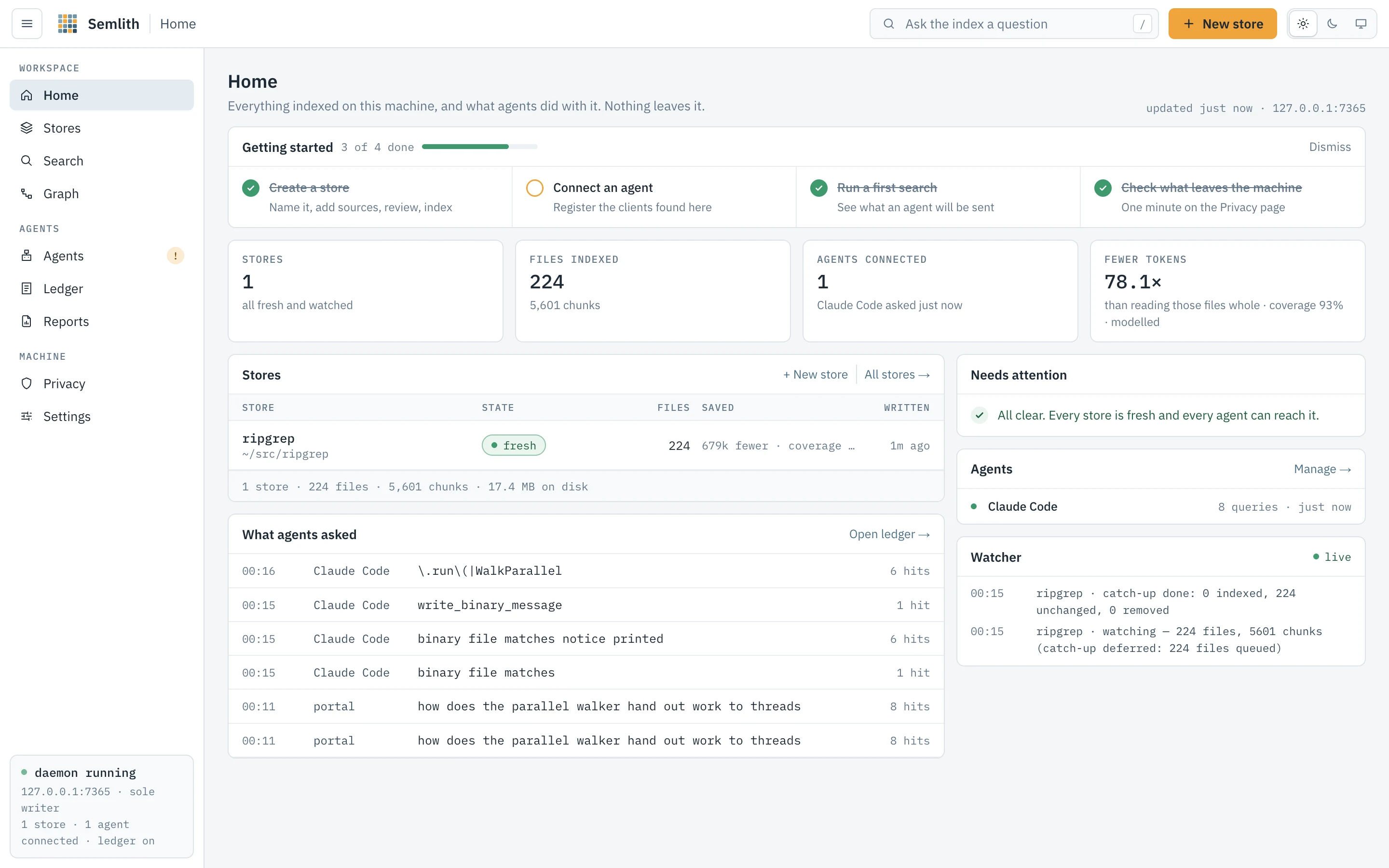
The portal
semlith start runs one daemon that owns every store: it holds each store's
write lock, watches its folders, re-embeds what you save, and serves a portal athttp://127.0.0.1:7365. The URL with its session token is printed once, on
stdout. docs/portal.md documents every page.
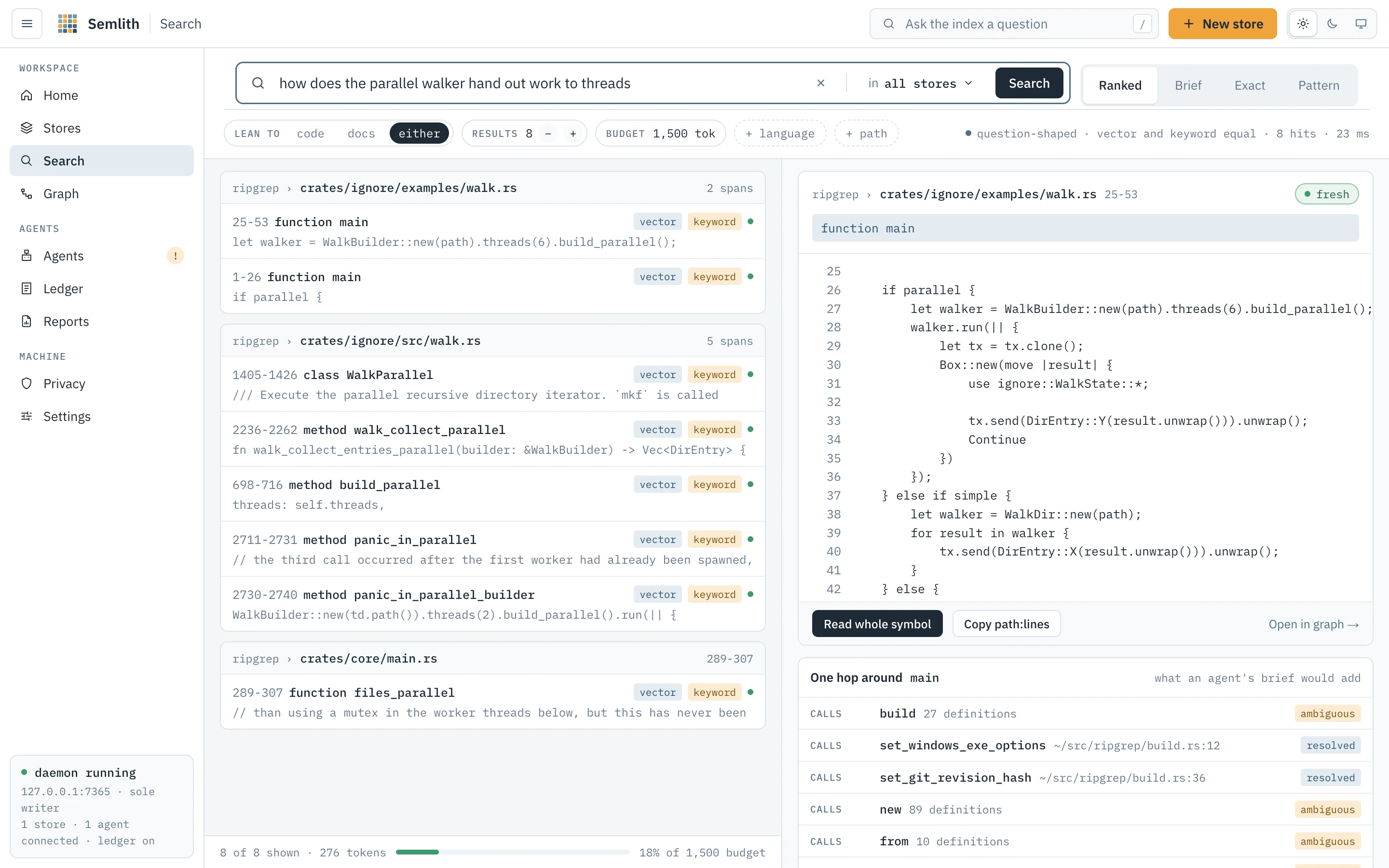 Search — hybrid results, each saying which list found it. |
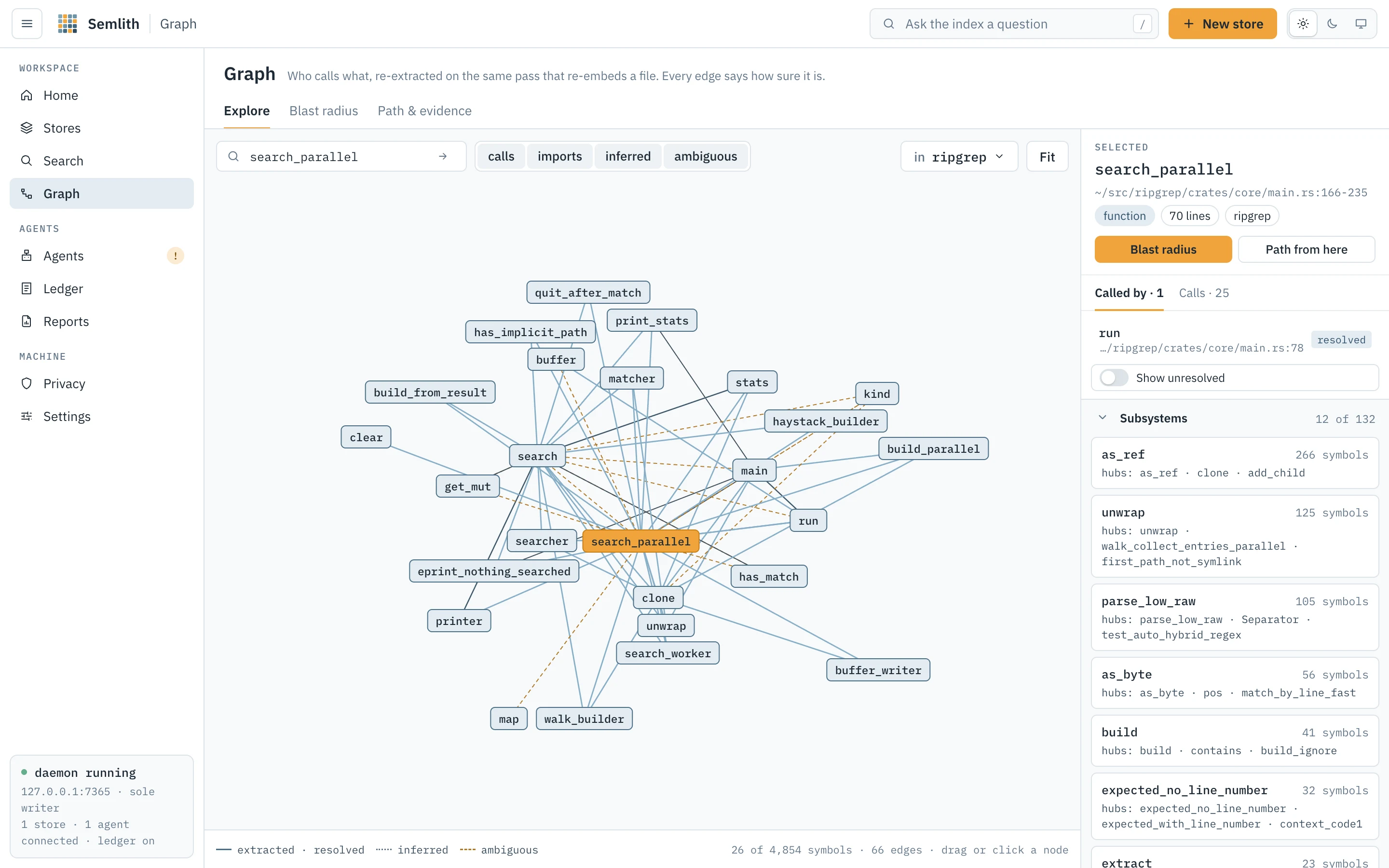 Graph — callers, callees, blast radius and paths. |
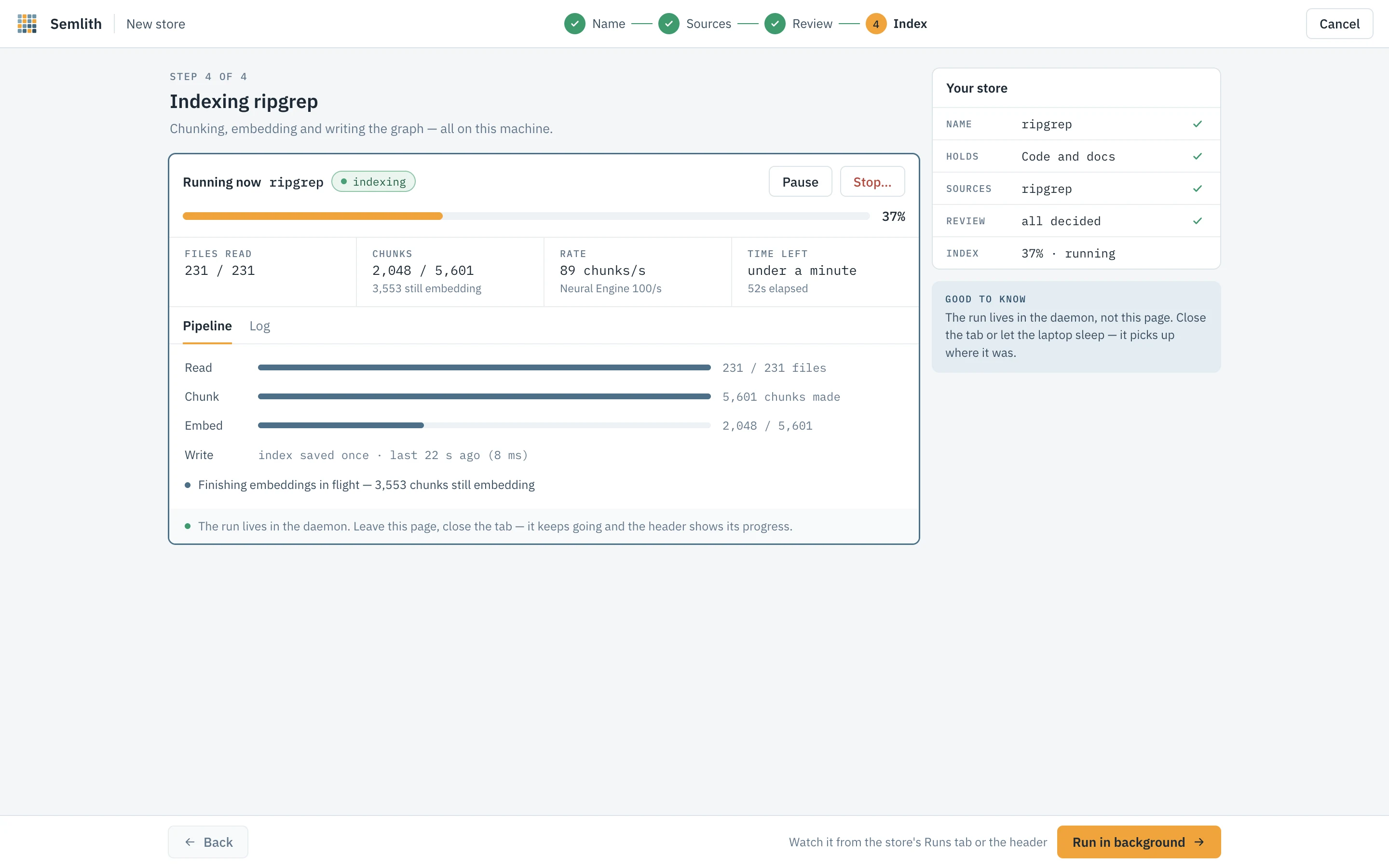 Index runs — live rate per device, pause and stop. |
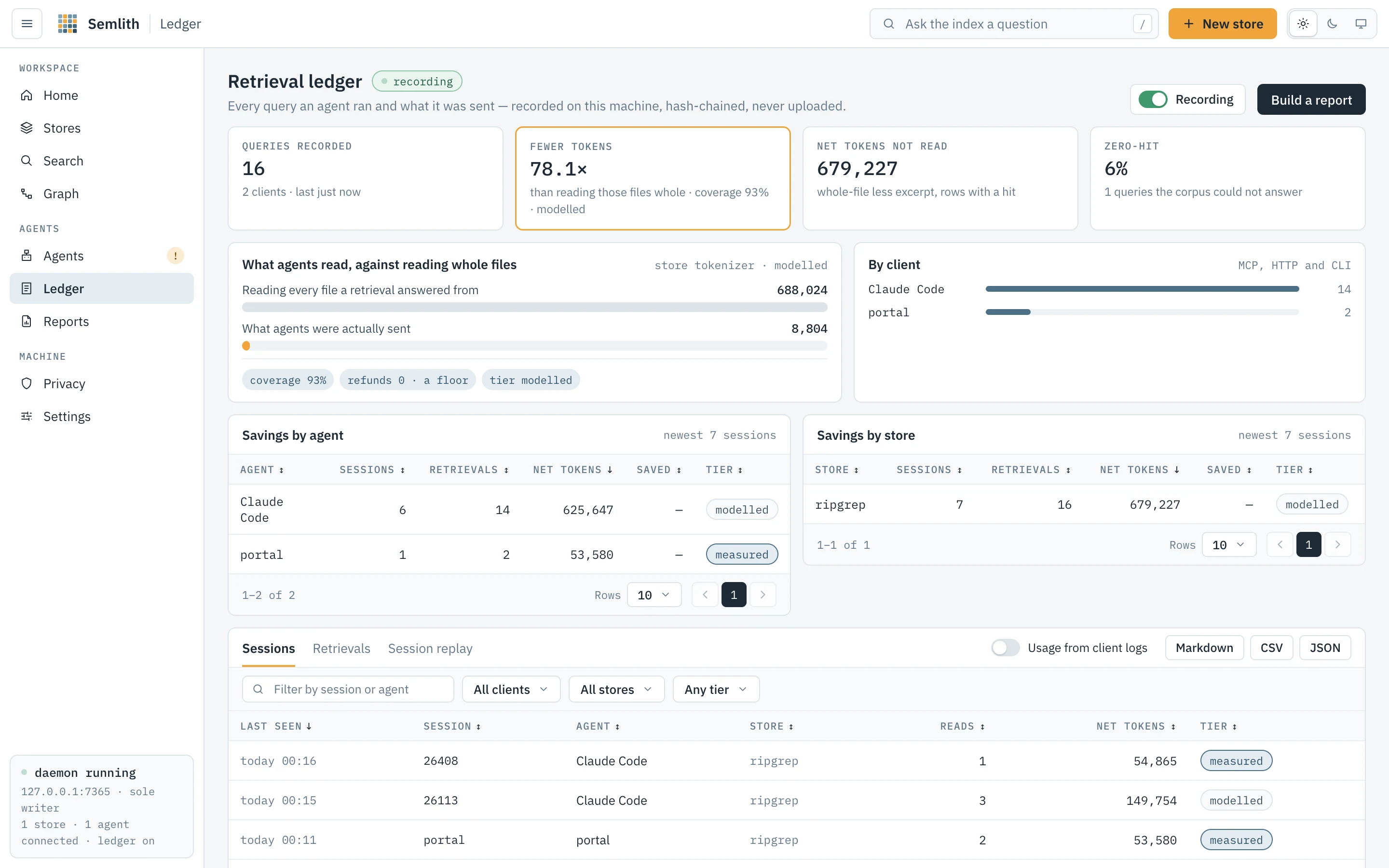 Ledger — every retrieval, and the tokens it saved. |
It is not on the network. The daemon binds 127.0.0.1 only, with no flag
to change it. Every page and /api/ route needs the per-run session token,
sent in a Semlith-Token request header; without it the answer is 401. The
agent key opens /mcp and nothing else. Responses carry aContent-Security-Policy of 'self', no CORS header is sent, and every byte
the portal loads is compiled into the binary. --airgap refuses every download
that is not already cached. The Privacy page checks these claims against the
running daemon; docs/security.md is the full account.
How it works
files ──chunk──> text ──embed──> vectors ──quantize──> index/*.tvim  (turbovec)
                  │
                  └──parse──> symbols, edges ─────────> store.db      (SQLite)

query ──embed──> vector ──search shards──┐
      ──keywords──> FTS5 ────────────────┴──fuse──> ranked spans ──> enclosing symbol
- Reading. Files are read as the text a person would see. Thirteen formats
have their own reader (PDF, Word, PowerPoint, Excel, notebooks and more);
everything else is UTF-8, cut into line-aligned chunks of up to 800
characters. A Markdown chunk is embedded with its heading path, a code chunk
with its enclosing definition. - Embedding.
granite-embedding-small-english-r2(int8, 384 dimensions,
~52 MB) through ONNX Runtime, fixed per store. The daemon also embeds on the
Neural Engine on Apple silicon and on the GPU (Core ML, WebGPU or CUDA), each
lane checked against known answers before its first batch. Images go through
CLIP ViT-B/32 into a second vector space; matching is by what an image shows,
not OCR. - Storing.
index/holds turbovec
shards of 65 536 quantized vectors;store.dbholds chunk text, spans,
symbols, edges, the ledger and the content hashes that make re-indexing
incremental. A save rewrites one shard. - Graph. All 46 languages carry edges. Each edge is
extracted(settled by
the file itself),resolved(one candidate),ambiguous(several, and it
says how many) orinferred(a bare name match).semlith pathrefuses to
cross a name it cannot pin down unless you pass--all-edges.
docs/architecture.md is the full account.
Commands
| Command | Does |
|---|---|
semlith index [PATHS...] |
Index paths into a store; re-running embeds only what changed. --each gives each path its own store, --projects <DIR> one per repository. |
semlith watch [PATHS...] |
Re-embed files as they are saved. |
semlith start |
The daemon: every store kept current, the portal and /mcp on 127.0.0.1:7365. |
semlith search <QUERY> |
Hybrid search. -k, --json, --path/--ext/--lang (repeatable; a leading ! excludes), --prefer code|docs, --exact for regex lines with their definition. |
semlith brief <QUESTION> |
Spans, their text and one-hop callers and callees, under --budget tokens (default 4000). |
semlith read <TARGET> |
One span (src/store.rs:1041-1080) or one symbol. |
semlith symbol, neighbors, impact, path, trace |
The graph: definitions, callers and callees, blast radius, chains, evidence. |
semlith pattern <QUERY> --lang L |
A tree-sitter structural pattern. |
semlith stats, files, languages, models |
What a store holds; files --tree shows what was not indexed and why. |
semlith refused, scan |
Files not indexed and why; files held that today's rules would refuse. |
semlith add <URL> |
Fetch one https URL into a store. No crawling, no credentials, no private addresses. |
semlith forget, compact, drop |
Remove a file, reclaim dead bytes without re-embedding, delete a store. |
semlith adopt, trust |
Move a store into the store home; allow one outside it. |
semlith ledger, report, schedule, prices |
Retrieval history, five reports in five formats, scheduled reports, the price table. |
semlith mcp, hook, key |
MCP over stdio, the steering hook, the HTTP agent key. |
semlith setup, doctor, upgrade |
Install and repair, diagnose each client, replace the binary. |
semlith accel |
Which devices embed: CPU (always on, SEMLITH_CPU_CAP caps it), Neural Engine, GPU, and the experimental CUDA, TensorRT, OpenVINO and llama.cpp lanes. |
semlith cloud |
Semlith Cloud. Nothing here touches the network until semlith cloud login. |
semlith <command> --help documents every flag.
Where stores live. ~/.semlith/stores/<name>, listed in~/.semlith/registry.json, so semlith mcp and semlith start find every store
with no flags. A command picks its store from --store / SEMLITH_STORE, then a.semlith beside the corpus, then the registered store covering the current
directory, and otherwise creates one.
What gets indexed. Everything under the given paths except .gitignored
and hidden files, binaries, files over 8 MiB, archives that expand past 32 MiB,
and generated or vendored directories (node_modules always; target, build,dist, vendor beside their manifest — SEMLITH_DEFAULT_IGNORES=0 keeps
them). Credentials are never indexed; the grey zone is yours to decide.
The retrieval ledger
Every retrieval — from an agent over MCP, the CLI or the portal — is recorded
in its store: the query, the client, the session, the hits and what was read.
Each row carries the hash of the row before it, so semlith ledger --verify
finds an edited or deleted row. It is local, on by default, and off with--no-ledger or SEMLITH_LEDGER=0.
What it saved on this repository. Ask semlith brief all 107 questions of
this repository's retrieval harness against a store of src/, then runsemlith ledger --verify: 3 982 tokens per answered question were sent to
the agent, against 105 132 for reading the 4.1 files those answers named,
whole — 26× less, at 100 % coverage, counted with the store's own tokenizer.
It is an upper bound: a file named by two answers is counted twice.
Benchmarks
Public code-retrieval benchmarks, run by bench/scorecard/
on one M1 MacBook Air in October 2026 and published as measured, including where
another tool wins. Every table, every chart and the command that reproduces each
number are on the scorecard page.
| Benchmark | semlith | baseline | instances |
|---|---|---|---|
| SWE-bench Verified, right file in the top 10 | 76.8 % | 47.0 % grep then read | 500 |
| SWE-bench Lite, right file in the top 10 | 72.3 % | 47.3 % grep then read | 300 |
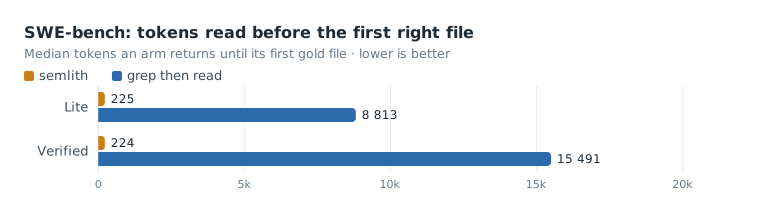
| SWE-bench Verified, median tokens to the first right file | 224 | 15 491 grep then read | 500 |
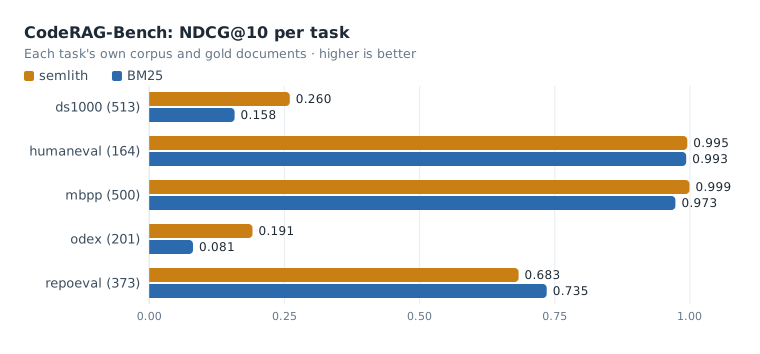
| CodeRAG-Bench DS-1000, NDCG@10 | 0.260 | 0.158 BM25 | 513 |
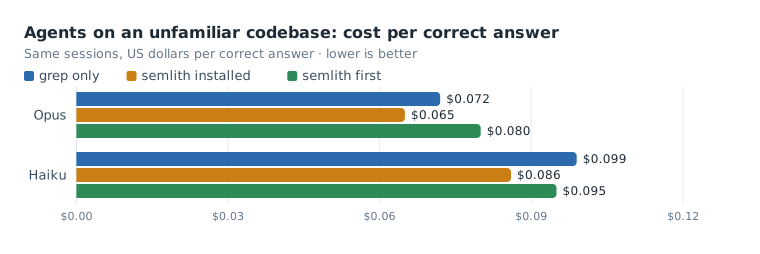
| Agents (Opus), cost per correct answer | $0.065 | $0.072 grep only | 50 × 3 runs |
| Documents (PDF, Office, EPUB, …), passage found within 4k tokens | 116/127 | 34/127 rga | 127 |
| Agents (Opus) on those documents, passage found | 124/127 | 80/127 grep only | 127 |
| Real sessions, tokens sent against whole files read | 75.2× fewer | 1,575 retrievals |
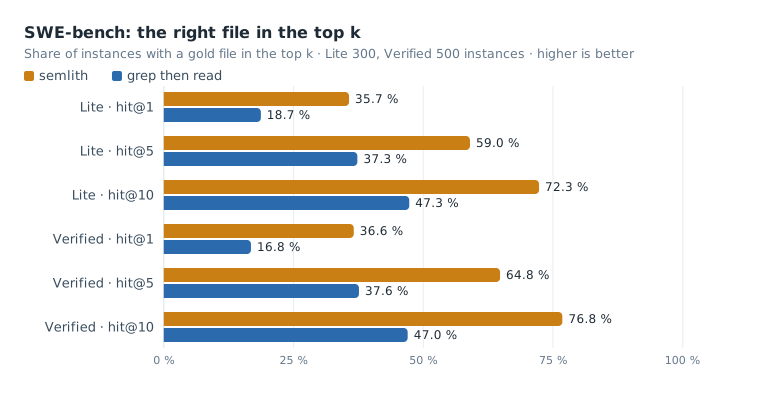
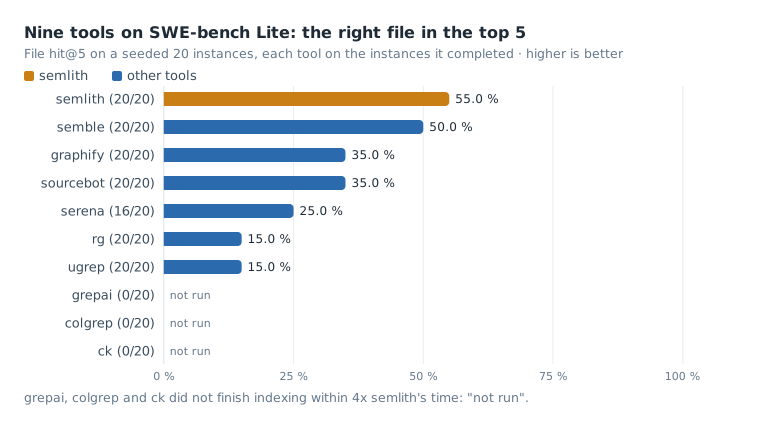
Where semlith does not win: Semble edges it at hit@1 and hit@10 on the 20-instance
competitor sample, BM25 beats it on CodeRAG-Bench's RepoEval, and with Grep built
in Opus rarely reaches for semlith on its own. The
scorecard page has these rows and RepoBench-R.
The numbers
Coverage, read out of the code; tests/readme.rs fails the build if any of
these drifts from its source:
| languages searchable and graphed | 46 |
| edge kinds | 6 |
| document formats with a reader | 13 |
| image types | 5 |
| MCP tools | 16 |
| CLI commands | 36 |
agent clients, each setup stanza run against the binary in tests/clients.rs |
12 |
| prebuilt targets | 4 |
Measured on a 4P+4E Apple silicon laptop, with the command that reproduces
each; docs/performance.md has the full tables:
| warm search at 700 / 7 000 / 70 000 chunks, peak RSS under 240 MB | 16.2 / 37.9 / 159.1 ms | cargo test --release --test measure -- --ignored --nocapture |
| edit on disk to searchable | under 5 s | the same |
| indexing on an M1 Air: Neural Engine / CPU and GPU through Core ML | 229.8 / 62.7 chunks/s p10 | docs/performance.md |
| daemon memory 60 s after a run, seven stores open | 465 MB | footprint -p <pid> |
| idle watcher CPU over 60 s | under 1.0 s | the same |
| one changed file | 1 shard rewritten | cargo test --release --test shards -- --ignored --nocapture |
tools/list |
2 633 bytes, eight tools; 1 323 tokens added to an Opus request | cargo test --release --test retrieval -- --ignored |
| retrieval, 30 sealed questions of 107 | hit@1 24/30, hit@3 27/30, hit@8 29/30, zero spread; identifiers 11 of 11 in the top three | the same |
| one search, rescoring off / on | 8.2 ms / 132.2 ms on a 300-file store | the same |
one answered question, brief against search-then-read |
1.00 calls vs 2.54, 1 112 tokens vs 725 | the same |
| call-edge resolution | 62 % settled | the same |
| the macOS arm64 binary | 125 435 312 bytes (119.6 MiB) | ls -l target/release/semlith |
| the Linux glibc floor | GLIBC_2.34 | objdump -T semlith runtime/libonnxruntime.so |
Peak memory does not grow with the corpus — plan for about 600 MB whatever you
index. Query latency does: the vector scan is linear.
Known limits
- One writer per store. While the daemon or
semlith watchholds a store, a
secondsemlith indexagainst it exits and names the holder. - First indexing is bound by the model: about 230 chunks/s on an M1's Neural
Engine, 63 on its CPU and GPU, 30 on the CPU alone. Later runs embed only what
changed. On macOS the CPU lane alone runs at about 60 % of a terminal's speed
inside the login service, because of how launchd schedules agent threads. - On a Mac the GPU does not embed beside the Neural Engine unless you run
semlith accel on gpu-beside-ane. CUDA runs on Linux x86_64 only; an NVIDIA
card on Windows embeds through WebGPU. - A new binary on macOS asks again for access to folders such as Documents, and
a store there waits, showingrunning, until the prompt is answered. - A store larger than
SEMLITH_INDEX_MEMORYreads shards from disk on every
query; raise the budget if the store fits in memory. - The default model is English-only and fixed when a store is created. Image
search is not OCR. - Search filters are SQLite
GLOB(no regex);--langmaps extensions and
never reads contents. Multi-store search merges rankings rather than ranking
jointly. Cross-encoder rescoring (SEMLITH_RERANK=on) is off by default: it
costs about 16× the search time for two more answers in 77 at k=1. - No code signing, no ARM64 Windows or Intel macOS build, and
semlith upgrade
only replaces a binary in~/.semlith/bin.
Documentation
| Document | Covers |
|---|---|
| docs/portal.md | Every page and control of the portal. |
| docs/clients.md | Setup stanzas for 12 agent clients and the HTTP transport. |
| docs/architecture.md | How the pieces fit together, and why. |
| docs/performance.md | Every measured number, with its command and date. |
| docs/models.md | The embedding models, and how to choose one. |
| docs/security.md | The threat model and what is on the wire. |
| docs/compatibility.md | What is a contract, and what a 0.x version promises. |
| CHANGELOG.md | What changed in each release. |
Contributing
Contributions are welcome. CONTRIBUTING.md covers building,
the checks CI runs and what is out of scope; AGENTS.md is the same
for a coding agent. Everyone follows the Code of Conduct.
To report a security problem, see SECURITY.md rather than opening
an issue.
Prior art
Semlith's vector index is turbovec by
Ryan Codrai (MIT), an implementation of TurboQuant from "TurboQuant: Online
Vector Quantization with Near-optimal Distortion
Rate" by Amir Zandieh, Majid Daliri, Majid
Hadian and Vahab Mirrokni. TurboQuant is data-oblivious: it rotates each vector
randomly and quantizes each coordinate on its own, with no training pass. That
is what an index refreshed on every file save needs — nothing to gather before
the first file, nothing to rebuild as the corpus grows, and a vector added is a
vector searchable.
License
Apache-2.0. See LICENSE and NOTICE.
Model weights are downloaded at runtime under their own licenses: the default,
ibm-granite/granite-embedding-small-english-r2, is Apache-2.0; the CLIP
ViT-B/32 pair, the WebGPU plugin (MIT) and the NVIDIA libraries the CUDA pack
fetches carry theirs. See docs/models.md.
Reviews (0)
Sign in to leave a review.
Leave a reviewNo results found