FABULA-LLM-5
Health Pass
- License — License: MIT
- Description — Repository has a description
- Active repo — Last push 0 days ago
- Community trust — 55 GitHub stars
Code Fail
- rm -rf — Recursive force deletion command in app/fabula-purge.sh
Permissions Pass
- Permissions — No dangerous permissions requested
No AI report is available for this listing yet.
Frontier models sell confidence. FABULA ships proof — an agent harness where any model is a swappable chip and every finished run mints a replayable, context-fingerprinted Proof-of-Done receipt. Sovereign, local, air-gapped-capable. macOS · Apple Silicon (today).
FABULA

Frontier models sell confidence. FABULA ships proof.
Any model in. Finished, verified work out.
Sovereign by default: your model, your data, your perimeter — and a receipt anyone can replay.
Platform: runs today on macOS with Apple Silicon (M-series) only. The engine is portable Bun/TypeScript — Linux is on the roadmap, not shipped yet.
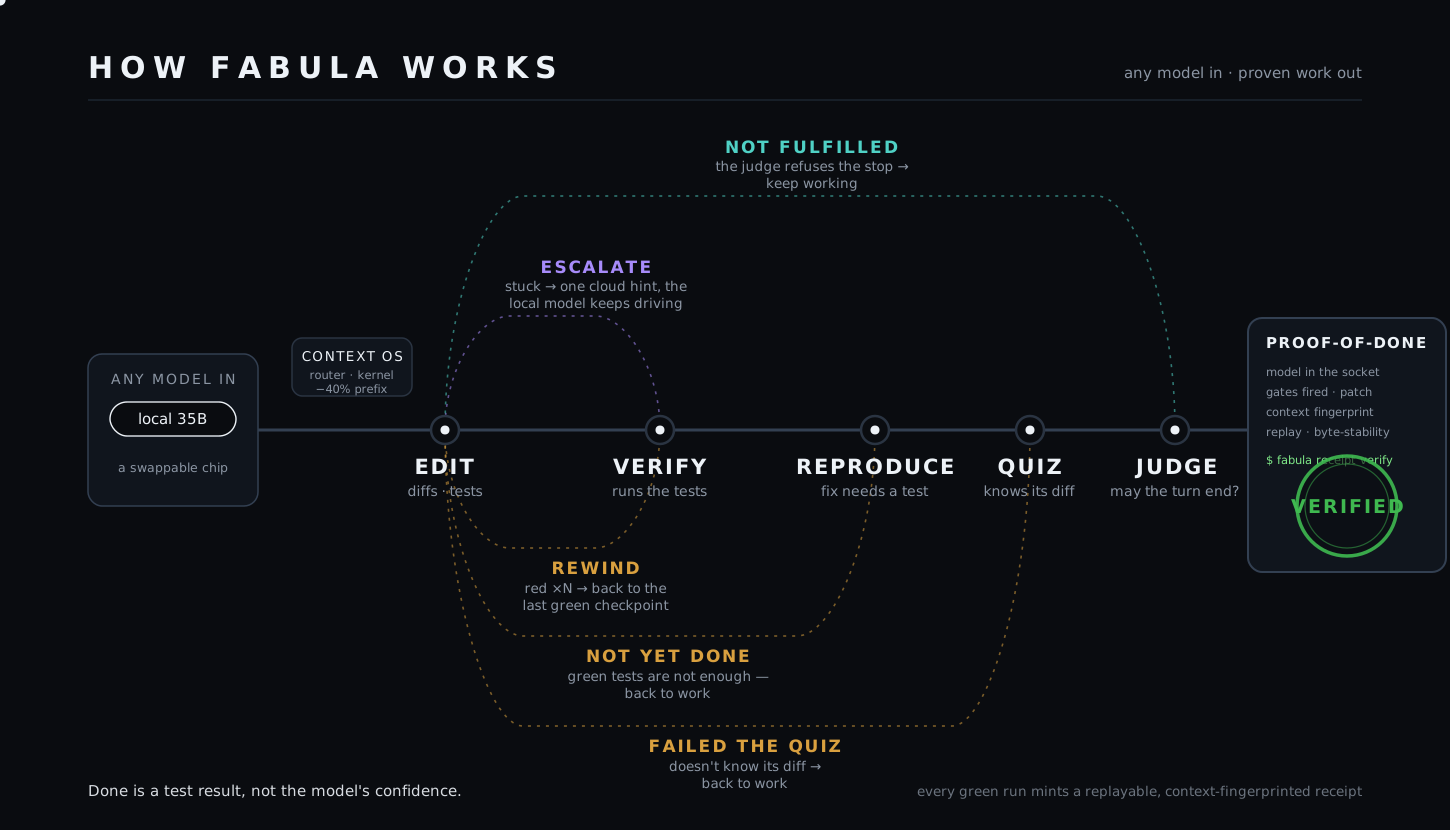
FABULA is an agent harness built on one bet: trust belongs to the proof, not the model. Any LLM — a small local model or a frontier cloud — is a swappable chip, and the autonomy lives in the machinery around it. Done is a test result, not the model's confidence. Every gate is open source you can read, and every fully-gated green run mints a replayable Proof-of-Done receipt (open spec draft). Run it fully local and nothing leaves your machine — not a cost argument, but sovereignty: the mode audited environments (on-prem, air-gapped) actually require, where a verified receipt from the model you own outranks an unverifiable claim from a model you rent.
The loop doesn't give up — and is built not to end in a story
A red verify doesn't stop the run: the model iterates against the real failing output. Repeated reds don't stop it either — the harness rewinds the files to the last green checkpoint, atomically, and steers a different approach. A dead end pulls one second opinion from a stronger model, and the local model keeps driving. NOT YET DONE is a transit state, not a verdict.
And the run won't quietly end in a claim. If source changed but the tests never ran, the force-verify gate re-enters and makes the model run them; if the retry budget is spent with the change still unverified, the final message is stamped NOT DONE (unverified) over the real failing output. A finished run is built to land in one of two honest states — VERIFIED, with a replayable receipt, or an explicit NOT DONE — not a confident "done" you were meant to take on faith. It's a strong best-effort gate, not a proof of impossibility: heavy context compaction, or handing the whole task to a subagent, can still slip past it.
The run can't even end early
Ending the turn is not the model's decision. Before any stop is honored, an independent judge reads the transcript — the real tool calls, not the model's summary — and refuses the stop until the request is fulfilled: done, not planned, described, or promised. The judge is fail-open (a broken judge can never trap you) and bounded (a low re-entry cap), and an explicit /goal condition makes it as strict as you want.
The right context, not all the context
Most agents ship the same giant system prompt and every tool schema on every step. FABULA compiles the minimal sufficient context per task: a deterministic router picks the profile's tools (the committed demo receipt records 64 tools on the coding profile; a masked tool called by name still executes — a router miss costs one roundtrip, never a blocked task), the kernel prompt carries only load-bearing contracts (28.8k → 4.9k tokens), and verbose tool prose went on a measured diet. From the wire: the request prefix dropped 72.3k → 43.5k tokens (−40%) — and it stays byte-stable within a task, so the local model's KV-cache survives across steps. That's why a 35B on a laptop keeps up. Every cut was gated: a tool-use golden-eval (right tool, right arguments) and behavioral gate probes ran before and after each step — zero regressions.
Proof
The scheme above is not a promise — a real captured run walked that exact path: the model fixed the bug, the tests went green, and the machine still answered NOT YET DONE until the proof existed. The run left a receipt. It is committed verbatim — replay it:
cd demo && fabula receipt verify
VERIFIED ✓ — the artifact replayed deterministically:
base c660a02ab138 + patch → `bun test` passed.
Don't trust it. Replay it. The receipt records the model in the socket (a quantized 35B running locally in LM Studio), the gates that fired, the diff and the passing verification — and the exact context that produced the work: a sha256 fingerprint of the prompt-prefix (system + tool schemas), the router profile, and a byte-stability verdict; as of v0.2 also a hash of the user's request text, the serving model's descriptor (arch/quantization — honestly labeled not a weights hash), and an optional real digest of the weight files on disk (spec; the committed demo receipt carries all of them — including a real 20.4 GB weights digest). fabula receipt verify prints it next to the claim:
Claim:    VERIFIED ✓ · qwen3.6-35b-a3b-uncensored-heretic-mlx (local) · 2 file(s)
Context:  prefix a38cb5a6f018b9c0 · profile coding · byte-stability held
Two receipts with the same prefix hash were produced in byte-identical contexts — the work is reproducible not just by artifact, but by context. Read the receipt.
The harder one is public too: a real SWE-bench Pro task, solved by the same local 35B and graded by the benchmark's hidden acceptance suite — fail-to-pass 4/4, RESOLVED. Its receipt ships with a one-command Docker replay: docs/receipts/. A second captured bench run and methodology: docs/EVALS.md.
The model didn't get smarter — the system around it refused to let "done" happen without proof.
Why a receipt, not a bigger model
Every agent vendor answers the trust question the same way: trust the model — it's smart. A merge
gate here, a pass-rate dashboard there — but the unit they ship is still an unverified claim, and
the remedy they sell is a bigger model. FABULA changes the unit: what leaves the run is a
content-addressed, third-party-replayable proof with the exact context that produced it —
prompt-prefix fingerprint, request-text hash, serving-model descriptor, optional weights digest,
byte-stability verdict. To our knowledge no other shipped agent mints that artifact. The moment work
is judged by its receipt, the capability gap stops being a rent: a verified receipt from a 35B you
own beats a confident claim from a frontier model you rent — everywhere someone audits (regulated,
enterprise, government: the buyers who already demand on-prem and air-gapped, which FABULA runs by
default).
The receipt format is an open specification — verified-autonomy receipt v0.2:
JSON schema, field-by-field honesty rules, and a replay protocol any agent can implement. Mint
receipts from your own harness; verify ours with one command. The proof economy gets better the more
producers it has.
Status: verified end-to-end on macOS (Apple Silicon) today. The engine is portable Bun/TypeScript with a web UI — the native app is the macOS shell, not a dependency; Linux builds are on the roadmap. Every captured run is replayable.
The raw evidence
For anyone who wants the unedited artifacts behind the scheme: the live recording of the refusal (docs/assets/refusal.cast, plays with asciinema) and its beat-by-beat render (docs/assets/captured-run.svg). The worst day — repeated red verifies, an automatic file rewind, a steered cloud second opinion — is the machinery's deeper ladder: docs/HARDEST-JOURNEY.md.
Try it
You need a Mac with Apple Silicon (M1 or newer) — that's the only shipped platform today.
git clone https://github.com/sergezuber/FABULA-LLM-5 && cd FABULA-LLM-5
./setup.sh
open FABULA-LLM-5.app
A planted bug is waiting in demo/ — every test is green anyway. Open demo/ as the project and paste:
Fix the export bug: the nightly export silently drops rows dated exactly on the end date. Prove it.
Then watch the machine refuse to finish until the proof exists — on your machine, with your model.
[!NOTE]
You need a tool-calling model: anything served locally by LM Studio or any other OpenAI-compatible local server, or any OpenAI-compatible cloud endpoint (key in.env,baseURLinfabula.config.json).
What's inside
| The gate | What it refuses |
|---|---|
| verify | "Done" without a green run of the project's own tests — the engine presses the run back into verification after source edits, by itself. |
| reproduce | A green suite that never exercises the fix — no test for the change, no done. |
| quiz | A change the agent can't explain — it is graded against its own diff before done stands. |
| judge | A turn that ends before the request is fulfilled — an independent judge reads the transcript and refuses the stop until it's done, not planned or promised. |
| provenance | Work of unknown origin — every receipt carries a sha256 of the exact context (system prompt + tool schemas + router profile), a byte-stability verdict, and (v0.2) the request-text hash + the serving model's descriptor, with an optional real weights digest. |
| rewind | Digging the hole deeper — repeated red verifies roll the files back to the last green checkpoint, atomically, from the harness's own shadow-git. |
| escalate | Looping on a dead end — the auto-rewind steers the model to fetch one cloud second opinion, then it keeps driving. |
Around the gates: web, shell, sandboxed code execution, drift-proof file edits, a real Chromium, memory and hand-off notes, checkpoints and undo, SSRF/redaction/injection defense on every call. The full map of every plugin and tool: docs/PLUGINS.md.
And an optional proof economy builds on the receipt — publish it to a content-addressed registry, have an independent cross-model witness attest the diff, escalate a stuck run to a cloud model that writes the patch you then re-verify, or compose a team's sub-receipts into one all-or-nothing proof tree. Six plugins, all off by default: the disrupt layer.
The protocol
The receipt format — which model sat in the socket, which gates fired, what patch shipped, how to replay it — is specified as a small open protocol, Verified Autonomy; FABULA is its reference implementation: docs/GREENPAPER.md.
Privacy
- Local models mean local data: nothing leaves the machine unless you configure a cloud provider.
- Deleting a chat purges its messages, artifacts, and caches — nothing is retained by the app.
- The app wipes WebKit caches on quit; secrets live only in gitignored
.env/*.keyfiles. - No telemetry, no account, no phone-home.
Docs
| Topic | Where |
|---|---|
| Every plugin and tool | docs/PLUGINS.md |
| The protocol (draft) | docs/GREENPAPER.md |
| The receipt spec — an open standard any agent can implement | docs/spec/verified-autonomy-receipt-v0.2.md |
| Public replayable receipts | docs/receipts/ |
| Evals & run notes | docs/EVALS.md |
| The hardest journey (capability walkthrough) | docs/HARDEST-JOURNEY.md |
| Architecture deep-dive | docs/ARCHITECTURE.md |
| Every dependency + install command | DEPENDENCIES.md |
| Configuration templates | fabula.config.example.json · .env.example |
| Contributing & testing rules | CONTRIBUTING.md |
| Security policy | SECURITY.md |
| Credits | docs/CREDITS.md |
Acknowledgements
Built on and grateful to: MiMoCode (the engine FABULA builds on, an OpenCode fork), LM Studio, SearXNG, Playwright, Bun, piper, and faster-whisper. Several supervision mechanisms — cross-provider conversation replay, silent context-overflow detection, prefix-cache telemetry, bounded tool output, drift-tolerant edits, and the conversation-rewind idea FABULA extends into a file-atomic rewind — were adapted from the mechanism designs of pi (Mario Zechner, MIT), reimplemented and tested here. The toolset follows naming and schema conventions that state-of-the-art assistants have made publicly familiar, implemented here independently for any model you choose to run. More: docs/CREDITS.md.
License
MIT — see LICENSE.
Reviews (0)
Sign in to leave a review.
Leave a reviewNo results found