yolonot
Health Warn
- License — License: MIT
- Description — Repository has a description
- Active repo — Last push 0 days ago
- Low visibility — Only 5 GitHub stars
Code Fail
- rm -rf — Recursive force deletion command in evals/fixtures/scripts/cleanup.sh
Permissions Pass
- Permissions — No dangerous permissions requested
No AI report is available for this listing yet.
Configurable command guardrails for AI coding agents across Claude Code, Codex CLI, OpenCode, Antigravity, and Cursor.

yolonot
Configurable command guardrails for AI coding agents.
One policy engine across 24 AI coding harnesses — Claude Code, Codex CLI, OpenCode, Antigravity, Cursor, GitHub Copilot CLI, Qwen, Grok, Kiro, Cline, and more.


yolonot evaluates shell commands before your coding agent runs them. Combine explicit rules, local parsers, external hooks and model judges, then apply a configurable risk policy. Session memory remembers approved commands and rejects repeated denied commands; script approvals track their contents. An optional escalation model reviews uncertain model verdicts before they reach you.
Shared policy, host-specific enforcement. Each harness exposes different hook and approval capabilities. Check the adapter behavior and
yolonot profile <harness>for the effective action map. Claude Code also has an optional transcript mod.
Model judgments can be wrong. Use explicit deny rules for commands that must be blocked. yolonot gates shell tool calls; it does not sandbox processes or cover every file, MCP or native tool action. See security, privacy and failure behavior.
Quick start
1. Install and configure your harness
go install github.com/sezaakgun/yolonot@latest

# To install the current source checkout instead of the published tag:
# go install .

# Make sure Go bin is in PATH
export PATH="$PATH:$(go env GOPATH)/bin"

# First-run wizard: hooks + rules + models + judge chain
yolonot setup

# Or target one harness explicitly
yolonot setup --harness codex
Targets: claude, codex, opencode, antigravity (agy), cursor, plus 19 additional harnesses (qwen, copilot, grok, crush, goose, kilo, pi, openhands, kimi, zcode, cline, muse, kiro, hermes, deepseek, devin, openclaw, mirror, amp — see docs/harnesses.md). Without a target,
setup installs into detected harnesses. The optional Claude transcript mod
is installed with yolonot install --harness claude --mod.
Setup offers chat providers, typed decision models and local endpoints.
Models live in a named catalog; an ordered judge chain
can combine them with fast_allow and trusted exec: hooks. yolonot config
lets you edit the chain, model endpoints, risk profiles and rules.
Upgrading from 0.x? File-based config is read without rewriting it;yolonot migrate writes the 1.x shape. Review the removed environment
overrides before upgrading.
2. Restart and inspect the policy
Restart your host CLI or start a new desktop session to load the hooks, then
inspect the effective policy:
yolonot profile codex               # use your harness name
yolonot doctor --harness codex      # health, hooks, config, escalation latency
yolonot audit --harness codex       # security, rule lint & host permissions audit
yolonot status --all --harness codex
yolonot judges
yolonot check "git status"          # dry-run without executing the command
Shell tool calls now run through the pipeline.
Using Claude Desktop? Configure model API-key variables in Local → gear;
terminal exports may not reach its hooks or mod. See the Desktop credential
caveat.
OpenCode V2 has a native plugin integration, including approval prompts.
Google workflows use Antigravity. yolonot Gemini CLI support has been retired;
remove old hooks with yolonot uninstall --harness gemini. See the dated version and verification matrix.
Choose failure handling, risk policy and the total decision budget
through settings or configuration. Nativeapprove, deny and reset commands work across harnesses. Start from a
reviewed example config and validate it with yolonot doctor before installation.
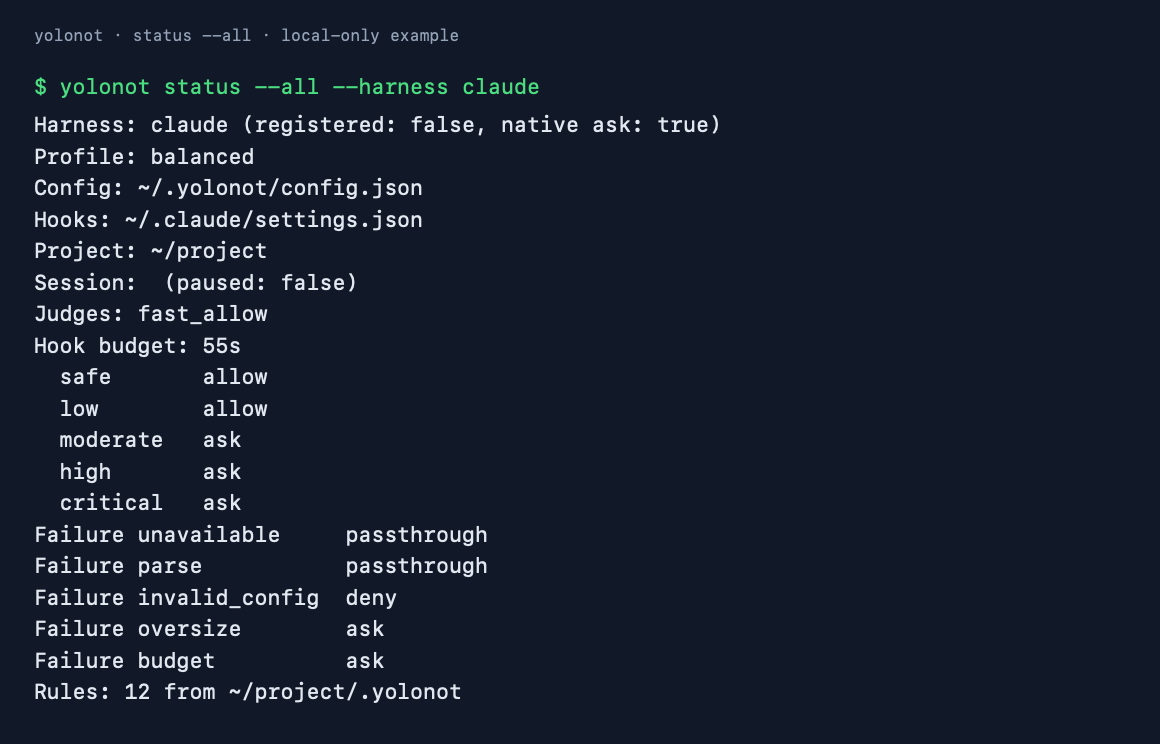
An example of yolonot status --all with the local-only configuration (temporary paths
shortened for display; hooks have not been installed in this example):
Docs
| Topic | File |
|---|---|
| How the pipeline decides — layers, hook ordering, pausing, dry-run | docs/how-it-works.md |
All CLI + /yolonot skill commands |
docs/commands.md |
| Configuration, diagnostics, failure policy, learning and session controls | docs/configuration.md |
| Editor schema and example configs | docs/config.schema.json, examples/ |
.yolonot rule files — format, walk-up, messages, redirects, sensitive files |
docs/rules.md |
Judges — the chain, fast_allow internals, Dippy and other hooks, security model |
docs/judges.md |
| Risk tiers — per-harness action policy, overrides | docs/risk-tiers.md |
Risk profiles — fast/balanced/strict/paranoid + custom |
docs/risk-profiles.md |
| Models — catalog, chat providers, typed decision models, env vars, escalation (second-opinion model) | docs/models.md |
Prompt customization — prose hints or a full system_prompt override, plus prompt verify |
docs/prompt.md |
Upgrading from 0.x — what changed in config.json and the CLI, yolonot migrate |
docs/upgrading.md |
| Harnesses — install flags, runtime pinning, per-host caveats | docs/harnesses.md |
| Native verification scope and known host limitations | docs/harnesses.md |
Analytics — yolonot log, stats, suggest, quiet mode |
docs/analytics.md |
| Eval suite — test prompt quality across models | docs/eval.md |
| Architecture — code layout, data directory | docs/architecture.md |
| Security scope, trusted configuration, privacy and failure behavior | docs/security.md |
Uninstall
yolonot uninstall # removes hooks + skill, preserves data
Data at ~/.yolonot/ is preserved. Delete manually if wanted.
Acknowledgements
The built-in fast_allow judge is heavily inspired by Dippy by Lily Dayton — specifically its SIMPLE_SAFE allowlist, subcommand-gating approach for multiplex tools (git, docker, kubectl, …), and its hostile-input test corpus. yolonot ports the allowlist tables into Go and re-walks the AST via mvdan.cc/sh instead of Dippy's hand-written Python bash parser (Parable). Where yolonot's parser reaches ambiguity it defers to the LLM — a fallback Dippy doesn't rely on — so the Go port can be stricter (reject-to-LLM) without hurting UX. The dippy_parity_test.go corpus and the rules system owe a direct debt to the Dippy project. MIT-licensed, credited in file headers.
License
MIT. See LICENSE.
Reviews (0)
Sign in to leave a review.
Leave a reviewNo results found