skill-trainer
Health Warn
- License — License: MIT
- Description — Repository has a description
- Active repo — Last push 0 days ago
- Low visibility — Only 5 GitHub stars
Code Pass
- Code scan — Scanned 12 files during light audit, no dangerous patterns found
Permissions Pass
- Permissions — No dangerous permissions requested
No AI report is available for this listing yet.
Stop writing skills, start training them: an agent-driven hill-climbing loop that trains SKILL.md files against scored task suites, with git as the checkpoint mechanism
skill-trainer
Your agent's SKILL.md is a guess. Train it until it's a measurement.
An agent-driven hill-climbing loop that trains skill files against scored
task suites. Git is the checkpoint mechanism, markdown is the model, and
every accepted edit earned its place on a held-out validation set.
Works with Claude Code, Codex, GitHub Copilot, Cursor, and opencode. Your
coding agent is the editor, the rollout worker, and the manager.


Tutorial · Run it now · How it works · What a run produces · Bring your own task · Launch a training run
Skills today are written once, by feel, and never verified. skill-trainer
closes the loop: propose a small edit, run the candidate against tasks the
editor never saw, keep it only if the score strictly improves. Rejected
edits roll back with git reset --hard and get fed to future editors as
evidence of what didn't work.
The harness is plain Python with one pip install -r requirements.txt
(LangChain and Pydantic, for the LLM judge), the optimizer is a manager
agent following PROGRAM.md, and everything that "learns"
is markdown. Rollouts and editing go through the agent CLI you already
have, billed on the same models and subscription your coding agent
already uses; only judge-mode suites need an API key of their own.
Prerequisites
- Python 3.11+ and git.
- At least one agent CLI installed and authenticated:
claude,codex,copilot,cursor-agent, oropencode. - Any platform with bash. On macOS,
train.shadditionally blocks system
sleep (viacaffeinate) so overnight runs survive; elsewhere it runs
unwrapped.
Run it now
Start with the framework's own test suite — deterministic, mock backend,
no model calls:
git clone https://github.com/shahshrey/skill-trainer
cd skill-trainer

# with uv:
uv venv .venv && uv pip install -r requirements-dev.txt -p .venv/bin/python
# or with plain pip:
python3 -m venv .venv && .venv/bin/pip install -r requirements-dev.txt

.venv/bin/python -m pytest tests/
Then watch it actually train, using the bundled example suite
(examples/mock-demo). The meta-eval deletes a
known-good rule from the reference skill and measures whether the loop can
rediscover it from failure symptoms alone. Rollouts stay mocked; only the
editor makes model calls (through claude -p), so it costs a handful of
prompts:
.venv/bin/python tests/meta_eval.py planted --ablate seamless-loop --max-steps 8
And the null test, the one most optimizers fail, checks that on a
pure-noise suite the trainer correctly accepts ~nothing:
.venv/bin/python tests/meta_eval.py null --max-steps 5
How it works
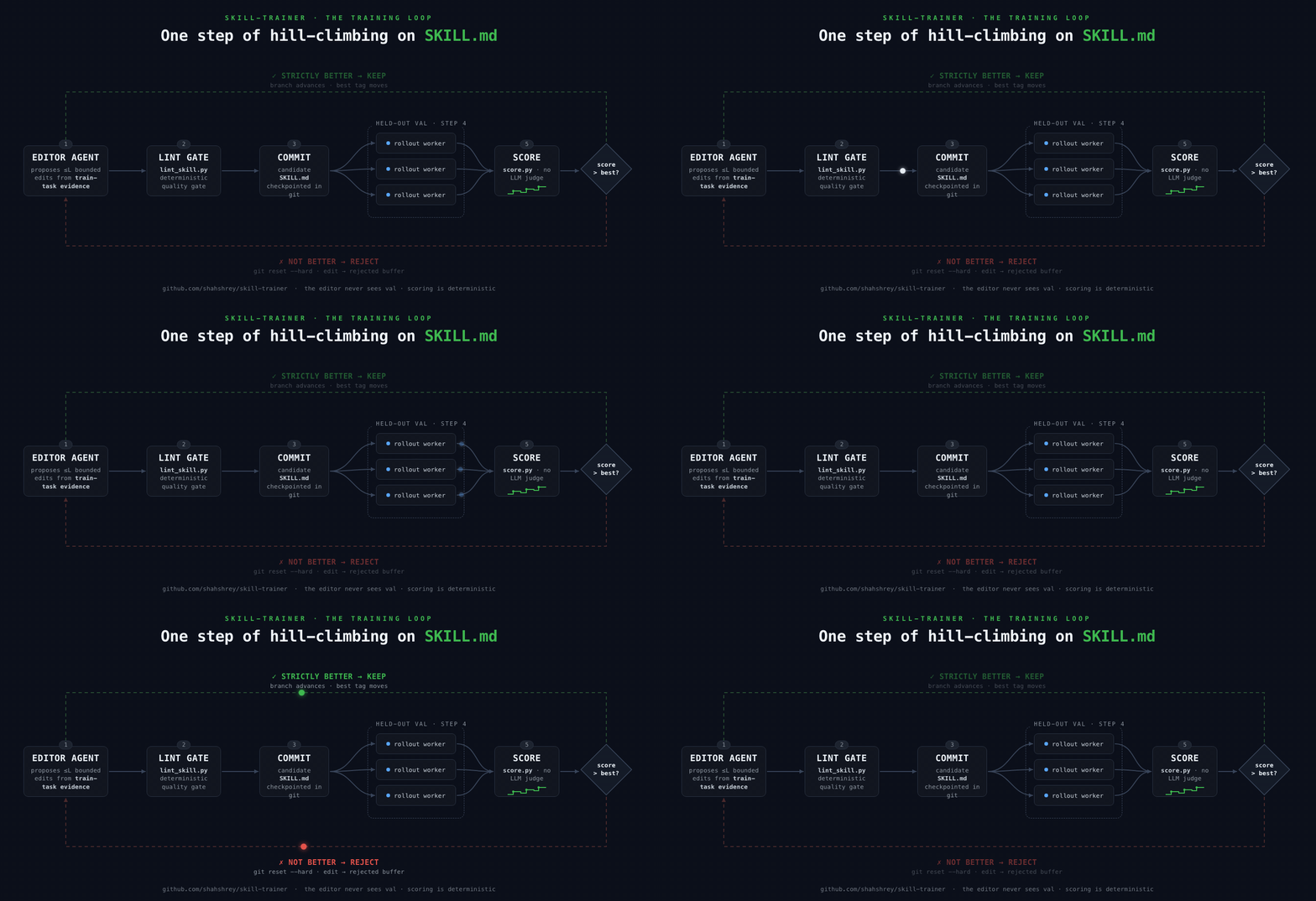
- An editor agent proposes a small set of bounded edits to
SKILL.md,
grounded in failure and success evidence from training tasks. - The manager applies them, runs the lint gate, and commits the
candidate. - Parallel rollout workers run the candidate against a held-out
validation set.score.pyturns the outputs into a number,
deterministically by default, or through a structured LLM judge for
suites that opt intojudgemode. - If the candidate is strictly better, the branch advances. Otherwise
git reset --hard, and the rejected edit text goes into a buffer
future editors read. - Every step lands in
results.tsv. Every E steps, an epoch boundary runs
a slow-update regression check and refreshes the optimizer's own memory
(META.md).
The manager is expected to die (context exhaustion, sleep, API errors).train.sh relaunches it until a terminal state exists, and the resume
ritual in PROGRAM.md §0 reconstructs everything from disk. Training runs
live on branches named train/<skill-name>/<tag>.
The guardrails are structural, not aspirational: the editor never sees val
tasks, the manager cannot modify the harness or the task suite, scores
never compare across gate modes or rubric versions (every scores.json
is stamped with a hash of the scoring contract; the gate refuses
mismatches), and post-run audits (harness/audit_run.py) grep for
leakage and rubric drift.
What a run produces
- The trained skill, at
skills/<skill-name>/SKILL.mdon thetrain/<skill-name>/<tag>branch. Best checkpoints are git-tagged; every
accepted step is a commit you can diff to see exactly what the training
changed and why. results.tsv— one append-only row per step: commit, epoch, step,
gate mode, val scores (mixed/hard/soft), rollout count, keep/discard
status, and a one-line description of the edits tried.runs/<tag>/— per-step artifacts: rollout workspaces, editor
transcripts, score reports, and finallyTERMINAL, a one-line<state>: <reason>file (success,no-progress,blocked, ...)
that is the only way a run ends.
What it costs
The test suite and all mock rollouts are free — no model calls at all. The
meta-eval makes a few editor calls per step through claude -p. A real
training run is the expensive mode: each step is roughly one editor call
plus K × |val| rollouts through your agent CLI, so an overnight run means
hundreds of rollouts on your existing subscription. Size K, the val set,
and --max-steps accordingly; there is no separate API bill.
Bring your own task suite
This repo is the framework only (see PROGRAM.md §8). Task suites and
the skills they train live in your working copy; tasks/ and skills/
are gitignored here by design.
Step 1: find the tasks. The best training tasks are the requests you
already make of your agent over and over, especially the ones it gets
wrong. Write those down as prompts, and for each one decide what a correct
answer must contain. That second part is the work: a task without a
checkable outcome cannot gate an edit, and nothing in this framework can
invent it for you.
Step 2: shape the suite. The bundledexamples/mock-demo is a complete working suite to
copy as a starting point. A suite is a directory:
tasks/<skill-name>/
  train.jsonl        tasks the editor learns from
  val.jsonl          held-out gate tasks; the editor NEVER sees these
  test.jsonl         optional final held-out set
  scoring.md         scoring contract: suite config (first fenced json
                     block), smoke_tools, example-template packaging rules
  rubric.py          score(task, workdir, mode) -> {hard, soft, checks}
                     (only needed for rubric-mode scoring)
  requirements.txt   suite-specific deps (installed into .venv)
  refs/              any reference files tasks list under "files"
Each line of a .jsonl file is a task: {"id": ..., "prompt": ..., "files": [...], "scoring": {...}}. Five scoring modes are built in:exact (regex on output), checklist (required substrings), command
(exit code), rubric (your rubric.py), and judge (an LLM judge, below).
The first four are deterministic and make no LLM calls.
LLM-judged suites
Some skills cannot be scored deterministically: UI design, how human a
text reads, the quality of a review. The judge mode asks an LLM for a
structured verdict and feeds the same hard/soft numbers into the
unchanged paired gate. It is a separate way to measure, not a replacement:
a suite picks its mode in scoring.md.
tasks/<skill-name>/
  judge.md           the judge prompt for THIS skill: criteria, weights,
                     what "pass" means (part of the scoring contract)
  scoring.md         {"default_mode": "judge", "judge": {"samples": 3, ...}}
  train.jsonl        each task may carry "reference": "<path>" (a good
                     output) and "judge_inputs": ["<workdir globs>"]
The judge needs a definition of good, and there are two ways to give it
one, in order of preference:
- A dataset. Give each task a
reference: what a good output looks
like for that prompt. The judge scores closeness to the reference, so
the loop climbs toward a concrete target exactly like a deterministic
suite. This is the default and the one to reach for first. - A rubric only. No reference;
judge.mdalone describes the ideal.
This works only as well as the rubric is written.
harness/judge.py --check --suite tasks/<skill> reports which mode each
task runs in, warns about rubric-only tasks, and verifies the key, the
dependency, and every reference path. run_task.py --smoke runs the same
check for judge suites.
The judge model is MiniMax M3 through its OpenAI-compatible API, driven by
the LangChain SDK (with_structured_output over the verdict schema,method="function_calling", the only method M3 honours; think-stripped
content JSON as the fallback). Nothing is truncated: judge inputs go in
whole and no output cap is sent unless the suite sets max_tokens. Put
the key in the repo .env as MINIMAX-API-KEY=... (or exportMINIMAX_API_KEY).
Verdicts are cached per workspace in judge.json, judge.md is hashed
into rubric_version, and examples/judge-demo is a complete judged suite
that trains a skill-review skill against 16 synthetic flawed skills.
The skill being trained lives at skills/<skill-name>/SKILL.md, with
optimizer memory in META.md beside it.
Launch a real training run
# One-time: verify tooling against your suite
.venv/bin/python harness/run_task.py --smoke --suite tasks/<skill> --backend claude

# Launch; keeps the manager alive until a terminal state.
# The third argument picks the agent: claude | codex | copilot | cursor | opencode
# Optional args 4-6: manager model, rollout model, reasoning effort.
./train.sh <skill-name> <tag> claude
./train.sh <skill-name> <tag> codex gpt-5.3
./train.sh <skill-name> <tag> cursor claude-sonnet-5-low
Before a real run, copy runs/CONFIG_TEMPLATE.md's JSON intoruns/<tag>/config.json and adjust it for your suite. The manager readsPROGRAM.md and takes it from there; it will not stop untilruns/<tag>/TERMINAL exists.
Layout
PROGRAM.md            manager agent instructions; the whole loop is here
train.sh              relaunch wrapper; keeps the manager alive
prompts/              worker prompt templates (editor, ranker, rollout, ...)
harness/              the training engine; read-only during training
examples/mock-demo/   complete example suite; template + meta-eval fixture
examples/sql-demo/    the tutorial's suite: SQL queries scored by row diff
examples/judge-demo/  LLM-judged suite: skill-review trained on flawed skills
docs/tutorial/        six chapters from clone to a trained skill
runs/CONFIG_TEMPLATE.md  canonical run config
tests/                deterministic framework tests + meta_eval.py
tasks/<name>/         your task suites (gitignored; yours to provide)
skills/<name>/        SKILL.md (trainable) + META.md (optimizer memory)
runs/<tag>/           per-run artifacts (gitignored)
results.tsv           training log (untracked)
harness/ and tasks/*/val.jsonl are ground truth: the manager must never
modify them, and the editor must never see val task contents.
Rollout batches go through harness/rollout_batch.py: N parallel
private-workspace workers with heartbeat supervision (the dispatcher kills
a stale worker and requeues it once).
Contributing
Harness improvements, new scoring modes, new agent backends, and doc fixes
are all welcome. See CONTRIBUTING.md. The one rule:tests/ must stay deterministic and LLM-free.
Reviews (0)
Sign in to leave a review.
Leave a reviewNo results found