gpt-ui-assets
Health Warn
- License — License: MIT
- Description — Repository has a description
- Active repo — Last push 0 days ago
- Low visibility — Only 6 GitHub stars
Code Fail
- exec() — Shell command execution in mods/attachment-preview/hooks/register.tsx
Permissions Pass
- Permissions — No dangerous permissions requested
No AI report is available for this listing yet.
Claude Code skill: design platform-native app UIs with GPT and turn them into production assets — every asset redrawn 1:1 (never cropped), SVG/VectorDrawable icons, app icons, frame/Lottie/AVD animation, fonts, theme code and a screenshot diff for a 1:1 build.
gpt-ui-assets
A Claude Code skill that designs platform-native screens for phones, tablets,
foldables, desktop apps and the web with GPT image models, and turns an approved design into production assets and
a 1:1 build. It runs on an OpenAI-compatible API key or on the local Codex CLI with your ChatGPT plan.
Every icon, illustration and background is redrawn from scratch at full resolution and matched 1:1; nothing is
cropped out of the screenshot. You also get:
- SVG / Android VectorDrawable icons;
- launcher icons for Android, iOS and the web;
- frame animations, Lottie and AnimatedVectorDrawable;
- theme code and fonts measured from the pixels;
- a screenshot diff that tells you exactly what your built screen gets wrong.
Claude is the driver. GPT is one instrument, and each job goes to whatever does it best:
- GPT image: mockups, painterly art, raster frames.
- GPT vision: inventory, critique, SVG icons, vector keyframes.
- Local measurement: scoring, colour matching, tracing, rigging, font matching, redlines, diffs.
- Claude: reviews every result and writes the code.
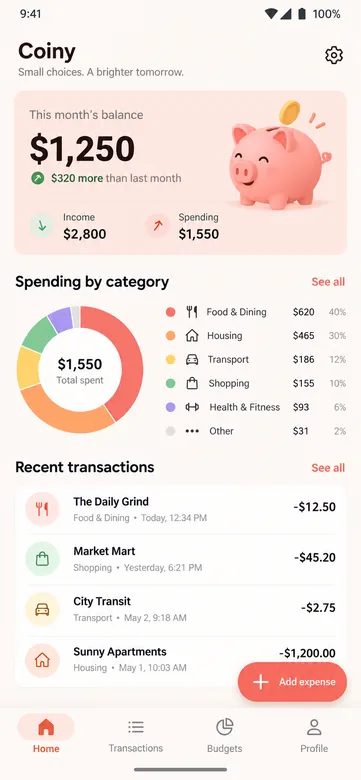

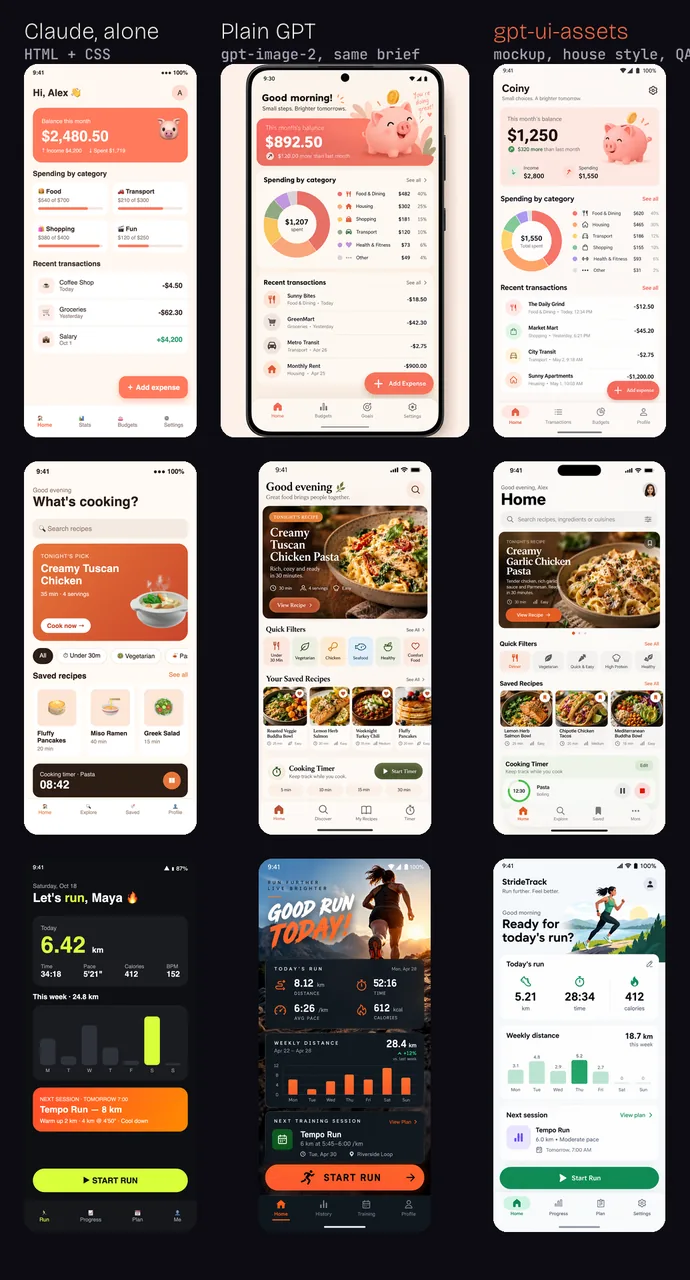
Same brief, three ways. Claude alone writes HTML/CSS; plain GPT paints a pretty picture you can't build from;
the skill gives a native screen in the house style that passed design QA, ready to inventory and build.
Why
When you ask GPT for "the assets of this design", it usually crops them out of the mockup. You get
low-resolution pixels with the card background baked in, neighbouring text bleeding in, and cut-off edges. Asking it to
redraw them from a text prompt gives generic art in a different style.
This skill does what a designer would do instead:
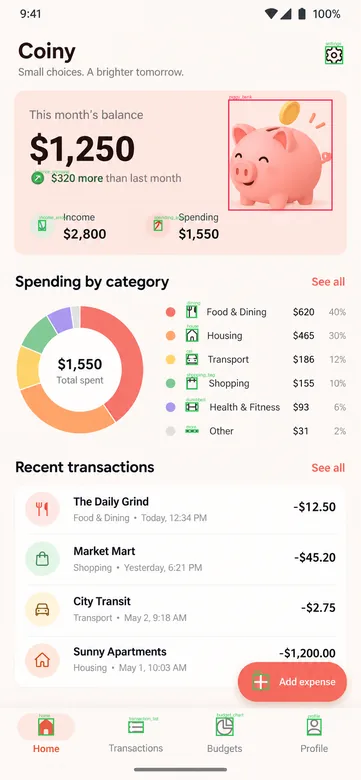
- It inventories the assets.
- It redraws each one from scratch, with a focused crop of the element as the only reference.
- It scores candidates against the design with a perceptual metric.
- It colour-corrects the winner in CIELAB.
- It rejects copies and crops automatically.
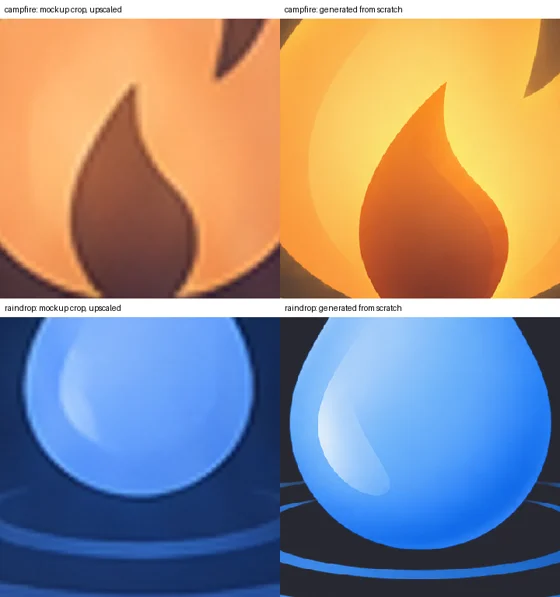
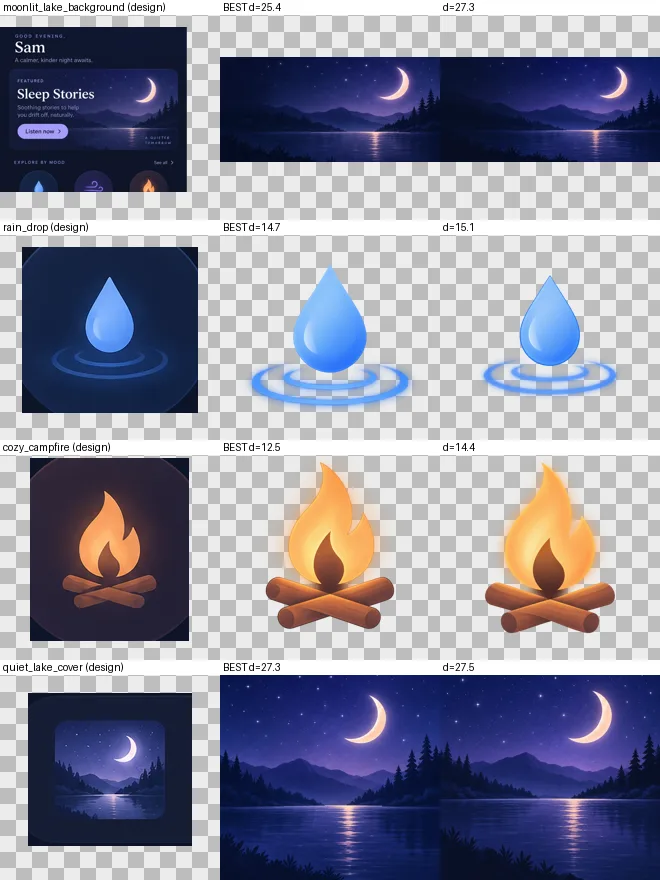
Left: the element cropped from the mockup and upscaled. Right: the redrawn asset. It's 5–7× the resolution,
40–100× sharper and on a real transparent background.
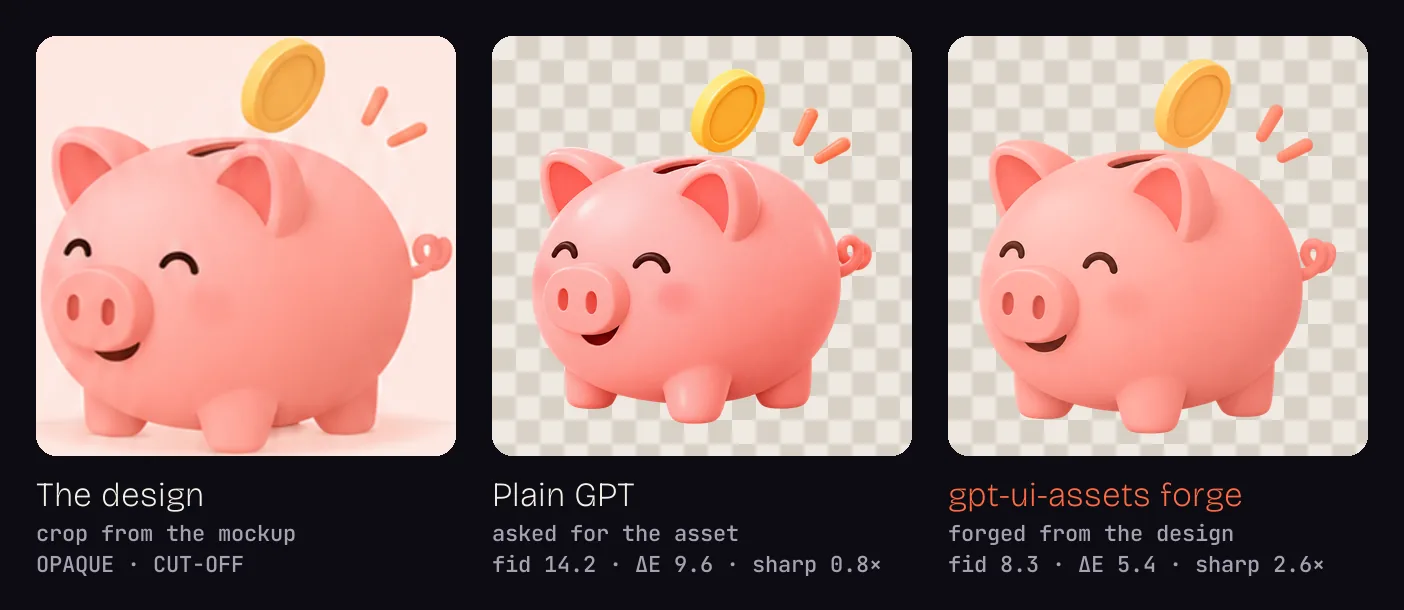
Asking plain GPT for the asset re-imagines it: new mouth, new colours. forge stays on the design, scored by the
kit itself (fid and ΔE, lower is closer).
What it does
| Phase | Commands | What you get |
|---|---|---|
| Research | research, blueprint |
In-depth, web-searched, cited market report (competitors, pain points, pricing, gaps) and a feature blueprint (RICE, user stories, screens with mockup briefs, roadmap) using gpt-6-sol at high/xhigh reasoning |
| Design | mockup --platform android|ios|web|macos|windows|linux --device phone|tablet|foldable|desktop, --set, --style-ref, critique |
Native-component screens on each device's canvas and chrome, in a clean, decluttered house style; one approved screen carried to every form factor; further screens in the approved design language; automatic design QA with measured contrast and hinge, density and fold checks |
| Inventory | manifest, spec, iconspec |
Every asset with bbox, kind and format (native components and system UI excluded); tokens with the native widget per component |
| Raster assets | forge, pick, fix |
1:1 redraws: parallel candidates, perceptual fid ranking, Lab colour match, copy/crop rejection |
| Icons | svg, icons, vd |
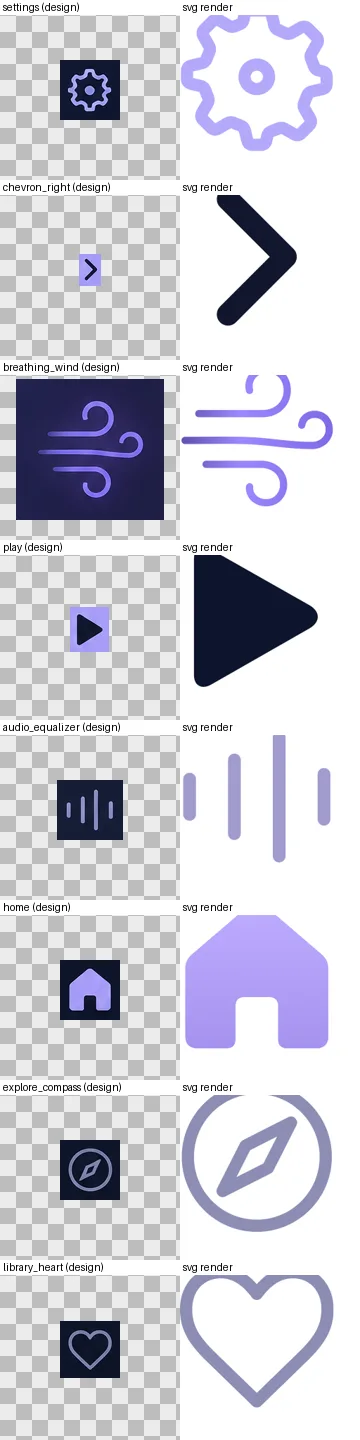
SVG icons scored against the design and retried when weak, on a 24-grid; new icons in the set's style; VectorDrawables validated by render round-trip + aapt2 |
| Vectors | trace |
Raster art → gradient-aware SVG/VectorDrawable, with a vector-or-raster recommendation |
| App icon | appicon concepts, appicon build |
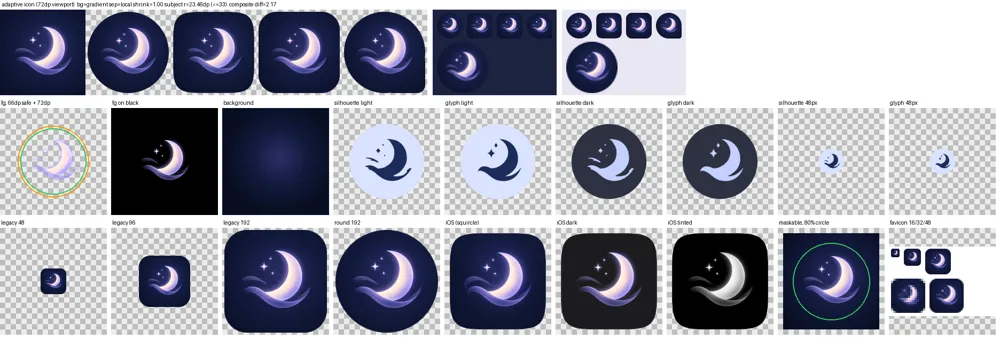
Android adaptive (foreground, background, themed monochrome), legacy + Play 512, iOS 1024 + dark/tinted, favicons + PWA/maskable |
| Animation | frames, sequence, vectorize, rig, animate |
Procedural motion (no API calls), generated frames with QA, layout-driven sequences (code animates, GPT paints keys, EbSynth carries them to every frame of smoke, drops or spray when the plan says it can, else GPT paints every frame), WebP/APNG/Lottie, Lottie and AnimatedVectorDrawable, rigged 1:1 vector animation |
| Hybrid screens | material, state, stage |
Screens built in HTML/CSS/JS around GPT-painted materials; state variants pixel-identical outside the change; stills, a frame-exact motion clip and a presentation shot rendered through Chrome |
| Build 1:1 | fonts, redline, tokens, compare |
Google Fonts matched by rendering; measured radii and gaps; Compose/SwiftUI/CSS/Tailwind theme code; screenshot-vs-design heatmap with ranked fixes |
| Export | export, doctor |
Android densities, iOS imagesets, web 1x/2x; setup check |
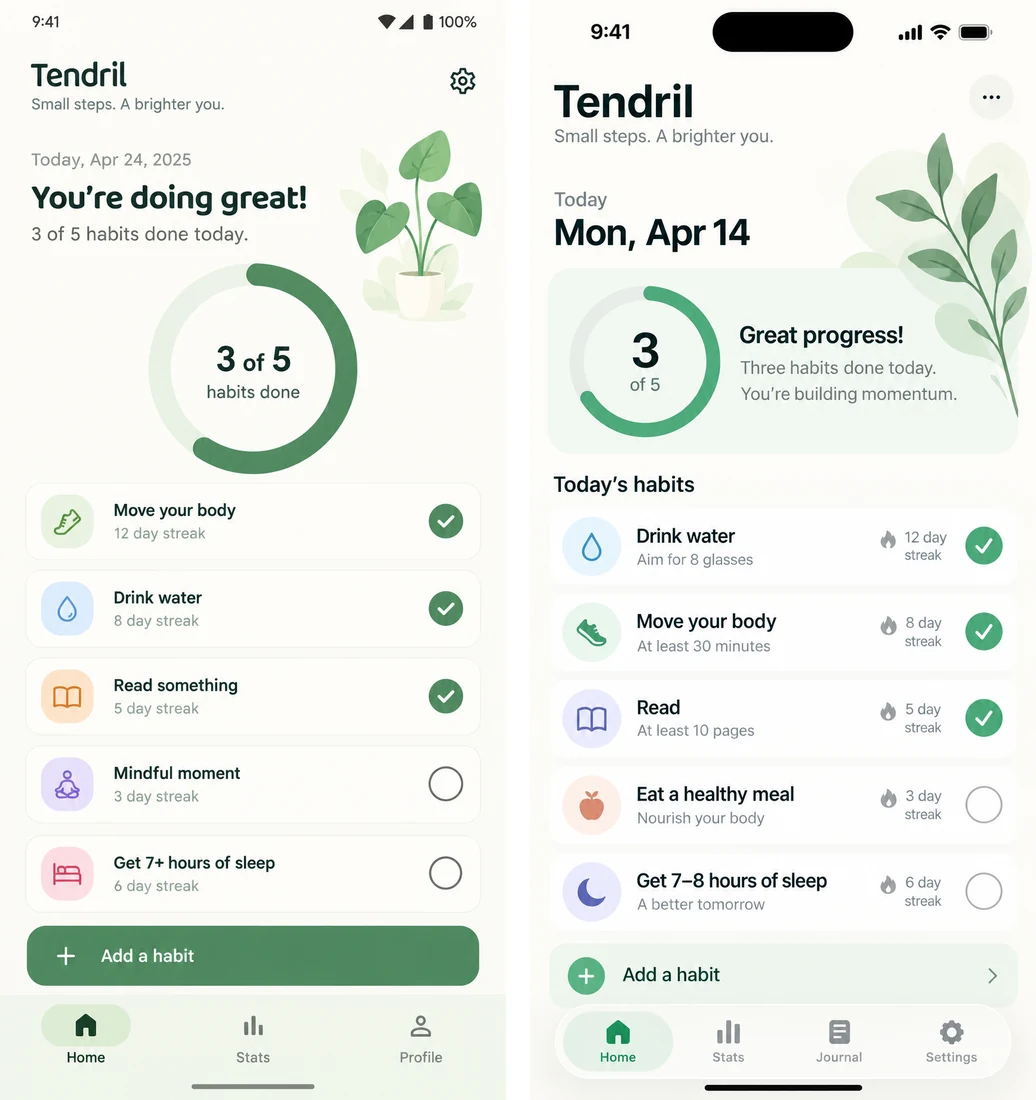
Platform-native design. The same brief, --platform android vs --platform ios: M3 top app bar, cards, navigation
bar with the pill indicator and gesture handle vs a large title, inset-grouped list, floating Liquid Glass tab bar and
Dynamic Island.
Every form factor. --device tablet gives list-detail and navigation rails or an iPad sidebar, --device foldable
keeps every control off the hinge (and QA measures it), --device desktop draws real macOS, Windows or Linux window
chrome at pointer density, and --platform web --page landing composes above the fold. --set tablet,desktop --anchor <approved phone screen> recomposes the same app for each form factor instead of stretching it.
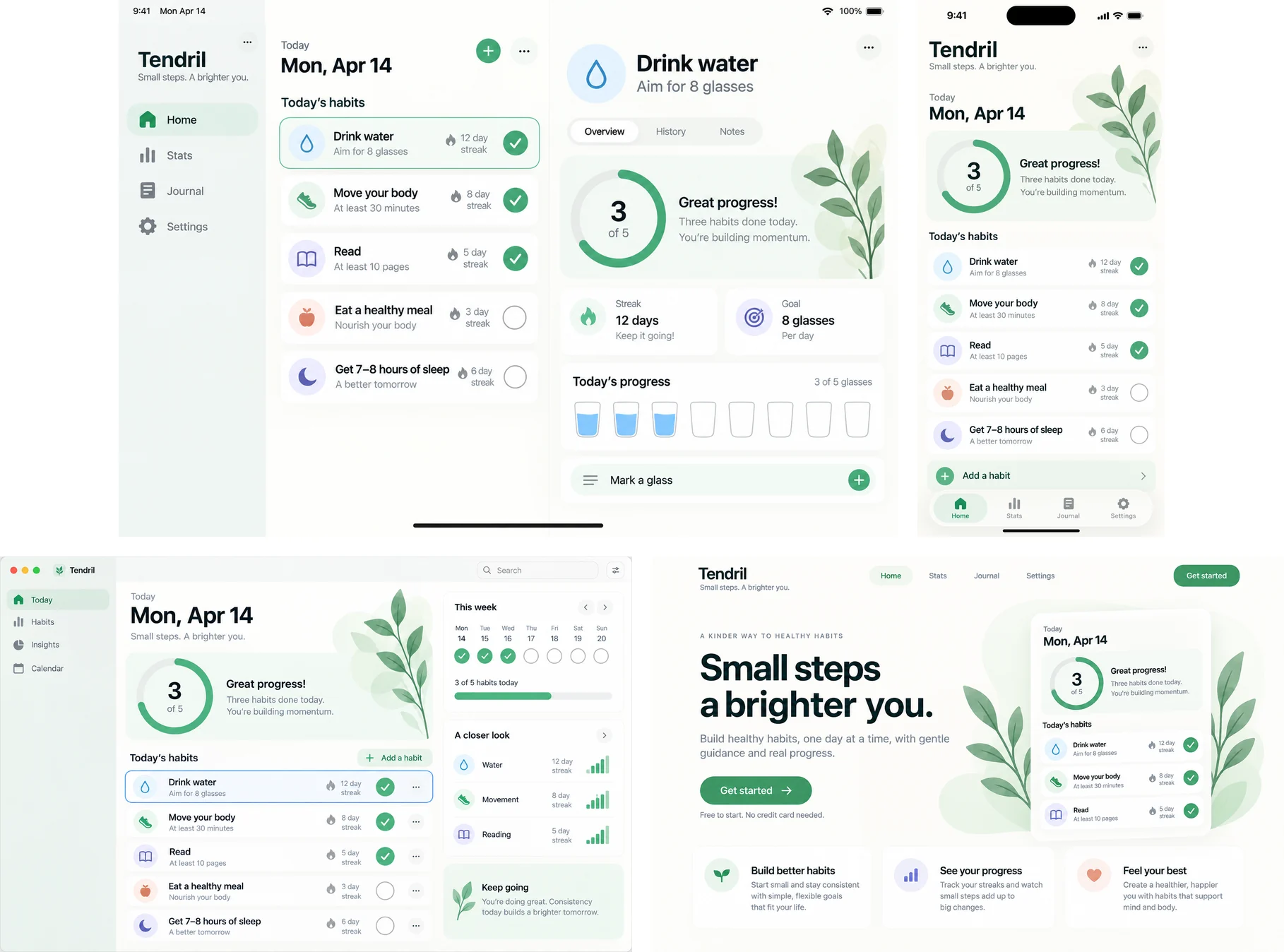
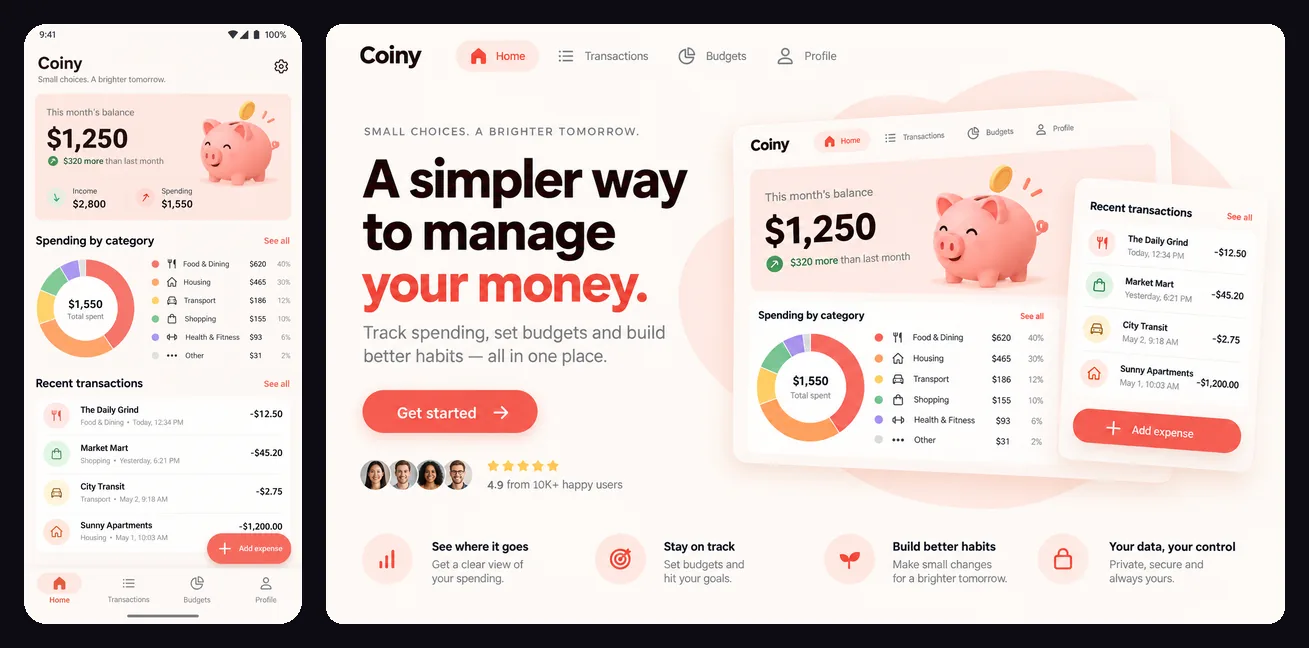
New screens in the approved design language (--style-ref): same wordmark, palette, type and illustration
style, with a new layout. Here the approved phone screen drives a web landing page.
Forge and icon review sheets.
App icon. Adaptive masks, the 66 dp safe zone, the themed glyph, and legacy, iOS dark/tinted, maskable and favicon versions.
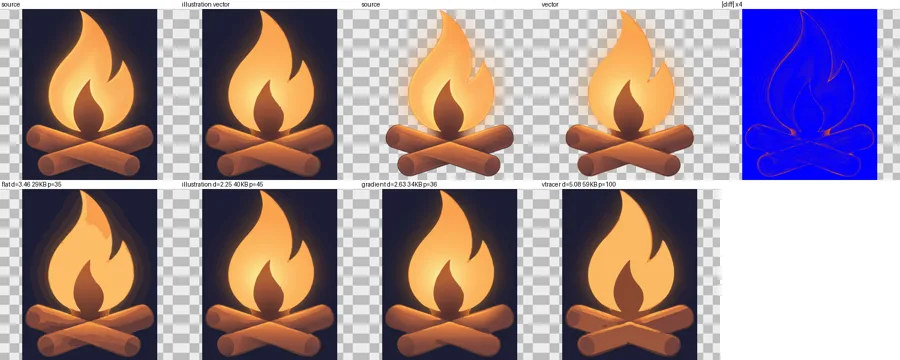
Tracing. Gradient-aware vectors: display diff 2.25 vs 5.08 for vtracer.
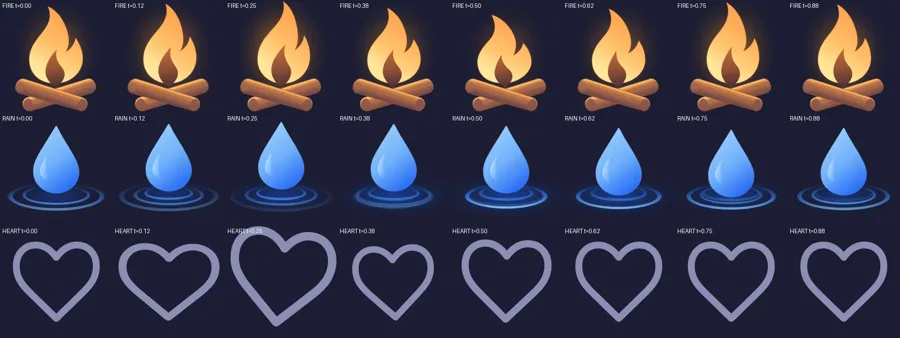
Animation. Registered raster frames, and vector motion as both Lottie and AnimatedVectorDrawable (morph, glow, a like-pop).

Compare. A screenshot of your build vs the design: a heatmap and a ranked list of fixes until it matches.
Install
As a plugin (recommended):
/plugin marketplace add Shakibuzzaman3104/gpt-ui-assets
/plugin install gpt-ui-assets@gpt-ui-assets
Or as a plain skill, linked so that git pull updates it:
git clone https://github.com/Shakibuzzaman3104/gpt-ui-assets.git ~/src/gpt-ui-assets
ln -s ~/src/gpt-ui-assets/skills/gpt-ui-assets ~/.claude/skills/gpt-ui-assets
A copied folder (cp -r) silently stays on the version you copied.
Then install the Python dependencies (Python 3.9+):
pip install -r ~/.claude/skills/gpt-ui-assets/scripts/requirements.txt   # requests, pillow, numpy
pip install vtracer scipy fonttools playwright                          # optional extras
These optional tools are used when present:
- Headless Chrome/Chromium: SVG rendering with alpha, lottie-web previews.
- The Android SDK's
aapt2: validates every VectorDrawable, adaptive icon and AVD. xcrun actool: validates the iOS app icon.
Configure
Pick a backend. The skill asks on first use, or run the setup yourself:
python3 ~/.claude/skills/gpt-ui-assets/scripts/gptkit.py setup # shows which backends are ready
- API key (best for pixel-exact asset work). The OpenAI API or any OpenAI-compatible endpoint that exposes
/images/generations,/images/editsand/responses:
or writepbpaste | python3 .../gptkit.py setup --backend api --api-key-stdin # never echoes or logs the key~/.config/gptkit/envyourself (chmod 600):GPTKIT_API_KEY=sk-... # optional GPTKIT_BASE_URL=https://api.openai.com/v1 GPTKIT_QUALITY=high # low | medium | high; low for cheap draftsOPENAI_API_KEYandOPENAI_BASE_URLare used as fallbacks. Models are routed per task from the endpoint's model
list;GPTKIT_IMAGE_MODEL/GPTKIT_TEXT_MODELpin one. - Local Codex CLI (no key; uses your ChatGPT plan's quota).
npm i -g @openai/codex && codex login, thengptkit.py setup --backend cli. Design, critique and research work fully. Its image tool has no size or fidelity
control, so the kit fits the aspect locally and recommends the API forforge,fixandsequence. Paid commands
print aplan:line in plan quota instead of dollars.
With GPTKIT_BACKEND=auto (the default), an API key wins and the Codex CLI is used when there is none. Check
everything with:
python3 ~/.claude/skills/gpt-ui-assets/scripts/gptkit.py doctor
House style. Every new design is a clean, decluttered, modern UI with artwork only where it carries meaning, no
ads and an invented product name unless your brief says otherwise. Put your own standing art direction inGPTKIT_HOUSE_STYLE (or off); --no-house-style skips it once.
Viewer. The optional attachment-preview mod (in mods/) shows every picture the kit prints in a terminal pane:
variant grids, up to four picks side by side, transparent assets on checker, light or dark backdrops, icon contact
sheets, and the aspect and design QA of each picture. Install it with/plugin install attachment-preview@gpt-ui-assets.
Use
Just talk to Claude:
Design an Android budgeting app home screen with GPT: this month's balance, spending by category, recent
transactions and an add-expense button, in warm coral and cream with a friendly piggy-bank mascot.
The second one. Now the budgets screen in the same style, and the home screen for tablets and the web.
Go ahead: give me all the assets, the app icon and the fonts, and build it in Compose.
Make the mascot bounce, and animate the flame as an animated vector.
Claude designs with native components for your platform and device, critiques each variant before showing it, and on "go
ahead" does the rest: inventories and forges the assets, reviews every result, exports to your platform, matches the
fonts, generates theme code, builds the screen and diffs a screenshot of it against the design until it matches. You
can also start from a design made in the ChatGPT app or anywhere else: give Claude the image.
How it stays 1:1
- A focused reference beats the full mockup. The element plus a 60% margin, upscaled, as the single reference
image. Text-only prompts come out in a generic style. - One reference per call. Multi-image edits were observed to return the mockup itself.
- Perceptual ranking.
fidcombines silhouette IoU after alignment, CIELAB distance and a colour-distribution
distance. It fixed a case where plain pixel diff preferred the wrong candidate. - Colour correction. Redraws drift yellower and more saturated, so a Lab transfer pulls them back to the design.
It's kept only when the score improves. - Automatic rejection.
COPY,OPAQUE,BACKDROPandCUT-OFFcandidates rank last. - Measure, don't guess. Palette hexes are snapped to pixels (ΔE00 1.35 → 0.36), fonts are matched by rendering,
radii are measured to within about 1 px, and vision is used for descriptions, never numbers. - Animation by layers. Generate only the moving part, and register everything back to the approved asset.
Rigged vector parts are completed underneath each other, so motion never tears.
The measurements behind every rule are in references/api-findings.md.
Cost and limits
- Each image call takes 35–80 s and is billed at your provider's image pricing. Paid commands print a
plan: ~N image calls … ≈ $Xline first;forge,sequence renderandresearchtake--dry-run, andGPTKIT_BUDGET_USDstops a command whose estimate is over budget. Every call is logged to~/.cache/gptkit/ledger.jsonl;gptkit.py cost --by cmdsums it at list prices (through a gateway or the
Codex CLI backend that is plan quota, not money).forgewith 2–3 candidates makes that
many calls per raster asset. Icons take one vision call per 6 icons. Procedural animation, tracing, rigging, fonts,
redline, tokens and compare make no image calls. - Some backends ignore
quality,sizeandn. The kit measures every render against its canvas, fits it locally
(empty gaps trimmed or extended, nothing scaled) and runs candidates in parallel. - Image models don't draw to scale, so sizes are snapped to platform norms and type sizes come from measurement.
- The fidelity thresholds were tuned mainly on dark UI designs. Check the review sheets on very light or busy backgrounds.
Layout
skills/gpt-ui-assets/SKILL.mdis a short router: the rules that hold in every phase and which reference to read.
Each phase's details are inskills/gpt-ui-assets/references/, loaded only when Claude reaches that phase.skills/gpt-ui-assets/scripts/gptkit.pyis the CLI (python3 gptkit.py <cmd> -h); the code is thescripts/gptkit/package, one module per area.mods/attachment-preview/is the optional viewer mod.python3 gptkit.py status <dir>shows where a project stands and the next command, with no API calls.CONTRIBUTING.mdhas the rules for changing the kit and how to run the tests.
Changelog
What changed in each release is in CHANGELOG.md. Security reports: SECURITY.md.
License
Reviews (0)
Sign in to leave a review.
Leave a reviewNo results found