ContextLattice
Health Pass
- License — License: Apache-2.0
- Description — Repository has a description
- Active repo — Last push 0 days ago
- Community trust — 136 GitHub stars
Code Fail
- Hardcoded secret — Potential hardcoded credential in .github/workflows/node24-runtime-gate.yml
Permissions Pass
- Permissions — No dangerous permissions requested
No AI report is available for this listing yet.
The local-first intelligence layer that gives AI agents durable continuity, explainable retrieval, portable context, and verified learning across harnesses.
ContextLattice
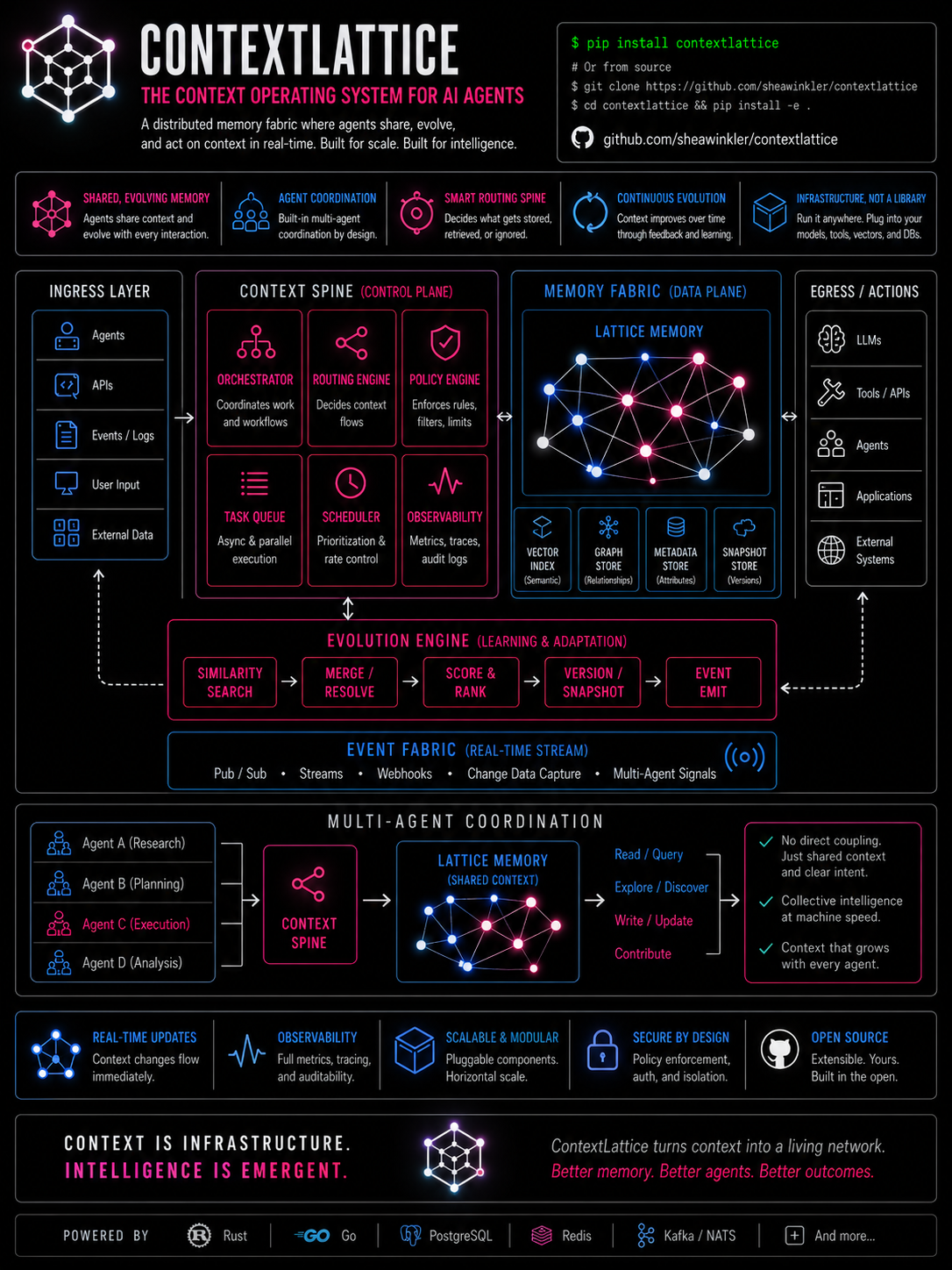
Open an agent. Already there.
The local-first intelligence layer that gives AI agents durable continuity, explainable retrieval, portable context, and verified learning across harnesses.





Overview | Architecture | Wiki | Roadmap | Installation | Integrations | Premium | App Surface | Troubleshooting | Updates
The Missing Layer
Models can reason. Harnesses can act. Neither one remembers the mission reliably after the chat, tool, account, or computer changes. ContextLattice closes that gap without turning every prompt into a transcript landfill.
- Durable continuity. Reopen the exact active mission with its checkpoint, decisions, risks, repository identity, proof, and next move already assembled.
- Explainable retrieval. Spend the context window on the evidence with the highest impact per token, then expose why each result was selected, opposed, deferred, or omitted.
- Portable context. Move signed, least-privilege continuation packets across agents, harnesses, accounts, and machines without surrendering provenance or execution control.
- Verified skill evolution. Convert repeated successful work into evaluated, human-approved skills; keep policy candidates shadow-only until deterministic evidence earns promotion.
- Privacy-bounded Aggregate Signal. Learn from explicitly opted-in, clipped statistics while raw prompts and memory stay local. Production cohort learning remains a controlled activation preview, hard-blocked until independent privacy and utility reviews pass.
More Than Memory
ContextLattice packages the full operating layer around agent intelligence: durable writes, scoped Context Packs, deterministic synthesis, temporal claims, graph links, Skills Index discovery, behavior provenance, agent sessions, Continuity Identity, Utility Ledger economics, Context Passports, encrypted Context Mesh, Agent Fit, Policy Laboratory, Pi/Droid runner adapters, and automatic instruction hooks for supported harnesses.
The CLI is the primary interface. The dashboard makes behavior and proof visible. HTTP and MCP remain companion integration surfaces for applications and harnesses that need them.
v4.0.2 is the current release baseline. The active application path is Go/Rust; Python is retained for build, development, migration, and audit tooling rather than live request handling. Public local mode is account-free. Paid artifacts add hosted distribution, workspace governance, protected operations, and advanced analytics without moving local memory into a mandatory cloud.
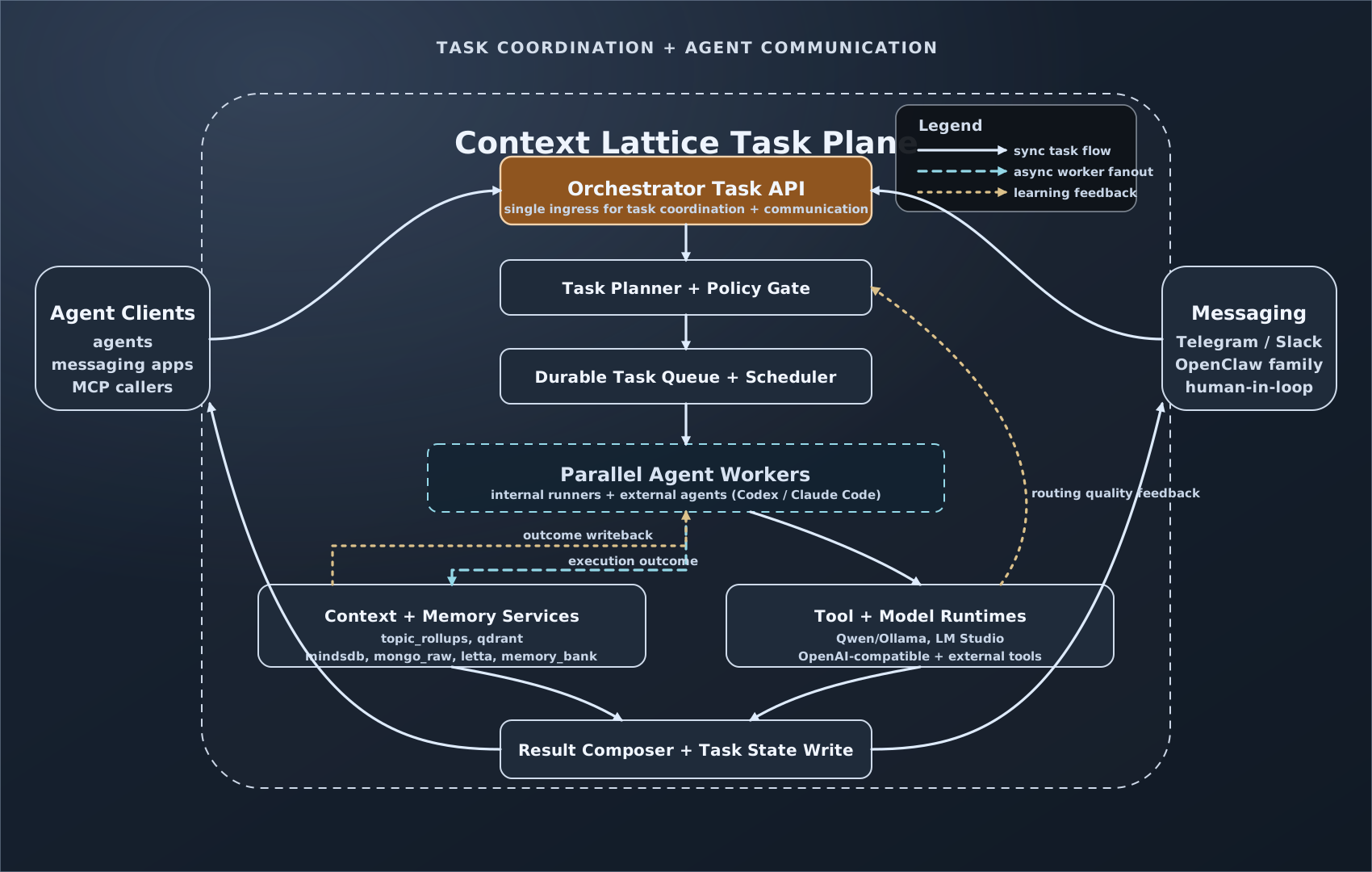
Architecture Snapshot
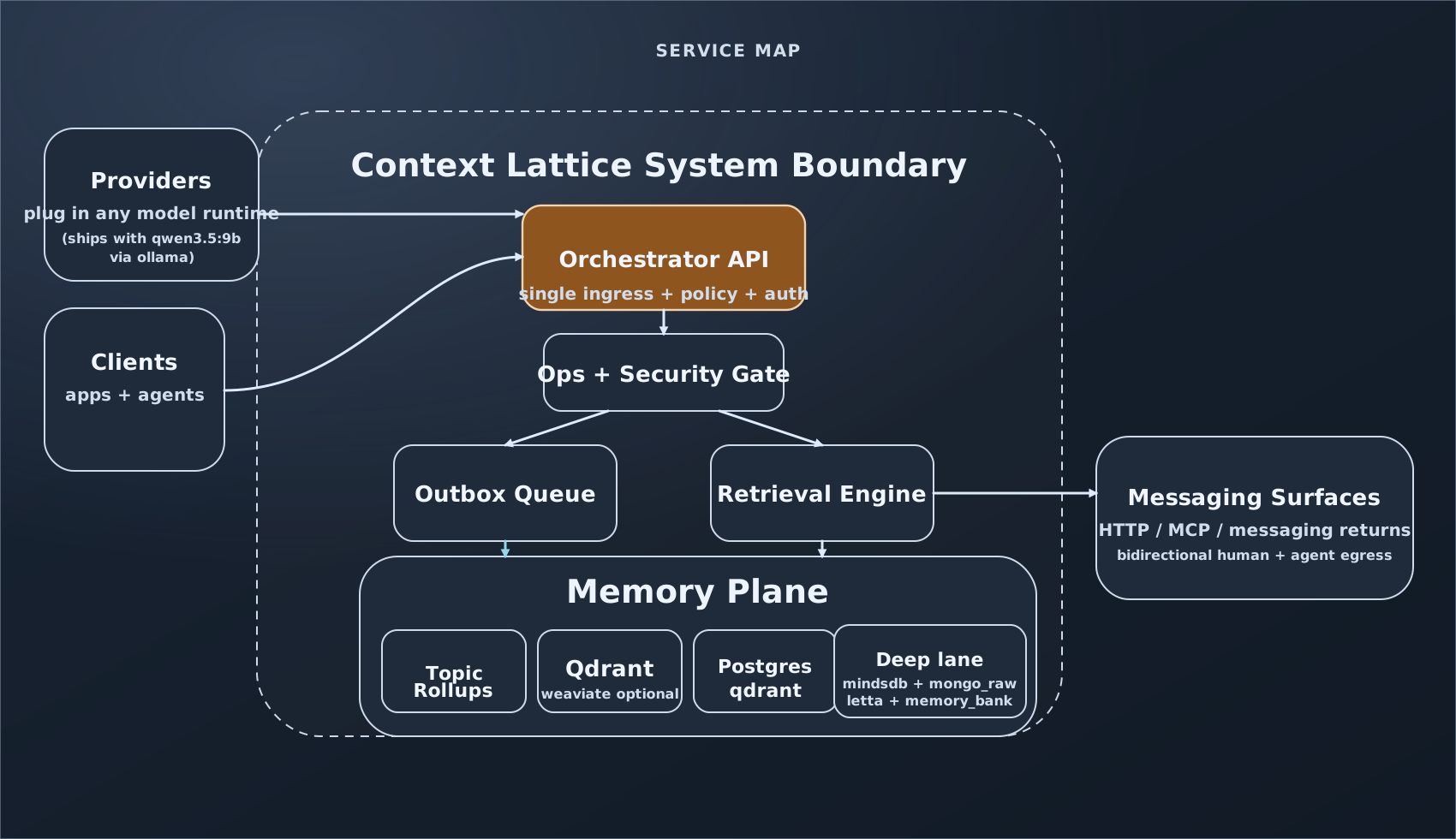
|
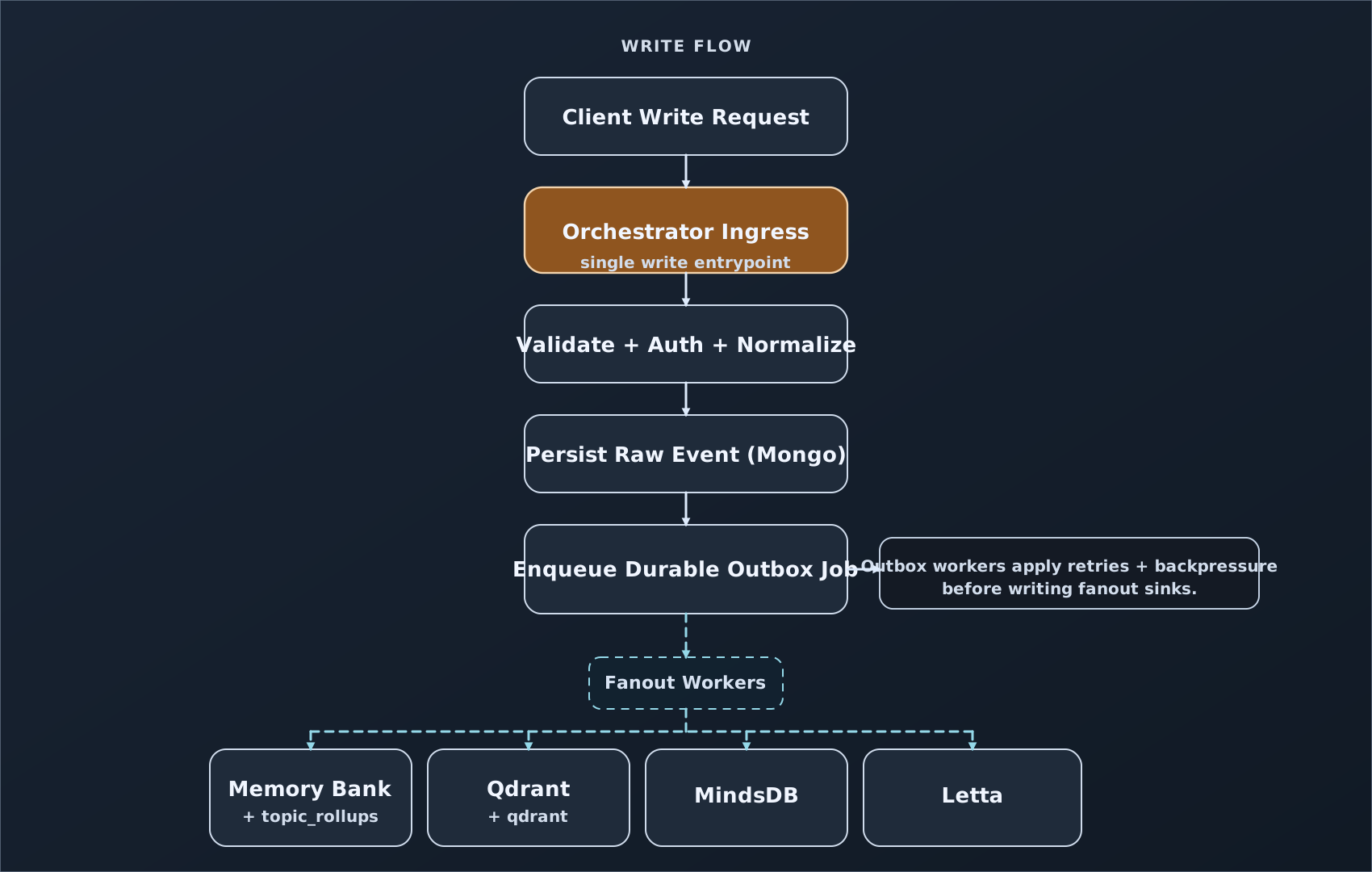
|
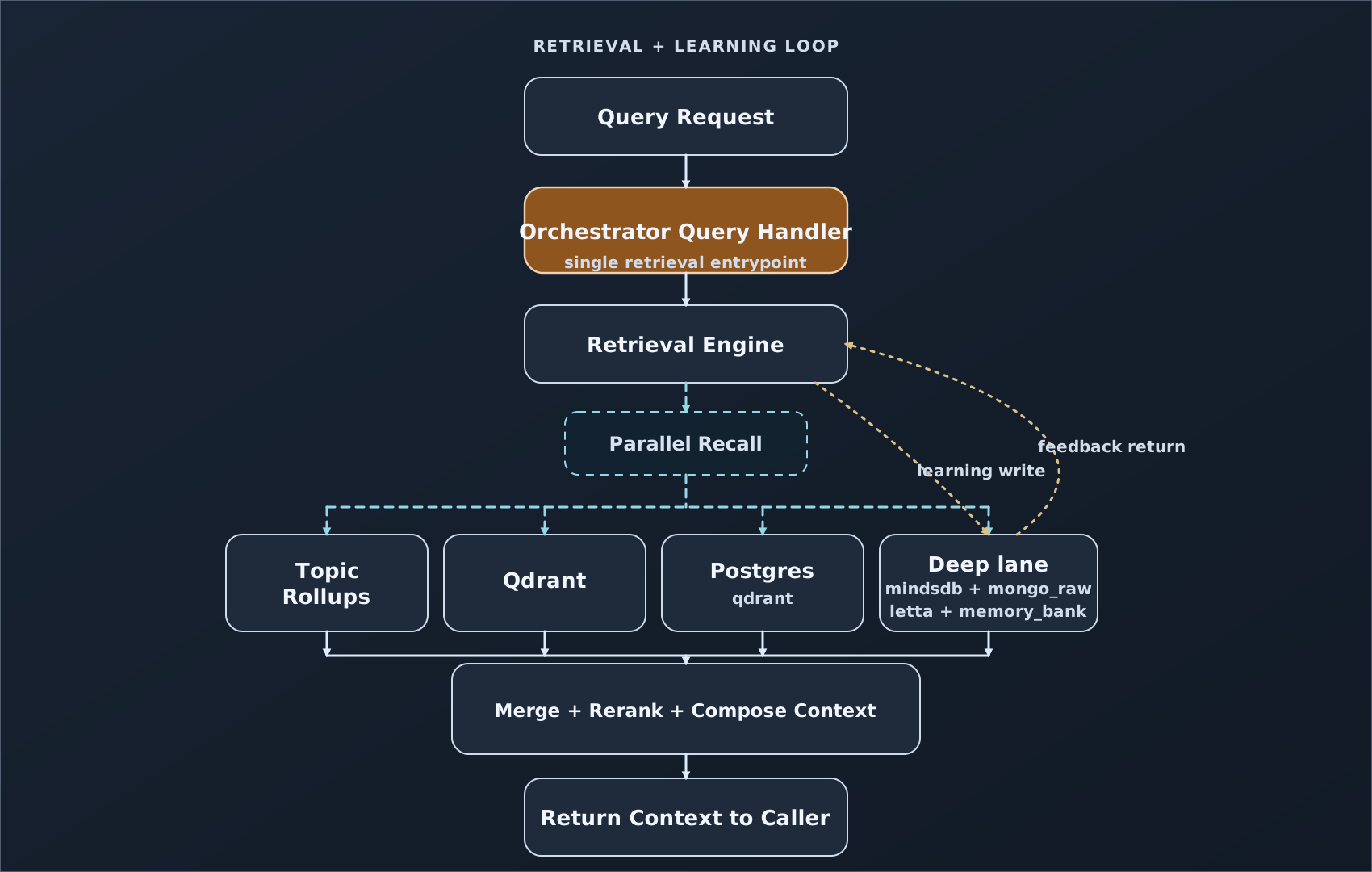
|
|
Operator Wiki
Use the new operator wiki as the canonical “best tools + graphics” runtime manual for public/main.
- Website wiki (recommended):
https://contextlattice.io/wiki.html - Repo mirror:
docs/wiki/README.md - Retrieval receipts and trust model:
docs/retrieval-receipts.md - Scope: endpoint atlas, retrieval mode policy, continuation behavior, release-ready playbooks, and agent templates
Cognition Core CLI
The CLI is the prescribed agent interface. HTTP and MCP remain integration fallbacks.
# Normal task lifecycle: compact context, one reusable session, automatic outcome learning.
contextlattice doctor --pretty
contextlattice context "debug the current release regression" --project contextlattice --pretty
contextlattice remember "checkpoint summary" --project contextlattice --pretty
contextlattice resume --project contextlattice --pretty
contextlattice correct "retrieval was stale" --category stale --project contextlattice --pretty
contextlattice finish "verified result" --success --project contextlattice --pretty

# Measure useful work without mixing model-visible, wire, or provider totals.
contextlattice utility status --project contextlattice --pretty
# Record the claim, then have the named independent verifier attest the result.
contextlattice utility record --session-id <id> --context-pack-quality-sample-id <id> --outcome-id <id> --utility-value 1 --utility-unit acceptance_points --verification-event-id <id> --verification-evidence-digest sha256:<64-hex> --verification-passed true --verifier-kind deterministic_test --verifier-id <independent-verifier> --pretty
contextlattice utility verify --agent-id <independent-verifier> --session-id <id> --sample-id <id> --outcome-id <id> --utility-value 1 --utility-unit acceptance_points --verification-event-id <id> --verification-evidence-digest sha256:<64-hex> --verification-passed true --verifier-kind deterministic_test --verifier-id <independent-verifier> --pretty
# Paid analytics and gates are advisory only; they never rewrite retrieval policy.
contextlattice utility analytics --project contextlattice --pretty
contextlattice utility gate --project contextlattice --utility-unit acceptance_points --minimum-pairs 2 --pretty

# Optional delta transport for clients that retain the last trusted packet.
# A full packet is the safe fallback and becomes the next base directly.
contextlattice context "continue the release proof" --project contextlattice \
  --base-packet-file agent-packet.json --raw > packet-update.json
contextlattice packet-reconstruct --base-packet-file agent-packet.json \
  --delta-file packet-update.json --raw > next-agent-packet.json
# Pre-upgrade packets without identity metadata safely receive a new full packet.
# Packet digests detect drift but do not authenticate origin; retain the base in trusted storage.

# Advanced cognition and operator surfaces follow.
# Ask what evidence should be retrieved, from where, and when to stop.
contextlattice_retrieval_plan "debug the current release regression" --project contextlattice --pretty

# Policy Laboratory is CLI-first and advisory unless an explicit operation applies a reversible receipt.
contextlattice_policy_lab status --project contextlattice --pretty

# Inspect governed retrieval operations. Public installs discover the contract;
# paid artifacts provide stateful workspace policy and operations.
contextlattice retrieval-governance status --feature receipts --project contextlattice --pretty

# Persist a structured, time-aware assertion with explicit provenance.
contextlattice_claim_write \
  --project contextlattice \
  --subject release \
  --predicate current_version \
  --object 4.0.1 \
  --statement "The current public release is 4.0.1." \
  --pretty

# Query current, historical, superseded, or contradicted claims.
contextlattice_claim_query "current public release" --project contextlattice --include-superseded --pretty

# Return claim-level support, opposition, temporal state, uncertainty, and missing proof.
contextlattice_synthesis_pack_v2 "prove release readiness" --project contextlattice --pretty

# Resolve one durable task identity before opening another execution lane.
contextlattice_continuity_reconcile "ship continuity identity" \
  --project contextlattice --repo contextlattice --task-id frontier-t1 \
  --branch main --agent-id codex_gpt5 --pretty

# Append lifecycle evidence, inspect the objective as it existed then, and record why a decision changed.
contextlattice_objective_transition "ship continuity identity" --type progressed \
  --project contextlattice --actor codex_gpt5 \
  --idempotency-key frontier-t1-contract-proof \
  --summary "HTTP and CLI contracts verified" --pretty
contextlattice_objective_graph --project contextlattice --pretty
contextlattice_decision_change --project contextlattice --objective-id <objective-id> \
  --idempotency-key frontier-t1-semantic-abstention \
  --before "reuse every semantic match" --after "require confirmation after exact miss" \
  --confidence-before 0.45 --confidence-after 0.92 --evidence <evidence-ref> \
  --actor codex_gpt5 --rationale "Ambiguous matches must abstain." \
  --reason-code evidence_changed --pretty

# Derive a candidate only from calibration-eligible outcomes, then inspect it.
contextlattice_policy_candidate --project contextlattice --pretty
contextlattice_policy_status --pretty

# Build from repeated verified runs, test separate holdouts, then export only with approval.
contextlattice_skill_draft --payload-file workflow-runs.json --pretty
contextlattice_skill_evaluate --draft-id <draft-id> --payload-file holdouts.json --pretty
contextlattice_skill_export --draft-id <draft-id> --human-approved --approver <identity> --pretty
contextlattice_skill_retire --draft-id <draft-id> --operator <identity> --reason "temporary proof completed" --pretty

# Steer capable agents, resolve their effective profile, and request advisor-only
# runner/model selection without moving execution into the gateway.
contextlattice agent-fit steering-watch --project contextlattice --agent-id codex_gpt5 --once --raw
contextlattice agent-fit profile-resolve --project contextlattice --agent-id codex_gpt5 --raw
contextlattice agent-fit runner-select --payload-file runner-candidates.json --raw
contextlattice agent-fit context-prep-schedule --project contextlattice --payload-file prep-request.json --raw

# Continuity Zero: open the one unambiguous active mission already assembled.
# The optional artifact is written owner-only; no local path is sent to the gateway.
contextlattice_continuity_zero --project contextlattice --agent codex \
  --output continuity-zero.json --pretty

# Carry signed evidence across machines without surrendering trust or transport.
contextlattice_passport_export "prepare the release handoff" --project contextlattice --output passport.json --pretty
contextlattice_passport_verify --file passport.json --pretty
contextlattice_mesh_identity --pretty

# Portable Continuation: grant narrowly, seal locally, move through your chosen
# channel, then decrypt and reconcile without importing or executing anything.
contextlattice_agent_tools portable-continuation grant-create \
  --payload-file grant-request.json --output grant.json --pretty
contextlattice_agent_tools portable-continuation manifest-create \
  --payload-file continuation-request.json --output continuation-envelope.json --pretty
contextlattice_agent_tools portable-continuation manifest-reconcile \
  --payload-file reconciliation-request.json --envelope-file continuation-envelope.json --pretty
contextlattice_agent_tools portable-continuation status --pretty
The planner remains shadow_only: learned candidates are advice, not a hidden configuration rewrite. Skill exports remain inactive files until reviewed and installed through the normal Skills Index workflow. Passport replay never executes imported text, and Mesh never owns transport. See docs/continuity-identity.md, docs/cognition-proof-core.md, docs/outcome-policy-skill-foundry.md, and docs/context-passport-mesh.md for contracts, safety boundaries, and HTTP fallbacks.
Quickstart
Agent Quickstart: Install + Integrate
If you are an AI agent reading this README because a user asked you to install or integrate ContextLattice, follow this section directly. Do not wait for the user to copy another prompt back to you.
Human users can also paste the block below into Codex, Claude Code, Hermes, OpenCode, OMP, Mercury, or another terminal-capable agent.
You are integrating ContextLattice.

Repository:
https://github.com/sheawinkler/ContextLattice.git

Goals:
- Install and launch ContextLattice locally.
- Verify the runtime is healthy.
- Integrate the target repo with ContextLattice-supported agent profiles.
- Do not install third-party agent harness binaries unless the user explicitly asks.

Important:
- `contextlattice_adopt integrate` writes managed instruction blocks for supported profiles.
- Installer flows may add managed instruction hooks for detected OMP and Mercury user-instruction files; they do not install OMP, Mercury, Codex, Claude Code, Hermes, Hermes Ultra, Pi, Droid, or other agent binaries.
- Optional Pi/Droid runner execution requires their CLIs (`brew install pi-coding-agent`, `brew install --cask droid`).
- Preserve existing user text in repo instruction files.
- If you are already inside a ContextLattice checkout, do not clone a duplicate repo.

Install ContextLattice:

git clone https://github.com/sheawinkler/ContextLattice.git
cd ContextLattice
cp .env.example .env
gmake quickstart

Verify ContextLattice:

curl -fsS http://127.0.0.1:8075/health | jq
contextlattice_adopt status --pretty

Integrate the target repo:

cd /path/to/target/repo
contextlattice_adopt integrate --repo . --agents codex,claude-code,opencode,hermes-agent,hermes-ultra,omp,mercury-agent,pi,droid --pretty
contextlattice_adopt integrate --repo . --agents codex,claude-code,opencode,hermes-agent,hermes-ultra,omp,mercury-agent,pi,droid --check --pretty
contextlattice_doctor --repo . --agents codex,claude-code,opencode,hermes-agent,hermes-ultra,omp,mercury-agent,pi,droid --skip-provider-smoke --pretty

If any step fails:
- Report the exact failing command and path.
- Fix only the local setup issue needed for that failure.
- Rerun the check.
- If ContextLattice is unreachable, continue in degraded-memory mode and say so explicitly.
For the full reusable agent contract, see docs/public_overview/templates/agents/universal.md.
1) Clone and configure
git clone [email protected]:sheawinkler/ContextLattice.git
cd ContextLattice
cp .env.example .env
2) Launch (recommended)
gmake quickstart
gmake quickstart prompts for runtime profile and then launches the selected stack.
It is the canonical first-install path; signed installers are bootstrap alternatives, not a competing control surface.
3) Verify
curl -fsS http://127.0.0.1:8075/health | jq
scripts/agent/agent-runtime-proof-pack --pretty
scripts/agent/agent-adoption-proof-matrix --skip-provider-smoke --progress --pretty
Expected:
/healthreturns{"ok": true, ...}agent-runtime-proof-packcompletes bootstrap, scoped recall, checkpoint, handoff, completion, status, prompt context package, and runtime telemetry phases.agent-adoption-proof-matrixverifies configured agent profiles and reports the skills, context, session, graph, and handoff evidence shaping each run, with trace commands for run-card export.
Model Runtime
Task inference defaults to ORCH_INFER_PROVIDER=auto. gateway-go detects the host profile and probes local backends before selecting a route.
- Apple Silicon default priority:
mlx,vllm-metal,ane_sidecar,llama-cpp,ollama. - CUDA/ROCm default priority:
sglang,vllm,openai-compatible,llama-cpp,lmstudio,ollama. - Generic CPU default priority:
openai-compatible,llama-cpp,lmstudio,ollama. - Supported provider ids include
sglang,vllm,vllm-metal,mlx,mtplx(alias for MLX),openai-compatible,lmstudio,llama-cpp,tgi,tensorrt-llm,ane_sidecar, andollama. /v1/inference/runtime-policyreturns live provider health plus resource-aware model guidance. If host memory/VRAM is not identifiable, it falls back to generic local advice: start with Q4/IQ4 7B-9B models, benchmark, then scale up.- The current opt-in local model shortlist lives in
docs/runtime/local-model-options.md; it includes small/medium MLX, GGUF, and HF/safetensors candidates plus frontier-provider connection guidance. GGUF models use an external llama.cpp-compatible connector; ContextLattice does not start or bundle llama.cpp in Lite. - Large Qwen3.6 Dream Mode models are opt-in only; ContextLattice does not bundle or pull them by default. The default GGUF recommendation is
mudler/Qwen3.6-35B-A3B-Claude-4.7-Opus-Reasoning-Distilled-APEX-MTP-GGUFfor llama.cpp-compatible advanced users. Abliterated variants are private-eval only behindCONTEXTLATTICE_DREAM_ALLOW_PRIVATE_EVAL_MODELS=true(GO_DREAM_ALLOW_UNCENSORED_MODELS=trueremains a legacy alias). - Inference runtimes must emit final assistant content through their API. Reasoning-only responses fail with repair instructions instead of being accepted. For MLX Qwen thinking templates, use
scripts/inference_mlx_server.sh --model /path/to/mlx/model --template-profile qwen-final-content, then verify withscripts/inference_template_conformance.sh --provider mlx --model /path/to/mlx/model. - Dream Mode reflects on LLM-generated hypotheses by default and performs one bounded deepening pass when the best output misses the sigma target (
GO_DREAM_REFLECT_ENABLED=true,GO_DREAM_DEEPEN_ON_WEAK_OUTPUT=true,GO_DREAM_REFLECTION_MIN_SCORE=0.74). If structured LLM synthesis is unavailable, Dream Mode returnsdream_unavailable; non-LLM evidence packaging belongs to context-pack or review. - Ollama remains a compatibility fallback, not the preferred always-on embedding path.
- Local helpers enforce one active LLM backend by default (
CONTEXTLATTICE_SINGLE_ACTIVE_INFER_BACKEND=true).
Inspect live routing and benchmark configured backends:
scripts/inference_runtime_policy.sh
scripts/benchmark_inference_backends.sh
scripts/inference_template_conformance.sh --provider mlx --model /path/to/mlx/model
Embedding defaults to the Rust fastembed-rs sidecar. Ollama stays available as an explicit compatibility fallback, not the preferred embedding path.
Useful model runtime knobs:
ORCH_INFER_PROVIDER=auto
ORCH_INFER_PROVIDER_PRIORITY=mlx,vllm-metal,ane_sidecar,sglang,vllm,openai-compatible,llama-cpp,ollama
ORCH_INFER_AUTO_PROBE_ENABLED=true
SGLANG_BASE_URL=http://127.0.0.1:30000
VLLM_BASE_URL=http://127.0.0.1:8000
VLLM_METAL_BASE_URL=http://127.0.0.1:8000
MLX_API_BASE=http://127.0.0.1:18087/v1
LLAMA_CPP_BASE_URL=http://127.0.0.1:8080
Agent CLI
Installer and quickstart paths install agent helpers under $HOME/.contextlattice/bin.
contextlattice_agent_adapter profiles
contextlattice_adopt status --pretty
contextlattice_doctor --agents codex --skip-provider-smoke --pretty
contextlattice_agent_start --soft --compact
contextlattice_agent_trace --session-id <session-id> --tree
contextlattice_pack "what should the next agent know?" --project my-project --pretty
contextlattice_search -h
contextlattice_write -h
contextlattice_checkpoint -h
contextlattice_skills_index search "browser automation" --pretty
contextlattice_passport_export "portable task context" --project my-project --output passport.json --pretty
contextlattice_mesh_status --pretty
contextlattice_agent_adapteris the first-class lifecycle helper for bootstrap, context-pack, checkpoint, handoff, state, event, and completion flows.contextlattice_agent_adapter state --state working|awaiting_user|blocked|done --session-id <id> --prettyreports semantic agent lifecycle state with authority, source, TTL, native session id, task id, repo, worktree, branch, cwd, and user/blocker fields.contextlattice_agent_discover --agents codex,claude-code,opencode,hermes-agent,hermes-ultra,omp,mercury-agent,pi,droid --repo . --prettyreports best-effort local process/profile/hook/repo-instruction evidence with explanations. Discovery is diagnostic evidence; explicit hook or adapter state remains authoritative.contextlattice_adoptis the zero-friction front door for local readiness, install guidance, profiles, and lifecycle proof;contextlattice_doctorcombines readiness, proof, and trace evidence in one bounded report.contextlattice_agent_startruns the lightweight startup guard for agents.contextlattice_agent_tracerenders the bounded run-shaping trail as a terminal tree, JSON, or Markdown run card.contextlattice_packcompiles a bounded prompt-ready packet with ranked evidence, files to inspect, risks, checks, source coverage, and areference_prompt.contextlattice_checkpointwrites a checkpoint and verifies readback.contextlattice_skills_indexdiscovers capabilities without loading every skill into startup context.contextlattice_passport_*signs, verifies, diffs, replays, and imports bounded context without executing imported instructions.contextlattice_mesh_*manages public recipient identity, grants, encrypted file/JSON envelopes, dry-run reconciliation, and explicit apply; transport remains caller-owned.contextlattice_source_backfillis an optional development helper, installed withscripts/install_global_agent_tools.sh --include-dev-python-tools, for bounded data imports.- Hook pack details:
docs/agent-hooks.md.
Agent Runtime Sessions
ContextLattice tracks live agent work as first-class sessions, independent of the runner or model provider.
- Start/list/read sessions through
GET|POST /v1/agents/sessionsandGET /v1/agents/sessions/{session_id}. - Emit normalized events through
POST /v1/agents/sessions/eventorPOST /v1/agents/sessions/{session_id}/events. - Inspect a bounded run trace through
GET /v1/agents/sessions/{session_id}/trace; the trace reports context, skills that may be helpful, source coverage, graph touches, handoffs, checkpoints, and timeline events without raw provider payloads. - Read live runtime telemetry from
GET /telemetry/agents/runtime. - Compile task context through
POST /memory/context-pack,POST /tools/context_pack, or globalcontextlattice_pack; responses includecontext_compiler, ranked evidence, deterministicagent_guidancefor themes/risk markers/candidate attention links, prompt sections, and a boundedreference_prompt. - Ask for Synthesis Pack v1 through global
contextlattice_synthesis_pack "<task>" --project <project> --pretty,POST /memory/synthesis-pack, orPOST /tools/synthesis_packwhen the next agent needs grouped high-signal findings, topic gravity, graph/cross-project bridges, must-not-forget constraints, recommended next actions, open questions, and semantic tags over the same bounded evidence. - Watch long-running recall through
scripts/agent/contextlattice-session watch --session-id <id> --continuation-token <token>; continuation responses includeretrieval_progress.v1, dashboard status links, and agent-visible steering when async work is ready. - Preflight, context-pack, and Dream Mode return
objective_runtime_state.v1withobjective_state,action_executed,evidence,objective_delta,risk_or_blocker, andnext_action. - Use
scripts/agent/contextlattice-agent-adapteror globalcontextlattice_agent_adapteras the first-class product path for agent bootstrap, context-pack, checkpoint, handoff, state, event, and completion flows. - Use
contextlattice_agent_adapter state --state working|awaiting_user|blocked|done --session-id <id> --prettyto report semantic agent lifecycle state with authority, source, TTL, native session id, task id, repo, worktree, branch, cwd, and user/blocker fields. - Use global
contextlattice_agent_discover --agents codex,claude-code,opencode,hermes-agent,hermes-ultra,omp,mercury-agent,pi,droid --repo . --prettyfor best-effort local process/profile/hook/repo-instruction discovery. Discovery explains why ContextLattice believes an agent is idle, working, waiting, blocked, or integrated; it does not replace explicit hook or adapter state. - Use
scripts/agent/contextlattice-adoptor globalcontextlattice_adoptbefore handing ContextLattice to a new agent/account;doctorcombines gateway health, helper install state, shell PATH, storage posture, session store, profile coverage, best-effort discovery, runtime-doctor checks, lifecycle proof, and run trace evidence into one bounded report. - Run
contextlattice_adopt integrate --repo . --agents codex,claude-code,opencode,hermes-agent,hermes-ultra,omp,mercury-agent,pi,droid --prettyinside a target repo to write managedAGENTS.md,CLAUDE.md,HERMES.md,MERCURY.md,PI.md, andDROID.mdinstruction blocks without overwriting user text. - Run
contextlattice_doctor --agents codex --skip-provider-smoke --prettyfor the fastest new-agent adoption proof. - The same doctor works for other agent profiles:
contextlattice_doctor --agents claude-code --skip-provider-smoke --pretty,contextlattice_doctor --agents opencode --skip-provider-smoke --pretty, orcontextlattice_doctor --agents codex,claude-code,opencode --skip-provider-smoke --pretty. - Run
scripts/agent/agent-runtime-proof-pack --prettyor globalcontextlattice_agent_runtime_proof --prettyfor a one-command live proof that bootstrap, scoped recall, checkpoint, handoff, completion, status, and runtime telemetry are wired end to end. - Use
scripts/agent/contextlattice-sessionfor CLI start/event/complete/fail/status/runtime/trace flows. - Use
scripts/agent/agent-run-trace --session-id <id> --treeor globalcontextlattice_agent_trace --session-id <id> --treeto see the terminal trace, then--markdownto export the run card. - Use global
contextlattice_runner_quality --prettyto inspect bounded runner-quality telemetry for adapter success/block/failure rates, context-pack quality linkage, exact prompt-token savings, modeled inference-avoidance signals, and advisor-only runner recommendations. Repo-localscripts/agent/runner-quality --prettyremains available for development fallback. - Use
scripts/agent/contextlattice-session sweep-stale-audits --all-projects --prettyfor dry-run-first cleanup of stale objective-runtime audit/preflight sessions; add--confirmonly after reviewing matches. scripts/agent/contextlattice-pack,scripts/agent/contextlattice-dream,scripts/agent/writeback, and compaction hooks auto-start or recover a session whenCONTEXTLATTICE_SESSION_IDis absent.- Pass
--session-idorCONTEXTLATTICE_SESSION_IDto force a specific session. SetCONTEXTLATTICE_AUTO_SESSION_DISABLED=1to disable automatic session creation.
Canonical event families include session.started, agent.state.working, agent.state.awaiting_user, agent.state.blocked, agent.state.done, context_pack.completed, retrieval.continuation.progress, retrieval.continuation.ready, retrieval.continuation.degraded, dream.completed, graph.neighbors_returned, graph.edge_touched, decision.made, test.ran, handoff.created, writeback.completed, and session.completed.
Agent lifecycle and retrieval lifecycle are intentionally separate. agent_lifecycle.state describes the actor (idle, working, awaiting_user, blocked, done); retrieval_lifecycle.status describes source-fetch progress. This prevents async retrieval warming from being misread as a blocked or degraded agent.
Runner quality is intentionally separate from both lifecycle surfaces. It is advisor-only telemetry for operator selection, not automatic dispatch. See docs/runtime/runner-quality-loop.md for the compact adapter measurement loop and its interpretation limits.
Download Installers
- macOS DMG:
https://github.com/sheawinkler/ContextLattice/releases/latest/download/ContextLattice-macOS-universal.dmg - macOS signing/notarization operator notes:
docs/releases/macos-signing-notarization.md - Homebrew cask:
brew tap sheawinkler/contextlattice && brew install --cask contextlattice - Windows MSI:
https://github.com/sheawinkler/ContextLattice/releases/latest/download/ContextLattice-windows-x64.msi - Linux bundle:
https://github.com/sheawinkler/ContextLattice/releases/latest/download/ContextLattice-linux-bootstrap.tar.gz
Resource Profiles
| Profile | CPU | RAM | Storage |
|---|---|---|---|
| Lite core | 2-4 vCPU |
8-12 GB |
25-80 GB |
| Lite advanced | 4-6 vCPU |
12-16 GB |
80-140 GB |
| Full | 6-8 vCPU |
12-20 GB |
100-180 GB |
Optional constrained-disk guard: set QDRANT_HOT_STORAGE_MAX_BYTES to make launch/storage verification fail before the Qdrant hot lane exceeds your chosen byte ceiling. This is a guardrail, not a filesystem quota.
Optional external model storage: set OLLAMA_DATA to an absolute path to keep local Ollama model blobs off a constrained internal disk. When unset, the existing home-directory model store remains the backward-compatible default; startup storage verification rejects mount drift.
Memory Graph
GET|POST /v1/memory/edgespersists explicit typed relationships.POST /v1/memory/edges/backfillaudits or applies deterministic retroactive edges and opt-in same-projectinferred_relatedscoring. It is dry-run by default.POST /v1/memory/neighborsreturns explicit/inferred edge neighbors merged with semantic/topic neighbors.
contextlattice_memory_graph_repair --project my-project --pretty
contextlattice_memory_graph_repair --project my-project --write --confirm-project my-project --max-writes 500 --pretty
contextlattice_memory_graph_efficacy --refresh-cases --project my-project --graph-max-cases 3 --pretty

# Repo-local advanced fallback; inferred scoring is opt-in.
./scripts/agent/memory-edge-backfill --project my-project --max-writes 500
./scripts/agent/memory-edge-backfill --project my-project --include-inferred --min-confidence 0.90
./scripts/agent/memory-edge-inferred-retrofill --project my-project --corpus disk --profile exploratory
Source Backfill
Bring existing data into ContextLattice without changing the ingest boundary.
Backfill is dry-run by default, writes go through /memory/write, and writes
require --write --confirm-write <project>.
./scripts/agent/source-backfill-memory --source jsonl --path exports/tasks.jsonl --project my-project --pretty
./scripts/agent/source-backfill-memory --source sqlite --path app.db --table notes --project my-project --pretty
./scripts/agent/source-backfill-memory --source parquet --path warehouse/events.parquet --project my-project --pretty
./scripts/agent/source-backfill-memory --source postgres --dsn "$DATABASE_URL" --query "select id,title,body from notes limit 100" --project my-project --pretty
./scripts/agent/source-backfill-memory --source jsonl --path exports/tasks.jsonl --project my-project --write --confirm-write my-project --apply-edges --pretty
Supported adapters: files/directories, JSONL, JSON, CSV, SQLite, DuckDB, Parquet
via DuckDB, and Postgres via optional psycopg. Import caps cover records, row
bytes, document bytes, total bytes, and structured-list items. Secret-like
fields are redacted by default, and graph edge repair is optional and bounded.
Skills Index And Quarantine Discovery
ContextLattice exposes active skills as a native Go Skills Index so agents can discover relevant capabilities without loading every SKILL.md into prompt context. In local installs, the active index mounts ${HOME}/.codex/skills read-only by default. Quarantined/vendor skill discovery remains a separate read-only lane and does not auto-load quarantined skills.
- Active index endpoint:
GET|POST /v1/skills/index/search - Active index tool:
GET|POST /tools/skills_index_search - Active index status/reindex endpoint:
POST /v1/skills/index/reindex(live native scan; no prompt loading) - Search endpoint:
GET|POST /v1/skills/quarantine/search - Tool alias:
GET|POST /tools/skills_quarantine_search - Reindex endpoint:
POST /v1/skills/quarantine/reindex(off by default; enable explicitly)
Runtime knobs:
ORCH_SKILLS_QUARANTINE_ENABLED=true
ORCH_SKILLS_QUARANTINE_HOST_BIN_DIR=${HOME}/.local/bin
ORCH_SKILLS_INDEX_HOST_ACTIVE_ROOT_DIR=${HOME}/.codex/skills
ORCH_SKILLS_INDEX_HOST_SYSTEM_ROOT_DIR=${HOME}/.codex/skills/.system
ORCH_SKILLS_INDEX_ROOTS=/opt/contextlattice/skills_active:/opt/contextlattice/skills_system
ORCH_SKILLS_QUARANTINE_HOST_ROOT_DIR=${HOME}/.codex/skills_quarantine
ORCH_SKILLS_QUARANTINE_SEARCH_CMD=/opt/contextlattice/skills/bin/codex-skills-quarantine-search
ORCH_SKILLS_QUARANTINE_REINDEX_CMD=/opt/contextlattice/skills/bin/codex-skills-quarantine-reindex
ORCH_SKILLS_QUARANTINE_TIMEOUT_SECS=8
ORCH_SKILLS_QUARANTINE_DEFAULT_LIMIT=20
ORCH_SKILLS_QUARANTINE_MAX_LIMIT=100
ORCH_SKILLS_QUARANTINE_REINDEX_ENABLED=false
CODEX_SKILLS_QUARANTINE_ROOT=/opt/contextlattice/skills_quarantine
CODEX_SKILLS_QUARANTINE_INDEX_DIR=/opt/contextlattice/skills_quarantine/index
CODEX_SKILLS_QUARANTINE_INDEX=/opt/contextlattice/skills_quarantine/index/skills_index.jsonl
Security and Privacy
- Local-first by default.
- API-key protected operational routes.
- Secret-like content redaction controls.
- Premium billing/provider route maps are intentionally kept out of public docs.
Docs Index
- Overview:
https://contextlattice.io/ - Architecture:
https://contextlattice.io/architecture.html - Local AI workspace comparison:
https://contextlattice.io/local-ai-workspaces.html - Scaling memory:
https://contextlattice.io/scaling-memory.html - Wiki:
https://contextlattice.io/wiki.html - Installation:
https://contextlattice.io/installation.html - Integrations:
https://contextlattice.io/integration.html - Troubleshooting:
https://contextlattice.io/troubleshooting.html - Updates:
https://contextlattice.io/updates.html - Plans and distribution boundaries:
docs/public_overview/premium.html - Retrieval receipts and trust model:
docs/retrieval-receipts.md - Release notes, newest first; older entries are historical:
docs/releases/v4.0.2.md(one product truth across CLI, dashboard, docs, installers, release gates, and lane licensing)docs/releases/v4.0.1.md(public installer boundary repair with unchanged Aggregate Signal runtime semantics)docs/releases/v4.0.0.md(privacy-bounded Aggregate Signal, explicit consent, cohort suppression, and proof-held paid governance)docs/releases/v3.26.0.md(zero-entry continuity, fail-closed objective selection, and governed external-adapter intents)docs/releases/v3.25.0.md(evidence-qualified skill evolution, atomic Foundry handoff, and exact-receipt governance)docs/releases/v3.24.0.md(signed collaborative grants, provenance-preserving imports, and encrypted replay-safe continuation)docs/releases/v3.23.0.md(Agent Fit steering, advisor-only selection, adaptive profiles, and explicit context preparation)docs/releases/v3.22.0.md(Policy Laboratory simulation, scoped learning, reversible lifecycle, contradiction, and storage governance)docs/releases/v3.21.0.md(retrieval receipts, trust isolation, ablation, causal proof, and governed paid operations)docs/releases/v3.20.3.md(complete evaluation gate and governed efficiency-policy entitlement)docs/releases/v3.20.2.md(source-identical paid release tests and exact artifact provenance)docs/releases/v3.20.1.md(current-release provenance binding and historical-proof separation)docs/releases/v3.20.0.md(verified Utility Ledger, exact context economics, and advisory paid analytics)docs/releases/v3.19.1.md(panic-free terminal session commands, canonical lifecycle events, and legacy-client healing)docs/releases/v3.19.0.md(digest-verified Agent Packet deltas, exact reconstruction, and one gap-aware proof timeline)docs/releases/v3.18.0.md(durable continuity identity, holdout-locked semantic reconciliation, shared objective graphs, and witnessed decision provenance)docs/releases/v3.17.5.md(latest-only configured state, bounded owner-only migration, and fail-closed semantic readers)docs/releases/v3.17.4.md(regression-locked public artifact boundary and complete installer publication)docs/releases/v3.17.3.md(owner-only local stores, approval-before-work, evidence-qualified advice, and exact runtime truth)docs/releases/v3.17.2.md(operator-chosen Ollama storage, verified mount truth, and sourceable environment profiles)docs/releases/v3.17.0.md(canonical commercial truth, self-contained installers, strict public boundary, and tiny-pack identity)docs/releases/v3.16.1.md(contract-valid compact lifecycle receipts for the primary CLI)docs/releases/v3.16.0.md(compact Agent Packet, session truth, monotonic async, outcome learning, unified CLI, and proof workbench)docs/releases/v3.15.1.md(Node 24 LTS convergence across local tooling, containers, packages, and release actions)docs/releases/v3.15.0.md(bounded graph repair, explicit graph efficacy, hydrated neighbors, and durable Foundry retirement)docs/releases/v3.14.0.md(signed Context Passport and encrypted Context Mesh)docs/releases/v3.13.0.md(outcome-trained canary policy and Skill Foundry)docs/releases/v3.12.0.md(Temporal Claim Graph, adaptive retrieval planning, and Proof-Carrying Synthesis v2)docs/releases/v3.11.2.md(evidence-preserving sparse Context Packs and grounded deterministic synthesis)docs/releases/v3.11.1.md(upgrade-safe runner discovery across long-lived agent environments)docs/releases/v3.11.0.md(Synthesis Packs, async warming, outcome calibration, memory activation evidence, and public-core parity)docs/releases/v3.10.2.md(Go-native feedback submit, idempotency, preference projection, and strict ownership coverage)docs/releases/v3.10.1.md(detected OMP/Mercury instruction hooks and default adoption coverage)docs/releases/v3.10.0.md(optional Pi/Droid runner adapters, runner-quality advisor, and CLI-first public surface)docs/releases/v3.9.1.md(dashboard contrast, settings clarity, public-site alignment, and current-version guidance)docs/releases/v3.9.0.md(agent-operable context-pack outcome telemetry and observed provider usage)docs/releases/v3.8.0.md(MongoDB driver v2 migration and Context Pack Quality Ledger)docs/releases/v3.7.1.md(MongoDB driver security patch for the v3.7 train)docs/releases/v3.7.0.md(tokenizer-exact prompt economics, bounded token-impact ledger, and release-note hygiene)docs/releases/v3.6.2.mddocs/releases/v3.5.0.mddocs/releases/v3.4.25.mddocs/releases/v3.4.14.mddocs/releases/v3.4.13.mddocs/releases/v3.4.12.mddocs/releases/v3.4.11.mddocs/releases/v3.4.10.mddocs/releases/v3.4.5.mddocs/releases/v3.4.2.mddocs/releases/v3.4.1.md
- Local model options:
docs/runtime/local-model-options.md
License
Apache License 2.0 (LICENSE).
Reviews (0)
Sign in to leave a review.
Leave a reviewNo results found