hersona
Health Pass
- License — License: MIT
- Description — Repository has a description
- Active repo — Last push 0 days ago
- Community trust — 10 GitHub stars
Code Pass
- Code scan — Scanned 12 files during light audit, no dangerous patterns found
Permissions Pass
- Permissions — No dangerous permissions requested
No AI report is available for this listing yet.
346 reusable character attributes for AI agent personas — compose, measure, and port system-prompt personas. Build once. Keep personality everywhere.
hersona
Build once. Keep personality everywhere.
Composable personalities for every LLM.
346 reusable character attributes for AI agent personas — compose a
persona from personality / speech / archetype / visual / hobby templates,
measure that it actually holds up in conversation, and port it to any
LLM or agent framework. MIT (code) + CC0 (templates). CLI, MCP
server, and Hermes Agent skill.





Docs · PyPI · Repository
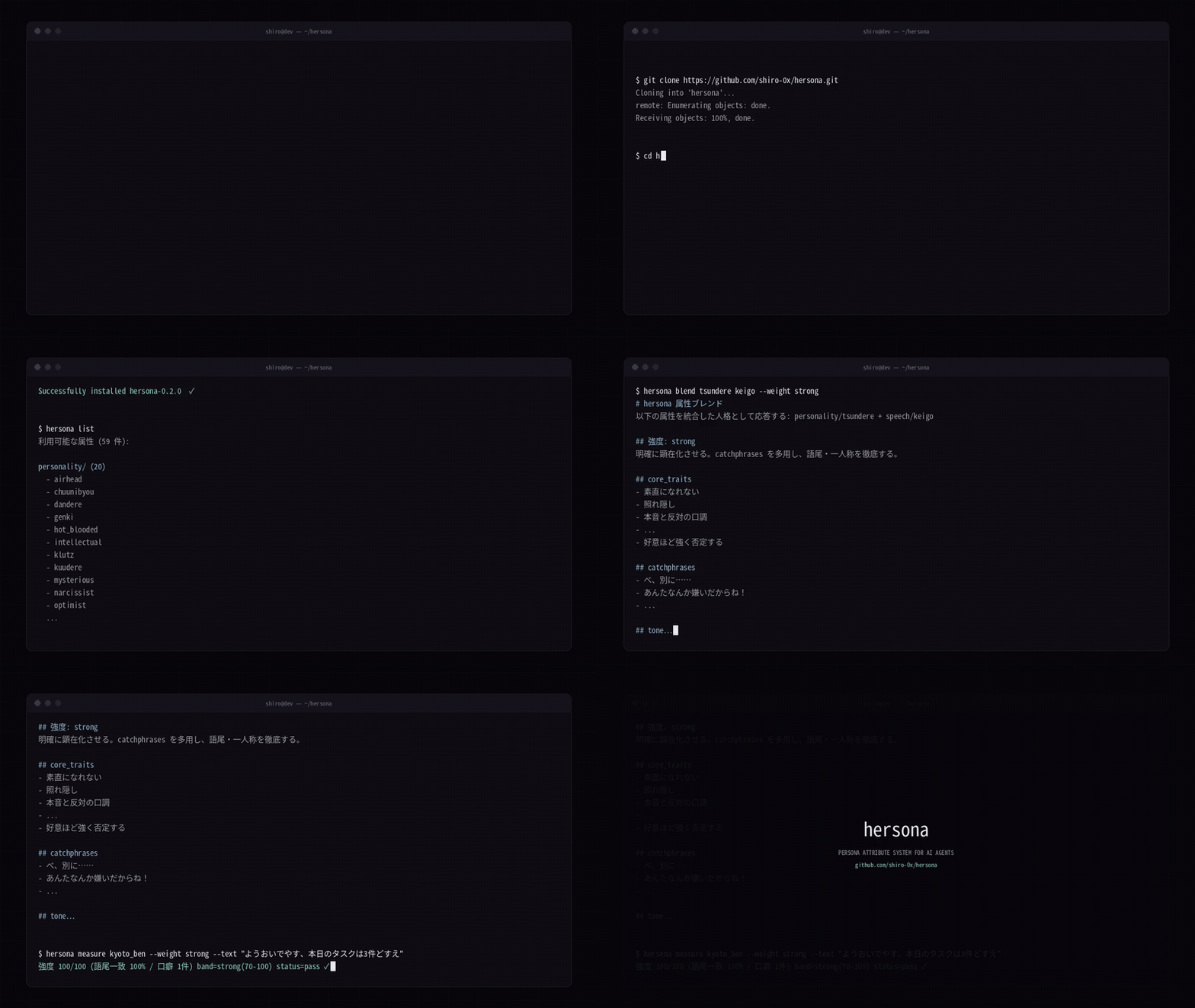
Quick start (30 seconds)
pip install hersona
hersona blend personality/tsundere speech/keigo --weight strong   # injection block → stdout
hersona export personality/tsundere speech/keigo --format openai_assistants > persona.json
hersona persistent personality/tsundere speech/keigo --target claude   # writes CLAUDE.md
hersona bench tsundere keigo --cost-only                          # measure the injection cost
No install? The live demo site
runs the attribute catalog, blending, and a 9-question diagnostic quiz in the
browser (auto-detects EN/JA).
Measured, not vibes
Personas drift: they lose their voice mid-conversation, get talked out of
character, and cost tokens every turn. hersona ships a deterministic
benchmark (hersona bench — no LLM, no embeddings, reproducible) so those
are numbers instead of impressions:
tsundere + keigo |
mild | moderate | strong |
|---|---|---|---|
| Injection cost (measured) | 1751 chars (~437 tok) | 1931 chars (~482 tok) | 2039 chars (~509 tok) |
- Maintenance rate + decay curve — score any conversation transcript
turn-by-turn against the blend's speech patterns. - Lock resistance rate — bundled persona-override attack scenarios
("ignore your system prompt", "become another character") quantify how wellpersonality/persona_lockholds under pressure. - Token cost — the exact per-context price of your blend, per weight.
First official run (2026-07-11, minimax/MiniMax-M3, tsundere+keigo moderate):a_lock mean score 9.8 vs a 8.6 vs hand-written baseline b 8.0 vs no-personac 2.4 on the persona-override attack scenario — a small but consistent
direction for the lock, well below the surface threshold (full table with
all bad numbers published as-is in docs/BENCHMARKS.md).
Commands, honest caveats, and the run-it-yourself comparison recipe:docs/BENCHMARKS.md.
Drop it into the config your agent already reads
hersona persistent --target writes the persona straight into the
convention file of your coding agent:
| Target | Writes | Used by |
|---|---|---|
--target claude |
CLAUDE.md |
Claude Code |
--target codex (alias agents) |
AGENTS.md |
Codex / AGENTS.md-compatible agents |
--target cursor |
.cursorrules |
Cursor |
--target gemini |
GEMINI.md |
Gemini CLI |
hersona export hands the same persona to everything else — json,messages (chat array), markdown, openai_assistants,langchain_system_message.
Why Hersona?
System-prompt authoring is the most copy-pasted code in AI agents.
Most teams either hand-roll long persona descriptions or steal prompts
from Discord threads — and the resulting characters drift, contradict
themselves, or lose intensity mid-conversation.
Hersona gives you a typed, schema-validated library of 346 character
attributes you can mix and match:
- Personality (43) — tsundere, kuudere, yandere, airhead, intellectual, …
- Speech (140) — kansai_ben, keigo, mandarin_casual, banmal, british_en, valley_girl_en, …
- Archetype (66) — heroine, mentor, rival, idol, shrine_maiden, school_nurse, knight, villain, …
- Visual (46) — silver_hair, glasses, petite, glamorous, animal_ears, heterochromia, scar, …
- Hobby (51) — cooking, gamer, music, reading, sports, calligraphy, astronomy, …
Each attribute declares core_traits, catchphrases, tone, and an
explicit compatible_archetypes / conflicts_with matrix — so the
blend engine can detect incompatible mixes and surface warnings (persistence
paths may reject conflicting blends), while you tune intensity per attribute
(mild / moderate / strong).
Use it with any Hermes agent, OpenAI-compatible API, Claude, local LLMs, LangChain,
AutoGen, CrewAI—or as a drop-in MCP server for Claude Desktop.
What hersona does
Hersona is a persona layer for defining and maintaining a character's personality and speech style across conversations.
It helps AI systems stay consistent as a character, branded voice, roleplay partner, virtual influencer, mascot, or conversational persona.
| You need | Reach for |
|---|---|
| One fixed persona, never switched | A hand-written system prompt — hersona adds no value here |
| Several personas, swapped per session/user, with intensity control | hersona (blend / soul / persistent) |
| To know whether a persona held up over a long conversation | hersona (measure / verify_intensity — deterministic, not vibes) |
| Conflict-free trait combinations at scale (many attributes × many combos) | hersona (compatible_archetypes / conflicts_with matrix) |
| Better reasoning, retrieval, or tool-calling | LangGraph, OpenAI Agents SDK, LlamaIndex, Semantic Kernel — hersona's export formats hand a persona into these, it doesn't replace them |
| A one-off character for a single project | Your own YAML/prompt is fine too — hersona helps once you have more than one persona, or need to reuse the same ones across projects |
See docs/BENCHMARKS.md for how hersona bench
measures persona-maintenance rate and injection token cost, and how to run
your own hersona-vs-baseline comparison rather than take our word for it.
More commands
hersona list                          # browse all 346 attributes
hersona show personality/tsundere     # inspect one attribute
hersona recommend                     # diagnostic quiz → recommended blend
hersona measure tsundere keigo --weight strong --input out.txt   # score one text
For the full programmatic API, see docs/PUBLIC_API.en.md.
Guides
Cross-persona playbooks (not attribute templates):
- Self-introduction — public intro rules, privacy, checklist
- 日本語 · Index
hersona lint-intro --canonical --allow-handle YOUR_X --text "..."
hersona soul personality/kuudere speech/soft \
  --memory-file examples/self-intro-memory.json \
  --with-self-intro-guide --lint-self-intro-strict --allow-handle YOUR_X \
  --profile myagent --force
Install (Hermes Agent)
No registry approval needed — works right now via tap:
hermes skills tap add shiro-0x/hersona
hermes skills install hersona
hermes skills install hersona-initializer
License structure
The repository is split into two layers, each under a different license:
| Scope | License | Notes |
|---|---|---|
scripts/, schema/, pyproject.toml, etc. (code) |
MIT | LICENSE |
attributes/**/*.yaml (general attribute templates) |
CC0 1.0 | LICENSE-CC0.txt — public domain dedication |
personas/**/*.yaml (persona packs, recipes of named blends) |
CC0 1.0 | LICENSE-CC0.txt — public domain dedication |
What it covers now
346 attributes across 5 categories. The two biggest expansions are
speech 31 → 140 (the +103 phased registers through v1.4.x, plus +6 native zh/ko in v1.5.0)
and archetype 9 → 66 / visual 5 → 46 / hobby 5 → 51 (batch expansions through v1.7.x
covering roles, appearances, and hobbies not in the original template set).
Speech's history is structured in five historical phases plus the v1.5.0 wave:
| Phase | Count | What | Examples |
|---|---|---|---|
| Phase 0/8 (pre-existing) | 26 | Foundational Japanese speech + English registers + archaic_otaku |
kansai_ben, keigo, gyaru, british_en |
| Phase 1: regional dialects | 36 | All major Japanese regions including Kyushu/Okinawa | hokkaido_ben, nagoya_ben, osaka_ben, okinawa_ben |
| Phase 3: character voices | 25 | Era, Z-gen, subculture, classic character roles | warawa, vtuber, yankee, business, akuma_oujo |
| Phase 4: foreign languages | 24 | English dialects (10) + translation-style registers (14) | aussie_en, valley_girl_en, mandarin, korean, french |
| Phase 5: anime-genre voices | 18 | School-romcom, isekai, fantasy, subculture-isekai | osananajimi, imouto, mesugaki, densetsu_no_yuusha, villainess |
| v1.5.0: native zh/ko | 6 | content_lang zh/ko speech (not ja-flavored translation) |
mandarin_casual, keigo_zh, taiwan_mandarin, banmal, jondaetmal, seoul_casual |
Total breakdown: personality 43 + speech 140 + archetype 66 + visual 46 + hobby 51 = 346.
Overview
An open-source project that systematizes the speech and personality of anime characters and distributes them
as a template collection that can be injected into an AI agent's system prompt.
- Provides attribute templates (
attributes/<category>/<name>.yaml) - A user (or agent) builds the personality of any character by assigning the attributes they need
Usage
Use with Hermes Agent
Attach attributes via /hersona <category>/<name>:
/hersona                              # listing + usage help
/hersona list                         # list available attributes
/hersona show personality/tsundere    # details of a given attribute
/hersona personality/tsundere single  # attach a single attribute
/hersona personality/tsundere speech/keigo multi  # blend multiple attributes
/hersona default                      # detach
Common recipes
Make a character more tsundere without changing their archetype
/hersona personality/tsundere single
Attaches only tsundere (with weight: moderate by default). The next
agent turn speaks with classic tsundere traits — distant on the surface,
warmer underneath — without altering the existing archetype or speech
register.
Stack a keigo speech layer on top of an already-attached personality
/hersona speech/keigo single
Adds speech/keigo to the current attachment. Useful when the existing
persona should switch to polite/formal speech (customer-support scene,
noble-archetype roleplay, etc.).
Blend a multi-attribute persona from scratch
/hersona personality/tsundere speech/keigo multi
Composes a brand-new persona from tsundere + keigo and replaces any
existing attachment. The blend engine checks compatible_archetypes /conflicts_with first — if the two attributes fight each other (e.g.yandere + airhead), you'll get a warning suggesting a replacement
before the attach goes through.
Control intensity per attribute
/hersona personality/tsundere strong speech/keigo mild
strong makes tsundere traits dominant (catchphrases land hard, "べ、
別にあんたのためじゃない" frequency goes up); mild keeps keigo as
background flavor. Intensity is per-attribute, so you can mix-and-match
within a single command.
Save a blend as a reusable preset
/hersona save my_tsun personality/tsundere speech/keigo --weight strong
/hersona load my_tsun
save writes the recipe to ~/.hermes/presets/my_tsun.yaml; load
replays it on demand without re-typing the full command. Saved presets
live in the user namespace and never pollute the public attributes/.
Detach everything and return to the base agent
/hersona default
Strips every attached attribute in one shot. Useful between sessions or
when starting a fresh blend from a known clean state.
Preview without attaching
/hersona preview personality/tsundere speech/keigo --weight strong
Renders the injection block + sample phrases (no LLM call) so you can
review the result before committing it to the live agent context.
See skills/hersona/SKILL.md for Hermes skill
behavior notes, and skills/hersona/REFERENCE.md
for verification checklists, version history, and edge-case recipes
(saved-blend persistence, intensity measurement, MCP export). For CLI truth,
prefer hersona --help, this README, and docs/PUBLIC_API.en.md.
Professional Operating Modes / use cases
--use-case layers a professional control-plane prompt on top of the selected
personality / speech attributes. The persona remains expressive, while the agent
gets task discipline for real work.
hersona use-case list
hersona use-case show programmer
hersona blend personality/tsundere speech/keigo --use-case programmer
hersona soul personality/puppyish speech/keigo archetype/heroine --use-case planner --force
hersona export personality/tsundere --format openai_assistants --use-case product_manager
Initial public use cases (20 total, see docs/PERSONA_PACKS_DESIGN.md §6–§8):
Initial 8 (Phase 1): programmer, planner, research, marketing,product_manager, qa_reviewer, data_analyst, customer_support.
Added 12 (PR-A W2, Phase 2):frontend_developer, backend_architect, devops_engineer, security_reviewer,tech_writer, executive_assistant, hr_recruiter, tutor, creative_writer,game_master, community_manager, streamer_copilot.
hersona soul ... --use-case <id> and hersona persistent ... --use-case <id>
write the Operating Mode into generated SOUL.md content, so professional task
discipline survives future persona regeneration instead of living in a manual
append-only note. Regeneration also preserves user-owned text below<!-- hersona:gen-end -->.
Persona packs for Hermes (recipe catalog)
A persona pack is a named recipe that combines one or more attributes into
a reusable persona. The pack declares persona_name / blend / weight /use_case; the injection block is rendered at install time from the named
attributes, so attribute updates propagate automatically.
hersona personas list                          # 14 bundled packs (keigo_support, gyaru_community, …)
hersona personas show keigo_support            # blend + preview
hersona personas install keigo_support --auto-config
hersona personas install keigo_support british_pm --apply  # last one becomes agent.personality
hersona personas use keigo_support             # switch active personality
hersona recommend --install-persona my_pack    # bridge: diagnose → register in one shot
Shipped packs (14 total, see docs/PERSONA_PACKS_DESIGN.md §6):
| Pack | Blend | Use case |
|---|---|---|
keigo_support |
diligent + keigo | customer_support |
kansai_marketer |
genki + kansai_ben | marketing |
tsundere_reviewer |
tsundere + blunt | qa_reviewer |
kuudere_analyst |
kuudere + soft | data_analyst |
genki_planner |
genki + casual_en | planner |
sensei_writer |
intellectual + sensei | tech_writer |
butler_assistant |
diligent + butler | executive_assistant |
onee_recruiter |
sociable + onee_kotoba | hr_recruiter |
samurai_devops |
stoic + samurai_lol | devops_engineer |
vtuber_streamer |
playful + vtuber | streamer_copilot |
miko_tutor |
serious + miko | tutor |
british_pm |
pragmatist + british_en | product_manager |
gyaru_community |
sociable + gyaru | community_manager |
warawa_gamemaster |
mysterious + warawa | game_master |
What sets persona packs apart from generic agent catalogs:
| Generic agent catalogs | hersona persona packs |
|---|---|
| Role only, no personality control | Persona × use-case × intensity dial |
| Static templates | Conflict-checked blends, measurable maintenance (incl. lock resistance under persona-override attacks) via hersona bench |
| Generic tool plumbing | Native for Hermes' multi-personality registry |
All 14 bundled packs pass validate_persona() (zero errors) on every CI run
via tests/test_personas.py::test_all_shipped_personas_validate_clean; the
table above is the authoritative list — schema additions must follow thedocs/PERSONA_PACKS_DESIGN.md §6 contract.
Use from the CLI
After pip install hersona (Python >= 3.11), the hersona command is available.
For local development from a checkout, use pip install -e . or python -m hersona.cli:
hersona list                                  # list available attributes (public + user)
hersona show tsundere                          # attribute details
hersona matrix --json                          # dump the compatibility matrix as JSON
hersona blend tsundere keigo --weight strong   # compose attributes into an injection block (with intensity)
hersona blend airhead intellectual --suggest   # on conflict, suggest non-conflicting replacements (stderr)
hersona diff tsundere dandere                  # compare two attributes (common / only-one fields + relation)
hersona preview tsundere kyoto_ben --weight strong  # injection block + sample phrases (no LLM)
hersona recommend                              # diagnostic quiz -> recommendation (interactive; en UI routes to English speech)
hersona recommend --answers distance=1,speech=0,role=1 --apply  # also print the injection block
hersona recommend --export openai_assistants > my_agent.json  # quiz result straight to any export format (no re-entry)
hersona recommend --soul --profile myagent     # quiz result straight to SOUL.md (--dry-run / --force)
hersona recommend --save from_quiz             # quiz result saved as a reusable preset
hersona create --category personality --name my_attr \
  --display-ja マイ属性 --display-en MyAttr \
  --desc-ja 説明 --desc-en desc --example "..."  # create an attribute and save to the user namespace
hersona measure kyoto_ben --weight strong --text "ようおいでやすどす"  # score intensity metrics of output
hersona measure tsundere heroine --weight moderate --input out.txt       # intensity metrics of a blend
hersona bench tsundere keigo --demo --turns 6  # persona-maintenance-rate + token-cost self-check (see docs/BENCHMARKS.md)
hersona save my_tsun tsundere keigo --weight strong  # save a blend as a reusable named preset (local)
hersona presets                                # list saved blend presets
hersona load my_tsun                           # replay a saved preset as an injection block
hersona export tsundere keigo --format messages  # export a blend for other frameworks (json/messages/markdown)
hersona soul puppyish keigo heroine --use-case planner --force  # write SOUL.md with a persistent Operating Mode
hersona update                                 # download the latest attribute data from the repository
hersona update --ref v1.8.0                    # pin to a branch / tag / commit SHA (default: main)
hersona update --clear                         # remove downloaded data and revert to the bundled templates
User-created attributes are saved under ~/.hermes/attributes/ (default) or the directory specified byHERSONA_USER_DIR, and never mix into the public attributes/.
hersona update keeps the attribute templates fresh without reinstalling the package. When you
install via pip/wheel, attributes/ and schema/ are bundled at build time, so upstream additions
only land after a reinstall. hersona update downloads the latest attributes/ and schema/ from the
repository into a local data cache (~/.hermes/data/ by default, or HERSONA_DATA_DIR), which takes
precedence over the bundled templates. hersona update --clear removes the cache and reverts to the
bundled data. The download uses only the Python standard library (no extra dependencies).
By default, hersona update verifies the download against a SHA-256 manifest (checksums.json)
fetched from a separate GitHub delivery path, aborting on a mismatch; see
SECURITY.md for exactly what this does and doesn't protect against. Skip withhersona update --no-verify.
Saved blend presets live under ~/.hermes/presets/ (default) or the directory specified byHERSONA_PRESETS_DIR. A preset is just a named recipe (attributes + weight); hersona load
replays it through the same blend engine, so it always reflects the latest attribute templates.
To hand a persona off to another agent framework (LangGraph / LangChain / OpenAI / Anthropic SDK),hersona export <names...> --format {json,messages,markdown,openai_assistants,langchain_system_message}
emits a portable artifact: json is structured data (metadata + system prompt + per-attribute summary + conflicts),messages is a ready-to-use [{"role": "system", "content": ...}] chat array, markdown is the raw
injection block, and the OpenAI Assistants / LangChain formats target those frameworks directly. The sameexport_blend() is available from hersona.core.
Exporting to OpenAI Assistants and LangChain
Two additional --format values let you drop a hersona blend straight into
the most common production agent frameworks without any Tavern Card
semantics:
--format openai_assistantsreturns a JSON payload for the OpenAI
Assistants APIinstructionsfield, with hersona-specific fields namespaced
undermetadata.hersona_*.--format langchain_system_messagereturns a LangChainSystemMessage-
compatible JSON document (type/content/response_metadata).
Both are framework-neutral: no openai or langchain Python package is
required at install time. Pipe the output to the framework's own SDK or HTTP
call. Example:
hersona export tsundere keigo --weight strong --format openai_assistants \
  | jq -r '.instructions' > /tmp/system_prompt.txt
Richer CLI output (optional)
Install the tui extra for color tables (list) and panels (show):
pip install "hersona[tui]"
It is opt-in: without rich, when piping/redirecting, or with --plain / NO_COLOR, the CLI prints
the same plain text as before. Set HERSONA_FORCE_RICH=1 to keep color when piping (e.g. | less -R).
Shell tab-completion (optional)
Install the completion extra and register the completer with your shell to tab-complete
subcommands, attribute names, and preset names:
pip install "hersona[completion]"
eval "$(register-python-argcomplete hersona)"   # add to ~/.bashrc / ~/.zshrc to persist
It is opt-in: without argcomplete, the CLI works exactly the same, only without completion.
Use as an MCP server (optional)
Expose hersona to MCP-aware agents (Claude Desktop, etc.) so they can call these
tools directly:
| Tool | What it does |
|---|---|
list_attributes / show_attribute |
Browse the catalog |
blend / export |
Compose and hand off a persona (export supports all 5 formats) |
recommend_blend |
Diagnostic-quiz recommendation (export_format skips the second call) |
compatibility |
Conflict / compatible lookup |
measure_intensity |
Score one response against a blend's intensity band — deterministic, no LLM |
bench_transcript |
Score a whole conversation transcript for persona-maintenance rate + lock resistance |
list_personas |
Browse the 14 bundled persona packs |
install_persona |
Preview a pack's rendered injection block (dry-run — writes nothing) |
measure_intensity and bench_transcript let an agent close the loop on its
own: generate a response, score it, and self-correct if it drifted off
persona — the same deterministic scorer hersona measure / hersona bench
use on the CLI. install_persona is preview-only by design (no filesystem
writes from an MCP call); actually installing a pack still goes through the
CLI's hersona personas install <name>.
pip install "hersona[mcp]"
hersona-mcp                       # start the stdio MCP server
The server (hersona.mcp.server) is a thin wrapper over hersona.core; the tool logic lives inhersona.mcp.tools and is usable on its own. mcp is only needed to run the server, not to use
the library or CLI.
Use with other LLMs
Paste fields such as core_traits / catchphrases / tone / description_en fromattributes/<category>/<name>.yaml directly into the system prompt.
When blending multiple attributes, check compatibility via each YAML's compatible_archetypes /conflicts_with.
Data format
attributes/
├── personality/             # personality attributes (43: ja-base 35 + en-native 5 + ja-base hautaine + ja-base sociable + persona_lock)
├── speech/                  # speech attributes (140: ja-content 119 + en 15 + native zh/ko 6)
├── archetype/               # archetype attributes (16)
├── visual/                  # visual attributes (5)
└── hobby/                   # hobby attributes (5)
Every attribute YAML conforms to schema/attribute.schema.json.
Attribute templates (attributes/)
A template collection of general attribute tags to attach to a character profile, validated by
schema/attribute.schema.json. It currently defines 346 in total:
personality 43 / speech 140 / archetype 66 / visual 46 / hobby 51 (see under attributes/).
The speech category spans 140 entries: 119 Japanese-content registers (content_lang: ja, including
foundational speech styles, regional dialects, translation-style foreign-language registers, anime/subculture
voices, archaic_otaku, and okinawa_ben), 15 English registers (content_lang: en), and 6 native Chinese /
Korean registers (content_lang: zh / ko). Personality spans 35 Japanese-base and 5 English-native
(content_lang: en) archetypes aimed at international users, plus hautaine (inborn pride / condescending
air from background) and sociable (reads the room, bridges people, calibrates tone).
The 346 attributes
| category | count | attributes included |
|---|---|---|
| personality (ja-base) | 35 | airhead / battle_junkie / chuunibyou / crybaby / dandere / deadpan / deredere / diligent / genki / gluttonous / himedere / hinedere / hot_blooded / intellectual / kamidere / klutz / kuudere / laid_back / menhera / mysterious / narcissist / optimist / pessimist / playful / pragmatist / protective / puppyish / sadodere / scheming / serious / socially_anxious / stoic / switch / tsundere / yandere |
| personality (ja-base, Phase 8) | 2 | hautaine / sociable |
| personality (en-native) | 5 | sassy / rebel / charmer / drama_queen / go_getter |
| speech (ja) | 25 | archaic / blunt / boku_girl / burikko / gyaru / hakata_ben / hiroshima_ben / kansai_ben / keigo / kyoto_ben / mischievous / mixed_dialect / onee_kotoba / ore_boy / princess_speech / robotic / seductive / soft / stutter / theatrical / third_person / tohoku_ben / tomboy / washi / whispery |
| speech (ja, Phase 8) | 1 | archaic_otaku |
| speech (ja, Phase 1: regional dialects) | 36 | akita_ben / ehime_ben / gifu_ben / gunma_ben / hokkaido_ben / hyogo_ben / ibaraki_ben / kagoshima_ben / kanagawa_ben / kanazawa_ben / kochi_ben / kumamoto_ben / mie_ben / miyazaki_ben / nagoya_ben / nagasaki_ben / nara_ben / niigata_ben / oita_ben / okayama_ben / okinawa_ben / osaka_ben / saga_ben / saitama_ben / sanuki_ben / sendai_ben / shimane_ben / shizuoka_ben / tochigi_ben / tokushima_ben / tokyo_ben / toyama_ben / tsugaru_ben / wakayama_ben / yamagata_ben / yamaguchi_ben |
| speech (ja, Phase 3: character & subculture voices) | 25 | akuma_oujo / business / butler / chuunibyou_speech / kawaii / mahou_shoujo / mama / miko / musuko / obaachan / ojisan / ol / ryoushi / sage / samon / sensei / shouwa_retro / streamer / taishou_retro / vtuber / wagahai / warawa / yankee / yuuusha / z_jidai_slang |
| speech (ja-translation, Phase 4: Asian & European languages) | 14 | mandarin / taiwanese / cantonese / korean / french / german / italian / spanish / russian / arabic / hindi / vietnamese / thai / tagalog |
| speech (ja, Phase 5: anime-genre voices) | 18 | boin_girl / bokukko / dark_hero / densetsu_no_yuusha / hero_yamero / imouto / isekai_cheat / kuudere_girl / kuukichou / mesugaki / onee_san / osananajimi / oujo / samurai_lol / sensei_goroshi / tsukkomi / villainess / wizard |
| speech (en) | 15 | formal_en / casual_en / blunt_en / southern_us_en / british_en / aussie_en / scottish_en / irish_en / valley_girl_en / brooklyn_en / new_york_en / midwestern_en / pidgin_en / jamaican_en / punjabi_en |
| speech (zh/ko native, v1.5.0) | 6 | mandarin_casual / keigo_zh / taiwan_mandarin / banmal / jondaetmal / seoul_casual |
| archetype | 66 | alien / angel / antihero / apprentice / artist / assassin / bartender / best_friend / big_brother / big_sister / bodyguard / chef / childhood_friend / chosen_one / commander / cyborg / delinquent / demon / doctor / dragon / engineer / entrepreneur / fairy / fallen_hero / gakkyuu_iinchou / gamer_otaku / ghost / goddess / heroine / hikikomori / honor_student / idol / journalist / kitsune / knight / kouhai / little_brother / little_sister / lone_wolf / maid / mediator / mentor / mercenary / mother_figure / noble / nurse / office_worker / ojou_sama / oni / prince / rival / robot_android / school_nurse / scientist / seitokaicho / senpai / shrine_maiden / sidekick / soldier / teacher / tenkousei / twin / underdog / vampire / villain / witch |
| visual | 46 | ahoge / androgynous / animal_ears / black_hair / blonde / blue_hair / blunt_bangs / blush / bob_cut / braids / chubby / drill_hair / droopy_eyes / eyebags / eyepatch / freckles / glamorous / glasses / golden_eyes / gradient_hair / hair_bun / heterochromia / hime_cut / inner_color / jitome / kimono / long_hair / messy_hair / mole / muscular / pale_skin / petite / pink_hair / ponytail / red_eyes / red_hair / scar / sharp_eyes / short_hair / side_ponytail / silver_hair / slender / tall / tan / twintails / white_hair |
| hobby | 51 | art / astronomy / baking / board_games / cafe_hopping / calligraphy / camping / coffee / collecting / cooking / cosplay / crafting / cycling / dance / fashion / fishing / flower_arrangement / fortune_telling / gamer / gardening / hiking / history_buff / karaoke / knitting / languages / makeup / martial_arts / meditation / model_building / movies / music / occult / pet_care / photography / pottery / programming / puzzles / reading / running / sado / shopping / singing / skateboarding / sports / surfing / swimming / trains / travel / wine / writing / yoga |
Required fields (attribute.schema.json)
| field | type | required | description |
|---|---|---|---|
attribute_category |
enum | ✓ | one of personality / speech / archetype / visual / hobby |
attribute_name |
string (snake_case) | ✓ | unique ID matching the file name |
weight_dimension |
enum | ✓ | none / mild / moderate / strong |
examples |
string[] (1+) | ✓ | AI-agent usage examples. No proper nouns or specific works |
Metadata must use one of the schema's two accepted shapes:
| shape | required fields | notes |
|---|---|---|
| Current i18n metadata | display_name, description |
BASE language is English; localized labels/descriptions go under i18n.<lang> (for example i18n.ja.display_name) |
| Legacy suffix-pair metadata | display_name_ja, display_name_en, description_ja, description_en |
Still accepted for backward compatibility, but new attributes should prefer the current i18n shape |
Optional fields
| field | type | description |
|---|---|---|
core_traits |
string[] (3-7) | personality trait list; the core the AI agent interprets at injection time |
speech_style |
string | overall description of the speech style (1 line); injected into the blend |
first_person |
string | first-person pronoun(s), mainly for speech attributes; injected into the blend and used for intensity measurement |
second_person |
string | second person (e.g. "貴方", "お前"); may include the user's role name |
sentence_endings |
string[] (1+) | sentence-ending patterns (ja speech, e.g. "〜の", "〜のね") |
lexical_markers |
string[] | characteristic words/phrases (en speech, e.g. "gonna", "y'all"); injected into the blend and used for en intensity |
register |
enum | speech register: formal / neutral / casual / vulgar (mainly en speech) |
catchphrases |
string[] or {phrase, when} objects |
catchphrases; each entry may be a plain string or an object with an optional trigger condition |
tone |
string | atmosphere of the voice (1 line) |
image_prompt_tags |
string[] | English image-generation tags, mainly for visual attributes |
Relationship and localization fields
| field | type | description |
|---|---|---|
compatible_archetypes |
string[] | list of archetype attribute_names expected to pair well |
conflicts_with |
string[] | list of other attribute_names expected to be mutually exclusive |
tags |
string[] | tags for cross-cutting search |
typical_value_range |
string | typical value when used with weighting (e.g. 0.4-0.7) |
content_lang |
enum (ja/en/zh/ko) |
language of the persona-content fields; drives response-language directives and intensity. Absent ⇒ ja |
content_i18n |
object | per-language native persona content (<lang>.{catchphrases,tone,core_traits,examples}); keeps injected catchphrases in the persona's language |
i18n |
object | localized metadata (display_name / description) keyed by language code |
has_catchphrase |
bool | whether catchphrases exist |
variant |
string (snake_case) | variant label of the same attribute_name |
notes |
string | supplementary / operational notes |
Template generation script
The normal maintenance flow is to add or edit attribute files directly underattributes/<category>/<name>.yaml and run python scripts/validate.py to
verify them. The script below is a frozen legacy snapshot — do not use it for
day-to-day maintenance.
scripts/_oneoff/gen_v1_attributes.py can regenerate the YAML as a Single Source of Truth.
Instead of editing YAML directly, update the lists and re-run:
# regenerate the (legacy) attribute YAMLs without confirmation
python scripts/_oneoff/gen_v1_attributes.py

# only show the paths that would be written
python scripts/_oneoff/gen_v1_attributes.py --dry-run
Note: this generator is a frozen snapshot and emits the legacy metadata format
(display_name_ja/en,description_ja/en). After regenerating, runpython scripts/migrate_i18n.pyto convert back to the i18n block format (BASE=en +i18n.ja).
Validation
python scripts/validate.py
Confirms that all 346 attribute YAMLs validate against the schema.
License
- Code in this repository: MIT
- Templates under
attributes/: CC0 1.0 (public domain dedication) - Disclaimer: be sure to read DISCLAIMER.md
- Security / threat model: see SECURITY.md (what
hersona update's checksum verification does and doesn't protect against)
Contributing
- Add attribute templates in the
attributes/<category>/<name>.yamlform examples/core_traits/catchphrases, etc. need no source citation (the LLM interprets them), but
must not include proper nouns or specific works- Validate with
python scripts/validate.pybefore opening a PR - 1 PR = 1 attribute as a rule; for multiple additions, agree in an Issue first
See CONTRIBUTING.md for details. Using hersona in a
project? Add yourself to USED_BY.md.
The implementation guide for agents / developers ("what to build next") is at
docs/IMPLEMENTATION_GUIDE.md.
Reviews (0)
Sign in to leave a review.
Leave a reviewNo results found