plan-build-run
Health Pass
- License — License: MIT
- Description — Repository has a description
- Active repo — Last push 0 days ago
- Community trust — 12 GitHub stars
Code Fail
- fs.rmSync — Destructive file system operation in bin/install-copilot.js
- os.homedir — User home directory access in bin/install-copilot.js
- fs module — File system access in bin/install-copilot.js
- child_process — Shell command execution capability in dashboard/bin/cli.cjs
- exec() — Shell command execution in dashboard/bin/cli.cjs
- process.env — Environment variable access in dashboard/bin/cli.cjs
- fs module — File system access in dashboard/bin/cli.cjs
- child_process — Shell command execution capability in dashboard/bin/stop.cjs
- execSync — Synchronous shell command execution in dashboard/bin/stop.cjs
Permissions Pass
- Permissions — No dangerous permissions requested
This agent is a development workflow plugin for AI coding assistants like Claude Code and Cursor. It solves the problem of "context rot" by breaking down large software projects into structured phases, delegating heavy work to fresh sub-agents, and persisting the state directly to your disk.
Security Assessment
Overall Risk: Medium. The tool actively interacts with your system's lower layers, which is expected for a local workflow manager but requires caution. It extensively uses the file system, including destructive operations (`fs.rmSync`) and user home directory access primarily within an installation script (`bin/install-copilot.js`). Furthermore, the dashboard components execute shell commands (`exec` and `execSync`) and read environment variables to manage the local server and CLI processes. No hardcoded secrets or dangerous explicit permission requests were detected. While the behaviors match the tool's stated purpose, any local execution agent with shell access warrants monitoring.
Quality Assessment
The project appears to be in very active and healthy condition. It received a push very recently (0 days ago) and is properly licensed under the standard MIT terms. Community traction is early but positive, having garnered 12 GitHub stars. The repository is well-documented, featuring clear installation instructions, architecture details, and active CI testing.
Verdict
Use with caution: the project is active, licensed, and well-documented, but grants itself local shell execution and destructive file system access.
Plan it. Build it. Run it. A Claude Code plugin for structured development with context-engineered agents.

Context-engineered development workflow for Claude Code, Cursor, GitHub Copilot CLI, OpenAI Codex, and OpenCode.
Build ambitious multi-phase software without quality degradation.








Problem • Install • Quick Start • Commands • Architecture • Config • User Guide • Wiki
The Problem
Claude Code is remarkably capable — until your context window fills up. As tokens accumulate, reasoning quality degrades, hallucinations increase, and the model loses track of earlier decisions. This is context rot.
Plan-Build-Run solves this. It keeps your orchestrator lean by delegating heavy work to fresh subagent contexts. All state lives on disk. Sessions are killable without data loss. Whether you're on Free or Max 5x, wasted context means wasted budget.
Use PBR for: Multi-phase projects — new features spanning 5+ files, large refactors, greenfield builds. Use
depth: quickon Free/Pro,depth: standardon Max,depth: comprehensiveon Max 5x.Skip PBR for: Single-file fixes, quick questions, one-off scripts. Use
/pbr:quickfor atomic commits without full workflow overhead.
Install
Claude Code Plugin (recommended):
claude plugin marketplace add SienkLogic/plan-build-run
claude plugin install pbr@plan-build-run
Verify: /pbr:help
npx (alternative):
npx @sienklogic/plan-build-run@latest
The installer prompts for runtime (Claude Code, OpenCode, Gemini, Codex) and location (global/local).
Non-interactive (Docker, CI, Scripts):
npx @sienklogic/plan-build-run --claude --global    # Claude Code
npx @sienklogic/plan-build-run --opencode --global   # OpenCode
npx @sienklogic/plan-build-run --gemini --global     # Gemini CLI
npx @sienklogic/plan-build-run --codex --global      # Codex CLI
npx @sienklogic/plan-build-run --all --global        # All runtimes
Plugin install scopes:
| Scope | Command | Effect |
|---|---|---|
| Global (default) | claude plugin install pbr@plan-build-run |
Available in all projects |
| Project only | claude plugin install pbr@plan-build-run --scope local |
This project only |
| Team project | claude plugin install pbr@plan-build-run --scope project |
Shared via git |
Cursor IDE: See Cursor Plugin wiki page.
GitHub Copilot:
npx @sienklogic/plan-build-run --copilot --local   # Install to .github/ in current project
npx @sienklogic/plan-build-run --copilot --global   # Install to ~/.copilot/ for all projects
This installs PBR agents, skills, references, and a minimal preToolUse hook guard into Copilot's directory structure. A copilot-instructions.md file is generated to bootstrap the workflow.
Note: Copilot runs PBR in degraded mode — lightweight skills (
pbr-status,pbr-todo,pbr-note,pbr-health,pbr-quick,pbr-explore, etc.) work fully. Advanced workflow skills (pbr-plan,pbr-build,pbr-review) require subagent spawning (Task()), which Copilot doesn't support yet. For the full PBR workflow, use Claude Code.See Copilot Integration for details on what's supported.
Codex CLI: See Codex plugin README.
Development install:
git clone https://github.com/SienkLogic/plan-build-run.git
cd plan-build-run && npm install
claude --plugin-dir .   # Load as local plugin
Quick Start
cd your-project && claude
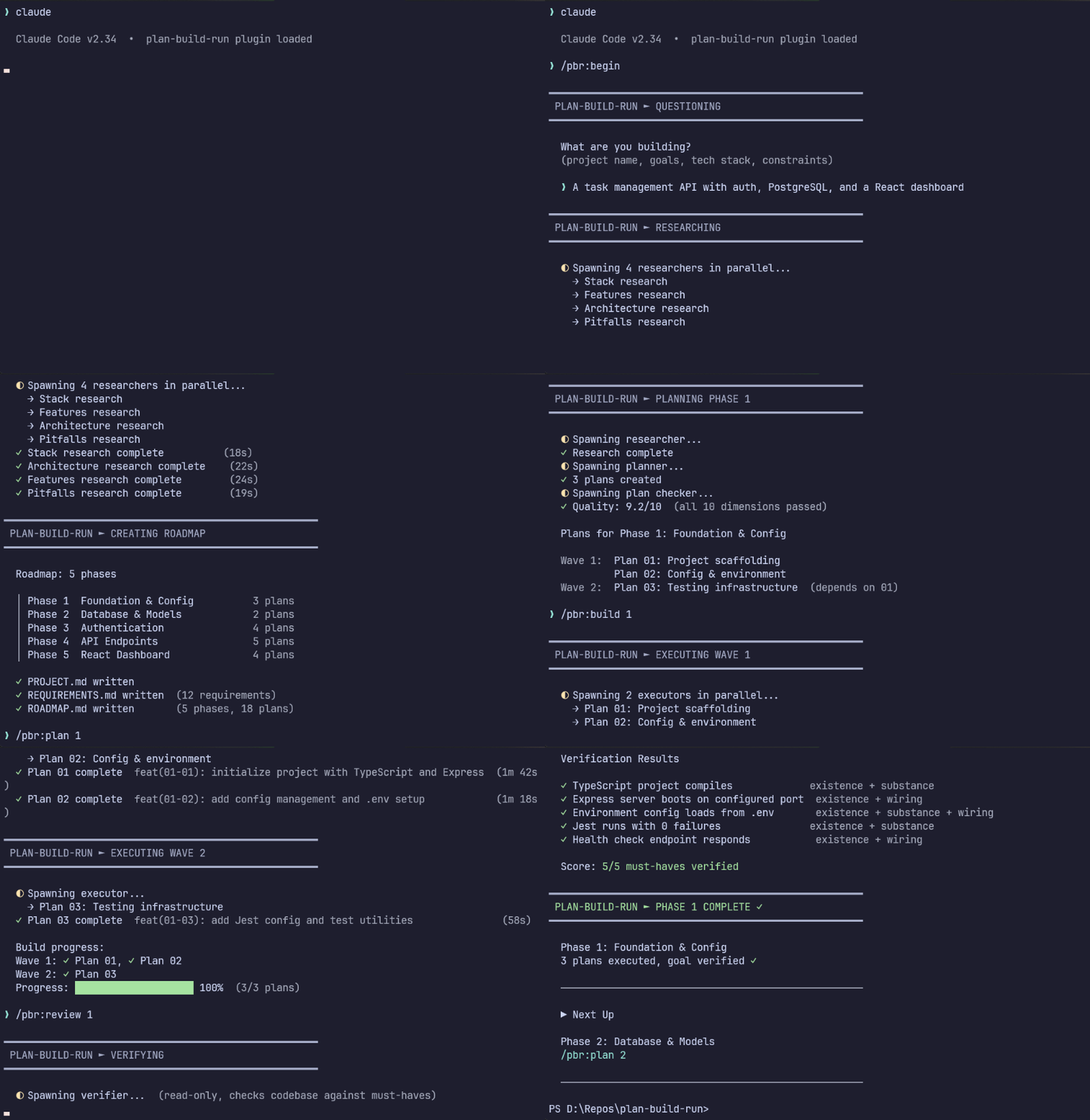
/pbr:new-project          # Questions → research → requirements → roadmap
/pbr:plan-phase 1         # Research + plan the first phase
/pbr:execute-phase 1      # Build with parallel agents, atomic commits
/pbr:verify-work 1        # Confirm the codebase matches requirements
Repeat plan → execute → verify for each phase. Kill your terminal anytime — /pbr:resume-work picks up where you left off.
Already have code? Run
/pbr:map-codebasefirst to analyze your existing stack, then/pbr:new-project.
Architecture
PBR is a thin orchestrator that delegates heavy work to fresh subagent contexts via Task(). Data flows through files on disk, not through messages.
Main Session (~15% context)
  │
  ├── Task(researcher)  →  writes .planning/research/
  ├── Task(planner)     →  writes PLAN.md files
  ├── Task(executor)    →  builds code, creates commits
  ├── Task(executor)    →  (parallel, same wave)
  └── Task(verifier)    →  checks codebase against must-haves
Plans are grouped into waves based on dependencies. Within each wave, plans run in parallel. Waves run sequentially. Each executor gets a fresh context window — zero accumulated garbage.
Three layers: Skills → Agents → HooksSkills (46 slash commands)
Markdown files with YAML frontmatter defining /pbr:* slash commands. Each skill is a complete prompt that reads state, interacts with the user, and spawns agents. Skills are the user-facing interface.
Agents (18 specialized subagents)
Markdown files defining agent prompts that run in fresh Task() contexts with clean 200k token windows. Each agent type has a specific role:
| Agent | Role |
|---|---|
researcher |
Domain research before planning |
planner |
Create execution plans with task breakdown |
plan-checker |
Validate plans across 10 dimensions before build |
executor |
Build code, write tests, create atomic commits |
verifier |
Goal-backward verification against must-haves |
debugger |
Hypothesis-driven systematic debugging |
codebase-mapper |
Parallel codebase analysis |
integration-checker |
Cross-phase integration and E2E flow verification |
Hooks (26 lifecycle hooks)
Node.js scripts that fire on Claude Code lifecycle events — enforcing commit format, validating agent dispatch, tracking context budget, syncing state files, and more. Hooks provide deterministic guardrails that don't rely on the LLM remembering to follow rules.
Hook server architecturePersistent HTTP Hook Server
PBR runs a persistent HTTP server (hook-server.js) on localhost:19836 that handles hook dispatch. Instead of spawning a new Node.js process for every hook event, Claude Code sends HTTP POST requests to the server, which routes them to the appropriate handler.
Why a hook server?
- Performance: HTTP dispatch is 2-30ms vs 200-500ms for process spawning per hook
- Shared state: In-memory config cache, circuit breaker state, and event log shared across all hooks
- Consolidated routing: 38 handler routes registered in a single
initRoutes()function - Fail-open design: Connection failures and timeouts are non-blocking — Claude Code continues normally
How it works:
Claude Code                     Hook Server (localhost:19836)
    │                                  │
    ├── POST /hook/PreToolUse/Bash  →  │── pre-bash-dispatch.js
    │   ← { decision: "allow" }        │     ├── validate-commit.js
    │                                  │     └── check-dangerous-commands.js
    │                                  │
    ├── POST /hook/PostToolUse/Write → │── post-write-dispatch.js
    │   ← { additionalContext: ... }   │     ├── check-plan-format.js
    │                                  │     ├── check-roadmap-sync.js
    │                                  │     └── check-state-sync.js
    │                                  │
    ├── POST /hook/PostToolUse/Read  → │── track-context-budget.js
    │   ← { }                          │
    │                                  │
    └── GET /health                  → │── { status: "ok", uptime: ... }
Lifecycle events handled:
| Event | Hooks | Purpose |
|---|---|---|
PreToolUse |
6 routes | Commit validation, dangerous command blocking, write policies, agent dispatch gates, context budget enforcement |
PostToolUse |
10 routes | Context tracking, plan/state sync, architecture guard, subagent output validation, test result analysis |
PostToolUseFailure |
1 route | Tool failure logging |
SubagentStart/Stop |
2 routes | Agent lifecycle tracking, auto-verification triggers |
TaskCompleted |
1 route | Task result processing |
PreCompact/PostCompact |
2 routes | State preservation across context compaction |
ConfigChange |
1 route | Config validation |
SessionEnd |
1 route | Cleanup and graceful server shutdown |
UserPromptSubmit |
1 route | Prompt routing |
Notification |
1 route | Notification logging |
5 hooks remain as command-type (process-spawned): SessionStart, Stop, InstructionsLoaded, WorktreeCreate, WorktreeRemove — these need stdin/stdout interaction that HTTP can't provide.
Server reliability features:
- PID lockfile with port tracking (
.hook-server.pid) - EADDRINUSE recovery — tries sequential ports if configured port is taken
- Crash recovery — auto-restart on health check failure
- MSYS path normalization — Windows Git Bash compatibility
- Per-hook timing — 100ms alert threshold,
hooks perfCLI for analysis - Circuit breaker — tracks handler failures to avoid cascading errors
Skills and agents communicate through files on disk, not messages:
.planning/
  ├── STATE.md           ← source of truth for current position
  ├── ROADMAP.md         ← phase structure, goals, dependencies
  ├── PROJECT.md         ← project metadata, locked decisions
  ├── REQUIREMENTS.md    ← requirements with completion tracking
  ├── config.json        ← workflow settings
  └── phases/NN-slug/
        ├── PLAN.md        ← written by planner, read by executor
        ├── SUMMARY.md     ← written by executor, read by orchestrator
        └── VERIFICATION.md ← written by verifier, read by review skill
Every task gets its own atomic commit immediately after completion:
abc123f docs(08-02): complete user registration plan
def456g feat(08-02): add email confirmation flow
hij789k feat(08-02): implement password hashing
The orchestrator never does heavy lifting. It spawns agents, waits, integrates results. Your main context stays at 30-40% while thousands of lines of code are written in parallel fresh contexts.
Commands
Core Workflow
| Command | What it does |
|---|---|
/pbr:new-project |
Full init: questions → research → requirements → roadmap |
/pbr:discuss-phase [N] |
Capture implementation decisions before planning |
/pbr:plan-phase [N] |
Research + plan + verify for a phase |
/pbr:execute-phase <N> |
Execute all plans in parallel waves |
/pbr:verify-work [N] |
User acceptance testing with auto-diagnosis |
/pbr:continue |
Auto-advance to the next logical step |
/pbr:quick |
Ad-hoc task with atomic commit (no full workflow) |
Navigation & Session
| Command | What it does |
|---|---|
/pbr:progress |
Where am I? What's next? |
/pbr:resume-work |
Restore from last session |
/pbr:pause-work |
Create handoff when stopping mid-phase |
/pbr:map-codebase |
Analyze existing codebase before new-project |
Milestone Management:
| Command | What it does |
|---|---|
/pbr:audit-milestone |
Verify milestone achieved its definition of done |
/pbr:complete-milestone |
Archive milestone, tag release |
/pbr:new-milestone |
Start next version |
/pbr:plan-milestone-gaps |
Create phases to close gaps from audit |
Phase Management:
| Command | What it does |
|---|---|
/pbr:add-phase |
Append phase to roadmap |
/pbr:insert-phase [N] |
Insert urgent work between phases |
/pbr:remove-phase [N] |
Remove future phase, renumber |
/pbr:list-phase-assumptions [N] |
See Claude's intended approach before planning |
Autonomous Mode:
| Command | What it does |
|---|---|
/pbr:autonomous |
Run multiple phases hands-free (discuss → plan → build → verify) |
/pbr:do [text] |
Route freeform text to the right PBR skill automatically |
Quality & Debugging:
| Command | What it does |
|---|---|
/pbr:debug [desc] |
Systematic debugging with persistent hypothesis tracking |
/pbr:test |
Generate tests for completed phase code |
/pbr:validate-phase |
Post-build quality gate with test gap detection |
/pbr:audit [--today] |
Review past sessions for workflow compliance |
/pbr:health [--repair] |
Validate .planning/ integrity |
Knowledge & Ideas:
| Command | What it does |
|---|---|
/pbr:note [text] |
Quick idea capture (persists across sessions) |
/pbr:todo [text] |
File-based persistent todos |
/pbr:explore [topic] |
Think through approaches, route insights |
/pbr:intel |
Refresh or query codebase intelligence |
Utilities:
| Command | What it does |
|---|---|
/pbr:settings |
Configure model profile and workflow |
/pbr:set-profile <profile> |
Switch model profile (quality/balanced/budget) |
/pbr:dashboard |
Launch web dashboard (Vite + React) |
/pbr:statusline |
Install terminal status line |
/pbr:scan |
Analyze an existing codebase |
/pbr:ship |
Create a rich PR from planning artifacts |
/pbr:release |
Generate changelog and release notes |
/pbr:help |
Show all commands and usage |
/pbr:update |
Update PBR with changelog preview |
See the User Guide for all flags, cost-by-depth tables, and detailed descriptions.
Configuration
PBR stores settings in .planning/config.json. Configure during /pbr:new-project or update with /pbr:settings.
| Setting | Options | Default | What it controls |
|---|---|---|---|
mode |
autonomous, interactive |
interactive |
Auto-approve vs confirm at each step |
depth |
quick, standard, comprehensive |
standard |
Agent spawn count and research scope |
context_window_tokens |
100000-2000000 |
200000 |
Context window size — set to 1000000 for Opus 1M |
Model Profiles
| Profile | Planning | Execution | Verification |
|---|---|---|---|
quality |
Opus | Opus | Sonnet |
balanced (default) |
Opus | Sonnet | Sonnet |
budget |
Sonnet | Sonnet | Haiku |
/pbr:set-profile quality
Workflow Agents:
| Setting | Default | What it does |
|---|---|---|
features.research_phase |
true |
Research domain before planning each phase |
features.plan_checking |
true |
Verify plans before execution (always-on, lighter check for quick depth) |
features.goal_verification |
true |
Confirm must-haves after execution |
features.auto_advance |
false |
Auto-chain discuss → plan → execute |
features.inline_simple_tasks |
true |
Simple tasks run inline without subagent overhead |
features.self_verification |
true |
Executor self-checks before presenting output |
Override per-invocation: /pbr:plan-phase --skip-research or --skip-verify
Parallelization:
| Setting | Default | What it does |
|---|---|---|
parallelization.enabled |
true |
Parallel plan execution within waves |
parallelization.max_concurrent_agents |
5 |
Max simultaneous executor subagents |
parallelization.min_plans_for_parallel |
2 |
Minimum plans in a wave to trigger parallel execution |
Git Branching:
| Strategy | Behavior |
|---|---|
none (default) |
Commits to current branch |
phase |
Branch per phase, merge at completion |
milestone |
One branch for entire milestone |
Hook Server:
| Setting | Default | What it does |
|---|---|---|
hook_server.enabled |
true |
Route hooks through persistent HTTP server |
hook_server.port |
19836 |
TCP port for hook server (localhost only) |
hook_server.event_log |
true |
Log all hook events to .hook-events.jsonl |
See the User Guide for the full config schema.
Security
PBR reads files to understand your project. Protect secrets with Claude Code's deny list:
{
  "permissions": {
    "deny": [
      "Read(.env)", "Read(.env.*)", "Read(**/secrets/*)",
      "Read(**/*credential*)", "Read(**/*.pem)", "Read(**/*.key)"
    ]
  }
}
PBR works best with frictionless automation:
claude --dangerously-skip-permissions
Or configure granular permissions in .claude/settings.json:
{
  "permissions": {
    "allow": [
      "Bash(date:*)", "Bash(echo:*)", "Bash(cat:*)", "Bash(ls:*)",
      "Bash(mkdir:*)", "Bash(wc:*)", "Bash(head:*)", "Bash(tail:*)",
      "Bash(sort:*)", "Bash(grep:*)", "Bash(tr:*)",
      "Bash(git add:*)", "Bash(git commit:*)", "Bash(git status:*)",
      "Bash(git log:*)", "Bash(git diff:*)", "Bash(git tag:*)"
    ]
  }
}
Troubleshooting
Common issuesCommands not found after install?
- Restart your runtime to reload commands
- Plugin: verify with
claude plugin list - npx: verify files exist in
~/.claude/commands/pbr/
Using Docker? Set CLAUDE_CONFIG_DIR before installing:
CLAUDE_CONFIG_DIR=/home/youruser/.claude npx @sienklogic/plan-build-run --global
Hook server not starting?
- Check port availability:
curl http://localhost:19836/health - Review logs:
.planning/.hook-events.jsonl - Run
hooks perfvia pbr-tools for timing analysis
Uninstalling:
# Plugin
claude plugin uninstall pbr@plan-build-run

# npx
npx @sienklogic/plan-build-run --claude --global --uninstall
Learn More
| Resource | Description |
|---|---|
| User Guide | Full configuration reference, all command flags, cost tables |
| Wiki | Agents, hooks, project structure, philosophy, platform details |
| Contributing | Development setup, testing, contribution guidelines |
| Dashboard | Web UI for browsing .planning/ state |
| Changelog | Release history grouped by component |
Local Development
git clone https://github.com/SienkLogic/plan-build-run.git
cd plan-build-run && npm install
npm test          # 6500+ tests across 296 suites
claude --plugin-dir .   # Load locally for testing
CI runs on Node 18/20/22 across Windows, macOS, and Linux (9 platform combinations).
46 skills • 18 agents • 26 hooks • 38 server routes • 4 platforms
Claude Code is powerful. PBR makes it reliable.
Reviews (0)
Sign in to leave a review.
Leave a reviewNo results found