SigilBuild
Health Pass
- License — License: MIT
- Description — Repository has a description
- Active repo — Last push 0 days ago
- Community trust — 24 GitHub stars
Code Warn
- process.env — Environment variable access in lib/config.ts
Permissions Pass
- Permissions — No dangerous permissions requested
This tool is an AI-powered agent that translates plain-English descriptions into complete, production-ready Solana Anchor programs. It generates the corresponding Rust source code, IDL, and configuration files automatically.
Security Assessment
The overall risk is Low. The repository does not request dangerous permissions, and there are no hardcoded secrets. The application accesses environment variables (`process.env`) solely to retrieve the required Anthropic API key, which is standard practice. It makes necessary outbound network requests to the Anthropic API to run the Claude agent loop, but does not execute arbitrary shell commands. Generated code should still be manually reviewed by a developer before deploying, as the security of the resulting smart contracts depends entirely on the AI's output.
Quality Assessment
The project is under active development, with its last push occurring today. It uses modern technologies (TypeScript, Bun) and is fully licensed under the permissive MIT license. While the community trust level is relatively early-stage with 24 GitHub stars, the repository is well-documented, clearly structured, and outlines a logical generation workflow.
Verdict
Safe to use, though developers should manually review the generated Solana smart contracts for logic flaws before deploying them to the blockchain.
Describe a Solana program in plain English - Sigil's AI agent writes the Anchor code.
Sigil


Describe a Solana program. Sigil writes the code.
Sigil is an AI agent that turns plain-English descriptions into complete, production-ready Solana Anchor programs — Rust source, IDL, Cargo.toml, Anchor.toml, all of it.
Generate From the CLI
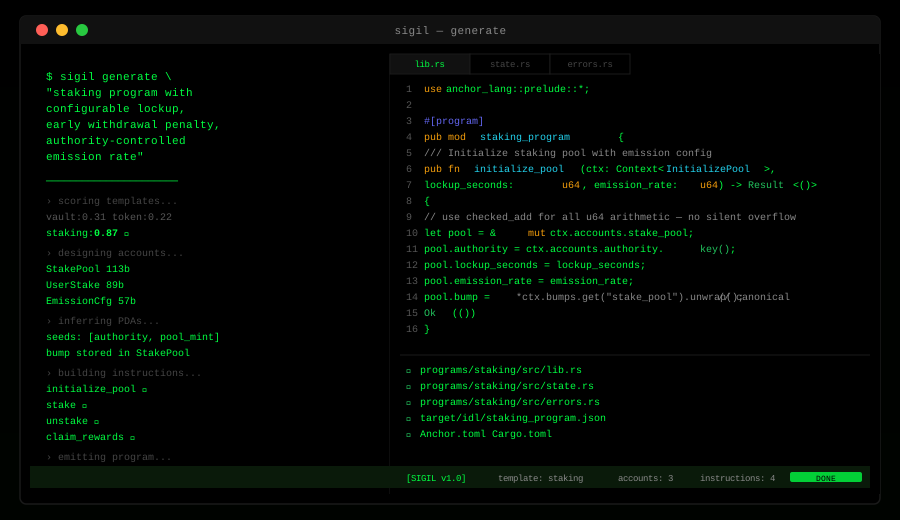
One command. Describe what you want to build. Sigil's Claude agent reasons through the architecture — scoring templates, computing exact account space, inferring PDA seeds — then emits compilable Anchor Rust in real time.
Every generation produces a complete Anchor project: Rust source split by instruction, on-chain account structs with exact space, a valid IDL, and the config files needed to build and deploy.
How It Works
Description → Claude agent loop → program design → code emitter → Anchor project
The agent runs a structured 4-step loop:
- select_template — matches your description to the closest base template (staking, vault, token, NFT, governance)
- design_accounts — defines on-chain account structs with typed fields and PDA seeds
- design_instructions — defines instruction handlers with args, account requirements, and error codes
- emit_program — assembles the final validated program design
Then the emitter turns the design into real Rust.
Quick Start
git clone https://github.com/your-org/sigil
cd sigil
bun install
cp .env.example .env   # add ANTHROPIC_API_KEY
bun run build

# generate a program
sigil generate "Create a token staking program with 7-day lockup and 15% APY"
Examples
# Staking program
sigil generate "Token staking with 30-day lockup and proportional rewards"

# DAO governance
sigil generate "DAO governance with proposal voting, quorum, and timelock execution"

# NFT collection
sigil generate "NFT collection with royalty enforcement and allow-list minting"

# Treasury vault
sigil generate "Multi-sig treasury vault with spending limits and time locks"
Templates
| Template | Description |
|---|---|
staking |
Token lockup + APY rewards |
vault |
Multi-sig treasury |
token |
SPL mint + authority controls |
nft |
Collection + royalties |
governance |
DAO voting + timelock |
custom |
Full free-form generation |
Project Structure
sigil/
├── agent/           Claude 4-step design loop + system prompt
├── builder/         Rust struct + instruction + program assembler
├── templates/       5 base templates + keyword matcher
├── emitter/         IDL, Cargo.toml, Anchor.toml generators
├── validator/       Design validation before emit
├── cli/             sigil generate CLI command
├── schemas/         Zod input validation
├── lib/             Config + logger + types
├── examples/        Runnable generation examples
├── tests/           Unit tests (Vitest)
└── docs/            Template reference
Configuration
| Variable | Default | Description |
|---|---|---|
ANTHROPIC_API_KEY |
— | Required |
CLAUDE_MODEL |
claude-opus-4-6 |
Model |
OUTPUT_DIR |
./output |
Where to write generated programs |
SOLANA_CLUSTER |
devnet |
Target cluster for Anchor.toml |
ANCHOR_VERSION |
0.31.0 |
Anchor version in generated Cargo.toml |
Technical Spec
Anchor Account Space Calculation
Sigil computes exact space parameters for every #[account] struct to avoid realloc failures at runtime:
space = 8 (discriminator) + Σ field_sizes
Field encoding rules Sigil enforces:
| Rust Type | On-chain bytes | Notes |
|---|---|---|
u64 / i64 |
8 | |
Pubkey |
32 | |
bool |
1 | |
String |
4 + len |
4-byte length prefix — not flat 64 |
Vec<T> |
4 + n × item_size |
4-byte length prefix + element array |
Option<T> |
1 + item_size |
1-byte discriminant |
A flat 64 for String is one of the most common space bugs in Anchor programs. Sigil catches it at design time.
PDA Canonical Bump Storage
Generated programs store the canonical bump seed in the account struct:
pub bump: u8, // canonical bump — stored to save ~20k CU vs re-derivation
Re-deriving the bump via find_program_address costs ~20,000 compute units. Storing it at init and passing it back in subsequent instructions is the standard Anchor pattern; Sigil enforces it.
Instruction Discriminators
Anchor computes the discriminator as:
sha256("global:<instruction_name>")[..8]
Duplicate instruction names in the same program cause a compile-time panic in Anchor (not a runtime error). Sigil's validator checks for duplicates and surfaces the error before code is emitted.
Checked Arithmetic
All generated u64 arithmetic uses checked_add / checked_sub:
// NOTE: use checked_add/checked_sub for all u64 arithmetic.
// Rust does not panic on integer overflow in release builds — silent wrap is a common exploit vector.
Solana release builds compile with overflow-checks = false by default. Silent integer wrap has been exploited in production programs. Sigil generates safe code by default.
Signer Validation
Sigil's validator scans every instruction for unsigned state mutation:
if mutatesState && !hasSigner → warning: "Instruction mutates state but has no apparent signer"
Instructions that write to accounts without a signing authority are a common access control vulnerability. The warning is surfaced before emit.
License
MIT
Reviews (0)
Sign in to leave a review.
Leave a reviewNo results found