public-browser
Health Warn
- License — License: MIT
- Description — Repository has a description
- Active repo — Last push 0 days ago
- Low visibility — Only 6 GitHub stars
Code Warn
- fs module — File system access in package.json
Permissions Pass
- Permissions — No dangerous permissions requested
No AI report is available for this listing yet.
Token-efficient Chrome browser automation MCP server for AI agents. Direct CDP, a11y-tree refs, multi-tab, server-side plan executor. 5.4x smaller page snapshots than Playwright MCP. MIT, no paid tier.
 Public Browser


The most token-efficient MCP server for Chrome browser automation. Direct CDP, a11y-tree refs, multi-tab ready — 2,310 TypeScript tests, 237 Python tests.
Built for Claude Code, Cursor, and any MCP-compatible client.
Looking for an alternative to Playwright MCP, Browser MCP, or claude-in-chrome? Public Browser talks to Chrome directly via the DevTools Protocol — no Playwright dependency, no Chrome extension bridge, no single-tab limit. One command to install, zero config. See benchmark comparison below.
Why Public Browser?
Every Chrome MCP server has the same problem: too many tokens, too few reliable refs. Screenshots eat 10-30x more tokens than text trees. Selector-based refs break the second the DOM rerenders. Extension bridges (Browser MCP) get stuck on the connected tab. Playwright wrappers spin up a new browser instance for every session.
Public Browser fixes this. It talks directly to Chrome via CDP (same protocol Playwright and Puppeteer use internally), returns an accessibility-tree-based reference map, and caches it across calls so click(ref: 'e5') and type(ref: 'e7', ...) survive scrolls and DOM updates.
| What you get | Playwright MCP | Browser MCP | claude-in-chrome | browser-use | Public Browser |
|---|---|---|---|---|---|
| Benchmark pass rate (31 scorable tests, LLM-driven) | 29/31 (563s) | 6/31, aborted | (24-test suite only) | 21/31 (1870s) | 30/31 (598s) |
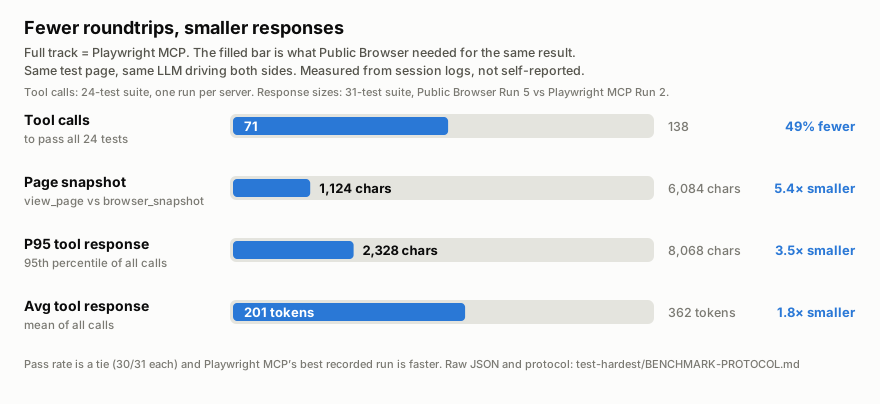
| Avg Tool-Response (Tokens est.) | 362 | — | — | — | 201 (1.8x smaller) |
| P95 Tool-Response (Chars) | 8,068 | — | — | — | 2,328 (3.5x smaller) |
view_page avg (Chars) |
6,084 (browser_snapshot) |
— | — | — | 1,124 (5.4x smaller) |
| Multi-tab support | Yes | No (single tab) | Yes | Partial | Yes |
| Connection | New browser | Extension bridge | Extension | Subprocess | Direct CDP (pipe or WebSocket) |
| Ref system | Playwright refs | Playwright refs | CSS selectors | Screenshots | A11y-tree refs (stable across DOM changes) |
| Drag & drop | Yes | No | Partial | No | Yes (native CDP mouse events) |
| Shadow DOM + iframe | Yes | Yes | Partial | No | Yes (with OOPIF session support) |
| Multi-step plan execution | — | — | — | — | run_plan — server-side plan executor with variables, conditions, suspend/resume |
Quick Start
Install in Claude Code
One command — installs globally for all projects:
claude mcp add --scope user public-browser npx -y public-browser@latest
Important: after claude mcp add you must fully quit and reopen Claude Code. /mcp reconnect is not enough — Claude Code reads the mcpServers config only at session start and caches it. After the restart, the first tool call auto-launches Chrome visible (no headless, no port setup). Done.
To enable parallel Python Script API access, add
--scriptto the args:claude mcp add --scope user public-browser npx -y public-browser@latest -- --script
Install in Cursor
Add to ~/.cursor/mcp.json:
{
  "mcpServers": {
    "public-browser": {
      "command": "npx",
      "args": ["-y", "public-browser@latest"]
    }
  }
}
For parallel Python Script API access, use
"args": ["-y", "public-browser@latest", "--", "--script"]
Install in Cline
Add to your cline_mcp_settings.json:
{
  "mcpServers": {
    "public-browser": {
      "command": "npx",
      "args": ["-y", "public-browser@latest"]
    }
  }
}
Install in other MCP clients
Any client that supports stdio MCP servers: npx -y public-browser@latest with no arguments.
Try it — your first prompt
After installing, paste this into your AI coding assistant:
Open mcp-test.second-truth.com, read the page, and fill the contact form with Name "Test User" and Email "[email protected]".
This exercises three core tools in sequence: navigate loads the page, view_page reads the accessibility tree with stable element refs, and fill_form fills multiple fields in one call. You should see Chrome open, the page load, and the form filled — all without writing a single line of code.
Uninstall
claude mcp remove --scope user public-browser
Chrome Profiles
By default, Public Browser starts Chrome with a fresh temp profile — no cookies, no logins, no extensions. For tasks like research on sites that block anonymous visitors, you can launch Chrome with your real profile instead.
List available profiles
npx public-browser profiles
Launch with a profile
Three ways — pick whichever fits your setup:
# CLI flag
npx public-browser --profile "Julian"

# Environment variable
PUBLIC_BROWSER_PROFILE="Julian" npx public-browser

# MCP tool (call BEFORE any browser interaction)
configure_session({ profile: "Julian" })
When using a real profile, Public Browser preserves extensions, cookies, logins, and sync. It creates a lightweight wrapper directory with a symlink to your real profile data — Chrome gets a "non-default" data dir (required for remote debugging) while using your actual profile.
If Chrome is already open
Public Browser detects this via lock-file inspection. If Chrome is running with remote debugging enabled, it attaches via CDP. If not, it shows a clear error asking you to close Chrome first.
Script API (Python)
A second way to use Public Browser — deterministic browser automation from Python, without an LLM in the loop. Scripts use the same tool implementations as the MCP server (Shared Core) — every improvement to click, navigate, fill_form etc. automatically benefits your scripts too. The MCP server handles AI-driven workflows; the Script API is for repeatable scripts you write yourself.
How fast that is without an LLM: a scripted run of the 24-test version of the benchmark suite finished the whole suite in 21 seconds (type: mcp-scripted, 2026-04-04). That number says what deterministic scripting costs, not how Public Browser compares to other MCP servers — every cross-server comparison in Benchmarks is LLM-driven on both sides.
Installation
The Python package is not currently published on PyPI. From a source checkout, install the local package:
python -m pip install ./python
Chrome.connect() auto-starts the Public Browser server as a subprocess via a local public-browser binary or the npx fallback — no manual Chrome launch or port setup needed.
Legacy single-file alternative: For quick prototyping you can copy
python/silbercuechrome.pyinto your project. This uses v1 direct CDP and does not benefit from server-side improvements — use the localpublicbrowserpackage for the full Shared Core experience.
How it works
Python Script                        Escape Hatch (Power User)
    |                                    |
    v                                    v
HTTP POST /tool/{name}              WebSocket (CDP)
Port 9223                           Port 9222
    |                                    |
    v                                    |
Public Browser Server                    |
    |                                    |
    v                                    |
registry.executeTool()                   |
    |                                    |
    v                                    |
Tool Handler                             |
(click.ts, navigate.ts, ...)             |
    |                                    |
    v                                    v
Chrome <------------ CDP --------------->
Your script sends HTTP requests to the Public Browser server on port 9223. The server executes the exact same tool handlers that the MCP server uses — one codebase, one test suite (2300+ tests), two access paths.
Auto-Start
Chrome.connect() finds and starts the server automatically:
- Running server — checks if port 9223 already responds, connects immediately
- PATH binary — finds
public-browserin PATH, starts it with--script - npx fallback — runs
npx -y public-browser@latest -- --script - Explicit path —
Chrome.connect(server_path="/path/to/public-browser")for custom setups
Example: Login + Data Extraction
from publicbrowser import Chrome

chrome = Chrome.connect()

with chrome.new_page() as page:
    page.navigate("https://competitor.example.com/login")
    page.fill({"#email": "[email protected]", "#password": "***"})
    page.click("button[type=submit]")
    page.wait_for("text=Dashboard")

    for cat in ["electronics", "furniture", "toys"]:
        page.navigate(f"https://competitor.example.com/prices/{cat}")
        prices = page.evaluate(
            "[...document.querySelectorAll('tr')].map(r => r.textContent)"
        )
        save_csv(cat, prices)

chrome.close()
Methods
| Method | Description |
|---|---|
Chrome.connect() |
Connect to or auto-start the Public Browser server |
chrome.new_page() |
Context manager — opens a new tab, auto-closes on exit |
page.navigate(url) |
Navigate and wait for load |
page.click(selector) |
Click element by CSS selector, text, or ref |
page.type(selector, text) |
Type text into an input |
page.fill({"sel": "val"}) |
Fill multiple form fields at once |
page.wait_for(condition) |
Wait for JS condition or "text=..." shorthand |
page.evaluate(expression) |
Run JavaScript, return result |
page.download() |
Enable downloads, return download dir |
page.close() |
Close the tab (auto-called by context manager) |
page.cdp.send(method, params) |
Escape Hatch — direct CDP access via WebSocket (see below) |
Escape Hatch: Direct CDP Access
For use cases the high-level API doesn't cover — network interception, console log subscriptions, performance tracing, cookie management — you can drop down to raw CDP commands:
with chrome.new_page() as page:
    page.navigate("https://example.com")

    # Enable network tracking
    page.cdp.send("Network.enable")

    # Get all cookies
    cookies = page.cdp.send("Network.getAllCookies")

    # Performance tracing
    page.cdp.send("Tracing.start", {"categories": "-*,devtools.timeline"})
The Escape Hatch communicates directly with Chrome via WebSocket (port 9222), bypassing the server. It connects lazily on the first send() call and reuses the connection for subsequent calls. Each page gets its own WebSocket routed to the correct tab.
MCP Coexistence
When the MCP server and Python scripts need to run at the same time, add --script to the MCP config. Chrome.connect() handles the rest automatically — each script works in its own tab, MCP tabs are never touched.
Enabling --script in MCP Config
Claude Code:
claude mcp add --scope user public-browser npx -y public-browser@latest -- --script
Cursor / Cline (mcp.json):
{
  "mcpServers": {
    "public-browser": {
      "command": "npx",
      "args": ["-y", "public-browser@latest", "--", "--script"]
    }
  }
}
See python/README.md for the full API reference and advanced examples.
Node Library API (multiple instances in one process)
The MCP server and the Python Script API both drive exactly one Chrome per
process. When you need several browsers at once — say a read-only research
browser and a separate action browser per agent — spawning onenpx public-browser per instance costs 4–6 s of start-up each. createSession()
runs the same session inside your own Node process instead:
import { createSession } from "public-browser";

const research = await createSession({
  cdpUrl: "http://127.0.0.1:9333",          // or cdpPort: 9333
  userDataDir: "/var/agents/a1/research",   // created if missing
  headless: true,
  stealth: false,                            // stay identifiable — see below
  downloadDir: "/var/agents/a1/quarantine",  // never deleted by us
  downloadHash: true,                        // adds sha256 to every download
  downloadNaming: "suggested",               // real filenames, not GUIDs
  cortexDir: "/var/agents/a1/cortex",        // per-instance pattern store
  inheritEnv: ["HTTPS_PROXY"],               // opt in — see Environment below
});

const action = await createSession({ cdpPort: 9334, userDataDir: "/var/agents/a1/action" });

await research.callTool("navigate", { url: "https://example.com" });
const page = await research.callTool("view_page", {});

await research.close();
await action.close();
callTool(name, params) takes the same tool names and parameters as the MCP
tools (navigate, view_page, click, type, fill_form, run_plan,download, ...) and routes through the identical handlers (Shared Core).
Isolation. Each session runs in its own worker thread by default, so the
module-level caches (element refs, selector cache, viewport state, stealth flag,
cortex matcher) exist once per session rather than once per process — two
sessions can never hand each other stale element refs.
Measured on macOS with isolation: "process", attaching to a Chrome started
outside Public Browser (a worker thread saves ~40 ms):
| Median | |
|---|---|
createSession() launches its own headless Chrome |
~0.9 s |
attach to a running Chrome, up to the first tool response |
~0.7 s |
| ...through to a real page navigated and read | ~1.8 s |
Most of the attach cost is Chrome starting a renderer for the tab Public
Browser opens for itself — an attached session never takes over tabs that
belong to someone else.
A thread is not a security boundary: same process memory, same file
descriptors. isolation: "process" forks one OS process per session instead —
separate heap, separate descriptors, separate crash domain — for integrators
whose trust model draws the line there. isolation: "inline" skips isolation
altogether and is only correct when the thread runs exactly one session.
isolation |
Boundary | Startup | Use when |
|---|---|---|---|
"worker" (default) |
thread — private module caches | ~1 s | several sessions in one trusted process |
"process" |
OS process — private memory + descriptors | ~1 s | the sessions must not share a process with the host |
"inline" |
none — the calling thread | fastest | exactly one session per thread |
No listening CDP port (transport: "pipe"). By default Chrome is launched
with --remote-debugging-port, which is what makes --attach, the Script API
and reconnect-after-crash possible — and which also means every other process
on the machine can drive that browser. For a session holding real logins that
is a way around any permission check you perform yourself.
const action = await createSession({
  transport: "pipe",                      // no --remote-debugging-port at all
  userDataDir: "/var/agents/a1/action",
  headless: true,
});
CDP then travels over the child's stdio pipe, which only Public Browser holds:lsof shows nothing listening and a second process finds no way in. The price
is everything the port paid for — no reconnect after a Chrome crash, no second
client, no attach, and no named profile (Chrome rejects the pipe with a
real user profile). Both contradictions fail at createSession() rather than
at the first tool call. session.transport reports which mode is in use, andsession.cdpPort is undefined — there is no port, and reporting the default
would name whatever Chrome the user has open on 9222.
Environment. A session does not start from the host environment. It
starts from a documented minimum and you widen it deliberately — an
orchestrator holding cloud credentials, API keys and tokens should not hand
them to a browser session just because the two share a process tree.
What a session always gets is ESSENTIAL_ENV_VARS: PATH, HOME, the temp
dir, CHROME_PATH, locale/timezone, the Linux display variables and the
Windows process basics. Everything else is opt-in:
// PATH/HOME/CHROME_PATH plus the proxy — and nothing else from the host.
await createSession({ inheritEnv: ["HTTPS_PROXY", "NO_PROXY"] });

// Full inheritance, the pre-2.8 behaviour.
await createSession({ inheritEnv: true });
Proxy variables are deliberately not essential: a proxy URL can carry
credentials, so it is allowlisted on purpose rather than inherited by accident.
On top of that, a session never inherits Public Browser's own SILBERCUE_* /PUBLIC_BROWSER_* configuration variables — in any inheritEnv mode. Each of
them has an option here, and a host-level variable, usually set for the host's
own Chrome, silently redirecting a configured session is a bug, not a feature:
with SILBERCUE_CHROME_HOST=10.9.9.9 in the orchestrator's environment, a
session created with cdpPort: 9450 still talks to 127.0.0.1:9450. Use env
to set one back deliberately.
Shutdown. close() resolves only once Chrome is actually gone — SIGTERM,
SIGKILL after 5 s — so the port and the user-data-dir are free for the next
launch instead of racing a process that was merely asked to exit.
One session per Chrome. Some CDP settings are browser-wide rather than
per-session, Browser.setDownloadBehavior among them: two sessions attached to
the same Chrome share one download directory, and whichever connected last
wins.
This fails silently and it corrupts the record: the losing session keeps
reporting paths under its downloadDir, but the file was written to the
other one. path then points at nothing, with no error to notice. Give each
session its own Chrome — its own port (or transport: "pipe") and its own
user-data-dir — whenever downloadDir matters.
| Option | Default | Description |
|---|---|---|
cdpUrl |
— | http://host:port, host:port or a bare port. Wins over cdpPort/cdpHost |
cdpPort / cdpHost |
9222 / 127.0.0.1 |
CDP endpoint this session drives. session.cdpPort is undefined with transport: "pipe" |
userDataDir |
— | Chrome --user-data-dir for auto-launch. One directory per instance |
profile |
— | Named Chrome profile instead of a raw directory |
headless |
false |
Launch Chrome headless |
stealth |
true |
false disables all navigator.webdriver masking |
attach |
false |
Never auto-launch; attach to a running Chrome and fail fast if there is none |
downloadDir |
temp dir | Where downloads land. A directory you supply is never deleted |
downloadHash |
false |
Report sha256 for every completed download |
downloadNaming |
"guid" |
"suggested" renames finished files to the server-supplied name |
cortexDir |
~/.public-browser/cortex |
Per-instance cortex store |
transport |
"port" |
"pipe" launches Chrome with no listening CDP port (no attach/reconnect/profile) |
inheritEnv |
false |
Essentials only. Array = essentials + allowlist, true = whole host env |
env |
— | Extra environment variables for the session, applied last |
isolation |
"worker" |
"process" for an OS-process boundary, "inline" for none |
eager |
false |
Launch/attach during createSession() instead of on the first call |
startupTimeoutMs |
30000 |
Budget for the session thread/process to report ready |
Multiple instances via the CLI
The same thing without a Node host — one process per Chrome, each on its own port:
public-browser --port 9333 --profile research --download-dir /q/research
public-browser --port 9334 --profile action   --download-dir /q/action
--profile <name> uses one of your real Chrome profiles. For a throwaway
per-agent Chrome, point at a raw directory instead — it is created if missing:
public-browser --port 9335 --user-data-dir /var/agents/a3/chrome
--attach connects to an already-running Chrome on the configured port instead
of launching one. SILBERCUE_CHROME_PORT and SILBERCUE_SCRIPT_PORT are the
environment equivalents of --port and --script-port and are part of the
stable public contract.
Identifiable automation (--no-stealth)
By default Public Browser masks navigator.webdriver (it reports undefined)
and launches Chrome with --disable-blink-features=AutomationControlled. That
is the right default for consumer automation, but the wrong one when your
integration must be transparently identifiable as a bot — compliance-driven
crawling, internal agent fleets, or sites whose terms require honest signalling.
Turn the masking off completely:
public-browser --no-stealth
# or
SILBERCUE_STEALTH=0 npx public-browser
await createSession({ stealth: false });
With stealth off, navigator.webdriver stays true and keeps its native
getter (Object.getOwnPropertyDescriptor(Navigator.prototype, "webdriver").get
still reports [native code]) — permanently, across navigations and tab
switches, with no post-correction needed on your side. No masking script is
injected at any point and the launch flag is omitted.
Downloads
Downloads land in a per-session temp directory that is removed on shutdown.
Point them at a directory of your own — a quarantine dir, a shared volume — with--download-dir / PUBLIC_BROWSER_DOWNLOAD_DIR / downloadDir. A directory you
supply is created if missing and never deleted by Public Browser.
With --download-hash (or downloadHash: true) every completed download also
carries a sha256, so the download tool returns path, size and digest:
{"filename":"report.pdf","path":"/q/research/A1B2...","size":48213,"sizeKb":48,
 "url":"https://example.com/report.pdf","sha256":"9f86d081884c7d659a2f..."}
Filenames. Chrome writes downloads under their internal GUID, so the file on
disk is called A1B2... and only the filename field carries the real name.
That is fine when you read the JSON, and useless when something else has to walk
the directory. --download-naming suggested (or downloadNaming: "suggested",PUBLIC_BROWSER_DOWNLOAD_NAMING=suggested) renames each finished file to the
server-supplied name:
{"filename":"report.pdf","path":"/q/research/report.pdf","size":48213,"sizeKb":48,
 "url":"https://example.com/report.pdf","sha256":"9f86d081884c7d659a2f..."}
The name is sanitised before it touches the disk — basename only, no control
characters, never hidden, length-capped — and a collision gets a -1, -2, ...
suffix rather than overwriting an existing file. filename always reports the
name the file actually has, so join(downloadDir, filename) equals path. If
the rename fails, the GUID path and the raw server name are kept and reported;
a download is never lost to a naming problem.
Timing. action: "status" waits up to 250 ms for a download to start
before reporting that there is none, because Chrome fires downloadWillBegin a
few milliseconds after the click that triggers it — without the window, the
first call after a click misses a file that is already on its way. Adjust it per
call with settle ({"action":"status","settle":0} for an instant check,5000 for a slow server). Once a download has started, status waits for it to
finish, bounded by timeout.
For polling loops use action: "list" — it returns the full session history
immediately and never waits, for either a start or a completion.
Tool Overview
| Tool | Description |
|---|---|
| Reading & Observation | |
view_page |
A11y-tree with stable e-refs — primary way to understand the page. filter: "interactive" (default) returns the elements an agent can act on; filter: "all" adds headings, paragraphs and other static text. 5.4x more compact than Playwright's browser_snapshot. |
capture_image |
WebP screenshot, max 800px, <100KB. For visual verification only — refs come from view_page. |
console_logs |
Browser console output with level/pattern filters |
network_monitor |
Start/stop/query network requests with filtering |
observe |
Watch DOM changes: collect (buffer over time) or until (wait for condition, then auto-click) |
wait_for |
Wait for element visible, page text, URL, network idle, or JS expression. assert: true checks once and fails with a typed code instead of waiting |
tab_status |
Active tab's cached URL/title/ready/errors (0ms) |
virtual_desk |
Lists all tabs with stable IDs. Call first in every session. |
dom_snapshot |
Bounding boxes, computed styles, paint order. For spatial questions view_page cannot answer. |
| Interaction | |
click |
Real CDP mouse events by ref, selector, text, or coordinates. Response includes DOM diff (NEW/REMOVED/CHANGED). |
type |
Type into an input by ref/selector |
fill_form |
Fill a complete form in one call — text, <select>, checkbox, radio. Per-field status. |
press_key |
Real CDP keyboard events — Enter, Escape, Tab, arrows, shortcuts (Ctrl+K, etc.) |
scroll |
Scroll page, element into view, or inside a specific container |
file_upload |
Upload file(s) to <input type="file"> |
handle_dialog |
Configure alert/confirm/prompt handling before triggering actions |
drag |
Native CDP drag & drop between elements |
download |
Enable downloads, return download dir |
| Navigation | |
navigate |
Load a URL. First call per session auto-redirected to virtual_desk to prevent overwriting the user's tab. |
switch_tab |
Open, switch to, or close tabs by ID from virtual_desk |
| Scripting | |
run_plan |
Multi-step batch execution with variables, conditions, saveAs, error strategies, suspend/resume. |
configure_session |
View/set session defaults (tab, timeout) and accept auto-promote suggestions |
batch_evaluate |
Visit multiple URLs sequentially and run the same JavaScript expression on each page. |
set_page_data |
Write large payloads to window.__pb_data[key] via server-side chunking for data that is too large for a single CDP message. |
evaluate |
Execute JS in page context. Anti-pattern scanner warns on querySelector/.click(). |
Benchmarks
Measured on https://mcp-test.second-truth.com against the 35-test version of the suite (April 2026) — 5 levels (Basics, Intermediate, Advanced, Hardest, Community Pain Points). Four of the 35 tests are runner-only and are excluded from every score, so all pass rates below are out of 31 scorable tests. The live suite has since grown to 42 tests in 6 levels; the numbers here are not re-measured against it, and cross-server comparisons are only valid within the same suite version. Each run is independent, values on the benchmark page are randomized per page-load, all runs started in a fresh Claude Code session out of /tmp (no project context bias), and all metrics measured post-hoc from the session JSONL via test-hardest/measure-tool-calls.sh — no self-reporting, no MCP-side instrumentation, just counting tool_use blocks and tool_result char lengths.
Head-to-Head (24-test suite, April 2026 — historical suite version)
All rows LLM-driven by Claude Opus 4.6 on the same test page, one recorded run each. Public Browser ran
2026-04-05, the other servers 2026-04-02. This is the older 24-test version of the suite — do not compare
these rows against the 31-scorable-test numbers below.
| MCP Server | Tests Passed | Duration | Tool Calls | Speed vs PB |
|---|---|---|---|---|
| Public Browser | 24/24 | 350s | 71 | -- |
| Playwright MCP | 24/24 | 570s | 138 | 1.6x slower |
| browser-use skill | 24/24 | 725s | 117 | 2.1x slower |
| claude-in-chrome | 24/24 | 772s | 193 | 2.2x slower |
| browser-use | 16/24 | 1813s | 124 | 5.2x slower |
Public Browser needed 71 tool calls where Playwright MCP needed 138 — roughly half the roundtrips for the
same 24 passes. Raw data: test-hardest/benchmark-*.json (Public Browser row:benchmark-silbercuechrome_mcp-llm-2026-04-05.json, type: llm-driven).
Pass Rate + Duration (31 scorable tests, LLM-driven)
Every row is one recorded run; the run id is named so each number is traceable to a single entry intest-hardest/BENCHMARK-PROTOCOL.md. No averaging across runs.
| MCP | Passed | Duration | Run |
|---|---|---|---|
| Public Browser | 30/31 (97%) | 598s | Run 5 |
| Playwright MCP | 29/31 (94%) | 563s | Run 2 |
| Playwright CLI | 28/31 (90%) | 376s | Run 1 |
| Chrome DevTools MCP (Google) | 27/31 (87%) | 535s | Run 2 |
| browser-use | 21/31 (68%) | 1870s | Run 5 |
| Browser MCP (browsermcp) | 6/31 (19%) | 294s, aborted | Run 1 |
| claude-in-chrome | 24-test data only, not re-benched | — | — |
Servers with several recorded runs, so you can see the spread rather than only the row above: Playwright MCP
ranges 29–30/31 across four runs, its best being 30/31 in 449s (Run 3); Chrome DevTools MCP ranges 27–29/31,
its best 29/31 in 518s (Run 1). Run 2 is quoted for both because that is the run the tool-efficiency analysis below
instruments end to end. On pass rate this field is effectively a tie — the durable difference is response size, and
that holds across every Playwright run measured (avg 1,216–1,467 chars in Runs 2–4).
Tool-Efficiency (the fair metric)
We measure each tool call's response char length directly, group by tool name, estimate tokens via chars/4. Why this metric: session-level token deltas are dominated by LLM overhead (system prompt + CLAUDE.md + conversation history = ~80-90% of the budget) and only show 5-15% differences between MCPs — untrustworthy for comparing browser servers. Tool-response size is the part the MCP server actually controls.
Public Browser Run 5 vs Playwright MCP Run 2 — the same two runs as the pass-rate table above.
| Metric | Public Browser | Playwright MCP | Difference |
|---|---|---|---|
| Tool calls (MCP-only) | 151 | 121 | +25% (PB uses more, smaller calls) |
| Avg Response size | 807 Chars | 1,448 Chars | PB 1.8x smaller |
| Avg Response tokens est. | 201 | 362 | PB 1.8x smaller |
| P95 Response | 2,328 Chars | 8,068 Chars | PB 3.5x smaller |
| Total response content | 128k Chars | 175k Chars | PB 27% less |
Per-Tool Breakdown (where the difference comes from)
| Tool | Public Browser Avg | Playwright MCP Avg | Verdict |
|---|---|---|---|
view_page¹ / browser_snapshot |
1,124 Chars (21 calls) | 6,084 Chars (8 calls) | PB 5.4x more compact per call |
evaluate / browser_evaluate |
510 Chars (33 calls) | 2,155 Chars (47 calls) | PB 4.2x more compact per call |
type / browser_type |
88 Chars (13 calls) | 147 Chars (13 calls) | PB 1.7x more compact |
click / browser_click |
1,278 Chars (63 calls) | 463 Chars (44 calls) | Playwright 2.8x leaner — but see trade-off below |
¹ recorded as read_page in the April 2026 runs; the tool was renamed to view_page afterwards.
The Ambient-Context trade-off
Ambient Context — Claude sees DOM changes for free, no extra
view_pageneeded
Public Browser's click is 2.8x larger than Playwright's because every click response embeds the DOM diff (NEW/REMOVED/CHANGED lines). Playwright returns a bare confirmation, forcing the LLM to follow up with a browser_snapshot or browser_evaluate to see what happened. Over a full benchmark run, Playwright MCP spends 47 browser_evaluate calls averaging 2,155 chars against Public Browser's 33 at 510 chars. Public Browser delivers the diff inline. Net result: PB's click+read_page+evaluate total is 120k chars vs Playwright MCP's 170k — 30% less response content overall.
view_pageis 5.4x more compact than Playwright MCP'sbrowser_snapshot
Measured on the 35-test benchmark (2026-04-09): Public Browser's view_page averages 1,124 chars per call vs Playwright MCP's browser_snapshot at 6,084 chars. Same page, same test suite, same LLM driver. The a11y-tree compression + Ambient Context pipeline means we only send what the agent actually needs — smaller responses, less context pressure, cheaper runs.
See test-hardest/BENCHMARK-PROTOCOL.md for the full protocol, per-test breakdown, and raw JSON runs with tool_efficiency blocks.
Cortex — Self-Learning Pattern Engine
Public Browser includes a lightweight learning layer called Cortex. It observes which tool sequences work on different page types and feeds that knowledge back as hints to the LLM agent. No ML model, no training step — just deterministic pattern recording and Markov-chain predictions.
How it works
Page Classification — Every page is classified by its accessibility tree into one of 16 functional types:
login,signup,mfa,search_form,search_results,data_table,form_simple,form_wizard,article,navigation,dashboard,settings,media,checkout,profile,error. The classifier is rule-based (ARIA roles, landmarks, keyword signals) — no domains or URLs are involved.Pattern Recording — Successful tool-call sequences (e.g.
navigate → view_page → fill_form → clickon aloginpage) are recorded into a local append-only Merkle log (~/.public-browser/patterns.jsonl). Only page type, tool names, a content hash, and a timestamp are stored — no URLs, no page content, no PII.Markov Predictions — Recorded patterns are ingested into a first-order Markov table that models
P(next_tool | last_tool, page_type). When the agent lands on a page, the Cortex returns the most likely next tools with probabilities. Stale entries decay automatically (0.95/week, removed after 30 days).Community Markov Table — A hand-curated transition table (
community-markov.json) ships with every installation. It contains baseline probabilities for common page types so that new installations benefit from community knowledge immediately, without needing local history. The table is SHA-256 verified at load time and merged with local patterns (local data takes precedence).
Privacy by design
The Cortex stores and transmits only structural metadata — page types (not domains), tool names (not arguments), and content hashes (not content). A login pattern reveals nothing about which login page was visited. The telemetry payload is built via explicit field allowlist (no spread operator), preventing accidental leakage of future fields.
Opt-in telemetry
Telemetry is disabled by default. To contribute your anonymised patterns back to the community table, set PUBLIC_BROWSER_TELEMETRY=1. Uploads go via HTTPS only; non-HTTPS endpoints are rejected. Each pattern is rate-limited to prevent duplicate uploads.
Local friction log (developer opt-in)
For development of Public Browser itself there is a second, fully local opt-in: SILBERCUE_CHROME_FRICTION_LOG=1 makes the server count tool calls, tool errors and detected fallback spirals per run in ~/.silbercue-chrome/friction-queue.json. It records counters, timestamps and the working directory — never page content, URLs or user input — and nothing ever leaves the machine. Without the variable the code path is not entered at all: no file, no counters, no hints.
Architecture
Public Browser (Node.js MCP server, public-browser)
+-- @modelcontextprotocol/sdk (stdio transport)
+-- CDP Client
|   +-- WebSocket transport (existing Chrome on :9222)
|   +-- Pipe transport (auto-launched Chrome with --remote-debugging-pipe)
+-- Auto-Launch: Chrome + optimal flags, visible by default
+-- A11y-tree cache + Selector cache
+-- Session Manager (OOPIF support for iframes and Shadow DOM)
+-- Tab State Cache (URL/title/ready across tabs)
+-- Cortex (self-learning pattern engine)
|   +-- Page Classifier (16 page types from a11y-tree)
|   +-- Pattern Recorder + Merkle Log (local persistence)
|   +-- Markov Table (transition predictions)
|   +-- Community Table (shipped baseline, SHA-256 verified)
|   +-- Hint Matcher (delivers predictions to tool responses)
|   +-- Telemetry Upload (opt-in, HTTPS, rate-limited)
+-- Script API (Python, source install from ./python)
|   +-- Shared Core via HTTP (:9223) — same tool handlers as MCP
|   +-- Escape Hatch via WebSocket (:9222) — direct CDP for power users
+-- 25 tools
    Reading - Interaction - Navigation - Scripting - Observation
Connection priority:
- Auto-Launch (default, zero-config) — starts Chrome as a child process via
--remote-debugging-pipe, visible as a window, with all flags set for reliable screenshots and keyboard focus. - WebSocket (optional) — if you already run Chrome with
--remote-debugging-port=9222, Public Browser connects to that instead. Use this to control your own browser with its extensions and login sessions.
Requirements
- Node.js >= 18
- Google Chrome, Chromium, or any Chromium-based browser (auto-detected on macOS/Linux/Windows; override with
CHROME_PATH)
Environment Variables
| Variable | Values | Default | Description |
|---|---|---|---|
SILBERCUE_CHROME_AUTO_LAUNCH |
true / false |
true |
Auto-launch Chrome if no running instance found |
SILBERCUE_CHROME_HEADLESS |
true / false |
false |
Opt-in headless mode for CI/server environments |
SILBERCUE_CHROME_PORT |
1–65535 |
9222 |
CDP debugging port. Non-default values spawn an isolated Chrome instance (separate --user-data-dir) that won't conflict with the user's browser. Alias: PUBLIC_BROWSER_CHROME_PORT |
SILBERCUE_CHROME_HOST |
host | 127.0.0.1 |
CDP host. Alias: PUBLIC_BROWSER_CHROME_HOST |
SILBERCUE_SCRIPT_PORT |
1–65535 |
9223 |
Script API port (needs --script). Alias: PUBLIC_BROWSER_SCRIPT_PORT |
SILBERCUE_STEALTH |
0 / 1 |
1 |
0 disables the navigator.webdriver masking. Alias: PUBLIC_BROWSER_STEALTH |
PUBLIC_BROWSER_DOWNLOAD_DIR |
path | — (temp dir) | Directory downloads are written to. Created if missing, never deleted |
PUBLIC_BROWSER_DOWNLOAD_HASH |
1 / true |
— (off) | Report a sha256 for every completed download |
PUBLIC_BROWSER_DOWNLOAD_NAMING |
guid / suggested |
guid |
suggested renames finished downloads to the server-supplied filename |
PUBLIC_BROWSER_CORTEX_DIR |
path | ~/.public-browser/cortex |
Per-instance cortex pattern store |
SILBERCUE_CHROME_PROFILE |
path | — | Chrome user profile directory (auto-launch only). Alias: PUBLIC_BROWSER_PROFILE (profile name) |
CHROME_PATH |
path | — | Path to Chrome binary (overrides auto-detection) |
PUBLIC_BROWSER_TELEMETRY |
1 / true |
— (disabled) | Opt-in: upload anonymised Cortex patterns to the community endpoint |
PUBLIC_BROWSER_TELEMETRY_ENDPOINT |
URL | https://cortex.public-browser.dev/v1/patterns |
Override the telemetry collection endpoint (must be HTTPS) |
Invalid values fail loudly: an unparseable port or naming mode aborts startup
with a named error instead of silently falling back to 9222. Sessions created
through the Node library ignore every variable in this table exceptCHROME_PATH and the telemetry pair — see Node Library API.
License
MIT licensed — see LICENSE. Use it however you want, commercially or otherwise.
Contributing
Issues and pull requests welcome at github.com/Silbercue/public-browser.
Privacy
Public Browser runs entirely on your machine. All browser automation happens locally via CDP. The Cortex learning layer stores only structural metadata locally (page types, tool names, content hashes — no URLs, no domains, no page content, no PII). Telemetry is off by default. If you opt in via PUBLIC_BROWSER_TELEMETRY=1, only the same structural metadata is uploaded via HTTPS — the payload is built from an explicit field allowlist to prevent accidental leakage.
Related
Building for iOS too? SilbercueSwift is the same idea for the iOS Simulator.
Links
Reviews (0)
Sign in to leave a review.
Leave a reviewNo results found