Kryon
Health Pass
- License — License: AGPL-3.0
- Description — Repository has a description
- Active repo — Last push 0 days ago
- Community trust — 21 GitHub stars
Code Fail
- rm -rf — Recursive force deletion command in .github/workflows/docker-build.yml
- network request — Outbound network request in .github/workflows/security-scan.yml
Permissions Pass
- Permissions — No dangerous permissions requested
No AI report is available for this listing yet.
Autonomous offensive-security agent: recon, authorized pentest, vuln hunting, DFIR & multi-framework compliance from a single prompt. Local-first (llama.cpp), skill-based, deterministic-first.


Autonomous Cybersecurity Agent — Local-first, Skill-based, Self-improving
Compliance audit, pentest, DFIR & incident response from a single prompt.





Installation · Execution Modes · Skill System · Architecture · Playbook Status · POC Reality
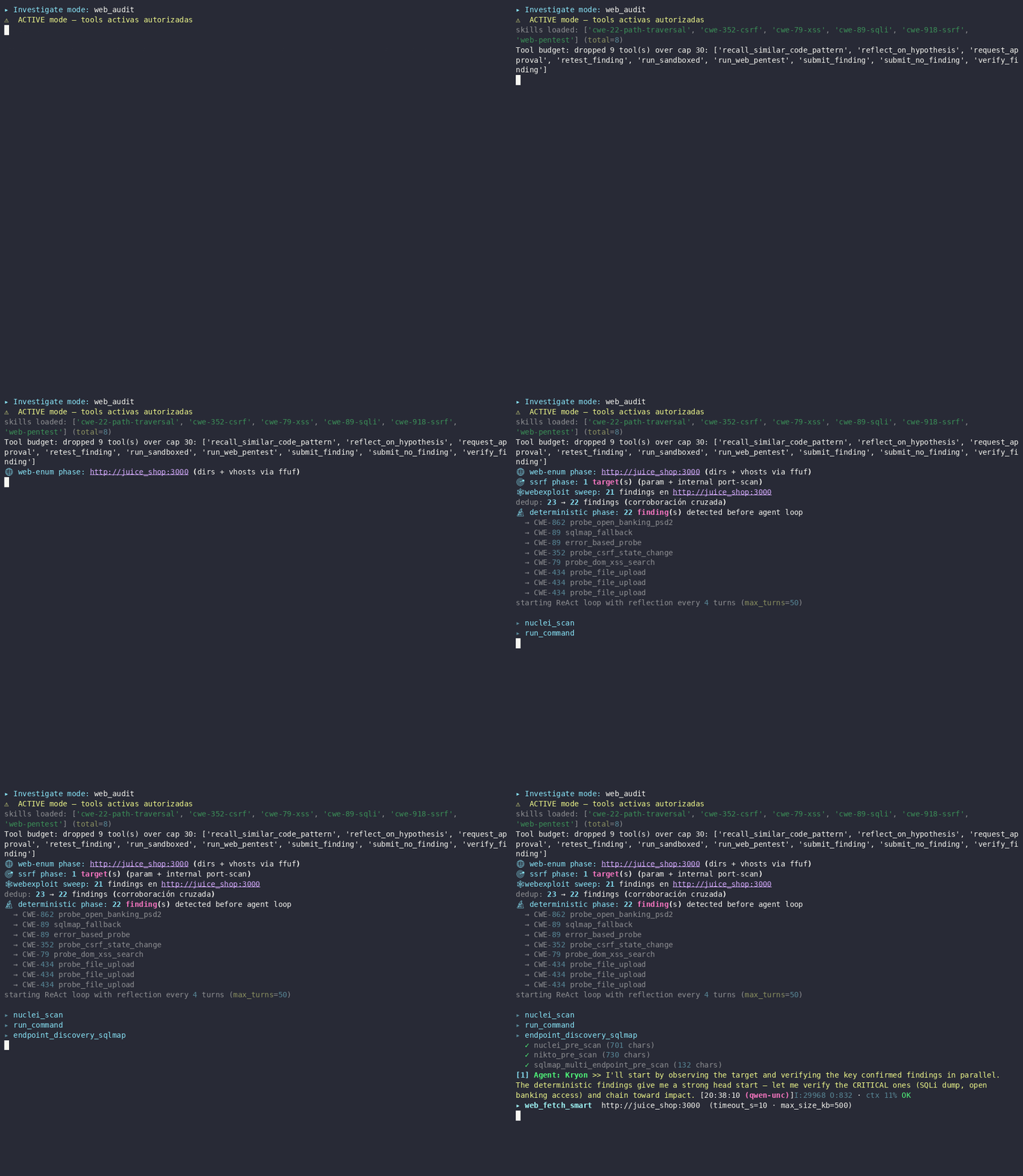
Real run against OWASP Juice Shop — deterministic detectors surface 22 findings before the LLM, then the agent chains toward impact.
What is KRYON?
Kryon is a local-first, autonomous offensive-security agent. Point it at a target and — from a single prompt — it runs recon, authorized pentesting, vuln hunting, DFIR, or a compliance audit, then hands back findings and a report.
It runs fully on your own hardware — a local, OpenAI-compatible LLM served via llama.cpp — so there's zero API cost and no data leaves the engagement perimeter. Need more raw capability? Swap to a cloud model with one env var.
What makes it different: the critical detectors run as deterministic pre-hooks before the model — the LLM narrates evidence, it can't skip the scanner. And coverage grows via
kryon update(nuclei/CVE/ExploitDB feeds), not a bigger model.
Scope: Kryon is a general offensive/compliance agent for any organization. Its compliance coverage spans many sectors — fintech (PCI-DSS, PSD2/FAPI), healthcare (HIPAA), data protection (GDPR), critical infrastructure (NIS2, OT/ICS), SaaS (SOC 2), defense (CMMC), and general baselines (ISO 27001, CIS, NIST CSF, Zero Trust) — plus edge/infra playbooks (FortiGate, Unifi, Windows, Tomcat, Proxmox, VoIP). Some sector playbooks are methodology templates, not turnkey scanners; see Playbook Status for what runs end-to-end vs. what's a starter frame.
Architecture is skill-based: one unified "Kryon" agent dynamically loads ~110 markdown playbooks based on target profile and operator intent. Critical detection paths run as deterministic pre-hooks (nuclei, nikto, sqlmap, fail2ban check, PCI-DSS validators, …) before the LLM ever gets control — the model narrates evidence, it cannot skip the detector.
One prompt — full engagement
$ kryon investigate "audita https://target.com"

 ✶ Kryon [investigate · ReActLoop] · 3 skills matched
 ● pre_hook nuclei -severity critical,high,medium       → 7 templates fired
 ● pre_hook curl -I + CSP+HSTS+Cookies parse            → 3 missing headers
 ● web_fetch_smart https://target.com                   → tech: Apache 2.4.41 / WordPress 6.4
 ● reflection turn 4: "no findings on /wp-admin, pivot to /xmlrpc"
 ● run_command wpscan --url ... --enumerate vp,u        → 2 vuln plugins
 ● writeback_engagement → eng_3e03db5e (chain saved)

╭─ Kryon ─────────────────────────────────────────────────────╮
│ ## Security Assessment: target.com                          │
│ **Findings (HIGH=2, MED=3, LOW=1)** — full chain in report  │
│ CWE-89 SQLi blind boolean on /wp-content/plugins/wpforo     │
│ CWE-79 stored XSS on comment form (auth required)           │
│ Missing: HSTS, X-Frame-Options, CSP                         │
│ Recommendations: 5 actionable items, with rollback commands │
╰─────────────────────────────────────────────────────────────╯

✅ Experience saved + draft skill auto-written (~/.kryon/drafts/)
⚡ Quickstart
# 1. Clone + launch the stack (Kali toolchain + local LLM + Kryon)
git clone https://github.com/skyvanguard/Kryon.git && cd Kryon
docker compose -f docker/docker-compose.kali.yml -f docker/docker-compose.override.yml up -d

# 2. Run your first engagement
docker exec -it kryon kryon investigate "audita https://your-target.com"
Kryon matches skills to the target, runs its deterministic detectors, then the agent loop, and returns findings + a report. Full install & configuration → · How it's built →
At a Glance
| Component | Count |
|---|---|
Skill playbooks (.md) |
110 (46 core + 40 imported + 11 CWE + 5 OT + 4 banking + 4 zero-day) |
@function_tool implementations |
362 — safe/passive by default; offensive branches under KRYON_RED_TEAM (credential dumping, lateral movement, AD, cloud, DFIR) |
| CLI entry points | 27 subcommands |
| API endpoints (FastAPI) | 140 |
| Compliance framework modules | 12 (PCI-DSS, CIS, NIST CSF, SOC2, ISO 27001, CMMC, DORA, NIS2, Zero Trust, HIPAA, GDPR, PSD2/FAPI) — OWASP/MITRE map via skills |
| Production-capable audit modules | 21 (PCI-DSS · Proxmox · FortiGate · Unifi · Asterisk · Windows · Tomcat · ESXi · KVM · Hyper-V · Xen · MikroTik · Cisco IOS · PostgreSQL · MySQL · nginx · Apache · IIS · Caddy · HAProxy · Linux) |
| Model | any local, OpenAI-compatible LLM via llama.cpp — swappable to any OpenAI-compatible endpoint (local or cloud) |
| LLM runtime | llama-server (llama.cpp), tool-calling via --jinja |
Core capabilities
- Four execution modes —
engage(compliance audits),investigate(open-ended ReAct loop),queue process(multi-target sweep),schedule(continuous-monitoring appliance). - Deterministic-first — critical detectors (nuclei, nikto, sqlmap + 11 hybrid probes) run as pre-hooks before the LLM; the model converts evidence, it doesn't invent it. OWASP Juice Shop bench: 18 findings / 0 false positives.
- Grows without a bigger model —
kryon updaterefreshes the detection feeds (nuclei / CVE / ExploitDB); a self-improving loop auto-drafts new skills from successful engagements. - Hallucination guards — CVE + finding applicability gates drop results that don't match the target's stack (e.g. a JSP CVE on a Node.js host).
- Deterministic finding validators — confirmed, not guessed: XSS/SSRF/IDOR replayed headlessly with a single canary GET (no external tool), sqlmap/dalfox/commix for the heavy classes, and an ASAN/canary oracle for SAST findings. Live probes double-gated (
KRYON_REPLAY_FIRE). - Full offensive arsenal — credential dumping, lateral movement, AD attacks (kerberoast / DCSync / BloodHound), privesc, plus cloud / DFIR / container branches — intrusive tools gated behind
KRYON_RED_TEAM. - Safe by default — passive recon, throttled nmap, no live probes unless double-gated (
KRYON_*_FIRE=true+fire=True). Safe-modification protocol: diagnose → propose → backup → apply → verify → rollback. - Local & private — runs on your own hardware, zero API cost, no data leaves the host. OpenAI-compatible → swap to a cloud model with one env var.
Execution modes
Kryon has four CLI entry points, each tuned for a different engagement shape.
1) kryon engage — compliance-driven, plan-based
For PCI-DSS / SWIFT CSP / CIS / NIST audits with a pre-defined phase plan and a deterministic compliance runner. Field-tested on an internal POC across 34 hosts in 3 network segments.
kryon engage \
  --target 192.168.10.11 \
  --framework pci_dss \
  --orchestrated \
  --auto-approve \
  --client example-internal \
  --engagement-id eng_001 \
  --out ./poc-reports
Phase plan loaded from pyproject.toml profiles; each phase re-matches skills against phase_name + objective + target and runs that skill's pre_hooks:. PDF report + JSON findings + reproducibility hash per engagement.
2) kryon investigate — open-ended ReAct loop
For exploratory work: "audita esta URL", "qué CVEs aplican a nginx 1.18", SAST sobre código local. ReAct stack: Observation → Reflection → Decision → Action → Verification, with stuck-pattern detection that breaks loops before wall-budget exhaustion.
# Safe / passive by default (web_fetch_smart + RAG + 11 hybrid detectors)
kryon investigate "audita https://target.com"
kryon investigate --url https://target.com
kryon investigate ./local/path/             # SAST on local source

# Active (requires written authorization)
kryon investigate "active sqli pentest contra https://target" --active

# Active + red-team tools (jwt_crack, hydra, ffuf, playwright)
KRYON_RED_TEAM=true kryon investigate "active rce pentest contra http://lab" --active
| Mode | Flag | Tools available | Pre-hooks fired |
|---|---|---|---|
| PASSIVE (default) | — | web_fetch_smart, RAG queries, DNS lookup |
Hybrid-mode deterministic only |
| ACTIVE | --active |
+ nmap, nuclei, sqlmap, etc. | ALL (incl. explicit-keyword skills) |
| ACTIVE + RED-TEAM | --active + KRYON_RED_TEAM=true |
+ 21 red-team tools | ALL |
14 explicit-keyword active skills cover OWASP Top-10 + API + JS-ecosystem. They activate ONLY with the literal phrase "active <X> pentest" (or "fire <X> probe" / "pentest activo <X>") — preventing pre-hook regression on broad-keyword triggers.
3) kryon discover --queue-add + kryon queue process — multi-target POC
For segment-wide POCs (CIDR not supported on engage directly). Discovers live hosts, queues them, then drains the queue invoking engage per item — safe serial by default.
# 1. Discover + enqueue (throttled nmap)
KRYON_NMAP_TIMING=T2 KRYON_NMAP_MIN_RATE=50 \
  kryon discover --subnet 10.x.x.0/24 --queue-add --output disc.json

# 2. Drain — sequential, no auto-retry on failure (manual triage)
kryon queue process \
  --concurrency 1 \
  --framework pci_dss \
  --orchestrated \
  --auto-approve \
  --client example-internal \
  --out ./poc-reports
--limit N cuts after N items. Failed items stay in status=failed for triage — no silent retries (avoids duplicate destructive actions on production hosts).
4) kryon schedule — continuous monitoring (appliance)
Turns Kryon from a one-shot scanner into a monitor. The product is not the scan — it's the diff: what changed since last run, forwarded to a SIEM (Wazuh / Splunk / Elastic / QRadar) and rendered as a plain-language "novedades" report (.md + branded PDF).
# Refresh detection feeds first (nuclei-templates, ExploitDB, NVD CVE cache)
kryon update

# Schedule a nightly feed-refresh, then a nightly segment sweep
kryon schedule add --id feeds  --update --cron "0 2 * * *"
kryon schedule add --id seg-10 --subnet 10.0.0.0/24 --cron "0 3 * * *" --framework pci_dss
kryon schedule run-due --watch --interval 60      # in-process daemon
Each scan diffs against the saved baseline into four buckets — new / worsened / resolved / stable — masking volatile-token noise (timestamps, session ids) so a bumped banner isn't a false "changed". A warm-up run establishes the baseline silently, so the first night on a new target isn't an alert avalanche. KRYON_NOTIFY_DRIFT=true + KRYON_SIEM_TYPE=wazuh wire the alerting.
Skill System
Kryon's intelligence lives in 110 markdown playbooks organized by purpose. Skills are auto-matched by target tech, open ports, and user keywords. Priority-based selection with a token budget cap (max 15 tools to fit a 16K-context active engagement).
src/kryon/skills/playbooks/
├── ~42 core skills         recon-scout, pentest, vuln-hunter, appsec,
│                            forensics, ctf-master, ssl-audit, server-hardening,
│                            safe-modification, rollback-recovery,
│                            tomcat-audit, fortigate-audit, unifi-audit,
│                            voip-asterisk-audit, dvr-audit, hackerone-engagement,
│                            burp-integration, http-fetch, evidence-forensics,
│                            cryptanalysis-techniques, browser-exploit,
│                            memory-corruption-exploits, binary-reverse-engineering, …
├── banking/ (4 .md files)  pci-dss-audit, audit-bank-full, proxmox-audit,
│                            cis-controls-v8.1
│                            ⚠ core-banking-assessment, mobile-banking-audit,
│                            atm-security, payment-gateway-testing, fraud-detection
│                            are *methodology templates* (not shipped .md playbooks).
│                            swift-network-security + open-banking-api now ship a
│                            deterministic runner/validator — see Playbook Status.
├── cwe-detection/ (11)     CWE-22, CWE-78, CWE-79, CWE-89, CWE-125, CWE-20,
│                            CWE-287, CWE-352, CWE-502, CWE-639, CWE-918
├── ot/ (5 skills)          modbus, dnp3, iec104, s7, mqtt-industrial
├── imported/ (40 skills)   from mukul975/Anthropic-Cybersecurity-Skills
│                            (Apache 2.0, MITRE ATT&CK / NIST CSF mapped)
├── zero-day/ (4 skills)    source-review / variant-analysis harness
│                            (intra-tree + recent-CVE patch-diff seeding)
└── pre_hooks/              Python escape-hatch helpers (sqlmap, IDOR probe)
Pre-hooks — deterministic-first execution
A skill can declare a YAML list of tool invocations that run before the LLM gets control. Output is injected as authoritative context — the model narrates findings, it cannot skip the detector.
---
name: vuln-hunter
priority: 30
required_tools: [nuclei_scan, run_command]
pre_hooks:
  - tool: nuclei_scan
    args: { target: "{ctx.target}", severity: "critical,high,medium" }
  - tool: run_command
    args: { command: "nikto -h {ctx.target} -Tuning x6 -maxtime 60" }
  - python: ./pre_hooks/sqlmap_rest_login_hook.py:run
---
Currently wired in: fortigate-audit, unifi-audit, proxmox-audit, pci-dss-audit, audit-bank-full, vuln-hunter, ssl-audit, appsec, wordpress-audit, the 14 explicit-keyword active skills, the 11 CWE-detection skills, and the 6 banking skills.
/skill REPL commands
KRYON> /skill list                      # All 110 loaded
KRYON> /skill show recon-scout          # View playbook content
KRYON> /skill search kubernetes         # Search upstream catalog (754 skills)
KRYON> /skill import exploiting-zerologon-vulnerability-cve-2020-1472
KRYON> /skill reload                    # After editing a .md
KRYON> /skill drafts                    # Auto-generated drafts pending review
KRYON> /skill review <draft>            # Inspect a draft
KRYON> /skill promote <draft>           # Promote draft to active skill
KRYON> /skill scores                    # Wilson-scored skill ranking
KRYON> /skill auto detect               # Trigger pattern detector
Custom skills
Drop a .md in src/kryon/skills/playbooks/:
---
name: my-custom-audit
description: "My specialized playbook"
triggers:
  tech: ["nginx"]
  keywords: ["nginx hardening", "reverse proxy audit"]
priority: 20
required_tools: [run_command, nuclei_scan]
pre_hooks:
  - tool: run_command
    args: { command: "curl -sI https://{ctx.target}" }
---

## Workflow
1. Verify nginx version + EOL status
2. Check TLS config (ciphers, HSTS, OCSP stapling)
3. ...
♻️ Self-improving loop — how Kryon auto-drafts new skills (click to expand)
| Layer | Purpose | Trigger |
|---|---|---|
| Drafting | Every successful engagement writes a draft .md to ~/.kryon/drafts/ via skill_synthesizer.py + draft_writer.py |
Auto on engage exit |
| Scoring | skill_scorer.py uses Wilson 95%-lower-bound confidence + reusability axis. Activate with KRYON_SKILL_RANKING=hybrid or =dual |
Per-selection telemetry to JSONL |
| Auto-creation | pattern_detector.py (Jaccard clustering) + LLM-assisted body + skill_evaluator.py (CWE → tools gate, hallucinated tools rejected) + auto_pipeline.py |
Manual: /skill auto detect |
CWE map override: ~/.kryon/cwe_map.yaml (or set KRYON_CWE_MAP).
every auto-generated draft now gets a sidecar .eval.json with guide_score (relevance + naturalness, threshold 0.6).
Architecture
                           ┌─────────────────────────────────────┐
                           │   kryon CLI (27 subcommands)        │
                           │   engage · investigate · queue ·    │
                           │   discover · approve · doctor · …   │
                           └────────────────┬────────────────────┘
                                            │
                                            ▼
                  ┌─────────────────────────────────────────────────┐
                  │   skills/  (PRIMARY interface)                 │
                  │   ┌────────────────────────────────────────┐    │
                  │   │ loader.py — match by tech/ports/kw     │    │
                  │   │ tool_budget.py — cap @ 15 tools        │    │
                  │   │ unified_agent.py — compose prompt      │    │
                  │   │ pre_hook_runner.py — deterministic-1st │    │
                  │   └────────────────────────────────────────┘    │
                  │   playbooks/  (110 .md files)                   │
                  └────────────┬────────────────────┬───────────────┘
                               │                    │
                               ▼                    ▼
            ┌──────────────────────────┐  ┌────────────────────────────┐
            │ sdk/agents/ (run loop)   │  │ tools/ (362 @function_tool)│
            │ ┌──────────────────────┐ │  │ 52 categories:             │
            │ │ Runner               │ │  │ reconnaissance, web,       │
            │ │ models/openai_native │ │  │ network, ad, cloud,        │
            │ │  + harmony_parser    │ │  │ container, forensics,      │
            │ │  + tool name fixes   │ │  │ exploitation, dfir,        │
            │ │ ReflectiveRunner     │ │  │ banking, ot, validation…   │
            │ └──────────────────────┘ │  └────────────────────────────┘
            └──────────┬───────────────┘
                       │
                       ▼
      ┌──────────────────────────────────────────────────────────────┐
      │ Cross-cutting subsystems                                     │
      │                                                              │
      │ services/  context mgmt (micro_compact, session_memory,      │
      │            tool_output_cap, auto_extract)                    │
      │ learning/  ChromaDB experiences + self-improving skill loop  │
      │ knowledge/ NVD + ExploitDB + writeups (embedding RAG OFF)    │
      │ compliance/ 12 frameworks (PCI-DSS, CIS, SWIFT, …) runners   │
      │ reporting/ PDF/DOCX/HTML, reproducibility hashes             │
      │ memory/    SQLite store (16 migrations) — engagements, KB    │
      │ server/    FastAPI — 140 endpoints, single-tenant, JWT/RBAC  │
      │ approval/  Human-in-the-loop for destructive actions         │
      └──────────────────────────────────────────────────────────────┘
                       │
                       ▼
              ┌────────────────────────┐
              │ llama-server (llama.cpp)│
              │  local OpenAI-compat   │
              │  LLM (swappable)       │
              └────────────────────────┘
kryon investigate trace (click to expand)
1. ParseArgs(url) ──▶ ReflectiveRunner(max_turns=N, reflect_every=4)
2. SkillLoader.match(url, intent) ──▶ 3-5 skills selected
3. ToolBudget.select(skills) ──▶ 30 tools wired to runner
4. _run_deterministic_phase(url) — hybrid mode
       ├── _check_http      ──▶ headers, redirects, tech fingerprint
       ├── _check_mysql     ──▶ banner, auth attempt
       ├── _check_ssh       ──▶ banner, ciphers
       └── (8 more detectors) ──▶ findings injected as GROUND TRUTH
5. pre_hooks of matched skills
       ├── nuclei_scan      ──▶ severity-prioritized top-N
       ├── nikto            ──▶ deduped by bracketed-id regex
       └── sqlmap (Python)  ──▶ JSON POST body discovery
6. LLM agent loop  (max_turns=8 reasoning / 5 instruct)
       observation ──▶ reflection (every 4 turns) ──▶ decision ──▶ action ──▶ verify
7. _parse_agent_findings
       ├── CVE applicability gate (drops e.g. a JSP CVE on a Node.js host)
       ├── Finding applicability gate (scans message+evidence for product kw)
       └── KRYON_DEBUG_PARSE=true ──▶ JSONL trace
8. writeback_engagement ──▶ ChromaDB + ~/.kryon/drafts/<auto>.md
Installation
Requirements
- Python 3.10+ (managed by
uv) - Docker (Kali Linux + 200+ security tools pre-installed)
- A local LLM — any OpenAI-compatible model served via llama.cpp (a GPU helps but isn't required; size the model to whatever hardware you have). Or point Kryon at a cloud endpoint instead.
- GitHub CLI (
gh) for/skill importfrom upstream catalog
Docker deployment (recommended)
git clone https://github.com/skyvanguard/Kryon.git
cd Kryon

# Copy environment template
cp docker/.env.docker.example docker/.env.docker

# Launch stack (Kali + llama-server + Kryon, GPU passthrough)
docker compose -f docker/docker-compose.kali.yml \
               -f docker/docker-compose.override.yml \
               --env-file docker/.env.docker up -d

# The `llama-server` service of the compose file serves your local model —
# mount any OpenAI-compatible GGUF and it exposes an OpenAI-compatible API
# on :8080 with tool-calling enabled via `--jinja`. There is no model-build
# step: llama.cpp loads the GGUF directly on startup. Verify it is up with:
docker exec kryon curl -s http://llama-server:8080/v1/models

# (Embedding RAG is OFF by default — see "knowledge/" notes below.)

# (Optional) Refresh detection feeds (nuclei-templates, ExploitDB, CVE cache)
docker exec -it kryon kryon update

# Launch the interactive TUI
docker exec -it kryon kryon tui
Safe by default (compliance audits)
# docker/.env.docker
KRYON_MODEL=kryon-local                  # alias for whichever local model your llama-server serves
                                     # (already the default, so you can omit this line)
KRYON_AGENT_TYPE=kryon
KRYON_UNIFIED=true
KRYON_FORCE_TOOL_TURNS=8               # local LLM tool-calling reliability
KRYON_MEMORY=true
KRYON_STREAM=false                     # Stable REPL

# Throttled scanning (gentle on production during business hours)
KRYON_NMAP_TIMING=T2
KRYON_NMAP_MIN_RATE=50
KRYON_NMAP_MAX_PARALLELISM=10
KRYON_NUCLEI_RATE_LIMIT=50
KRYON_NUCLEI_BULK_SIZE=10
KRYON_NUCLEI_CONCURRENCY=10

# CVE / finding applicability gates (drop hallucinated cross-stack CVEs)
KRYON_CVE_CACHE_REQUIRED=true
KRYON_CVE_APPLICABILITY=true           # default
KRYON_FINDING_APPLICABILITY=true       # default
Active pentest (authorized targets only)
# Add to the safe-by-default block
KRYON_REASONING_EFFORT=medium          # — only when pre-hooks active
KRYON_PHASE_TURNS=10                   # — bump from auto-8
KRYON_RED_TEAM=true                    # Unlock 21 red-team tools

# ENGAGEMENT CAGE — hard authorization enforced at the tool-execution layer (not
# a prompt — a technical gate). The agent physically cannot act outside its
# written authorization, even running fully autonomously. Three axes; any one set
# turns the cage ON, all unset = off (backward compatible):
#   WHERE — scope: every tool call's target validated against the allowlist
KRYON_SCOPE=10.65.168.0/24,*.creative.thm,https://app.target.com
KRYON_SCOPE_DENY=10.65.168.1           # optional hard deny (e.g. the gateway)
#   WHEN — engagement window: out of window → every tool blocked
KRYON_ENGAGEMENT_START=2026-06-18T02:00:00Z
KRYON_ENGAGEMENT_END=2026-06-18T06:00:00Z
#   WHAT — action tier ceiling: passive < active < exploit < post. Tools above
#   the ceiling are refused (e.g. 'active' allows scanning, blocks exploit/post)
KRYON_MAX_TIER=active
Network egress cage (defense-in-depth, OS level — caps subprocess tools + obfuscated
targets the software gate's regex can miss). Generated from KRYON_SCOPE, applied
in the container (needs NET_ADMIN, already granted):
python -m kryon.agents.network_egress apply        # default DROP egress except scope + DNS + LLM
python -m kryon.agents.network_egress              # dry-run: print the iptables ruleset
Kill-switch — hard external stop for an autonomous run (checked at the tool layer;
tripping STOPS the run). Bounds HOW MUCH the agent acts and lets a human pull the
plug. Any one set turns it on:
KRYON_KILL_FILE=/tmp/kryon.stop        # `touch` this file to abort mid-run
KRYON_DEADLINE=2026-06-18T06:00:00Z    # hard wall-clock stop
KRYON_MAX_ACTIONS=200                  # cap total tool calls this run
Switch to DeepSeek (higher recall, off-perimeter)
The hardened harness is model-agnostic; flipping to a stronger cloud model is one
step. deepseek-chat (V3) uses the native path; deepseek-reasoner (R1)
auto-routes to litellm for the reasoning_content round-trip. Misconfig (missing
key / wrong base_url / stale KRYON_LOCAL_LLM) is flagged fail-fast at startup so
a paid run isn't wasted.
KRYON_MODEL=deepseek-chat
OPENAI_BASE_URL=https://api.deepseek.com
OPENAI_API_KEY=sk-...                   # real DeepSeek key
KRYON_LOCAL_LLM=false                   # cloud, not the local server
Live-probe gates (DOUBLE gate: env + fire=True argument)
KRYON_BOLA_FIRE=true # detect_bola live HTTP
KRYON_GRAPHQL_FIRE=true # graphql_recon live HTTP
KRYON_RETEST_FIRE=true # retest_finding live HTTP
KRYON_BRAND_FIRE=true # typosquat_scan live DNS
KRYON_REPLAY_FIRE=true # replay_xss/ssrf/idor deterministic validators
</details>

---

<a id="playbook-status"></a>

<details>
<summary><b>🎯 Playbook status — production-ready vs template, across all verticals (click to expand)</b></summary>

Not every playbook is turnkey today. Kryon spans infra/edge (FortiGate, Unifi, Windows, Tomcat, Proxmox, VoIP), web/app, and sector-specific playbooks (banking, payments, healthcare) — here's what runs end-to-end vs. what's a methodology frame:

| Playbook | Status | Notes |
|---|---|---|
| **`pci-dss-audit.md`** | ✅ **production-capable** | **21 deterministic checks** across PCI requirements 1·2·4·5·6·7·8·10·11 — incl. **1.4.1** (host firewall), **4.2.1** (strong TLS), **5.2.1** (anti-malware), **6.4.3** (payment-script SRI + CSP), **7.2.1** (least-privilege file perms), **8.4.3** (SSH MFA, FIDO2/WebAuthn-aware), **10.3.1** (audit-log protection), **11.5.1** (IDS/IPS). Reproducibility-hashed. SAQ B/C/D scoping. |
| **`proxmox-audit.md`** | ✅ **production-capable** | **17 deterministic PVE checks** — web/API SSL+auth, SSH (key-only + ciphers + fail2ban + **kernel sysctl**), MFA + **named users**, API tokens, firewall (deny + logging), patching (version + repo-hygiene + **auto-upgrades**), cluster quorum, time-sync, **backup jobs**. Validated in internal pilot. |
| **`audit-bank-full.md`** | ✅ **production-capable** | orchestrates the three core audits + multi-framework PDF. |
| **`fortigate-audit.md`** | ✅ **production-capable** | **28 checks** (FGT-1.1..FGT-6.3) wired to `run_compliance_audit(framework="fortigate")` — admin hardening (incl. 1.7 GUI-TLS, 1.8 password-policy, 1.9 maintainer), services (incl. 2.5 strong-crypto), SSL-VPN, logging, patching + **firewall policy hygiene** (6.1 no allow-all, 6.2 accept-policy logging, 6.3 UTM profiles). CIS Fortinet Benchmark + CVE catalog (CVE-2022-42475, CVE-2024-21762, CVE-2024-23113). Read-only via SSH. |
| **`unifi-audit.md`** | ✅ **production-capable (controller)** + 📝 template (WiFi capture) | 18 controller checks via `mongo --port 27117 ace`. Hash estable. Active WiFi capture runs on operator host. |
| **`voip-asterisk-audit.md`** | ✅ **production-capable** | 8 checks (VOIP-1.1..VOIP-3.3): anonymous register / AMI default secret / allowguest / AMI WAN / SRTP / SIP-TLS / version currency. |
| **`windows-server-audit.md`** | ✅ **production-capable** | 15 checks (WIN-1.1..WIN-4.2) via WinRM: SMBv1 / LSA / PrintNightmare / Defender RTP / firewall / BitLocker / LLMNR / WSUS / LAPS / audit policy / RDP NLA / UAC / EDR. |
| **`tomcat-audit.md`** | ✅ **production-capable** | 8 checks (TOMCAT-1.1..TOMCAT-2.4): EOL versions / AJP 8009 Ghostcat (CVE-2020-1938) / Manager+Host Manager exposure / version leak / /docs + /examples deployed. |
| **`dvr-audit.md`** | 📝 recon-only template | Dahua/Hikvision/ONVIF fingerprint + nuclei CVE templates (CVE-2017-7921, CVE-2021-33044/45, CVE-2021-36260). Custom checks v2 post-POC. |
| `core-banking-assessment.md` | 📝 template | T24/Flexcube/Finacle/Bantotal — methodology + checklist only. Needs vendor sandbox per engagement. |
| `swift-network-security.md` | 🟡 runner + template | **CSCF v2026** (25 mandatory + 7 advisory): 17 deterministic host checks (`swift-csp-2026.yaml`, SWIFT-1.1..7.2) wired to `run_compliance_audit(framework="swift-csp")`, covering principles 1·2·4·5·6·7. SWIFT-component controls (Alliance Access/Connect, HSM) + the now-mandatory 2.4M back-office data flow need partner attestation. NOT a KY3P replacement. |
| `atm-security.md` | 📝 template | Requires physical access + NCR/Diebold lab + PCI-PTS certified team. |
| `open-banking-api.md` | 🟡 validator + template | FAPI 1.0 Advanced **discovery-doc validator** (10 read-only checks: PAR, PS256/ES256, mTLS/DPoP, PKCE S256, no-implicit, JARM, SCA ACR/AMR) wired to the **PSD2 RTS** compliance mapper. Safe (read-only, live fetch double-gated). Full authenticated flow (per-bank mTLS certs + client_id) is still per-engagement. |
| `payment-gateway-testing.md` | 📝 template | Bancard/Infonet/Stripe/MercadoPago. Checklist only. |
| `fraud-detection.md` | 📝 template | Interview + rule-review guide, not a technical scan. |
| `mobile-banking-audit.md` | 📝 template | Frida/objection/jailbroken device outside the container. |

**Rule of thumb**: ✅ = end-to-end deterministic + reproducibility hash. 📝 = methodology guide; execution requires manual steps and vendor-specific access.

---

### What runs today (POC reality)

End-to-end proven in production engagements:

- **Internal POC (2026)** — 34 hosts across 3 segments (VoIP, workstations, servers), low-impact during business hours via operator VPN. 11 systemic findings, 0 false positives. 26 new Kryon features shipped from POC feedback.
- **OWASP Juice Shop bench** — avg 18 findings, 0 FPs, 3/3 SATISFIED (n=3 reproducible). Ground truth: 10 canonical CWEs (CWE-89/79/639/285/200/22/352/915/1004/319).
- **HackTheBox-style walkthrough bench** — 4/7 PWN rate (chain_match 100%) on web-only ready set (SQLi, XSS, IDOR, RCE, SSRF, CSRF, XXE). Note: `ready_url` points to PortSwigger docs, NOT the live lab. Measures **reasoning over documentation**, not live exploit.
- **Juliet SAST bench** — 67.1% recall + 15% FPR @ HIGH.

Edge-network coverage (FortiGate + Unifi + VoIP + Windows + Tomcat) extends the data center perimeter all the way to WiFi and PBX.

</details>

---

<details>
<summary><b>🎯 Use cases — end-to-end examples (compliance · bug bounty · CTF · DFIR · hardening) (click to expand)</b></summary>

### Compliance audits (multi-sector)

```bash
kryon engage --target 192.168.10.11 --framework pci_dss --orchestrated
kryon engage --target fw01.corp --framework fortigate --orchestrated
kryon engage --target unifi.corp --framework unifi --orchestrated
kryon engage --target dc01.corp --framework windows --orchestrated
Bug bounty / authorized pentest
KRYON_RED_TEAM=true kryon investigate "active sqli pentest contra https://target" --active
KRYON_RED_TEAM=true kryon investigate "active rce pentest contra http://lab"     --active
KRYON_RED_TEAM=true kryon investigate "active idor pentest contra api.target"    --active
CTF / HackTheBox
KRYON_RED_TEAM=true kryon investigate "resolvé esta máquina: 10.10.10.5" --active
Forensics & incident response
KRYON> /agent select forensics
KRYON> analizá este memory dump con volatility
KRYON> investigá este phishing email (eml adjunto)
KRYON> detectá lateral movement en los logs
Server hardening (SSH remediation)
kryon engage --target 192.168.1.10 --ssh-user admin --ssh-key ~/.ssh/id_ed25519 \
             --framework cis_linux --orchestrated
→ Loads server-hardening + safe-modification + rollback-recovery. Diagnose (read-only) → Propose (table + STOP) → Apply (with backups) → Verify.
Multi-target segment POC
KRYON_NMAP_TIMING=T2 kryon discover --subnet 10.0.10.0/24 --queue-add --output disc.json
kryon queue process --concurrency 1 --framework pci_dss --orchestrated --auto-approve \
                    --client mycorp --out ./poc-reports
Supported AI Models
| Provider | Recommended | Config | Notes |
|---|---|---|---|
| llama.cpp (local) | any OpenAI-compatible GGUF | KRYON_MODEL=kryon-local |
DEFAULT (local-first). Serve any tool-calling GGUF sized to your hardware via llama-server, native tool-calling via --jinja. KRYON_MODEL (kryon-local) is just the compose alias — swap the model by flipping -m in the compose. A small model reliably runs the harness; a bigger one raises recall. |
| DeepSeek | deepseek-chat (V3), deepseek-reasoner (R1) |
OPENAI_BASE_URL + OPENAI_API_KEY + KRYON_LOCAL_LLM=false |
Cloud, OpenAI-compatible — recommended when raw capability beats locality (data leaves the engagement perimeter). deepseek-chat uses the native path; deepseek-reasoner auto-routes to litellm for reasoning_content. |
| OpenAI | GPT-4o, o3 | OPENAI_API_KEY |
Cloud — data leaves the engagement perimeter. |
| Anthropic | Claude Sonnet 4.6 | ANTHROPIC_API_KEY |
Cloud. |
| OpenRouter | 200+ models | OPENROUTER_API_KEY |
Cloud. |
Recommended (local): any tool-calling GGUF you can run — local, zero API cost, native tool-calling via llama.cpp's --jinja. A small local model reliably runs the harness (tools, deterministic pre-hooks, intel pipeline) — by design the offensive knowledge lives in the deterministic layer, not the model's weights, and coverage grows via kryon update, not a bigger brain. A small model will not discover novel/zero-day issues and has limited recall on open-ended exploration; for higher recall or research work, swap to a cloud model (one env var). Safe sampling defaults are baked into the llama-server command in the compose file.
Compliance Coverage
| Framework | Coverage | Status |
|---|---|---|
| PCI-DSS v4.0.1 | 21 deterministic checks (reqs 1·2·4·5·6·7·8·10·11, incl. 4.2.1 TLS, 5.2.1 anti-malware, 7.2.1 least-privilege, 8.4.3 MFA, 11.5.1 IDS/IPS), SAQ B/C/D | ✅ production |
| CIS Linux Benchmark | via server-hardening + safe-modification |
✅ production |
| CIS Fortinet Benchmark | 28 checks via fortigate-audit (incl. device hardening + firewall policy hygiene) |
✅ production |
| Proxmox / PVE hardening | 17 checks via proxmox-audit |
✅ production |
| VMware ESXi (CIS Benchmark) | 17 checks via vmware/esxi runner — timeouts, MOB, lockout, banner, NTP+firewall, syslog, host firewall, SNMP, vSwitch security (promiscuous/forged), password policy, weak-TLS, VIB acceptance (esxcli over SSH) |
✅ production |
| KVM / libvirt / QEMU | 14 checks via kvm/libvirt runner — daemon access (no unauth TCP, socket perms, TLS key/verify, audit), guest isolation (sVirt, VNC+SPICE, mount namespace), privilege (non-root, image perms, seccomp, capability drop, cgroup device ACL) (config + stat over SSH) |
✅ production |
| Microsoft Hyper-V (CIS Benchmark) | 9 checks via hyper-v runner — MAC-spoofing, automatic-stop, admins-group, Secure Boot (Gen2), guest file-copy, Production+automatic checkpoints, Live-Migration Kerberos, nested-virt (PowerShell over WinRM) |
✅ production |
| Xen / XCP-ng / XenServer | 5 checks via xen/xcp-ng runner — dom0 SSH key-only, time sync, remote syslog, version currency (EOL), pending patches (xe CLI + config over SSH) |
✅ production |
| MikroTik RouterOS | 6 checks via mikrotik/routeros runner — cleartext services (telnet/ftp/www/api), SSH strong-crypto, bandwidth-server, NTP, default SNMP community, remote logging (RouterOS CLI over SSH) |
✅ production |
| Cisco IOS / IOS-XE (CIS Benchmark) | 5 checks via cisco/ios runner — VTY SSH-only (no telnet), enable secret, service password-encryption, no default SNMP community, HTTP server disabled (show run over SSH) |
✅ production |
| PostgreSQL (CIS Benchmark) | 5 checks via postgresql/postgres runner — SSL/TLS, connection+disconnection logging, scram-sha-256, no network trust auth (psql peer-auth over SSH) |
✅ production |
| MySQL / MariaDB (CIS Benchmark) | 5 checks via mysql/mariadb runner — TLS required, local_infile off, no anonymous users, root not on %, test DB removed (mysql client socket-auth over SSH) |
✅ production |
| nginx (CIS Benchmark) | 4 checks via nginx runner — server_tokens off, weak TLS (SSLv3/TLS1.0/1.1) disabled, autoindex off, workers not root (nginx -T over SSH) |
✅ production |
| Apache HTTPD (CIS Benchmark) | 4 checks via apache/httpd runner — ServerTokens Prod, ServerSignature Off, no directory listing (Options Indexes), TraceEnable Off (config grep over SSH) |
✅ production |
| Microsoft IIS (CIS Benchmark) | 4 checks via iis runner — directory browsing off, no client-facing detailed errors, Server header removed, HTTP logging on (PowerShell/WebAdministration over WinRM) |
✅ production |
| Caddy | 4 checks via caddy runner — admin API not network-exposed, auto-HTTPS not disabled, no weak TLS (tls1.0/1.1), file-server browsing off (Caddyfile over SSH) |
✅ production |
| HAProxy | 4 checks via haproxy runner — weak TLS (ssl-min-ver ≥ TLSv1.2), stats page auth, logging configured, runtime admin socket not TCP-exposed (config over SSH) |
✅ production |
| Linux OS baseline (CIS) | 5 checks via linux/cis-linux runner — no password root SSH, no empty-password SSH, no empty-password accounts, only root UID 0, /etc/shadow not world-readable (SSH) |
✅ production |
| OWASP Top 10 | Web + API + Mobile (active skills) | ✅ production |
| MITRE ATT&CK | Technique mapping via imported skills | ✅ production |
| NIST CSF 2.0 | 6 functions incl. Govern; control alignment (version verified 2026-07) | ✅ production |
| CIS Controls v8.1 | 18 controls / 153 safeguards; ~32 AUTO via crosswalk, governance MANUAL | ✅ production |
| SWIFT CSP (CSCF) v2026 | 17 technical host checks (of 32; 25M+7A) via swift-csp runner |
🟡 runner + template |
| SOC 2 (TSC 2017/2022) · ISO 27001:2022 · CMMC 2.0 L2 · DORA (EU 2022/2554) · NIS2 (EU 2022/2555) · Zero Trust (CISA ZTMM v2.0) | compliance/ finding→control mappers — framework versions verified current (2026-07) |
📝 catalog |
| HIPAA · GDPR | technical safeguards mapped (§164.312 / Art. 32); process controls manual | 📝 partial |
| PSD2 RTS (EU 2018/389) / FAPI 1.0 Advanced | SCA + secure-comms mapped; FAPI discovery-doc validator (10 checks) → RTS controls; process/legal manual. Current regime (verified 2026-07); PSD3/PSR ~2028 & FAPI 2.0 on the roadmap | 📝 partial |
Docker Stack
# Full Kali + llama-server + Kryon
docker compose -f docker/docker-compose.kali.yml \
               -f docker/docker-compose.override.yml up -d

# Interactive REPL
docker exec -it kryon kryon

# Kali shell (nmap, sqlmap, hydra, burp, wpscan, nuclei, …)
docker exec -it kryon bash

# VPN for CTF / restricted engagement
docker exec -u root -d kryon openvpn --config /workspace/htb.ovpn
| Container | Purpose | Resources |
|---|---|---|
kryon |
Kali Linux + Python + 200+ security tools | sized to your host |
kryon-llama |
Local LLM inference (llama.cpp llama-server), GPU passthrough |
sized to your chosen model |
nginx (optional) |
Reverse proxy with TLS | 256 MB |
Testing
# Full test suite
uv run pytest

# Specific modules
uv run pytest tests/agents/ -k "pentest"
uv run pytest -m "unit and not slow"

# Coverage (target: 95% on src/kryon/sdk/agents subtree)
make coverage
Test layout mirrors the package (tests/<subsystem>/...). asyncio_mode = "auto"; do not add @pytest.mark.asyncio manually.
Contributing
Custom skills
Drop a .md in src/kryon/skills/playbooks/ with YAML frontmatter and pre_hooks: if applicable. Kryon picks it up via /skill reload. Prefer a skill over a new Python agent. Generic-value skills can be contributed upstream to mukul975/Anthropic-Cybersecurity-Skills under Apache 2.0.
Code
See CONTRIBUTING.md. Conventional commits: feat:, fix:, refactor:, docs:, test:, chore:, perf:, ci:. Do not commit .kryon/, workspaces/, logs/, nohup.out, ci/ — all excluded from the hatch build.
Disclaimer
KRYON is designed exclusively for authorized security testing, research, and education.
You must have explicit written authorization before testing any system you do not own. Comply with all laws and regulations applicable in your jurisdiction. Unauthorized access to computer systems is illegal. See DISCLAIMER.
License
Kryon is licensed under the GNU Affero General Public License v3.0 or later (AGPL-3.0-or-later). See LICENSE for the full text and NOTICE for third-party attributions. Portions under src/kryon/sdk/agents/ derive from openai-agents-python (MIT). Upstream imported skills retain their original Apache 2.0 license (see each file's frontmatter).
Reviews (0)
Sign in to leave a review.
Leave a reviewNo results found