open-relay
Health Pass
- License — License: MIT
- Description — Repository has a description
- Active repo — Last push 0 days ago
- Community trust — 40 GitHub stars
Code Fail
- network request — Outbound network request in .github/workflows/release.yml
- child_process — Shell command execution capability in npm/bin/oly.js
- spawnSync — Synchronous process spawning in npm/bin/oly.js
- process.env — Environment variable access in npm/bin/oly.js
- fs module — File system access in npm/bin/oly.js
- child_process — Shell command execution capability in npm/install.js
- execSync — Synchronous shell command execution in npm/install.js
- fs.rmSync — Destructive file system operation in npm/install.js
- fs module — File system access in npm/install.js
Permissions Pass
- Permissions — No dangerous permissions requested
No AI report is available for this listing yet.
`oly` turns long-running and interactive CLI workflows into persistent, supervised sessions for humans and AI agents. Close the terminal, keep the process alive, get notified when input is needed, and jump back in from anywhere.
oly — Open Relay


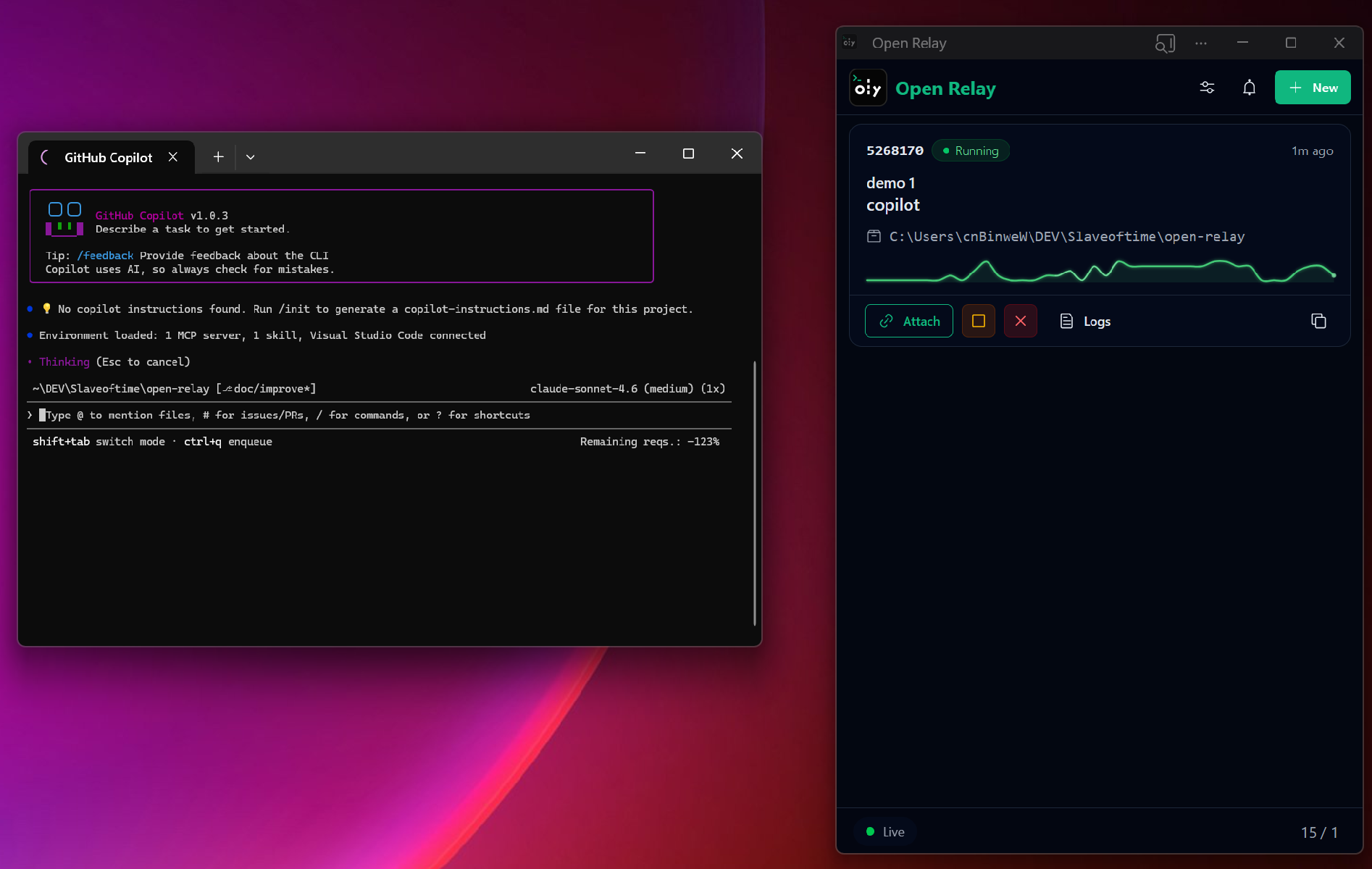
Open or download the full demo video
Run interactive CLIs and AI agents like managed services.
oly gives long-running terminal jobs a durable home.
Start a command once, detach, close your terminal, come back later, inspect logs, send input only when needed, or reattach and take over. It is built for AI agent workflows, interactive CLIs, and any session you do not want tied to one fragile terminal window.
If oly saves you time, please star the repo. That helps more people discover it.
For deep implementation details, see ARCHITECTURE.md, ARCHITECTURE_PTY.md.
Why people use oly
- Detach without losing the process. The daemon owns the session, not your terminal.
- Stop babysitting prompts. Watch logs or wait for likely input-needed checkpoints.
- Intervene surgically. Send text or keys without attaching.
- Resume with context. Reattach and replay buffered output first.
- Keep an audit trail. Session output and lifecycle events persist on disk.
- Control it from more than one place. Use the CLI, the web UI, or route work to connected nodes.
oly is not trying to replace your favorite terminal. It is a supervision layer for long-lived, interactive workloads. A simple CLI proxy.
Install
npm
npm i -g @slaveoftime/oly
Cargo
cargo install oly
Homebrew
brew tap slaveOftime/open-relay https://github.com/slaveOftime/open-relay
brew install slaveOftime/open-relay/oly
Prebuilt binaries
Download the latest release from the Releases page.
Current release artifacts are published for:
- macOS: Apple Silicon (
arm64) - Linux:
x86_64/ AMD64 - Windows:
x86_64/ AMD64
Quick start
If you only try one workflow, make it this one:
# Start the daemon.
# By default, the local web UI/API is enabled and protected by a password
# you set at startup.
oly daemon start --detach

# Launch a detached session
oly start copilot

# See what's running
oly ls

# Check recent output and optionally wait for an input-needed checkpoint
oly logs <id> --wait-for-prompt --timeout 1m

# Send input without attaching
oly send <id> "yes" key:enter

# Reattach when you want full control
oly attach <id>

# Stop the session
oly stop <id>
Useful behavior to know:
oly attach,oly logs,oly send,oly stop, andoly notifyaccept an optional session ID. If you omit it,olytargets the most recently created session.- To detach from an attached session, press
Ctrl-], thend. oly ls --jsonprints machine-readable output for scripts and agents.
What oly does well
1. Supervise agent sessions
Run coding agents, REPLs, installers, or approval-heavy workflows in the background without keeping one terminal open forever.
2. Detect likely human checkpoints
oly logs --wait-for-prompt lets you block until a session likely needs attention, then inspect the output before deciding what to do next.
3. Let humans stay in the loop
When a process needs confirmation, credentials, or a decision, you or agent can send input directly:
oly send <id> "continue" key:enter
oly send <id> key:ctrl+c
oly send <id> key:up key:enter
4. Keep a browser-accessible control plane
By default, oly daemon start -d also serves a local web UI and HTTP API on http://127.0.0.1:15443.
- Use
--portto change the port. - Use
--no-httpfor CLI-only operation. - Use
--no-authonly if you understand the risk and are protecting access elsewhere.
5. Route work to other machines
oly can connect multiple daemons together so one primary can supervise sessions on secondary nodes.
Core workflow patterns
Detached agent run
oly start --title "fix failing tests" --detach copilot
oly logs --wait-for-prompt
oly send <id> "approve" key:enter
Watch logs without attaching
oly logs <id> --tail 80
oly logs <id> --tail 80 --keep-color
oly logs <id> --tail 120 --no-truncate
Start on a connected node
oly start --node worker-1 --title "nightly task" --detach claude
oly logs --node worker-1 --wait-for-prompt <id>
Command reference
Session and daemon commands
| Command | Purpose |
|---|---|
oly daemon start [--detach] [--port <port>] [--no-auth] [--no-http] |
Start the daemon, optional local web API/UI |
oly daemon stop [--grace <seconds>] |
Stop the daemon and let sessions exit cleanly first |
oly start [--title <title>] [--detach] [--disable-notifications] [--cwd <dir>] [--node <name>] <cmd> [args...] |
Start a session |
oly ls [--search <text>] [--json] [--status <status>]... [--since <rfc3339>] [--until <rfc3339>] [--limit <n>] [--node <name>] |
List sessions |
oly attach [id] [--node <name>] |
Reattach to a session |
oly logs [id] [--tail <n>] [--keep-color] [--no-truncate] [--wait-for-prompt] [--timeout <duration>] [--node <name>] |
Read logs without attaching |
oly send [id] [chunk]... [--node <name>] |
Send text or special keys to a session |
oly stop [id] [--grace <seconds>] [--node <name>] |
Stop a session |
oly notify enable [id] [--node <name>] |
Enable notifications for a session |
oly notify disable [id] [--node <name>] |
Disable notifications for a session |
oly skill |
Print the bundled oly skill markdown |
Supported oly send key forms include named keys like key:enter, key:tab, key:esc, arrows, home/end, pgup/pgdn, del/ins, modifier forms like key:ctrl+c, key:alt+x, key:meta+enter, key:shift+tab, and raw bytes via key:hex:....
Federation commands
| Command | Purpose |
|---|---|
oly api-key add <name> |
Create an API key on the primary and print it once |
oly api-key ls |
List API key labels on the primary |
oly api-key remove <name> |
Revoke an API key on the primary |
oly join start --name <name> --key <key> <url> |
Connect this daemon to a primary |
oly join stop --name <name> |
Disconnect and remove a saved join config |
oly join ls |
List saved outbound join configs on this daemon |
oly join ls --primary |
Ask the daemon for currently active primary-side joins |
oly node ls |
List secondary nodes currently connected to the primary |
Browser access and remote supervision
oly serves its HTTP API and web UI on loopback by default:
http://127.0.0.1:15443
That default is deliberate. The safe pattern is:
browser or phone -> your auth gateway -> your tunnel -> local oly HTTP service
Examples:
- Cloudflare Access
- Tailscale / Headscale
- SSH tunnel
- your own reverse proxy with strong auth
This keeps oly small and local-first while still supporting remote intervention when you need it.
Notification hooks
If desktop notifications are not enough, you can configure a custom notification hook in config.json under OLY_STATE_DIR (or the default state directory for your OS).
{
  "notification_hook": "python C:\\scripts\\oly_notify.py {kind} {session_ids}"
}
Placeholders available in the command:
{kind}{title}/{summary}{description}{body}{navigation_url}{node}{session_ids}{trigger_rule}{trigger_detail}
The same values are also exported as OLY_EVENT_* environment variables.
Hooks are best-effort: failures are logged, but they do not block the session or notification pipeline.
State, config, and files
Default state directory:
- Windows:
%LOCALAPPDATA%\oly - Linux:
$XDG_STATE_HOME/olyor~/.local/state/oly - macOS:
~/Library/Application Support/oly
You can override it with OLY_STATE_DIR.
Inside that directory, oly stores:
- the SQLite database
- daemon logs
- session logs and metadata
- generated default
config.json - saved join configs on secondary nodes
- optional
wwwrootstatic content
Good fits for oly
- GitHub Copilot CLI, Claude Code, Gemini CLI, OpenCode, and similar agent workflows
- Long-running installs or migrations that may need approval later
- Interactive REPLs or TUIs you want to resume safely
- Background automation that still needs occasional human intervention
- Single-operator or small-team setups that want a lightweight supervision layer
Learn more
- SPEC.md for the implementation-aligned product spec
- ARCHITECTURE.md for the system overview
- ARCHITECTURE_PTY.md for PTY behavior
- ARCHITECTURE_NOTES.md for edge cases and operational notes
If you are building agent workflows and want durable, inspectable terminal sessions, oly is for you.
Reviews (0)
Sign in to leave a review.
Leave a reviewNo results found