mini-ork
Health Pass
- License — License: Apache-2.0
- Description — Repository has a description
- Active repo — Last push 0 days ago
- Community trust — 29 GitHub stars
Code Pass
- Code scan — Scanned 12 files during light audit, no dangerous patterns found
Permissions Pass
- Permissions — No dangerous permissions requested
No AI report is available for this listing yet.
Ship AI-agent artifacts, not demo theater — verifier-gated, cross-family runs that learn which model wins. TRUE recursive self-improvement: its apply loop promotes changes to its own prompts and workflows with no human approval — real measurement required, nothing reviewed first. Run on a throwaway worktree; see docs/SAFETY.md.

mini-ork
A task operating system for AI agents — one that makes them prove their work.





mini-ork turns a goal into a planned, executed, and verified run across a fleet of
different models: classify → plan → execute → verify → reflect → improve. The
verdict on every change is what the code actually did when it ran — tests, type
checks, schemas, real execution in an isolated sandbox — not a model's opinion of its
own output.
It is for teams who want an agent to do real work without treating fluent output, a
green-looking diff, or a panel of agreeing models as proof.
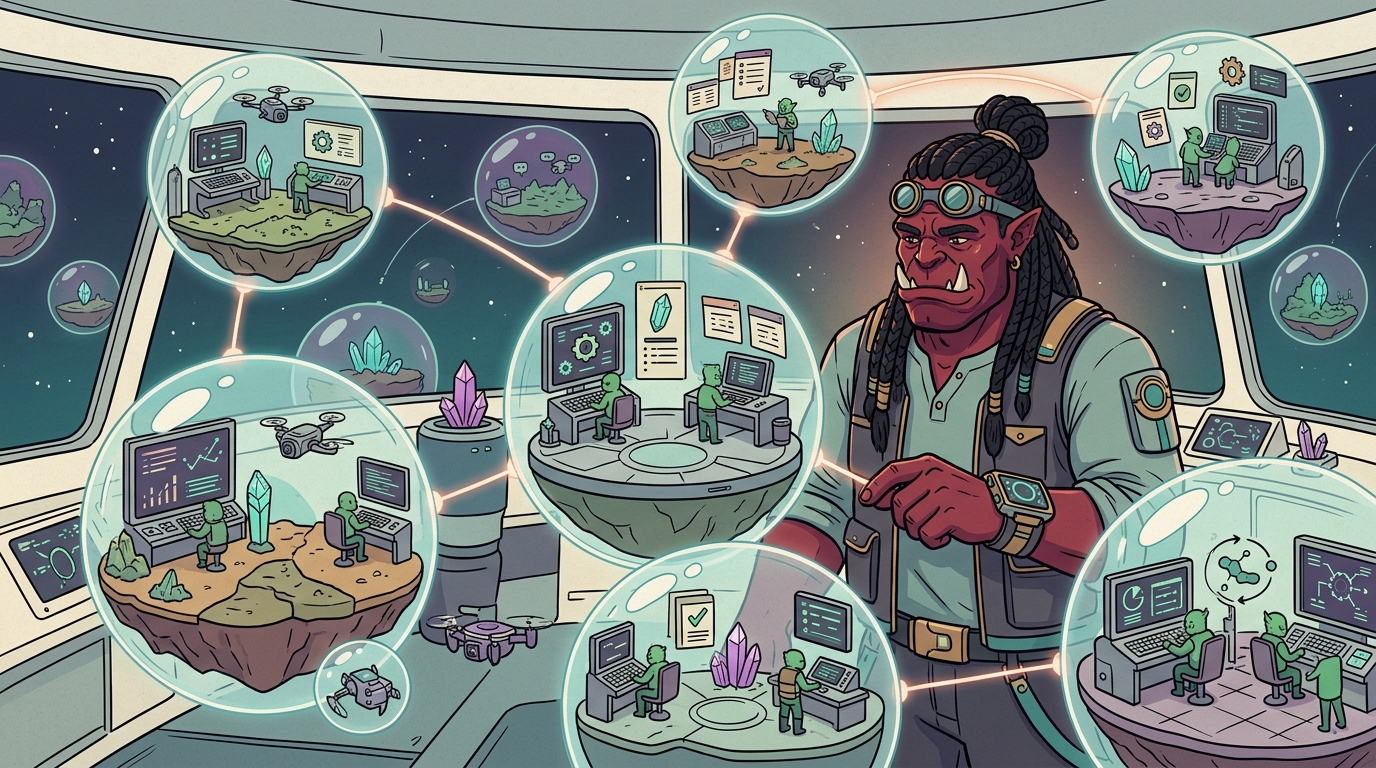
Warning: this system modifies itself, unattended
[!WARNING]
mini-ork's apply loop can rewrite its own recipe prompts, agent prompts, and workflow
nodes and edges — and promote those changes without a human approving each one. It
runs the candidate change over a held-out probe set, compares the publish rate before
and after, and promotes only on a measured improvement that does not regress a
previously-passing task. There is no "review this first" gate in that loop, and no
environment variable that puts one back.
Read that as what it is: the machine is allowed to rewrite itself while you are not
looking. The measurement is real — no promote happens without one — but a measurement
is evidence, not a guarantee. A probe set is only as strong as its probes, and the loop
cannot know what it never tested.
This is recursive self-improvement, not a metaphor for it. The human approval gate
that earlier versions had was deliberately removed, and it was removed because the
measurement gate is what does the work: there is no code path that promotes without a
real held-out measurement, and there is no flag that restores the human branch. What
protects you from a bad promote is the probe set, the per-task no-regression rule, and
your version control — not a person in the loop.
🛡️ If that is not what you want, the safe configuration is:
- 🔒 Leave
MO_APPLY_ENABLEDandMO_AUTO_APPLYunset. Both default to off, and the
unattended sweep requires both to be1. - 🧪 Run it on a throwaway worktree, never on a checkout you care about.
- 🧮 Know your caps:
MO_APPLY_PROBE_BUDGET_USDandMO_APPLY_PROBE_MAX_TASKSbound what
a single apply run can spend. - 🌿 Keep the target repository under version control.
mini-ork rollback agent <target>
restores the pre-promotion file andmini-ork rollback workflow <name>the workflow,
but your VCS is the ultimate backstop — review the promoted diffs the way you
would review a junior engineer's commit.
This is a research-grade, self-improving system under active development. A promotion
is a change that has already landed, not a proposal waiting for you. See
docs/SAFETY.md for the full posture and the gates that do hold.
🎯 Why this exists
AI agents now write code faster than any team can review it. The bottleneck moved from
generation to validation. An agent that writes its own tests and then grades itself
produces output that agrees with itself — fluent, green-looking, and wrong often enough
to break production. And the naive fix (send everything to a frontier model, run it many
times) makes the bill grow faster than the unit price falls.
mini-ork is built for the world after "make it generate": ship agent work you can
trust, at a cost you can defend, on a system that gets sharper on your codebase the more
you run it.
Why now:
- 📈 Reliability is the new bottleneck. 81% of enterprise technology leaders report an
increase in production issues linked to AI-generated code (CloudBees,
2026 State of Code Abundance Report). - 💸 Cost routing is a real lever. Routing between a strong and a weak model can cut cost
more than 2× without compromising quality
(RouteLLM, arXiv:2406.18665) — the lever mini-ork
automates, but conditioned on a verification bar rather than a guess. - 🚧 Pilots stall on the same three things. Most agent pilots don't reach production, and
the blockers are consistently evaluation, reliability, and governance — the three layers
mini-ork treats as runtime primitives instead of afterthoughts.
🧱 Three things an orchestration framework won't do for you
Wiring agents into a graph is now commodity (LangGraph, CrewAI, AutoGen). mini-ork adds
the three layers that decide whether agent work is actually shippable.
1. ✅ It verifies correctness — it doesn't just orchestrate
The source of truth for a change is its execution outcome, captured in an isolated
runtime (mini-ork's Crucible, over Prime Intellect's MIT-licensed verifiers):
- Execution-anchored reward. A change is scored on what it did — did the test run,
did the assertion pass — not on a reviewer's approval. An LLM judge may only veto a
passing result, never fabricate a passing one (reward_from_status,mini_ork/learning/writeback.py). - A real failure ≠ a broken harness. The runtime distinguishes a genuine assertion
failure (a real reproduction) from a broken test or a broken environment, so a correct
patch is never rejected because the probe had a typo. - Non-regression is certified. Candidates that would break a previously-solved,
held-out task are blocked before they ship (per-task no-regression gate,mini_ork/cli/apply.py). - A run with no meaningful check is reported as vacuous, not silently successful.
2. 💰 It governs cost across a pool of models
You don't pay frontier prices for work a cheaper model can pass:
- Heterogeneous dispatch. Bring your own providers (OpenAI/Codex, MiniMax, Kimi, GLM,
Anthropic, or any OpenAI-compatible endpoint) and route each node to a lane by role. - Cost-optimizing routing policies. Selectable strategies from
frontier_onlytocheap_onlytolearning_governed— route to the cheapest lane that still clears the
verification bar (MO_ROUTING_POLICY). - Hard cost controls. A daily-spend circuit breaker, a periodic cost-pause sentinel
an operator must approve, and a wall-clock deadline budget — so an autonomous run can't
quietly burn your account.
3. 🔁 It learns from what actually verified
Every run leaves a trail of verified outcomes, and the system feeds that signal back:
- Cost-free contextual-bandit routing adjusts which lane gets each role next time,
from real advantage — no extra model calls (mini_ork/lane_router.py). - GRPO group-relative writeback and textual-gradient prompt evolution improve the
planner / implementer / reviewer prompts across runs. - Verified-outcome memory persists only what passed the gates, so the learned
signal is clean rather than noise. A closed learn → apply loop materializes,
scores, and non-regression-gates each proposed improvement before it lands.
🧭 Where it fits
mini-ork isn't a prettier agent graph or a cheaper autonomous coder. Orchestration
frameworks wire agents together; coding products write and ship; eval tools score after
the fact. mini-ork is the open-source runtime where correctness is the primitive:
every run yields a verified outcome, that outcome routes the next run to a cheaper model,
and the signal compounds on your repository.
That combination — correctness-conditional, cost-optimizing, compounding, and
open-source — is what the framework is built around.
Honest about the edges: the execution oracle is only as strong as what you can run, so
its guarantees are richest on code with real tests and thinnest on subjective or
untestable work — where mini-ork is built to surface the uncertainty and refuse the
promote rather than manufacture confidence. (Refusing does not mean asking you: the
self-improvement loop has no approval prompt. See the warning above.)
📦 What is in the box
119 shipped capabilities across seven pillars (full code-anchored list in the
feature inventory):
| Pillar | What you get |
|---|---|
| 🧩 Orchestration core | Full run lifecycle, keyword task classifier, planner with repair-on-bad-JSON, recovery DAG, a multi-epic scheduler, and a meta-policy conductor. |
| 🔀 Heterogeneous model dispatch | BYO provider registry (5 kinds), 6 routing policies, role-aware fallback chains, per-provider throttle guards, and an owner-only secrets store. |
| 🛡️ Runtime reliability | Durable-DAG resume (resurrect a failed run at the step or turn), single-writer leases + fencing, idempotent tool receipts, and cost/deadline circuit breakers. |
| ✅ Verification & gates | An extensible gate registry (deterministic verifiers, reviewer/human/budget/scope gates), evidence-cited grounded rejections, and promotion gated on measurable evidence. |
| 🔁 Self-improvement & learning | Anti-Goodhart reward contract, cost-free bandit router, GRPO writeback, reflection pipeline, semantic long-term memory, and a closed apply loop. |
| 📊 Observability surface | A FastAPI app (127.0.0.1:7090) with an SSE live event stream, run detail + DAG overlay, a "why did this fail" aggregator, learning dashboards, and OTel/Langfuse export. |
| ⌨️ Operator & dev ergonomics | A stable CLI — init, run, validate, doctor, providers, garden, serve, recover — plus worktree-aware, file-surface-leased workflows for safe concurrent agents. |
🚀 Start here
make install installs the supported local runtime: required OS tools, a checkout-local.venv, the .[full] Python profile (CLI, local web sidecar, and Crucible), and the
per-user mini-ork command. Dry runs do not call a model provider. Real runs
additionally need the provider CLIs or provider configuration selected by your lanes.
# Get mini-ork and install the full runtime (macOS, Linux, or WSL).
git clone https://github.com/SourceShift/mini-ork.git
cd mini-ork
make install

# Open a new terminal if the installer changed PATH, then confirm it uses .venv.
mini-ork version
On native Windows PowerShell, install the OS prerequisites with winget first
(Python.Python.3.11, Git.Git, jqlang.jq, MikeFarah.yq, and SQLite.SQLite), then
run this from the checkout:
py -3 .\scripts\full_install.py
mini-ork version
make install is safe to re-run after an upgrade. It reuses .venv, updates the
editable package, repairs the managed command, and verifies the OS tools. UseINSTALL_SYSTEM_DEPS=0 only when those tools are already managed outside mini-ork. Use
mini-ork install --help to see --bin-dir, --no-path, --force, and
--dry-run for the command-only installer.
🧪 Your first verifier-backed workflow
Start in a real Git repository. Keeping the mini-ork checkout path lets you copy its
example into the project you want to work on.
# In the mini-ork checkout, remember its location before leaving it.
MINIORK_SOURCE="$PWD"

# Make a small project to try it on.
mkdir -p ~/miniork-demo && cd ~/miniork-demo
git init
mini-ork init

# A kickoff states the goal, scope, artifact, and verification expectation.
cp "$MINIORK_SOURCE/examples/01-hello-world/kickoff.md" ./kickoff.md

# First run locally and without provider calls.
MINI_ORK_DRY_RUN=1 mini-ork run code-fix ./kickoff.md

# Confirm the project and recipe are wired before spending tokens.
mini-ork validate
After the dry run, inspect .mini-ork/runs/ for run artifacts and .mini-ork/state.db
for recorded state. For a real run, review .mini-ork/config/agents.yaml, authenticate
the CLI or configure the providers it names, then run the same command withoutMINI_ORK_DRY_RUN=1:
mini-ork run code-fix ./kickoff.md
🛠️ Use mini-ork well
- ✍️ Write a verifiable kickoff. State the target repository, allowed files, intended
artifact, and the command or rule that proves success. - 🧪 Dry-run every new recipe or environment first. It checks the lifecycle and
artifact paths without model calls; it does not prove the eventual change is correct. - 🎯 Give an agent an oracle when you can. Prefer an existing test, typecheck, schema,
fixture, or observable acceptance criterion over an LLM-only score. - 🔍 Use multiple lenses deliberately. Heterogeneous review is useful for discovery and
diagnosis; it does not replace deterministic verification. - 👀 Read the evidence before promotion. mini-ork retains traces and can learn from
runs, but automatic promotion is intentionally restricted to classes with measurable
external evidence. Note that this is the only thing standing between a learned
directive and your recipe files — there is no human approval step to catch a bad
promote.
🧰 Pick a starting recipe
| Need | Start with |
|---|---|
| 🩹 A focused patch with checks | code-fix |
| 📝 A documentation change | docs |
| 🔎 A multi-perspective codebase audit | refactor-audit or bug-audit-cmgk |
| 🔬 A literature or research brief | research-synthesis |
| ♻️ Self-improvement of this repository | recursive-self-improve (see below) |
| 🧩 A new workflow shape | Copy a recipe and follow the extension guide |
Recipes live in recipes/. To create one, define a task class, workflow,
artifact contract, prompts, and verifiers; see the extension guide.
♻️ Recursive self-improvement: two loops
mini-ork improves itself through two loops that are easy to conflate, yet their blast
radii are nothing alike. The warning
at the top of this file is about the second one. Know which one you are starting.
🔬 The self-improvement loop — bounded, branch-isolated, dry-runnable
mini-ork self-improve (bin/mini-ork-self-improve) is a wall-clock-budgeted outer
loop that runs the recursive-self-improve recipe
against the mini-ork checkout. One iteration scans the repo, the run database, and
benchmark deltas for bottlenecks, runs three heterogeneous-family research lenses plus
an arXiv research lane (MiniMax / Kimi / Codex — low-correlation voters, not three
prompts on one model), asks Opus to synthesize a ranked patch plan, has a cheaper lane
implement the top patch, and gates the result.
The gate is four layers, not one: three deterministic verifiers — bottlenecks-found,self-tests-pass (runs mini-ork's own pytest suite in a hermetic sandbox, so the verdict
reflects the patch and not the machine around it), and no-regression — plus an Opus
patch critic, so a diff that passes pytest but is off-plan, gamed, or a no-op is still
caught. The runner, not the implementer, is the only thing that calls git commit,
and only once the gates pass. Every iteration lands on its ownself-improve/iter-<N>-<ts> branch in a fresh worktree under $MINI_ORK_HOME/worktrees/.
Nothing reaches the branch you are on unless you pass --auto-merge.
# Prove the wiring with no model calls. Start here.
bin/mini-ork-self-improve --dry-run --max-iters 1

# A real session: 3h soft cap, 5h hard cap; branches left for you to review.
bin/mini-ork-self-improve --soft-cap-hours 3 --hard-cap-hours 5

# Resume after Ctrl-C — picks the last iteration back out of MINI_ORK_DB.
bin/mini-ork-self-improve --resume --soft-cap-hours 3 --hard-cap-hours 5
--soft-cap-hours finishes the iteration in flight then stops; --hard-cap-hours kills
mid-iteration. Caps are also enforced in dollars (MO_DAILY_BUDGET_USD, plus per-iter
and per-epic budgets in config/agents.recursive-self-improve.yaml), and a pre-iteration
cost check (MINI_ORK_PRE_ITER_COST_CHECK=1, the default) refuses to start a new
iteration once the daily cap is hit. Override lanes by copyingconfig/agents.recursive-self-improve.yaml to $MINI_ORK_HOME/config/agents.yaml.
⚙️ The apply loop — unattended, and the one to be careful with
mini-ork apply closes learn → apply for prompt and workflow changes: it picks the
highest-confidence proposed change, materializes it as a workflow candidate, scores it on
a frozen held-out probe set, applies a per-task non-regression gate, and then either
rewrites the target file or quarantines it with a reason. Quarantine is the gate doing its
job, not an error — the command exits 0 either way.
Only the probe scorer can promote. mock and gepa are deterministic placeholders
that fabricate a utility and never promote; they exist for tests. With no measurement
there is no promote.
Probe sets live at recipes/<recipe>/probes/*.md — code-fix and obs-smoke ship them
today, so those are the task classes you can build on. You also need an initialized
project (pattern_records is created by mini-ork init), because a run against a bare
home has nothing to pick from.
mini-ork init                      # once, in the project you are improving
mini-ork apply --task-class code-fix \
  --target recipes/code-fix/prompts/implementer.md --dry-run
Both flags that make this dangerous are off by default:
MO_APPLY_ENABLED=1— the master gate. Without it a candidate is prepared but the
file write and version registration are skipped.apply --enablesets it for one call.MO_AUTO_APPLY=1— the unattended sweep inside a run. The sweep fires only when
both this andMO_APPLY_ENABLEDare1; there is no code path that promotes on
one alone.MO_APPLY_DRY_RUN=1— score and decide, write nothing.MO_APPLY_PROBE_MAX_TASKS(default 2) andMO_APPLY_PROBE_BUDGET_USD(default 2.0) —
the spend ceiling for a single probe evaluation.
Because that sweep has no approval prompt, the rollbacks are yours to know:mini-ork rollback agent <name> restores the pre-promotion prompt file andmini-ork rollback workflow <name> the workflow; your VCS is the backstop. Both read
the version registry straight out of MINI_ORK_DB, which nothing sets for you — export it
first, or the command exits on MINI_ORK_DB unset:
export MINI_ORK_DB="$MINI_ORK_HOME/state.db"
mini-ork rollback agent <name>
See docs/SAFETY.md for quarantine semantics.
✍️ The manual loop that surrounds both
Between the two, the same primitives are drivable by hand — propose, score, decide:
mini-ork improve --dry-run                     # show what it would propose, spend nothing
mini-ork improve --task-class code-fix --limit 3
mini-ork eval    --candidate <id>              # run the benchmark suite against a candidate
mini-ork promote --candidate <id> --dry-run    # compute the gate decision, write nothing
🗄️ Where the state lives
Everything above writes to $MINI_ORK_DB (default $MINI_ORK_HOME/state.db):
sqlite3 .mini-ork/state.db "SELECT iter, outcome, notes FROM self_improve_runs ORDER BY iter;"
sqlite3 .mini-ork/state.db "SELECT iter, rank, category, title, outcome, severity, confidence FROM learning_record ORDER BY iter, rank;"
sqlite3 .mini-ork/state.db "SELECT decision, COUNT(*) FROM apply_attempts GROUP BY decision;"
learning_record carries the per-bottleneck trail — a bottleneck is written open when
the scanner finds it, resolved when an iteration commits a fix for it, and superseded
once a later successful iteration lands over a deferred one. apply_attempts records
every apply decision, including each quarantine and the reason, so a directive that failed
a gate is never re-proposed.
⚖️ Honesty by design
mini-ork does not claim a universal oracle. Where there is no trustworthy external
check — a subjective product decision, untestable code — it surfaces the uncertainty
rather than manufacturing confidence. That discipline is wired in, not aspirational:
- 🫥 A run whose verification is absent or meaningless is reported as vacuous.
- 📉 The dispatch and learning surfaces refuse to invent a number below their evidence
threshold (Wilson-CI honesty:<5samples returnsevidence: "none"). - 🧾 Every gate rejection cites the evidence trace it was based on, so a "no" is auditable.
- 🚫 The promotion gate has no human branch. "Not promotable" is a recorded verdict with a
reason attached, never a request sent to a person — the loop has nobody to ask, and it
does not pretend otherwise.
📚 Learn more
Embedding mini-ork in your own app? The Python SDK covers both
the importable primitives (verification, dispatch, memory, routing) and the MiniOrk
orchestrator client.
Read the architecture, operator guide,
safety model, and feature inventory
when you need the detailed contracts.
🗺️ Roadmap
The near-term work is operational trust: truthful dispatch telemetry, error and
finish-reason taxonomy, heartbeat/failure handling, capability-aware routing, cost
accuracy, and operator intervention policies. See the full roadmap.
The next research track is verifier-led escalation: use failure analysis to build a
library of recovery behaviors, then learn a routing policy that chooses among a cheap
tool call, more planning, a stronger model, or a user interruption — with the learning
signal being verified progress at decision checkpoints, balanced against compute,
latency, and the user's interruption budget. (A proposal, not yet a shipped capability.)
🤝 Contributing and status
mini-ork is Apache-2.0 licensed and early. Use a dedicated worktree for framework
changes, keep a verifier with every behavior claim, and run the focused checks for the
surface you change. The contribution workflow and quality gates are in
AGENTS.md; project direction lives in GOVERNANCE.md.
Reviews (0)
Sign in to leave a review.
Leave a reviewNo results found