imi
Health Warn
- License — License: MIT
- Description — Repository has a description
- Active repo — Last push 0 days ago
- Low visibility — Only 7 GitHub stars
Code Pass
- Code scan — Scanned 12 files during light audit, no dangerous patterns found
Permissions Pass
- Permissions — No dangerous permissions requested
No AI report is available for this listing yet.
Open-source knowledge engine: ingest anything, grow a knowledge graph, query it over MCP
imi
Turn everything your team says and writes into a knowledge graph your AI agents can query.


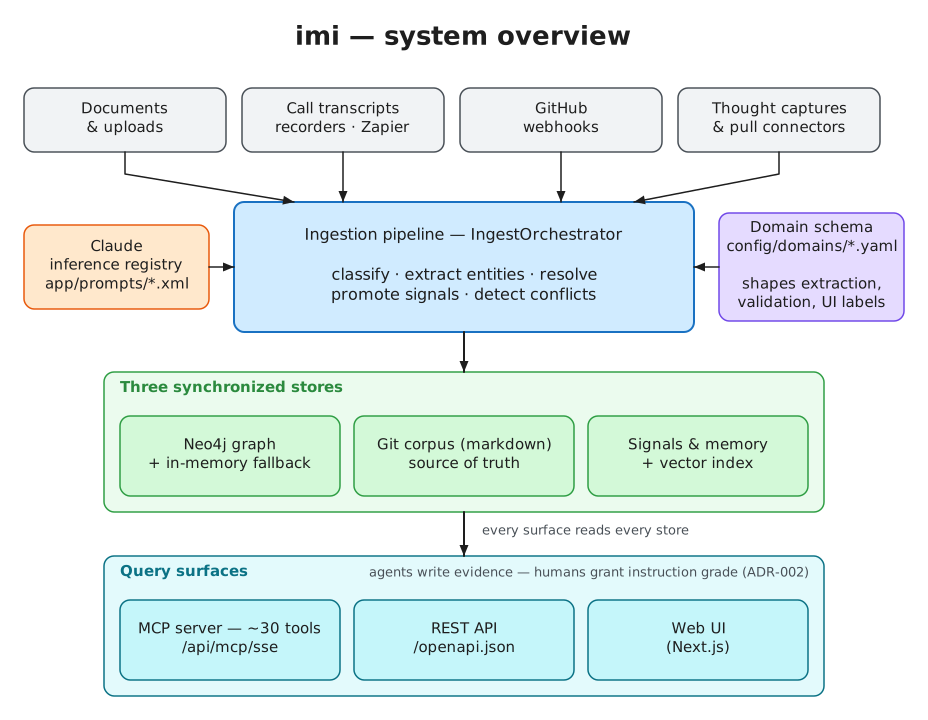
imi is a self-hosted knowledge engine. Feed it documents, call transcripts, and commits — it
classifies them with Claude, extracts entities, decisions, and action items into a Neo4j
knowledge graph, and serves the result to humans (web UI) and AI agents (MCP) in real time.
What it does
- Ingest anything — direct upload, Zapier, GitHub webhooks, or drop in a call transcript
from any recorder (Otter, Fathom, Grain, Fireflies, Zoom). - Classify + extract — Claude classifies content, extracts entities and relationships, and
enriches them with domain-aware context. - Knowledge graph — every entity, signal, decision, and action item lands in a Neo4j graph
(with an in-memory fallback) and a git-backed markdown corpus. Files are the source of truth. - Governed memory — observations are promoted into typed signals with a trust/authority
axis and a full audit trail. Agents write evidence; only humans grant instruction grade
(ADR-002). - MCP server — ~30 tools over the Model Context Protocol, so Claude Code, Claude Desktop,
Cursor, or any MCP client can search, recall, and write back to your knowledge base. - Domain-agnostic — one YAML schema defines your entity types, extraction steering, and UI
labels. Six ready-made domains ship inconfig/domains/; write your own to fit your business.
1 · Install
Docker-only — no local Python or Node needed.
docker --version           # Docker 24+
docker compose version     # Compose v2 — note the space: `docker compose`, not `docker-compose`
You also need an Anthropic API key, ~2 GB free RAM, and free
host ports 8080 (app), 7474 / 7687 (Neo4j).
# 1. Clone
git clone https://github.com/sufficiently-advanced-ai/imi.git
cd imi

# 2. Configure — two required values, everything else has working defaults
cp .env.example .env
#   ANTHROPIC_API_KEY=sk-ant-...
#   NEO4J_PASSWORD=<choose-any-password>

# 3. Build and start (first run pulls images and builds the frontend — allow 5–12 minutes)
docker compose up -d --build
Verify it's up. The app waits for Neo4j's healthcheck, so startup is not instant — poll
rather than assume:
docker compose ps                                      # both containers -> "healthy"
curl -fsS http://localhost:8080/health && echo " OK"   # 200 = up; connection error = still booting
The web UI is at http://localhost:8080. Step-by-step setup with verification after every step:
Onboarding guide. Setting up with Claude Code? The
bundled imi-onboarding skill (.claude/skills/imi-onboarding/) walks an agent through the
whole install.
2 · Configure
The one decision that matters on day one is your domain — the YAML schema that shapes what
entity types exist, what extraction looks for, and what the UI calls things:
ACTIVE_DOMAIN |
Built around |
|---|---|
consulting_firm (default) |
accounts, projects, people, teams |
b2b_saas |
accounts, projects, people |
agency |
clients, campaigns, deliverables |
solo_consulting |
clients, engagements, stakeholders |
member_network |
members, groups, events |
personal_crm |
contacts, companies, activities |
Pick the closest and set it in .env — switching later is an env change + restart. When none
fit, the domain schema guide walks through writing your
own, and the domain-config-advisor skill can draft one from a description of your business.
Everything else — models, vector backend, auth, git corpus, telemetry — is covered in the
configuration reference. The knobs most people touch:
| Variable | Default | Description |
|---|---|---|
ANTHROPIC_API_KEY |
required | Claude auth; nothing extracts without it |
NEO4J_PASSWORD |
required | Neo4j password (applied on first init of the data volume) |
ACTIVE_DOMAIN |
consulting_firm |
which domain schema shapes the instance |
AUTH_MODE |
none |
none (open) or demo (cookie login) — bind to loopback or proxy before exposing |
VECTOR_BACKEND |
sqlite |
semantic-memory store: sqlite (persistent) or pgvector |
GIT_REPO_URL |
— | GitHub repo to back the knowledge corpus (setup guide) |
3 · Test it
Ingest something and watch the pipeline run:
curl -X POST http://localhost:8080/api/ingest \
  -H "Content-Type: application/json" \
  -d '{
    "content": "Meeting with Jordan Chen from Acme Corp. Decided to move the rollout to Q3. Casey will draft the migration plan by Friday.",
    "title": "Acme sync",
    "source_id": "first-test-1",
    "participants": ["Jordan Chen", "Casey Park"]
  }'
The response is a 202 with a job_id. Check what happened:
curl -s http://localhost:8080/api/ingest/<job_id>/status   # status: "completed"
curl -s http://localhost:8080/api/ingest/<job_id>/delta    # human-readable "what changed" report
You should see entities (Jordan Chen, Casey Park, Acme Corp), a decision signal ("rollout to
Q3"), and an action_item (Casey's plan) — in the delta report, at
http://localhost:8080/explorer, or via curl -s http://localhost:8080/api/signals/feed.
Always send a stable
source_id— it's the idempotency key. Re-posting the same one updates
instead of duplicating.
For a full end-to-end check (build, boot, import sweep, real ingestion):
./scripts/smoke_test.sh            # both phases; pipeline phase needs ANTHROPIC_API_KEY
./scripts/smoke_test.sh --quick    # import sweep only, no API key required
4 · Use it
The day-to-day rhythm is feed it → review what it learned → query it. The full guide is
Day-to-day usage; the short version:
Connect your AI tools over MCP. Copy .mcp.json.example to .mcp.json (or add the
equivalent to Claude Desktop / Cursor):
{ "mcpServers": { "imi": { "type": "sse", "url": "http://localhost:8080/api/mcp/sse" } } }
Your agent can now call ask_kb, search_knowledge_graph, memory_recall,add_call_transcript, and ~30 other tools — catalog in
MCP & API, agent etiquette in the
agent operating guide.
Wire up real inputs:
- Call recorders — point a Zapier zap (or the recorder's webhook) at
POST /api/ingest/zapier - A git knowledge repo — back the corpus with a GitHub repo for offsite history and human edits (setup guide)
- Ad-hoc thoughts —
POST /api/capturesor thecapture_thoughtMCP tool
Review and govern. The Overview page surfaces what needs review; confirming a signal is
what promotes it from evidence to instruction — the grade agents are allowed to treat as
policy. The Decisions page tracks every decision's lifecycle (active, stale, superseded,conflicting) so you always know what the current ruling is.
Documentation
The full suite — with reading paths for operators, developers, and AI agents — starts atdocs/README.md. Highlights:
| You want to… | Read |
|---|---|
| Set up an instance, step by verified step | Onboarding |
| See every configuration knob | Configuration reference |
| Back the corpus with a GitHub repo | Git corpus guide |
| Run it day to day | Day-to-day usage |
| Understand how the machine works | System overview + the architecture docs |
| Customize it — config to code | Customization map |
| Fit the schema to your business | Domain schemas |
| Operate it as an AI agent | Agent operating guide |
| Change the source code | CLAUDE.md / AGENTS.md |
Design records live in docs/adr/ (architecture decisions),docs/prd/ (the memory-governance and decision-state systems), anddocs/world-model-concept.md (the concept behind the graph).
Troubleshooting
| Symptom | Cause & fix |
|---|---|
imi-neo4j stays unhealthy, imi-app never starts |
Neo4j applies NEO4J_PASSWORD only on the first init of its data volume. Reset: docker compose down -v && docker compose up -d --build (wipes data). |
curl .../health connection refused |
Build/boot still in progress (first build is 5–12 min). Watch docker compose logs -f app for Application startup complete. |
Port already in use (8080/7474/7687) |
Free the port, or change PORT in .env (app); Neo4j ports live in docker-compose.yml. |
Ingest job returns "status": "failed" |
Check docker compose logs app; a missing or invalid ANTHROPIC_API_KEY is the most common cause. |
| Startup crash mentioning domain/validation | Malformed domain YAML — schema errors fail fast at boot by design; the error names the field. |
| Semantic search / memory recall returns nothing | The vector index is empty (backend switch, or records from before one). Rebuild once: curl -X POST localhost:8080/api/admin/backfill-memory-index. |
More in the onboarding guide's troubleshooting section.
Contributing
Issues and PRs welcome — CONTRIBUTING.md covers the dev environment, test
suites, and the extraction-quality evals. Design decisions are recorded indocs/adr/.
License
MIT — see LICENSE. Dependencies are overwhelmingly permissively licensed
(MIT/BSD/Apache-2.0/ISC), with a few weak-copyleft libraries used unmodified: the backend
uses PyGithub (LGPL-3.0), the frontend bundles
libvips native binaries via sharp (LGPL-3.0), and some
build tooling is MPL-2.0. None of these conflict with MIT distribution, but include their
license texts if you redistribute built images.
Reviews (0)
Sign in to leave a review.
Leave a reviewNo results found