swarmpit
Health Pass
- License — License: EPL-1.0
- Description — Repository has a description
- Active repo — Last push 0 days ago
- Community trust — 3423 GitHub stars
Code Pass
- Code scan — Scanned 12 files during light audit, no dangerous patterns found
Permissions Pass
- Permissions — No dangerous permissions requested
This tool provides a lightweight, mobile-friendly web interface for managing Docker Swarm clusters. It allows users to easily handle stacks, services, networks, and secrets while seamlessly integrating with Docker Hub or custom private registries.
Security Assessment
Overall Risk: Medium. The application requires mounting the Docker socket (`/var/run/docker.sock`), which grants it extensive root-level access to your host system's container orchestration. Because it is a self-hosted web UI managing infrastructure, it inherently executes Docker commands and interacts with the local network. The automated code scan checked 12 files and found no dangerous code patterns or hardcoded secrets, and the tool requests no special host permissions outside of standard Docker access.
Quality Assessment
The project demonstrates excellent health and high community trust. It is very actively maintained, with its most recent code push occurring today. The repository has garnered over 3,400 GitHub stars, indicating widespread adoption and community confidence. Furthermore, it operates under the EPL-1.0 license, which is a standard, OSI-approved open-source license.
Verdict
Safe to use, provided you understand the inherent security implications of granting a self-hosted container management tool direct access to your Docker socket.
Lightweight AI-friendly Docker Swarm management UI

Lightweight mobile-friendly Docker Swarm management UI






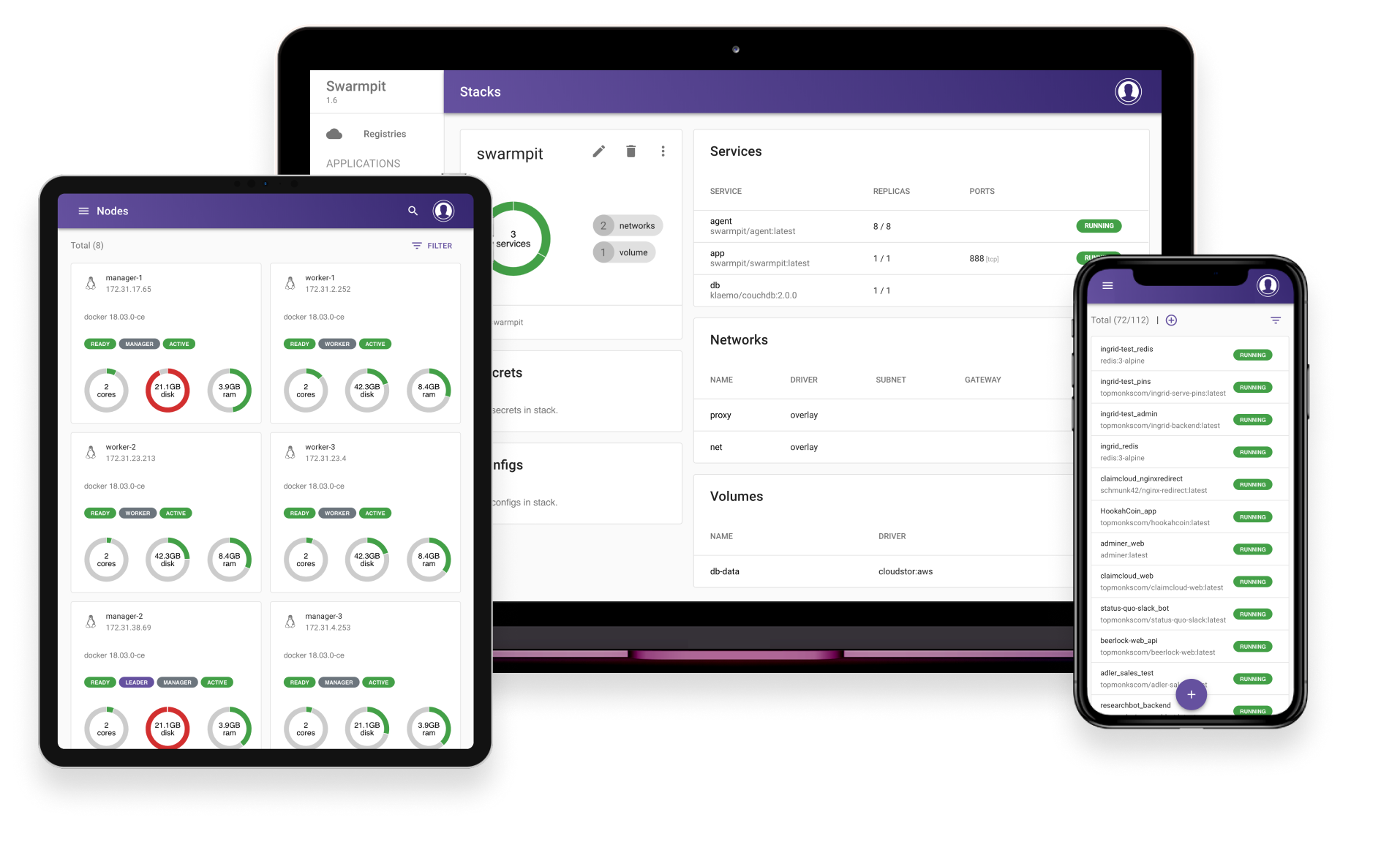
Swarmpit provides simple and easy to use interface for your Docker Swarm cluster. You can manage your stacks, services, secrets, volumes, networks etc. After linking your Docker Hub account or custom registry, private repositories can be easily deployed on Swarm. Best of all, you can share this management console securely with your whole team.
Swarmpit doesn't compromise your privacy as it is completely self-hosted and will never gather any metrics or other data from you.
More details about future and past releases can be found in ROADMAP.md

Installation
The only dependency for Swarmpit deployment is Docker with Swarm initialized, we are supporting Docker 1.13 and newer. Linux hosts on x86 and ARM architectures are supported as well.
Package installer
Installer is your guide to setup Swarmpit platform. For more details see the installer
Stable version
Deploy our current milestone version
docker run -it --rm \
  --name swarmpit-installer \
  --volume /var/run/docker.sock:/var/run/docker.sock \
  swarmpit/install:1.9
Edge version
Deploy latest version for the brave and true
docker run -it --rm \
  --name swarmpit-installer \
  --volume /var/run/docker.sock:/var/run/docker.sock \
  swarmpit/install:edge
Manual installation
Deploy Swarmpit by using a compose file from our git repo with branch of corresponding version.
git clone https://github.com/swarmpit/swarmpit -b master
docker stack deploy -c swarmpit/docker-compose.yml swarmpit
For ARM based cluster use custom compose file.
git clone https://github.com/swarmpit/swarmpit -b master
docker stack deploy -c swarmpit/docker-compose.arm.yml swarmpit
This stack is a composition of 4 services:
- app - Swarmpit
- agent - Swarmpit agent
- db - CouchDB (Application data)
- influxdb - InfluxDB (Cluster statistics)
Feel free to edit the stackfile to change an application port and we strongly recommend to specify following volumes:
- db-data
- influxdb-data
to shared-volume driver type of your choice. Alternatively, you can link db service to the specific node by using constraint.
Swarmpit is published on port 888 by default.
Environment Variables
Refer to following document
User Configuration
By default Swarmpit offers you to configure first user using web interface. If you want to automate this process, you can use docker config to provide users.yaml file.
Refer to following document for details.
User Types
Refer to following document
Development
Swarmpit is written purely in Clojure and utilizes React on front-end. CouchDB is used to persist application data & InfluxDB for cluster statistics.
Everything about building, issue reporting and setting up development environment can be found in CONTRIBUTING.md
Demo

Deploys Swarmpit to play-with-docker sandbox. Please wait few moments till application is up and running before accessing
port 888. Initialization might take a few seconds.
Contributors
Code Contributors
This project exists thanks to all the people who contribute. [Contribute].
Financial Contributors
Become a financial contributor and help us sustain our community. [Contribute]
Individuals

Organizations
Support this project with your organization. Your logo will show up here with a link to your website. [Contribute]





Reviews (0)
Sign in to leave a review.
Leave a reviewNo results found