engram
Health Pass
- License — License: MIT
- Description — Repository has a description
- Active repo — Last push 0 days ago
- Community trust — 11 GitHub stars
Code Pass
- Code scan — Scanned 12 files during light audit, no dangerous patterns found
Permissions Pass
- Permissions — No dangerous permissions requested
No AI report is available for this listing yet.
Engram Alpha - Inspectable graph memory for AI coding assistants
Engram Alpha





Inspectable long-term project memory for AI coding assistants. Local-first, user-owned, graph-first.
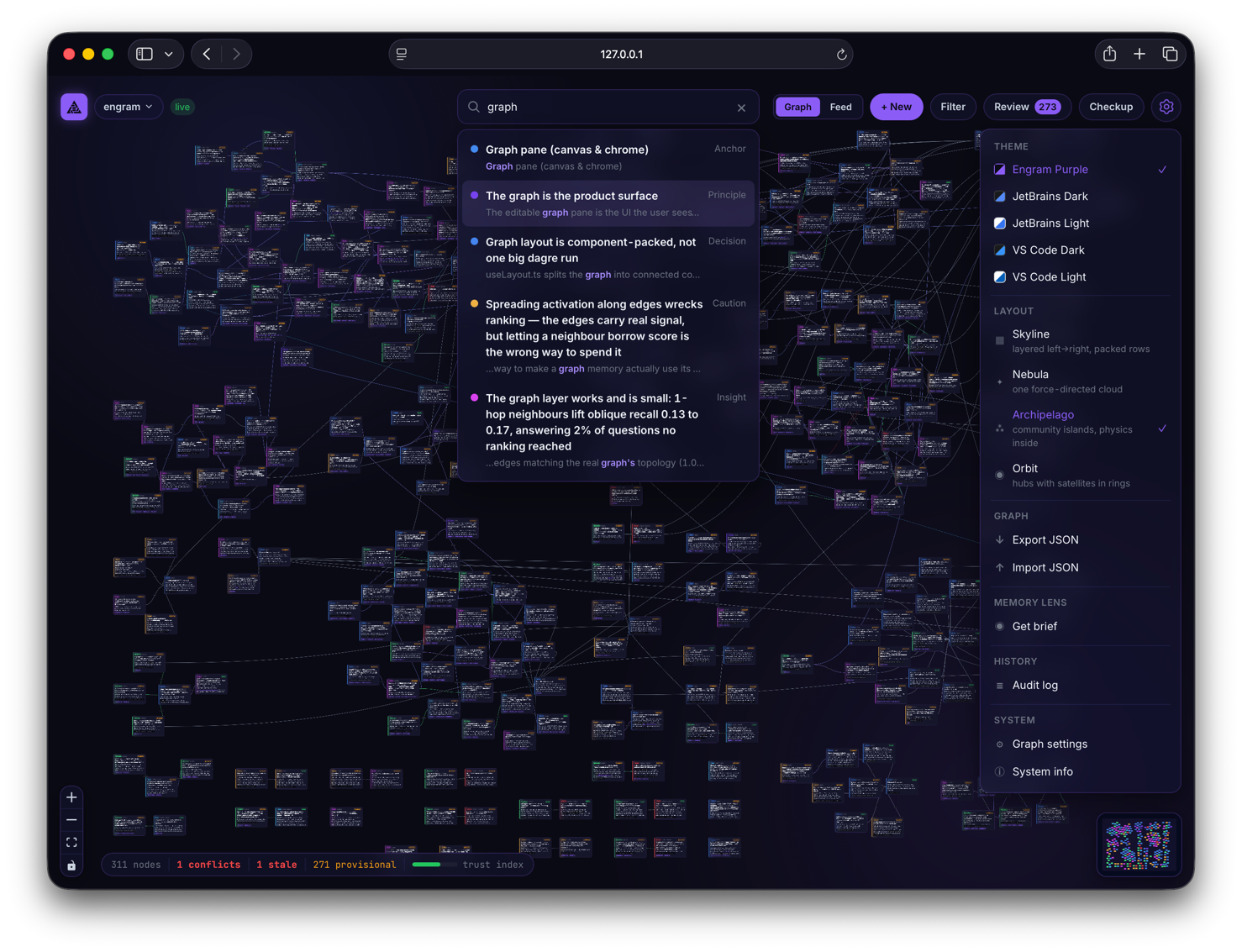
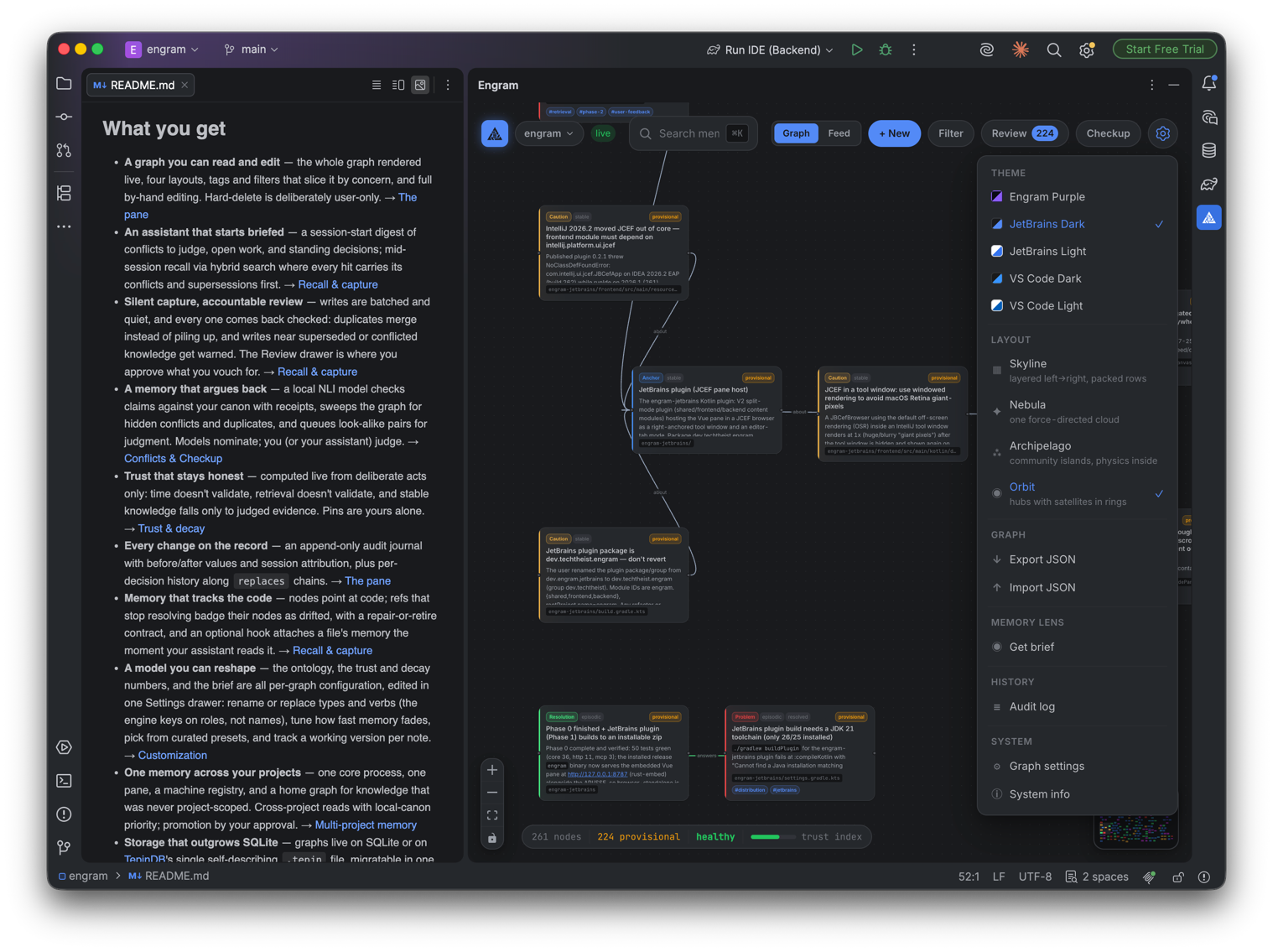
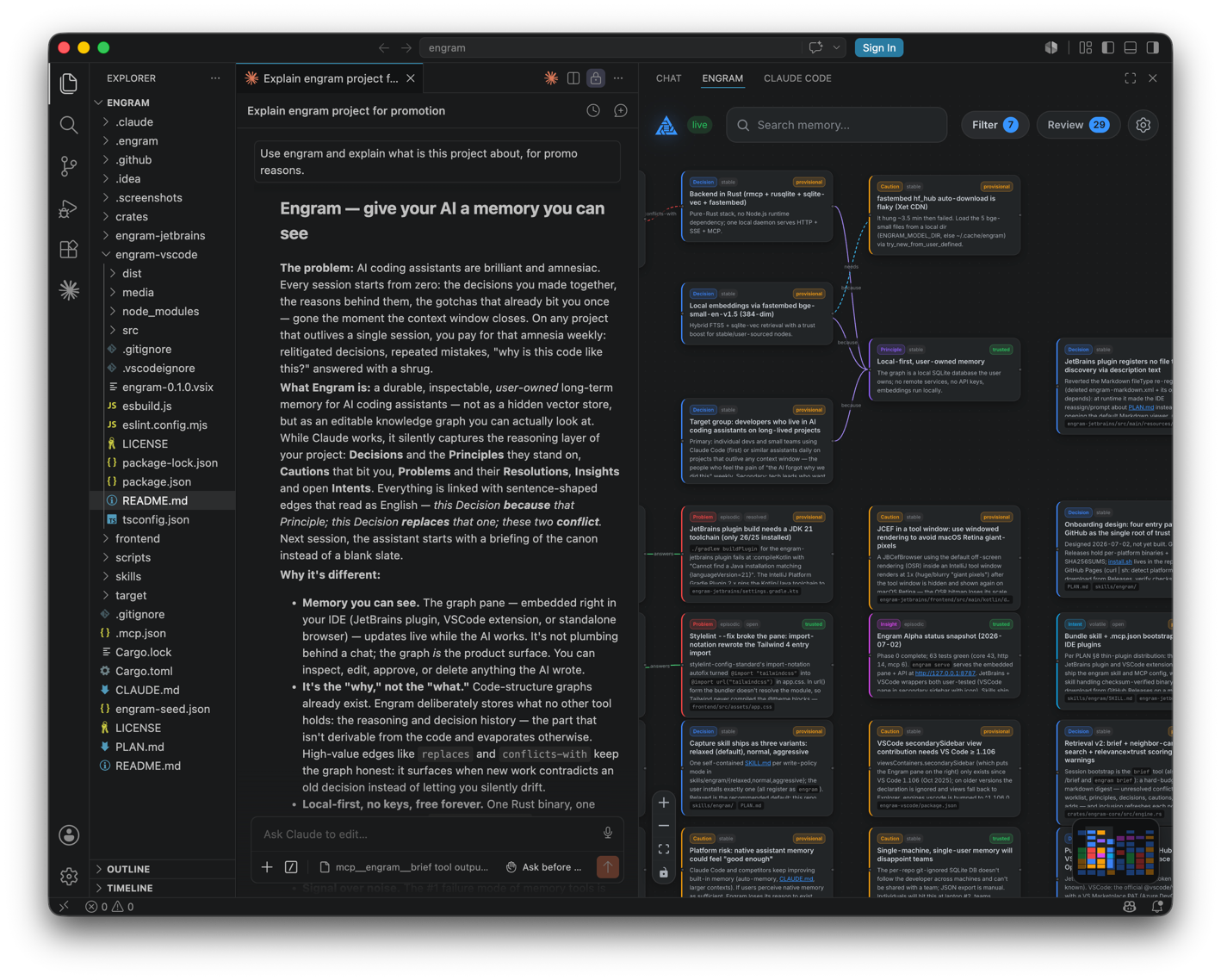
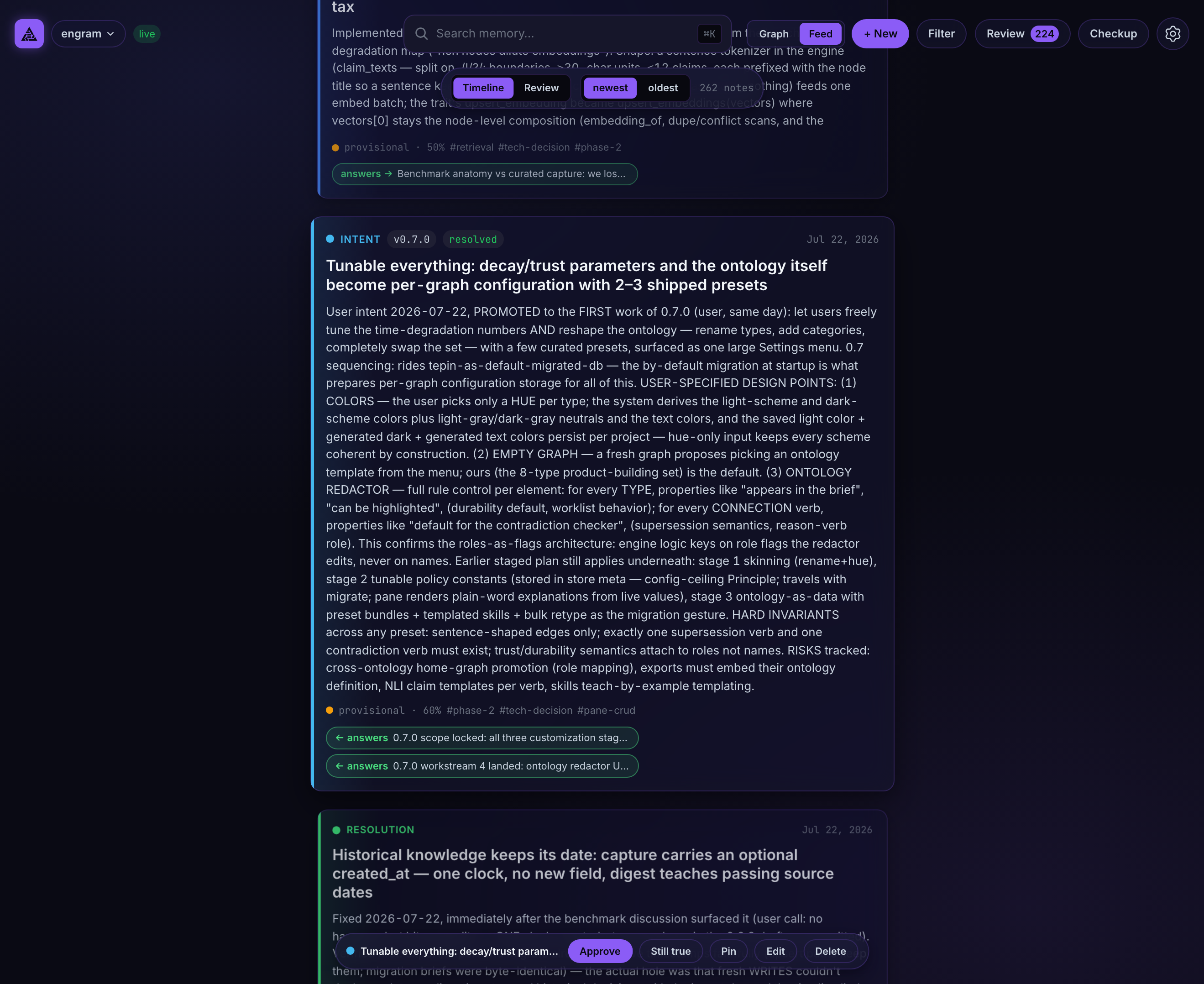
Unlike a flat note pile, Engram's graph is active: superseded knowledge is
archived behind a replaces edge instead of silently contradicting the new
canon, look-alike claims get flagged and judged, contradictions become
visible conflicts-with edges, and trust fades on scratch that never gets
re-confirmed — while stable decisions hold their trust until contradicting
evidence lands, and anything you pin never fades at all. The payoff shows up
the second time something goes wrong: when your assistant meets a problem it
has fought before, the graph already holds the Problem, the
Resolution that answered it, and the Caution that would have
prevented it.
- Local-first — your memory is a file inside your repo. Embeddings and
every scan run on your machine: no cloud, no keys, fully offline. Portable
via JSON export/import, not a binary blob. - Portable across agents — one local backend serves Claude Code, Codex
(CLI and desktop app), Gemini CLI, OpenCode, Kilo, and Google Antigravity
over MCP, plus a browser UI. Your agents share one memory: a decision
captured by Claude is recalled by Codex. - Graph-first — the graph is the product surface, not hidden plumbing.
Reviewing, judging, and repairing memory all happen in the pane.
Every screenshot on this page is Engram's own graph — the project is built by
dogfooding it.
Install
From your project's root:
curl -fsSL https://raw.githubusercontent.com/techtheist/engram/main/install.sh | sh
Then engram-alpha serve and open http://127.0.0.1:8787 — or use the
JetBrains plugin / VS
Code extension instead of the browser. Claude Code users can install
everything as a plugin: /plugin marketplace add techtheist/engram. Windows,
per-assistant wiring, and updating: Getting started.
What you get
- A graph you can read and edit — the whole graph rendered live, four
layouts, tags and filters that slice it by concern, and full by-hand
editing. Hard-delete is deliberately user-only. → The pane - A timeline you can scroll — the second screen renders the same memory
as a vertical feed: the project's story in order with version markers, a
review lens for what needs an eye, edge-hopping with a back-trail, and
judgment actions right on the centered card. → The pane - An assistant that starts briefed — a session-start digest of conflicts
to judge, open work, and standing decisions; mid-session recall via hybrid
search where every hit carries its conflicts and supersessions first.
→ Recall & capture - Silent capture, accountable review — writes are batched and quiet, and
every one comes back checked: duplicates merge instead of piling up, and
writes near superseded or conflicted knowledge get warned. The Review
drawer is where you approve what you vouch for.
→ Recall & capture - A memory that argues back — a local NLI model checks claims against
your canon with receipts, sweeps the graph for hidden conflicts and
duplicates, and queues look-alike pairs for judgment. Models nominate;
you (or your assistant) judge. → Conflicts & Checkup - Trust that stays honest — computed live from deliberate acts only:
time doesn't validate, retrieval doesn't validate, and stable knowledge
falls only to judged evidence. Pins are yours alone.
→ Trust & decay - Every change on the record — an append-only audit journal with
before/after values and session attribution, plus per-decision history
alongreplaceschains. → The pane - Memory that tracks the code — nodes point at code; refs that stop
resolving badge their nodes as drifted, with a repair-or-retire contract,
and an optional hook attaches a file's memory the moment your assistant
reads it. → Recall & capture - A model you can reshape — the ontology, the trust and decay numbers,
and the brief are all per-graph configuration, edited in one Settings
drawer: rename or replace types and verbs (the engine keys on roles, not
names), tune how fast memory fades, pick from curated presets, and track a
working version per note. → Customization - One memory across your projects — one core process, one pane, a
machine registry, and a home graph for knowledge that was never
project-scoped. Cross-project reads with local-canon priority; promotion
by your approval. → Multi-project memory - Storage that outgrows SQLite — graphs live on SQLite or on
TepinDB's single self-describing.tepinfile, migratable in one command with the audit journal intact —
and inspectable withnpx tepindbeven while Engram is running.
→ Storage & TepinDB - Local models you choose — embeddings, reranker, and NLI run offline
and are swappable from the pane (presets or any compatible ONNX export by
URL); an embedding swap re-embeds your graphs in one guarded pass.
→ Local models
The memory model
Eight node types (Principle, Decision, Caution, Problem, Resolution,
Insight, Intent, Anchor) and seven edge verbs that read as sentences — a
Decision because a Principle, a Resolution answers a Problem, the
newer replaces the older, two claims conflict-with each other. Three
capture intensities (relaxed / normal / aggressive) set how much your
assistant writes. It's the shipped default, and the one most projects should
keep — but every part of it is yours to reshape.
→ The memory model
Documentation
All user documentation lives in docs/ — install and
wiring, the memory model, trust, the pane, conflicts, multi-project memory,
storage, local models, and troubleshooting (engram-alpha doctor diagnoses
the whole chain; engram-alpha stop halts everything cleanly).
Security posture: SECURITY.md. Full spec and roadmap:PLAN.md. Status: early development, heavily dogfooded.
Stack
Rust core (rmcp — stdio + daemon-hosted streamable HTTP, rusqlite +sqlite-vec with a TepinDB backend
behind the same storage trait, fastembed — local ONNX embeddings +
reranker + NLI, all user-swappable; no LLM ever runs in the daemon) · Vue 3
- TypeScript + Vue Flow · JetBrains (JCEF) & VSCode (Webview) wrappers.
License
Reviews (0)
Sign in to leave a review.
Leave a reviewNo results found