prflow
Health Pass
- License — License: MIT
- Description — Repository has a description
- Active repo — Last push 0 days ago
- Community trust — 86 GitHub stars
Code Warn
- network request — Outbound network request in .devflow/config.schema.json
Permissions Pass
- Permissions — No dangerous permissions requested
No AI report is available for this listing yet.
Make agentic coding work on real codebases. DevFlow is a Claude Code plugin that turns a request into a complete, tested, reviewed, documented pull request that's ready for your final review, and improves itself weekly.
DevFlow — agentic coding that ships on real codebases
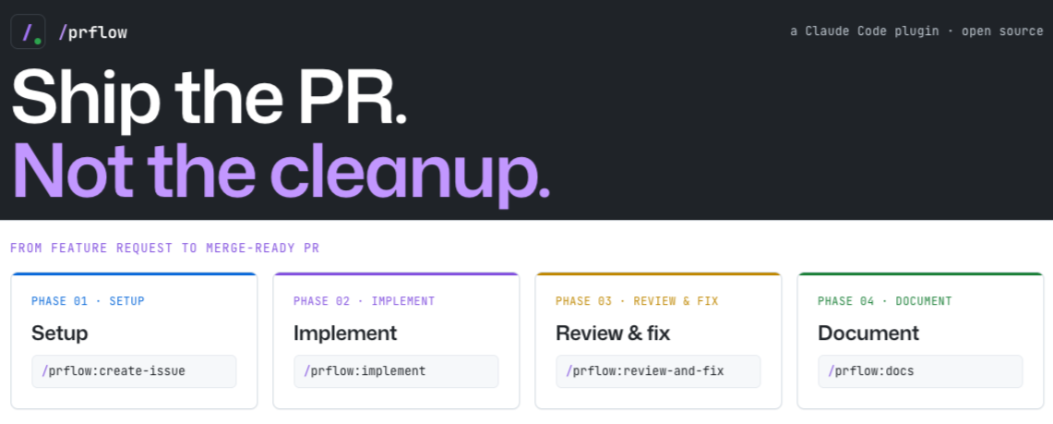



AI coding agents dazzle on a demo repo, then stall on a real ticket in a large production codebase. DevFlow is the Claude Code plugin that closes that gap — it carries one feature request all the way to a complete, tested, reviewed, documented pull request, so you do the final review and merge, not the cleanup.
[!NOTE]
Automatic review on pull request is withheld from this release. A fresh installation
receives nodevflow-review.yml,devflow-runner.ymlortelemetry-push.yml. The
supported review path is a repository collaborator commenting/devflow:reviewon a pull
request — an outside fork contributor cannot self-trigger a review. A repository that
already installed the tier keeps it, and keeps its exposure to issues #930 and #920 until
it removes the files by hand. Seedocs/workflow-triggers.md
for the reason and the removal procedure.
Quick start
[!TIP]
Just ask your agent. Paste this into Claude Code and it handles steps 1 and 2 for you — the install, the setup, and the PATH dependencies/plugin installdoesn't cover. Then ship your first PR with step 3.Read https://github.com/The01Geek/devflow-autopilot#quick-start and install DevFlow and its dependencies.
1. Install (two commands — run in order; works in any shell):
claude plugin marketplace add The01Geek/devflow-autopilot
claude plugin install devflow@devflow-marketplace
2. Set up — launch Claude Code and scaffold your config:
claude /devflow:init # launches Claude Code and scaffolds your config
3. Ship a PR — turn a feature request into a reviewed, documented pull request:
/devflow:create-issue <user_story>
/devflow:implement <issue_number>
The local tier runs with zero configuration — every value already has a built-in default. /devflow:init is recommended: it keeps the plugin auto-updated and writes a .devflow/config.json you can tweak. See Installing & updating for the full options (the zero-dependency install, PyYAML, the cloud tier) and Requirements for the handful of tools it expects on your PATH.
Why DevFlow
- Ships the whole PR, not a fragment — grounded in your architecture and patterns, with the tests the change actually needs, on production code. How it's different →
- Review that fixes what it finds — and audits itself — the review-and-fix loop applies fixes and re-reviews until it approves, then a structurally-independent shadow pass re-checks the approval. Skills and agents →
- Docs stay in sync — internal docs, external docs, and release notes kept aligned with the code in the same run.
- It learns every week — a retrospective loop reads the trail of merged PRs and files human-reviewed issues that prevent the next recurring failure.
- Zero-config to start — the local tier runs entirely inside Claude Code with no infrastructure; an optional cloud tier runs it autonomously on GitHub.
Contents
- How it's different
- Who it's for
- The workflow, end to end
- Requirements
- Skills and agents
- Project configuration
- The self-improving loop
- Learn more
- Repository layout
- Contributing
How it's different
The thesis isn't code generation — it's disciplined, auditable AI software delivery at production scale. A single LLM pass is variable; DevFlow's architecture is built around not trusting any single pass.
- ✓ Works on real codebases, not just pet projects. Unlike a raw agent that drafts part of the change and stops, DevFlow delivers the full round — grounded in your architecture and patterns, with the tests the change needs — on production code.
- ✓ Review that fixes what it finds. It doesn't just hand you a list. The review-and-fix loop applies the fixes and re-reviews, iterating until it approves — backed by independent verification checklists, a panel of specialized reviewers, mechanical corroboration, and a shadow pass (a second, structurally-independent review that re-checks the approval before it stands). The shadow pass narrows the gap to a standalone review; it never closes it.
- ✓ It learns. Every run leaves a trail — a DevFlow Reflection logging assumptions and anything unverified, an effectiveness trace of which steps earned their keep, living docs, and a weekly retrospective that opens the smallest fix preventing the next recurring failure.
DevFlow delivers a review-ready PR for your final human review and merge — it is not auto-merged.
Who it's for
A developer or team shipping in a large, business-grade codebase, already on Claude Code + GitHub, who wants agentic coding to complete a real ticket — branch, tests, review, docs — not just draft a snippet.
The workflow, end to end
The intended way to drive DevFlow — from a feature request to a reviewed pull request:
   you: a feature request
       │
/devflow:create-issue   →  explore codebase → implementation options → detailed GitHub issue
       │
/devflow:implement      →  architect → code → build/test → /devflow:review-and-fix loop → /devflow:docs
       │
/devflow:review         →  (optional) independent, comprehensive check → PR ready for developer hand-off
       │
   you: final review & merge
- Create the issue.
/devflow:create-issue Add CSV export to the reports pageinterviews you until the issue is unambiguous, shows you the draft, and files it only after you confirm. Say it lands as #42. - Start implementation. Run
/devflow:implement 42in Claude Code — or, on the cloud tier, comment/devflow:implement 42on the issue (gh issue comment 42 --body '/devflow:implement 42'). Because you posted the comment, GitHub fires the workflow natively (no@claude, bot comment, or PAT needed — see cloud setup). - DevFlow implements it. It creates a branch, plans against your codebase, writes the code and tests, opens a draft PR, self-reviews with
/simplify, runs/devflow:review-and-fix, files follow-up issues for deferred findings, updates the docs, and flips the PR to ready. - Review and merge. On the cloud tier,
/devflow:reviewruns as a gate and posts its verdict on the PR. You do the final human review and merge.
The cloud tier (steps 2–4 running automatically on GitHub) needs only a
CLAUDE_CODE_OAUTH_TOKENsecret by default (routing a workflow through an optional third-party model provider adds one more,DEVFLOW_PROVIDER_API_KEY) — seedocs/cloud-setup.md. Everything else runs locally inside Claude Code with no infrastructure.
Requirements
Local tier — these must be on your PATH (in a checkout of this repo, bash lib/preflight.sh checks all of them for you):
gitandgh(GitHub CLI, authenticated viagh auth login) — you most likely already have these.jq— JSON wrangling inside the skills.- Python 3.11+ with PyYAML — install PyYAML with
python3 -m pip install PyYAML. The step people miss:/plugin installnever runspip, so install PyYAML yourself. Name the package rather than reaching for-r requirements.txt: that path resolves against your working directory, not the plugin cache, so in a Python project it installs your project's dependencies instead.
All four are used by the core skills; none is optional. Shell helpers avoid GNU-only flags, so macOS/BSD work without GNU coreutils.
On Windows any POSIX bash works — WSL bash, Git Bash, or MSYS2 bash (DevFlow mandates none); point DevFlow at the one you want with DEVFLOW_BASH, and in a checkout of this repo bash lib/preflight.sh prints a devflow-bash: breadcrumb confirming which bash is in use (a host with no POSIX bash at all is out of scope). A non-executable gh or jq shim can also shadow the real binary on PATH; DevFlow resolves the first gh/gh.exe (and jq/jq.exe) that actually runs (execution-verified via the shared lib/resolve-bin.sh resolver), and you can force a specific binary by setting DEVFLOW_GH / DEVFLOW_JQ to the working one. Windows-form paths are normalized to the running shell's POSIX form by lib/normalize-path.sh. See Windows: choosing the bash DevFlow runs under, Windows: resolving gh, and Windows: resolving jq.
Cloud tier — nothing to install on your machine; the GitHub Actions runner provisions its own toolchain. By default every job runs on ubuntu-latest, but the runner is configurable via the DEVFLOW_RUNNER repository/organization variable (a bare label or a JSON label array), which dispatch-enables self-hosted / Windows runners — read the prerequisites and the smoke-test boundary in docs/cloud-setup.md before treating a non-Linux runner as production-ready.
Skills and agents
| Skill | What it does |
|---|---|
/devflow:implement <issue#> |
Full 4-phase lifecycle: issue → branch → plan → implement → test → draft PR → /simplify → /devflow:review-and-fix → file follow-up issues → docs → ready PR |
/devflow:review [PR#] |
Comprehensive review — verification checklist + the first-party devflow: review agents & the first-party devflow:requesting-code-review final-pass reviewer; returns APPROVE/REJECT |
/devflow:review-and-fix [PR#] |
/devflow:review plus an automatic fix loop (default 5 iterations) that writes a deferrals manifest at exit |
/devflow:pr-description [issue#] |
Generate/update the PR description from the branch diff |
/devflow:docs |
Orchestrate the three doc steps in one session |
/devflow:docs-sync-internal · -sync-external · -release-notes |
Update internal docs, align external docs, generate release notes |
/devflow:docs-verify <topic> · -bootstrap-internal · -bootstrap-external |
Verify one topic; stand up internal/external docs from scratch |
/devflow:create-issue |
Rough idea → well-structured GitHub issue |
/devflow:init |
One-time setup: scaffold .devflow/config.json + refresh the schema |
/devflow:retrospective-weekly |
The weekly self-improvement loop (details) |
Agents (agents/): the review-engine trio checklist-generator, checklist-deduper, and checklist-verifier build, dedupe, and verify the review engine's verification checklist; the /devflow:implement code-explorer and code-architect handle discovery and planning; and the five pr-review-toolkit reviewers (code-reviewer, comment-analyzer, pr-test-analyzer, silent-failure-hunter, type-design-analyzer) run the deep-dive review passes.
Namespacing matters where names collide with built-ins.
/review,/init, and/security-revieware built-in Claude Code commands — always use the/devflow:-prefixed form to reach DevFlow's engine (a bare/reviewreaches Claude Code's reviewer, not DevFlow's). DevFlow's cloud workflows trigger on bare/devflow:*comments (no@claude), so they coexist with Anthropic's Claude GitHub App, which owns plain@claudementions and/security-review.
No companion plugins. DevFlow declares zero companion-plugin dependencies —
/plugin install devflow@devflow-marketplaceresolves on its own, with noclaude-plugins-officialprerequisite and none of the olddependency-unsatisfiedErrors-tab friction. Every external asset its engine once dispatched is now a first-party DevFlow file: thepr-review-toolkitreview agents and thefeature-devcode-explorer/code-architectsubagents underagents/, and thesuperpowersfinal-pass reviewer (requesting-code-review) and fix-loopreceiving-code-reviewskills underskills/— all hard-forked with upstream licenses retained verbatim underLICENSES/. See Installing & updating./simplifyis a built-in Claude Code skill.
Project configuration
The local tier needs no config — every value has a built-in default. To customize, run /devflow:init to scaffold .devflow/config.json from DevFlow's shipped template (it never clobbers a config you've filled in) and refresh .devflow/config.schema.json (your editor reads it for autocomplete + field descriptions).
Common keys the skills read: documentation paths (docs.internal, docs.external, docs.release_notes_file, docs.changelog_file, docs.labels), the workpad marker (devflow.workpad_marker), the bot allowlist (devflow.allowed_bots), the review base (base_branch), retrospective settings (devflow_retrospective.*), and — cloud tier only — runtime provisioning (setup.*) and the plugin ref (devflow_version). Full reference: System overview §17.
The self-improving loop
Every bot-authored PR leaves evidence — review comments, post-bot commits, CI signals, workpad state. Once a week, /devflow:retrospective-weekly reads the accumulated trail, finds failure patterns that recur, and files a human-reviewed issue proposing the smallest change that would prevent the next occurrence (a CLAUDE.md tweak, a skill rewrite, a missing doc, a new lint rule). You triage it, and it runs through the normal implement → review pipeline like any other change.
/devflow:retrospective-weekly
Run it interactively from the repo root, ideally weekly; it confirms a clean default branch, runs the full pipeline, and prints a status report with the issues to triage. Deterministic scripts handle all scanning, gating, and git/issue mechanics — the LLM is invoked only at the two genuine-judgment points (per-PR retrospective and per-pattern issue-spec drafting). The loop proposes, it does not dispose: it files one well-formed GitHub issue per actionable pattern and lets the normal implement → review pipeline execute it, rather than auto-editing the repo.
Full mechanics — the pipeline, the data files, how patterns become issues: System overview §12.
Learn more
- System overview — the complete system reference (architecture, every deep dive, the Scope-Acknowledged Findings contract §13, the security model §15).
- Installing & updating — all install paths, dependency resolution, both-tier updates.
- Cloud setup — secrets, triggers, runtime provisioning for the autonomous tier.
- Shadow review · Review-agent overrides · Efficiency traces · Workflow triggers
- Changelog — release history.
Repository layout
.claude-plugin/   # plugin.json (declares dependencies) + marketplace.json (this repo is its own marketplace)
skills/           # one SKILL.md per command (/devflow:implement, /devflow:review, /docs, …)
agents/           # 10 subagents: checklist-generator/-deduper/-verifier + code-explorer/-architect + 5 pr-review-toolkit reviewers
scripts/          # Python + shell CLIs (workpad.py, config-get.sh, match-deferrals.py, …)
lib/              # retrospective-loop helpers (*.sh, *.jq), preflight.sh, test/
.github/          # optional cloud tier: workflows + composite actions (incl. vendor-plugin)
.devflow/         # config.example.json + config.schema.json (+ learnings/, logs/)
install.sh        # one-command cloud-tier install/update (thin by default; DEVFLOW_VENDOR=1 to commit the plugin)
Skills reference bundled helpers via the portable single-statement anchor ($CLAUDE_SKILL_DIR on Claude Code, with a runner-reported base-directory fallback on other agentic CLIs) so they resolve from any install location and runner.
Contributing
See CONTRIBUTING.md. Run the test suite with bash lib/test/run.sh (CI runs it on every PR). Security reports: SECURITY.md.
License
MIT © 2026 Daniel Radman.
Third-party components. DevFlow redistributes several agents and skills authored by others,
which remain under their own upstream licenses (Apache-2.0 from Anthropic's feature-dev andpr-review-toolkit plugins; MIT from Jesse Vincent's superpowers) and have been modified by
DevFlow. LICENSES/README.md maps each vendored file to its upstream
project, license, and copyright holder; the full license texts are in LICENSES/.
Reviews (0)
Sign in to leave a review.
Leave a reviewNo results found