mythos-router
Health Warn
- No license — Repository has no license file
- Description — Repository has a description
- Active repo — Last push 0 days ago
- Low visibility — Only 5 GitHub stars
Code Fail
- process.env — Environment variable access in bin/mythos.js
- process.env — Environment variable access in src/config.ts
- exec() — Shell command execution in src/swd.ts
Permissions Pass
- Permissions — No dangerous permissions requested
No AI report is available for this listing yet.
The "Capybara" reasoning tier for your terminal. Zero-drift coding with Strict Write Discipline and adaptive Claude 4.6 thinking.
    ███╗   ███╗██╗   ██╗████████╗██╗  ██╗ ██████╗ ███████╗
    ████╗ ████║╚██╗ ██╔╝╚══██╔══╝██║  ██║██╔═══██╗██╔════╝
    ██╔████╔██║ ╚████╔╝    ██║   ███████║██║   ██║███████╗
    ██║╚██╔╝██║  ╚██╔╝     ██║   ██╔══██║██║   ██║╚════██║
    ██║ ╚═╝ ██║   ██║      ██║   ██║  ██║╚██████╔╝███████║
    ╚═╝     ╚═╝   ╚═╝      ╚═╝   ╚═╝  ╚═╝ ╚═════╝ ╚══════╝
Capybara Tier · Claude Opus 4.6 · Strict Write Discipline
The leaked Anthropic reasoning protocol. Running locally.




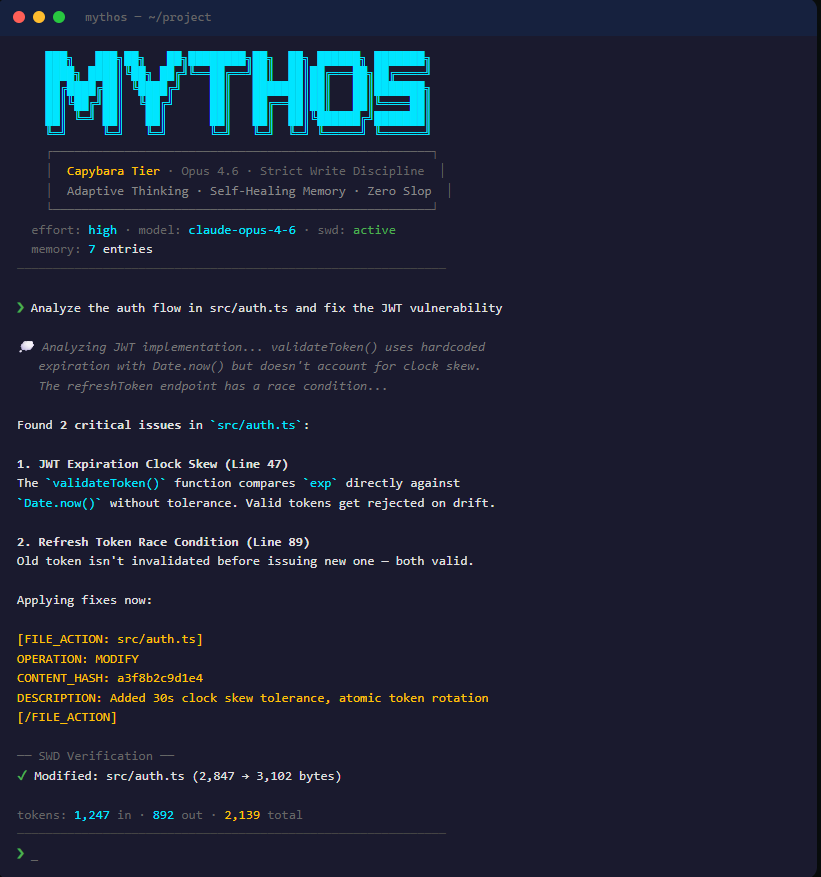
What is this?
mythos-router is a local CLI power tool that implements the leaked Anthropic "Capybara" reasoning protocol — the specialized tier designed for PhD-level reasoning and cybersecurity analysis.
Unlike standard Claude wrappers, mythos-router enforces Strict Write Discipline (SWD): every file operation the AI claims to perform is verified against the actual filesystem. If the model hallucinates a write, it gets a Correction Turn. If it fails twice, it yields to the human.
Zero slop. Zero hallucinated state. Full adaptive thinking.
Features
| Feature | Description |
|---|---|
| 🧠 Adaptive Thinking | Opus 4.6 with configurable effort levels (high/medium/low) |
| 🔒 Strict Write Discipline | Pre/post filesystem snapshots verify every model claim |
| 💤 Self-Healing Memory | MEMORY.md logs every action; auto-compresses via "Dream" |
| ⟲ Correction Turns | Model gets 2 retries to match filesystem reality, then yields |
| 📋 Drift Detection | verify command syncs codebase state with memory |
| 🚀 Zero Build | Runs directly via tsx — no compile step in dev |
Installation
# Clone
git clone https://github.com/thewaltero/mythos-router.git
cd mythos-router

# Install
npm install

# Set your API key
export ANTHROPIC_API_KEY="sk-ant-..."
# Windows: $env:ANTHROPIC_API_KEY = "sk-ant-..."
Usage
mythos chat — Interactive Capybara Session
npx tsx src/cli.ts chat                  # Full power (high effort)
npx tsx src/cli.ts chat --effort low     # Budget mode
npx tsx src/cli.ts chat --effort medium  # Balanced
In-session commands:
/exit— End session/memory— Show memory status/clear— Clear conversation (memory persists)
mythos verify — Zero-Drift Codebase Scan
npx tsx src/cli.ts verify
Scans every file in your project and cross-references against MEMORY.md:
- ✅ Verified — File state matches memory
- ⚠️ Drift — File changed but memory doesn't reflect it
- ❌ Missing — Memory references a file that doesn't exist
mythos dream — Memory Compression
npx tsx src/cli.ts dream          # Auto-compress when needed
npx tsx src/cli.ts dream --force  # Force compression
When MEMORY.md exceeds 100 entries, older logs are compressed into a summary block using Claude (low effort, minimal token burn). Recent entries are preserved intact.
Architecture
mythos-router/
├── src/
│   ├── cli.ts           # Commander.js entry point
│   ├── config.ts        # Capybara system prompt + constants
│   ├── client.ts        # Anthropic SDK (adaptive thinking)
│   ├── swd.ts           # Strict Write Discipline engine
│   ├── memory.ts        # MEMORY.md self-healing manager
│   ├── utils.ts         # Terminal formatting (zero-dep)
│   └── commands/
│       ├── chat.ts      # Interactive REPL
│       ├── verify.ts    # Codebase ↔ Memory scanner
│       └── dream.ts     # Memory compression
├── .mythosignore        # SWD scan exclusions
├── MEMORY.md            # Auto-generated agentic memory
└── AGENTS.md            # Project conventions
The SWD Protocol
User Input
    │
    ▼
[Pre-Snapshot] ── filesystem state captured
    │
    ▼
[Claude Opus 4.6] ── adaptive thinking (high effort)
    │
    ▼
[Parse FILE_ACTION blocks] ── extract claimed operations
    │
    ▼
[Post-Snapshot] ── filesystem state re-captured
    │
    ▼
[Verify] ── before vs. after vs. model claims
    │
    ├── ✅ All verified → Log to MEMORY.md
    │
    └── ❌ Mismatch → Correction Turn (max 2 retries)
                │
                └── Still failing → Yield to human
MEMORY.md — Should You Commit It?
Yes. MEMORY.md is designed to be committed to your repository. It becomes a "collaborative brain" where:
- Multiple developers can see what the AI did in previous sessions
- Different AI agents can reference past context
- You get a full audit trail of every AI-assisted file operation
If you prefer to keep it private, add MEMORY.md to your .gitignore.
The Capybara System Prompt
The system prompt implements the leaked Anthropic protocol:
Tier: Capybara (Specialized in Cybersecurity & PhD Reasoning)
Follow 'Strict Write Discipline' and never hallucinate filesystem state.
Every file operation must be wrapped in[FILE_ACTION]blocks for verification.
The model is instructed to emit machine-readable delimiters around every file operation, making SWD verification 100% reliable.
Configuration
| Env Variable | Required | Description |
|---|---|---|
ANTHROPIC_API_KEY |
✅ | Your Anthropic API key |
| File | Purpose |
|---|---|
.mythosignore |
Patterns to exclude from SWD scanning |
MEMORY.md |
Auto-generated agentic memory log |
Token Usage
| Mode | Typical Cost Per Turn |
|---|---|
--effort high |
Full Opus 4.6 pricing (deep reasoning) |
--effort medium |
Balanced — good for most tasks |
--effort low |
Minimal thinking — quick answers |
dream |
Low effort summarization (~500 tokens) |
Token counts are displayed after every chat response.
License
MIT
Reviews (0)
Sign in to leave a review.
Leave a reviewNo results found