mdvp-cli
Health Uyari
- License — License: MIT
- Description — Repository has a description
- Active repo — Last push 0 days ago
- Low visibility — Only 6 GitHub stars
Code Basarisiz
- fs module — File system access in action/action.yml
- execSync — Synchronous shell command execution in cli.mjs
- process.env — Environment variable access in cli.mjs
- execSync — Synchronous shell command execution in commands/audit-local.mjs
- process.env — Environment variable access in commands/audit-local.mjs
Permissions Gecti
- Permissions — No dangerous permissions requested
Bu listing icin henuz AI raporu yok.
Deterministic, explainable design-quality measurement for any live URL — CSS health, Oklab/APCA color science, Shannon entropy, AI-UI detection, and DESIGN.md compliance. Runs locally, no API key.
  ███╗   ███╗██████╗ ██╗   ██╗██████╗
  ████╗ ████║██╔══██╗██║   ██║██╔══██╗
  ██╔████╔██║██║  ██║██║   ██║██████╔╝
  ██║╚██╔╝██║██║  ██║╚██╗ ██╔╝██╔═══╝
  ██║ ╚═╝ ██║██████╔╝ ╚████╔╝ ██║
  ╚═╝     ╚═╝╚═════╝   ╚═══╝  ╚═╝
@mdvp/cli



DOM analysis for any live URL. Counts, ratios, and a pattern registry for the rendered HTML. Runs locally via Puppeteer — no API key, no account, no baseline needed.
npx @mdvp/cli audit myapp.com
Pipeline
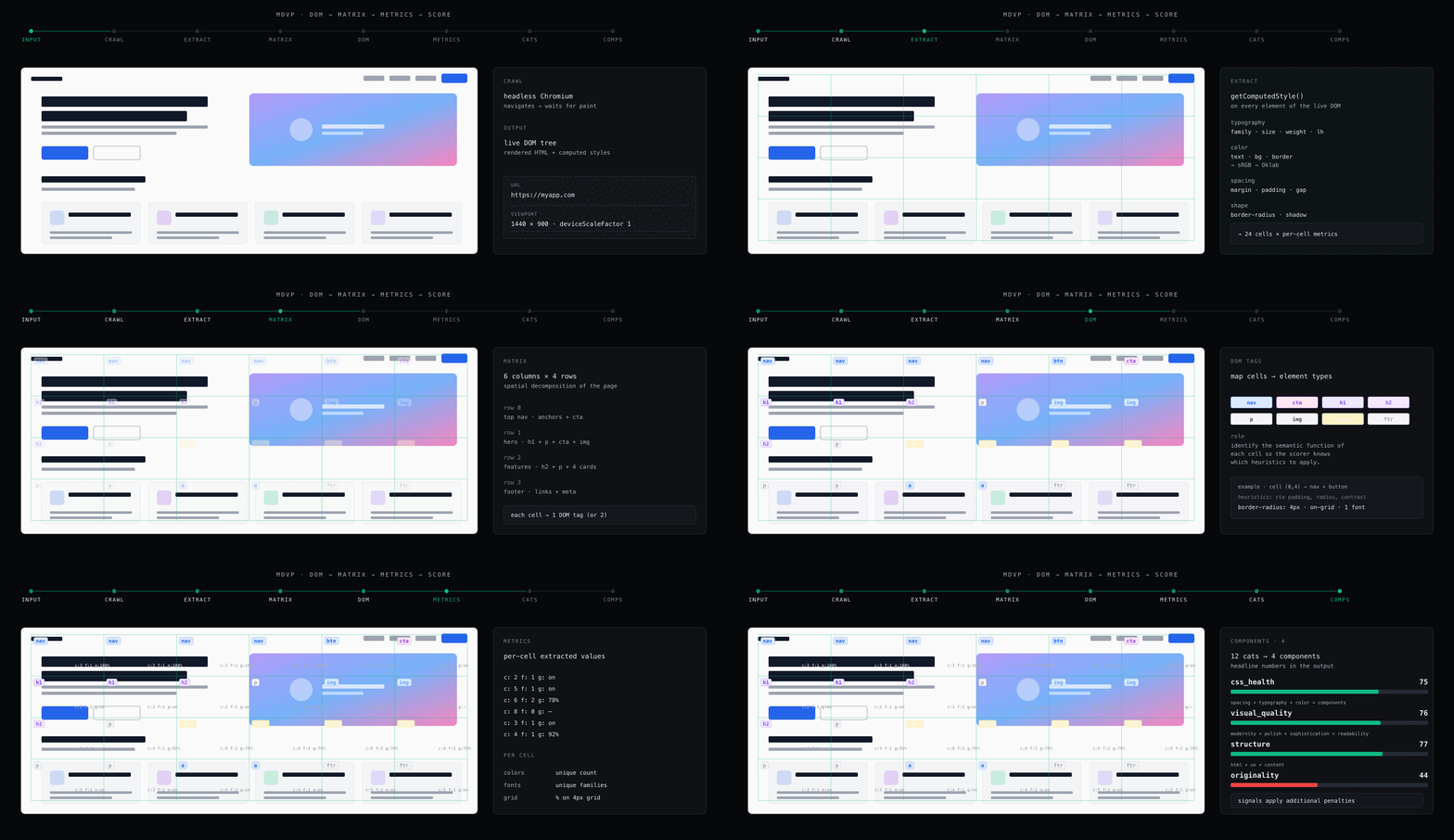
Puppeteer opens the URL → getComputedStyle() reads every element → 12 categories score into 4 components → a pattern registry highlights common design heuristics. See How it works below for the full walkthrough.
Why
Tools like v0, Bolt, Lovable, and Cursor generate frontends fast — but the output often shares common patterns: Inter as the primary font, Tailwind's default purple-blue-pink gradient palette, every button is border-radius: 9999px, 40+ unique CSS colors with no system. Visual regression tools can't help (no prior snapshot to compare against); linters check syntax, not rendered quality.
MDVP gives you numbers on the rendered DOM. It instruments the page, extracts computed CSS values via getComputedStyle(), runs perceptual color analysis in Oklab space, and counts against design-system heuristics. The scoring is deterministic: the same DOM produces the same score, bit-identical.
Quickstart
# Score any URL locally (first run downloads Puppeteer's Chromium, ~30s)
npx @mdvp/cli audit myapp.com

# Enforce thresholds in CI — exits 1 on violation
npx @mdvp/cli audit myapp.com --check

# Look up a known site from the public dataset (no local crawl)
npx @mdvp/cli audit myapp.com --cloud

# Contribute your local result to the public dataset
npx @mdvp/cli audit myapp.com --swarm

# JSON output for scripting
npx @mdvp/cli audit myapp.com --json | jq .components.css_health

# Print a README badge for your site
npx @mdvp/cli badge myapp.com
Output:
myapp.com  C+  58/100  local crawl

  css_health      ████████░░░░  48   32 colors · 4 fonts · 61% on grid
  visual_quality  ██████████░░  67
  structure       ████████████  81
  originality     ████░░░░░░░░  38

entropy 0.82 · apca 94.2 · grid 61%
Lowest: originality (38) · color (44) · spacing (51)
  · 32 unique colors. Professional limit: 8–12
  · 4 font families. Professional limit: 2
  · Inter + Tailwind purple-blue palette — common design pattern
How it works
Puppeteer opens the URL, getComputedStyle() is read on every element, the scorer groups 12 categories into four named components, and a pattern registry of independent heuristic detectors deducts from the originality component when common patterns match. See the methodology paper for the full algorithm, weight table, and prior-work comparison.
Documentation
- Install — requirements, install, first run, troubleshooting
- CLI commands — every flag, every subcommand, exit codes
- Scoring — what the four components measure, the signal registry
- DESIGN.md compliance — diff your rendered DOM against your design system
- CI enforcement —
.mdvprc, GitHub Action, exit codes, other CI systems - MCP server — plug into Claude, OpenCode, Cursor, Windsurf, Cline
- Architecture — components, job protocol, self-hosting
- Methodology — full scoring paper (4 pillars, weight table)
- Benchmark — sensitivity / ablation + live reference panel
- Development — setup, tests, adding a signal, cutting a release
Add a score badge to your project
Show your MDVP score in your project's README: docs/badge.md. Submit your site, then generate the shields.io markdown:
npx @mdvp/cli badge myapp.com
Contributing
Bug reports and feature requests: GitHub Issues. Code and signal detectors: see CONTRIBUTING.md. Adding a signal is a one-file change — see the development guide.
Citing
If you use MDVP in research, cite via the "Cite this repository" button (powered by CITATION.cff). A preprint draft of the methodology is in docs/paper.md.
License
MIT. The local scoring engine, CLI, MCP server, and GitHub Action are in this repository. The hosted coordination layer and dataset are not part of this open-source package — see docs/architecture.md for the boundary.
Yorumlar (0)
Yorum birakmak icin giris yap.
Yorum birakSonuc bulunamadi