claude-skill-odoo-integration
Health Pass
- License — License: MIT
- Description — Repository has a description
- Active repo — Last push 0 days ago
- Community trust — 20 GitHub stars
Code Warn
- Code scan incomplete — No supported source files were scanned during light audit
Permissions Pass
- Permissions — No dangerous permissions requested
No AI report is available for this listing yet.
Claude Code skill for Odoo integrations: XML-RPC (Odoo 8-19) and the new JSON-2 API (Odoo 19+)
odoo-integration
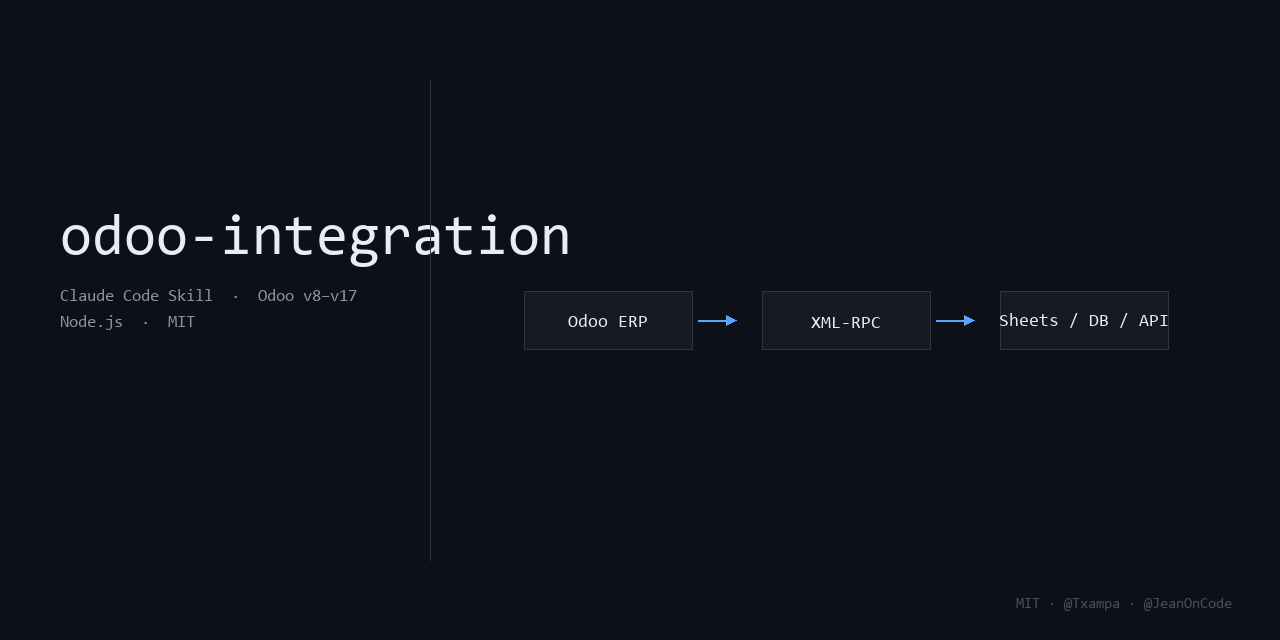
A Claude Code skill that gives Claude expert knowledge of Odoo integrations, over XML-RPC and the new JSON-2 API. Connect to any Odoo instance, query models, sync data to Google Sheets or other outputs, and deploy on Railway — without explaining the basics every time.
Works with Odoo 8 through 19.
⚠️ Odoo is retiring XML-RPC
Odoo 19 deprecated the XML-RPC and JSON-RPC endpoints (/xmlrpc, /xmlrpc/2, /jsonrpc). They are scheduled for
removal in Odoo 22 (fall 2028) and Odoo Online 21.1 (winter 2027). The replacement is the
External JSON-2 API: onePOST /json/2/<model>/<method> per call, an API key as bearer token, arguments by name.
The skill ships both clients with the same methods, so moving an integration to JSON-2 means swapping the client
and the credentials, not rewriting the sync:
const OdooClient = require('./config/odoo');            // XML-RPC, Odoo 8–19
const OdooJson2Client = require('./config/odoo-json2'); // JSON-2, Odoo 19+, no dependencies

const odoo = new OdooJson2Client(); // ODOO_URL + ODOO_API_KEY
await odoo.authenticate();
const pickings = await odoo.searchRead('stock.picking', [['state', '=', 'assigned']], ['id', 'name', 'scheduled_date']);
Two things that catch people out: JSON-2 runs every call in its own transaction, and on Odoo Online the external
API (old and new) is only available on the Custom plan.
How it works
Install the skill once. From that point, Claude understands the full integration stack without you having to explain it:
- XML-RPC and JSON-2 clients, authentication and API keys
- Which models to query and what their fields are called in your version
- How states differ between Odoo versions
- How to build reliable, incremental syncs with deduplication
- The traps of creating records over the API (onchanges that don't run, crons that do)
- How to deploy on Railway with proper secret management
Just describe what you need.
"Sync stock.picking records in state 'waiting' to Google Sheets every 15 minutes"
"Read all confirmed sale orders from Odoo 16 and export to CSV"
"Migrate this XML-RPC sync to the JSON-2 API, we're moving to Odoo 19"
"Debug why my sync stopped writing to the correct sheet tab"
"Add pagination — I have more than 100 pickings"
Version compatibility
The XML-RPC protocol is the same from Odoo 8 to 19. What changes is field names, states and models. Checked against
the Odoo source of each branch, and the Odoo 19 rows against a running Odoo 19:
| What | Before | After | Since |
|---|---|---|---|
| Picking lines | move_lines |
move_ids |
16 |
| Picking scheduled date | min_date |
scheduled_date |
11 |
| Detailed operations | pack_operation_ids |
move_line_ids |
11 |
| Done quantity on a move | quantity_done |
quantity |
17 |
| Stockable product | type = 'product' |
type = 'consu' + is_storable |
18 |
| Invoices | account.invoice |
account.move |
13 |
| Customer / supplier | booleans customer, supplier |
customer_rank, supplier_rank |
13 |
| Locked sale order | state done |
sale + locked |
17 |
| Locked purchase order | state done |
purchase + locked |
19 |
stock.picking.date |
exists | removed (use create_date) |
19 |
stock.move.name |
exists | removed | 19 |
res.partner.mobile |
exists | removed | 19 |
Asking for a field that doesn't exist in that version makes the whole call fail, so the skill doesn't "fall back" by
requesting both names. It asks the server once:
const fields = await odoo.fieldsGet('stock.picking');
const LINES = 'move_ids' in fields ? 'move_ids' : 'move_lines';
const DATE  = 'scheduled_date' in fields ? 'scheduled_date' : 'min_date';
What's new in v2
- JSON-2 client for Odoo 19+, with the same interface as the XML-RPC one, and a migration path.
- Tested against a running Odoo 19.0: both clients, every field list in the skill, errors and API keys.
That test caught two more fields removed in 19 (stock.picking.date,stock.move.name). - Version table corrected. v1 said
move_idsandscheduled_datearrived in Odoo 13: they arrived in 16 and 11.
Added the changes in 17, 18 and 19. fieldsGeton both clients, to pick field names from the server instead of guessing.- Field lists per version for pickings, moves, orders, products and partners.
- Lessons from a production integration: silent data loss with
limit+order,readvssearch_readwith
record rules, UTC datetimes, idempotent creates, incremental sync bywrite_date, onchanges and automated actions
on API-created records, rounding, retries.
What's inside the skill
The skill teaches Claude to generate this project structure from scratch:
odoo-sync/
├── config/odoo.js        OdooClient — XML-RPC wrapper (Odoo 8–19)
├── config/odoo-json2.js  OdooJson2Client — JSON-2 API (Odoo 19+), same methods
├── utils/sync.js         SyncManager — incremental sync with dedup
├── utils/sheets.js       SheetsClient — Google Sheets output
├── index.js              Cron scheduler
├── test-odoo.js          Verify raw Odoo connection
├── debug-states.js       Inspect model states in production
├── debug-move-lines.js   Inspect lines inside a specific picking
├── .env.example
└── Procfile              Railway: web: node index.js
Covered in depth: stock.picking, stock.move, sale.order, purchase.order, product.product, res.partner — with states, key fields, and domain filter patterns for each.
Installation
git clone https://github.com/txampa/claude-skill-odoo-integration \
  ~/.claude/skills/odoo-integration
Claude Code discovers skills automatically from ~/.claude/skills/. No configuration needed. The skill activates when you mention Odoo, XML-RPC, JSON-2, stock.picking, ERP sync, or Railway deployment.
Requirements
- Claude Code
- An Odoo instance, 8 to 19 (self-hosted, Odoo.sh, or Odoo Online on the Custom plan)
- Node.js 18+ in your project
- A Google Cloud service account (only if syncing to Sheets)
Credits
Created by @Txampa.
Built from real production integrations with Odoo 8, extended with the field changes up to Odoo 19 and the JSON-2 API.
License
MIT — free to use, modify, and distribute. See LICENSE.txt.
Reviews (0)
Sign in to leave a review.
Leave a reviewNo results found