security-monitor
Health Warn
- License — License: Apache-2.0
- Description — Repository has a description
- Active repo — Last push 0 days ago
- Low visibility — Only 5 GitHub stars
Code Pass
- Code scan — Scanned 12 files during light audit, no dangerous patterns found
Permissions Pass
- Permissions — No dangerous permissions requested
No AI report is available for this listing yet.
Local-first security monitor: tracks CVEs across your repos and what actually runs in production

Security Monitor
You fixed it in the repo. Is production still vulnerable?




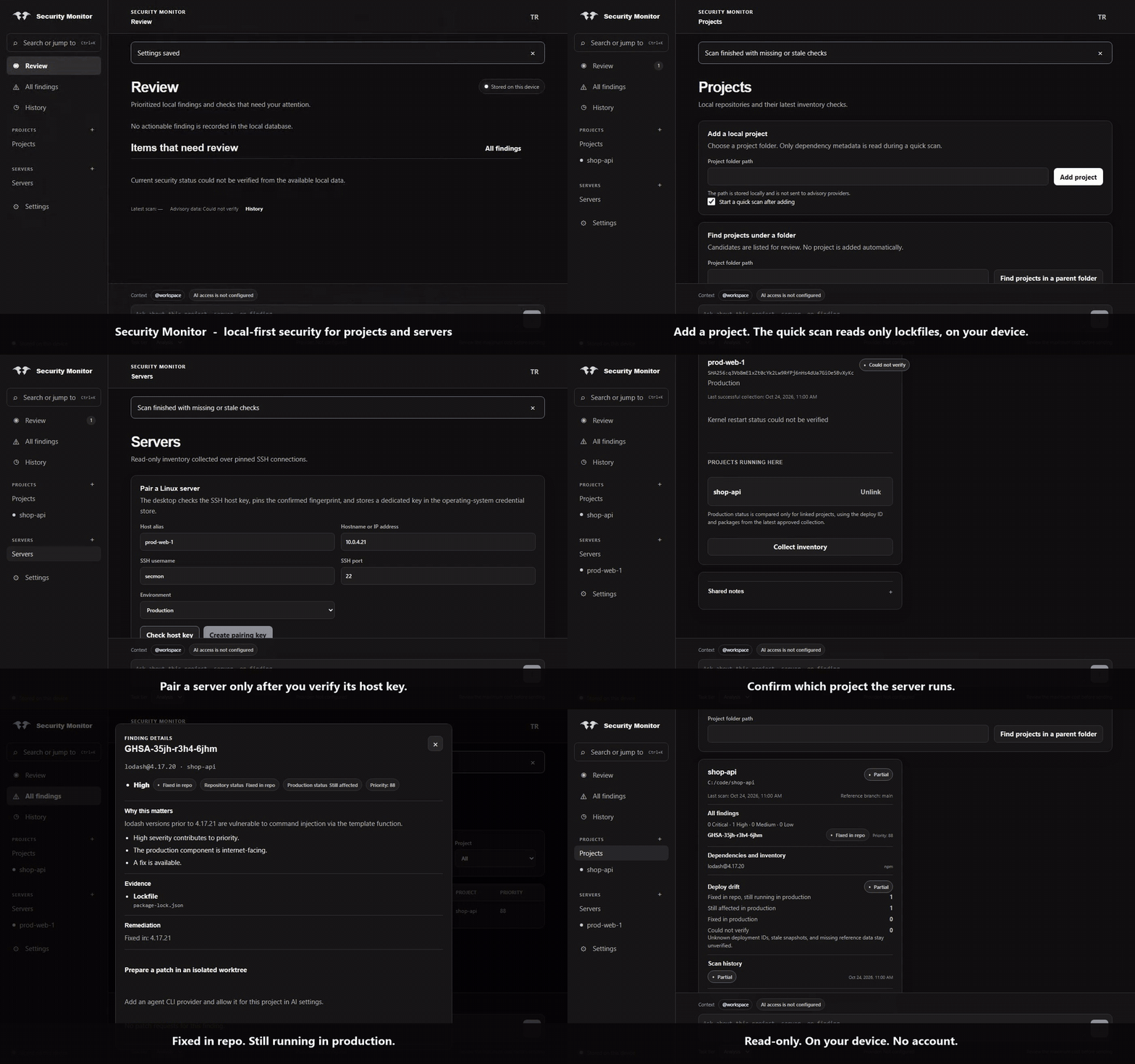
Demo recorded from the desktop UI with sample data (lodash 4.17.20, GHSA-35jh-r3h4-6jhm); no real scan or server.
Security Monitor (secmon) is an open-source, local-first security monitor for your projects and your Linux servers. It matches your dependencies against vulnerability advisories on your own machine, then checks what is actually running in production, so a fix that never got deployed does not look finished.
No account. No cloud dashboard. Source code, lockfiles, and inventory stay on your device unless you approve a specific transfer.
Status: pre-release. v1.0 is code complete; signed installers are not published yet. Build from source to try it. Missing, stale, or unverified data is always shown as could not verify, never as safe.
What it does
- Finds vulnerable dependencies locally. Lockfile inventory, offline OSV data, GHSA, CISA KEV and EPSS, plus OSV-Scanner, Trivy, and Semgrep adapters.
- Compares the repo with production. A read-only Linux agent (or agentless SSH) reports what is installed and running, including kernels that need a reboot and processes still using deleted libraries.
- Warns before vulnerable code is pushed.
secmon hookchecks only the changed lockfiles, offline, in under three seconds. - Works with your coding agent. One command connects Claude Code, Codex, or OpenCode to a local MCP server and Security Monitor skills.
- Prepares fixes you approve. Fixes are prepared in an isolated Git worktree and tested in a network-disabled sandbox; nothing is applied without your approval.
Why it is different
| Security Monitor | Typical SaaS scanners | Repository scanners (Dependabot, OSV-Scanner, Trivy) | |
|---|---|---|---|
| Account required | No | Yes | Varies |
| Source code leaves your device | Only with explicit approval | Usually | No |
| Sees what runs on your servers | Yes, read-only | Some, with cloud agents | No |
| "Fixed in repo, still running in production" | Yes | Rarely | No |
| Missing data shown as safe | Never | Varies | Varies |
| Cost | Free, Apache-2.0 | Paid tiers | Free |
Security Monitor uses OSV-Scanner, Trivy, and Semgrep as local adapters; it builds on them rather than replacing them.
How it works
flowchart LR
  subgraph Device["Your device"]
    Repo["Projects and lockfiles"] --> Engine["Local inventory and matching"]
    Scanners["OSV-Scanner, Trivy, Semgrep (local)"] --> Engine
    Engine --> Store[("Local SQLite")]
    Store --> Desktop["Desktop app and tray"]
    Store --> CLI["secmon CLI, Git hooks, SARIF / CycloneDX / OpenVEX reports"]
    Store --> MCP["Local MCP server"]
    MCP --> Agents["Claude Code, Codex, OpenCode"]
  end
  Server["Linux server: read-only agent or agentless SSH"] -- "approved, pinned SSH" --> Engine
  Feeds["OSV, GHSA, CISA KEV, EPSS, cve.now, RSS/Atom"] -- "only with public downloads on" --> Engine
  Desktop -. "reviewed and approved request" .-> AI["Optional AI provider you choose"]
  Desktop -. "approved destinations" .-> Notify["Webhook, Slack, Discord, email"]
The agent has no remote-command feature: it runs only a fixed, compile-time list of read-only collectors and never needs root.
Privacy: what leaves your device
| Data | Leaves the device? |
|---|---|
| Source code, lockfiles, project inventory | No, unless you approve a specific AI request or export |
| Server inventory | Moves from your server to your device over a pinned SSH connection, after you approve each collection |
| Advisory and feed updates | Only when public downloads are enabled; OSV requests name the ecosystem, not your packages |
| AI requests | Only after you review the redacted prompt, destination, tools, and cost limit; budgets default to zero |
| Secrets (SSH keys, API keys, webhooks) | Stored only in the OS credential store |
| Telemetry | None |
See Privacy for the full model.
Quick start (from source)
Install Rust, Node.js 22 or newer, pnpm 10.27.0, and the Tauri prerequisites.
pnpm install --frozen-lockfile
pnpm -C apps/desktop tauri dev
CLI:
cargo run -p secmon -- scan <project-path> --offline
cargo run -p secmon -- report --format sarif
cargo run -p secmon -- hook install --pre-push --mode warn
cargo run -p secmon -- integrate claude-code --dry-run
Linux agent: build the static binary, verify its checksum, and install it with the provided script. Confirm the SSH host-key fingerprint independently before pairing. See Linux agent installation.
With coding agents
secmon integrate <claude-code|codex|opencode> --dry-run
secmon integrate <claude-code|codex|opencode>
secmon integrate remove <claude-code|codex|opencode>
This adds the local MCP server, the Security Monitor skills, and, where supported, a hook that runs secmon hook run before the agent pushes. --dry-run shows the exact diff, and remove restores the previous files. Agents can read findings and leave notes; they cannot change a finding's status or priority. See Coding-agent integrations.
Screenshots
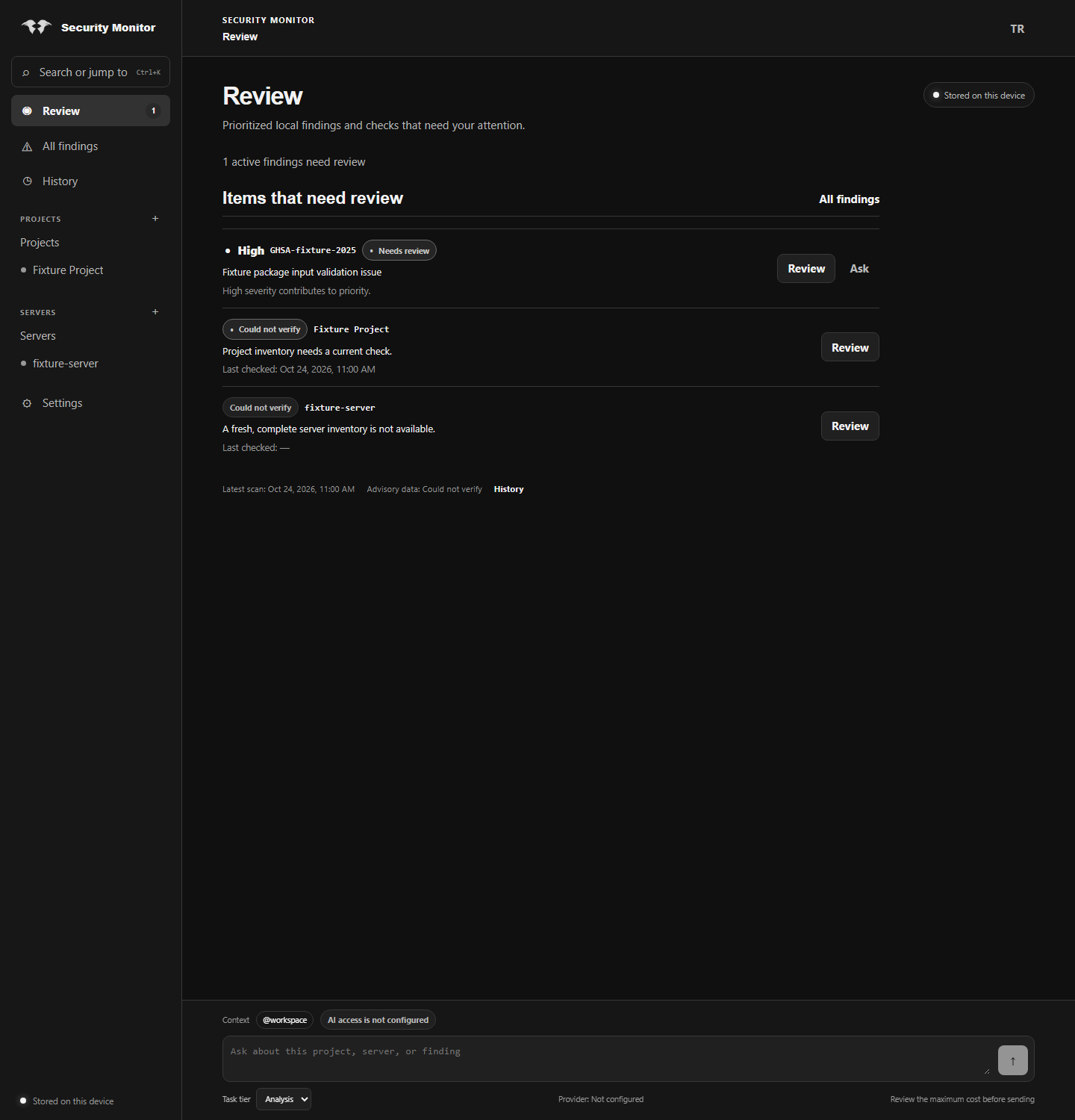
| Screen | Light | Dark |
|---|---|---|
| Findings | 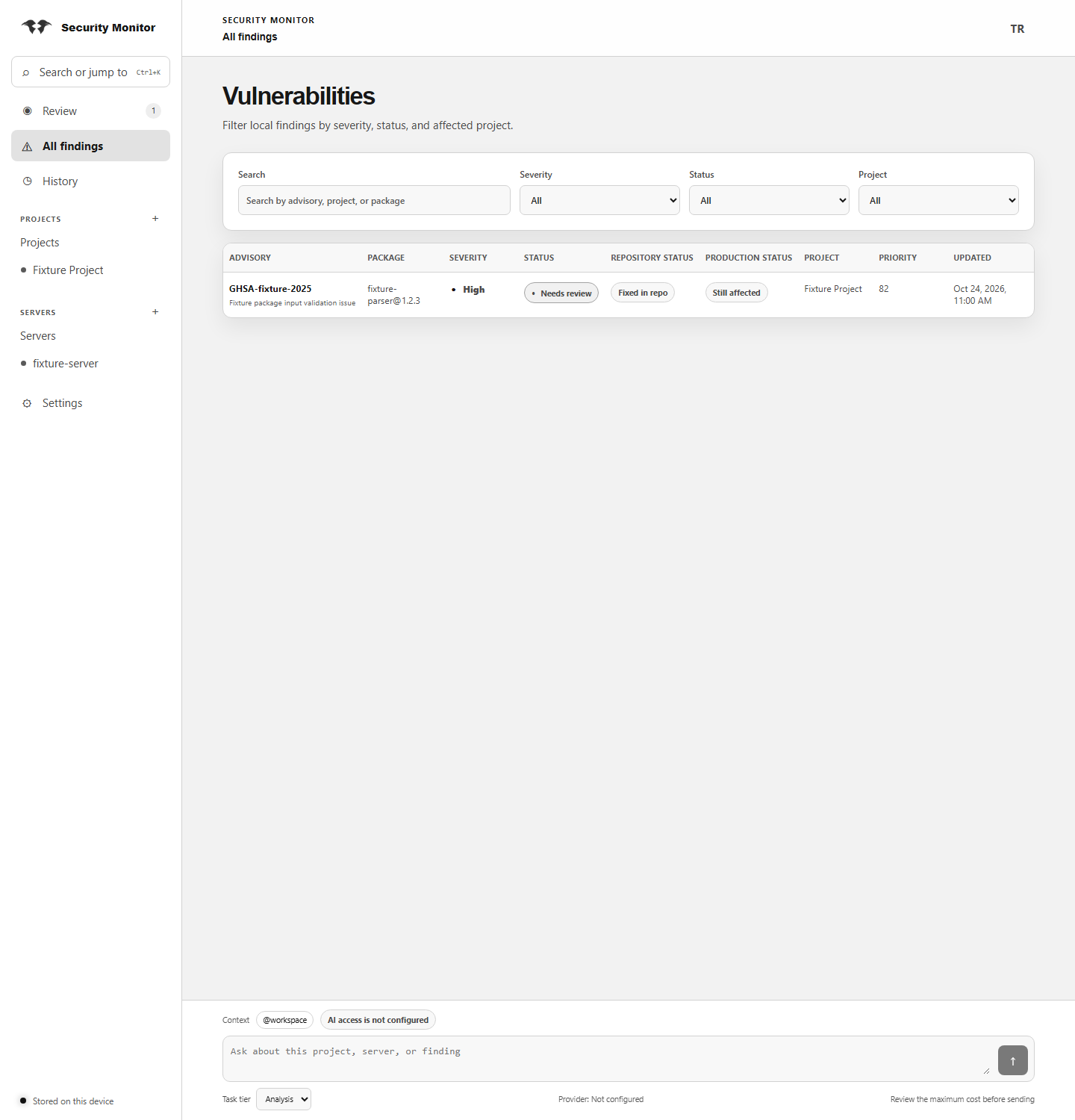 |
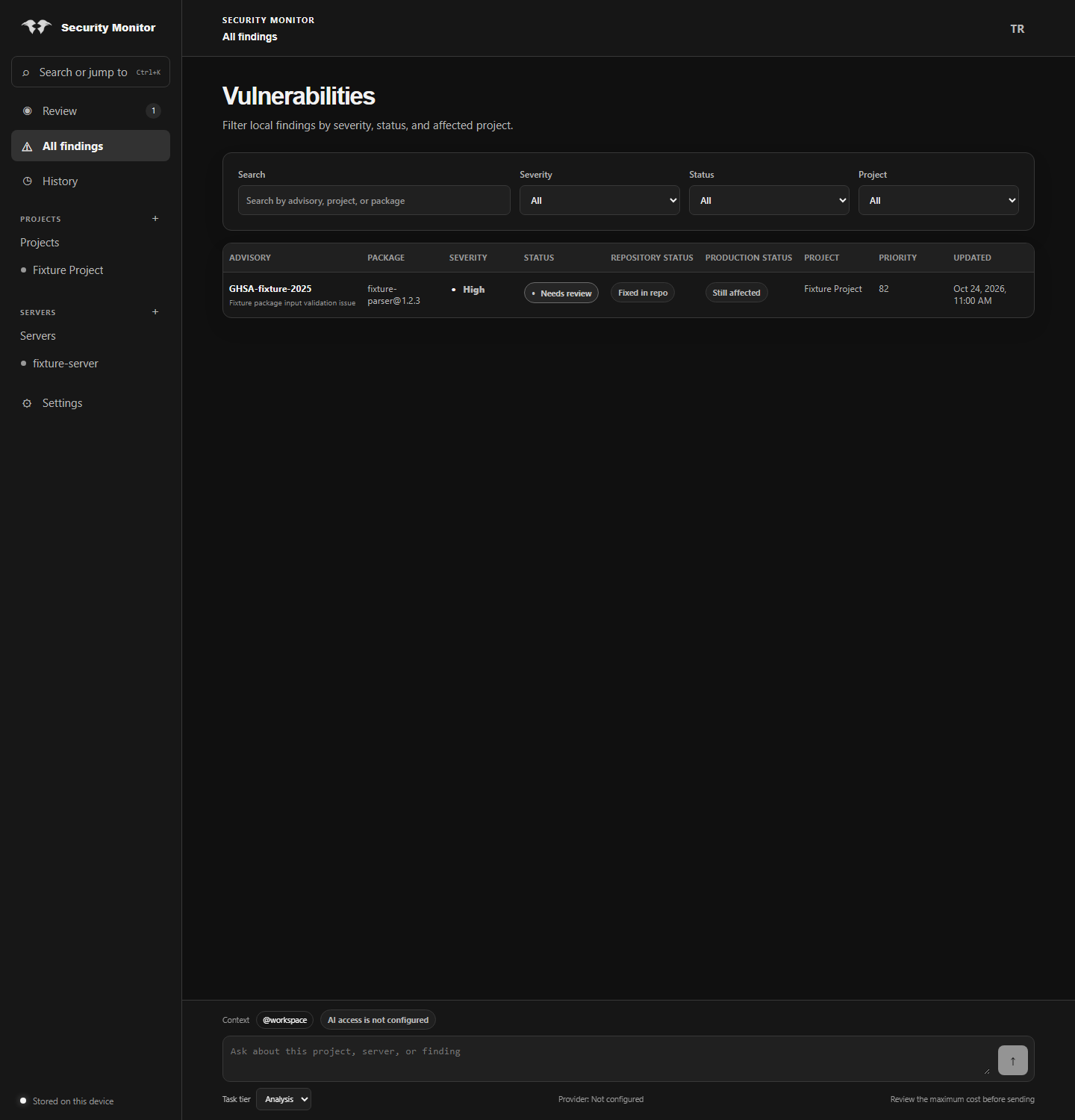 |
| Projects | 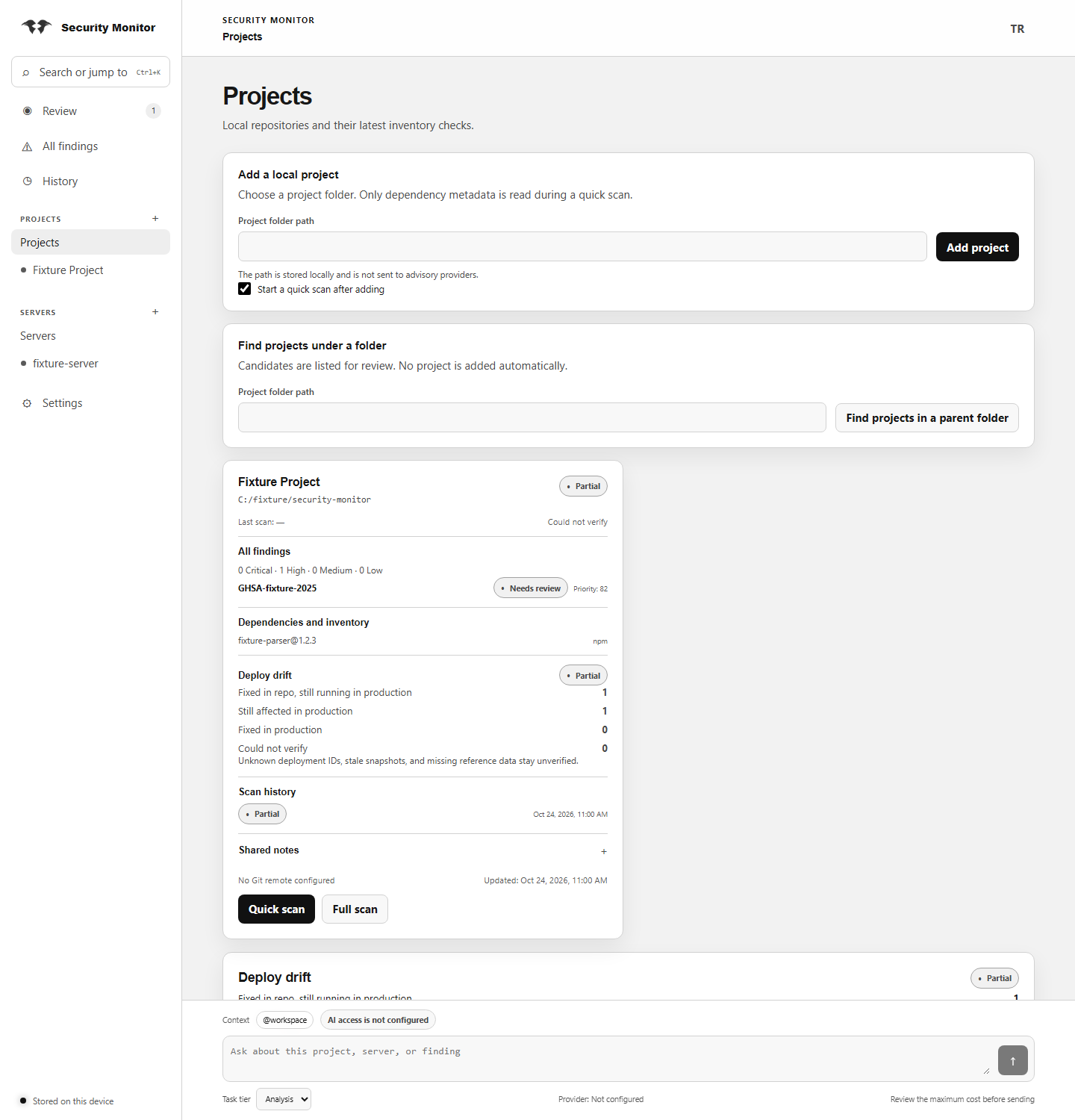 |
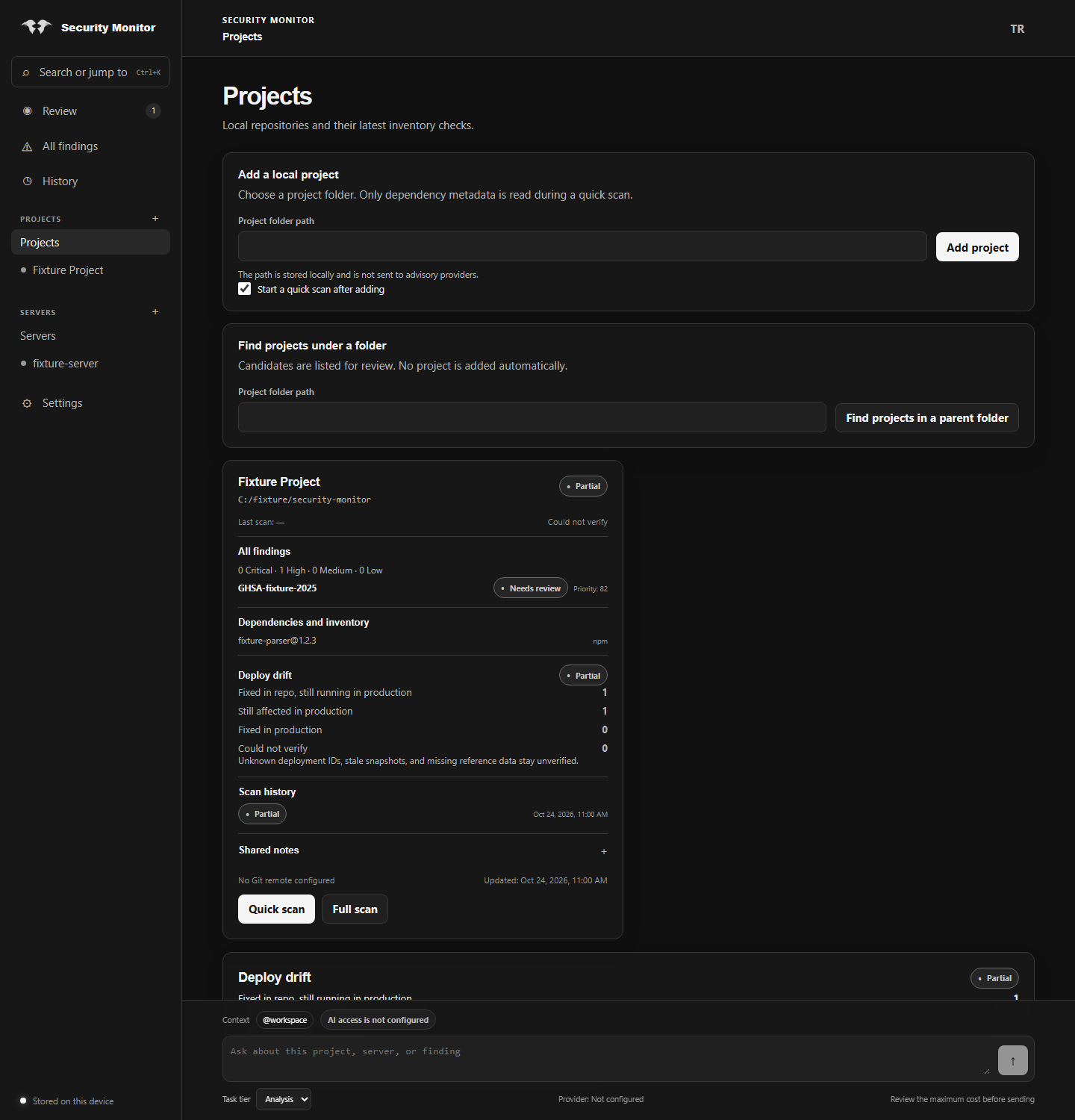 |
| Servers | 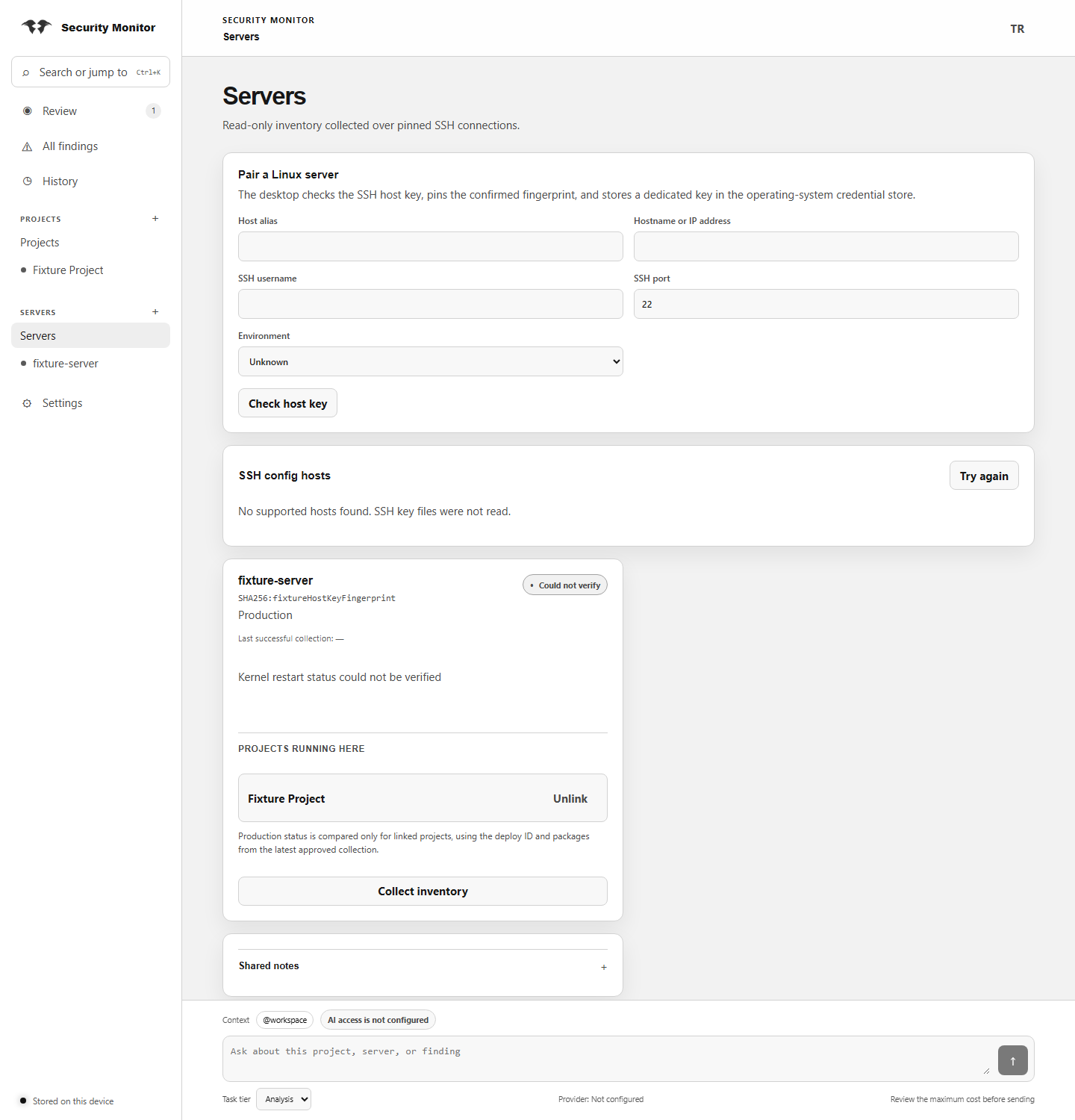 |
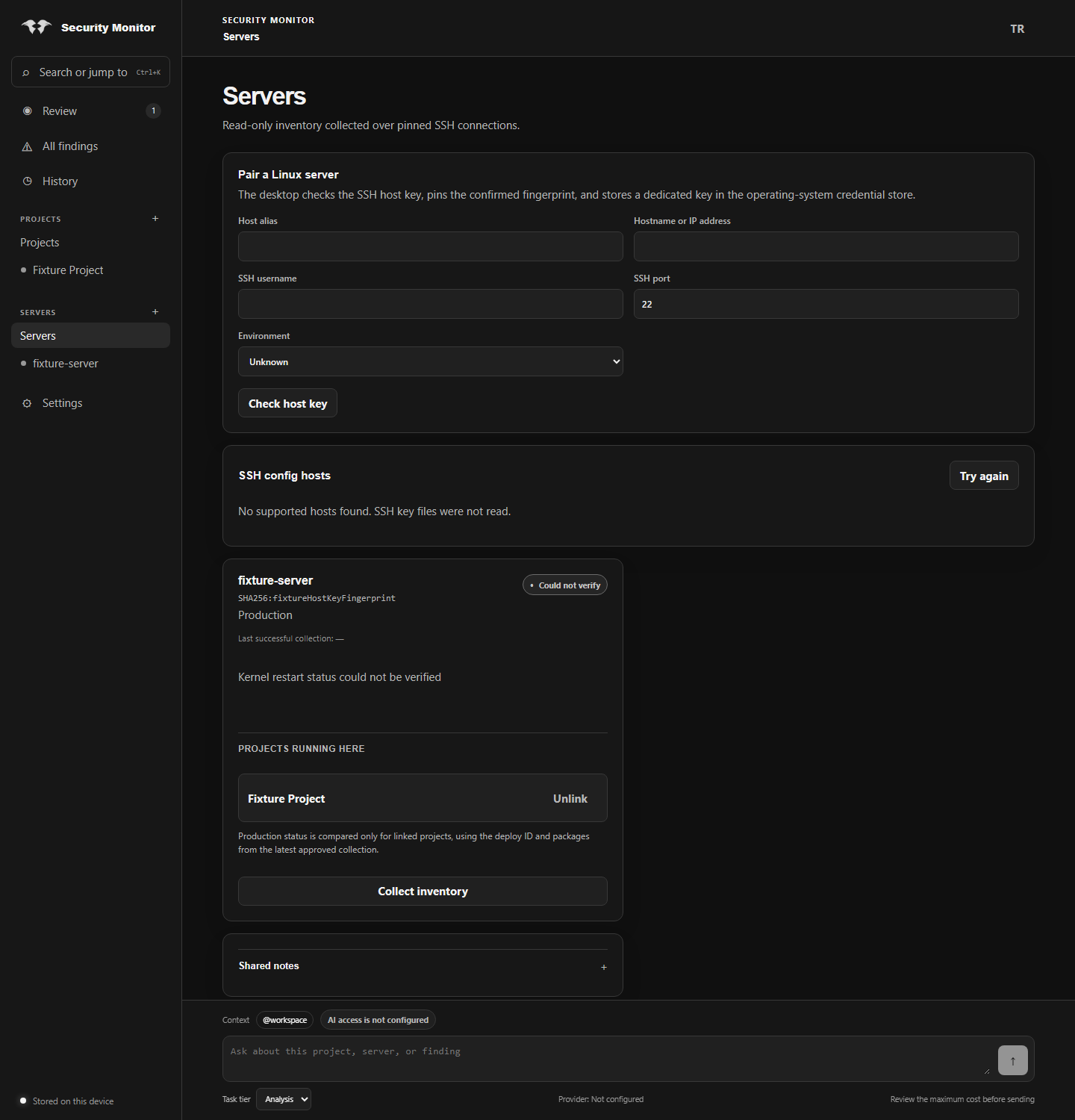 |
| History | 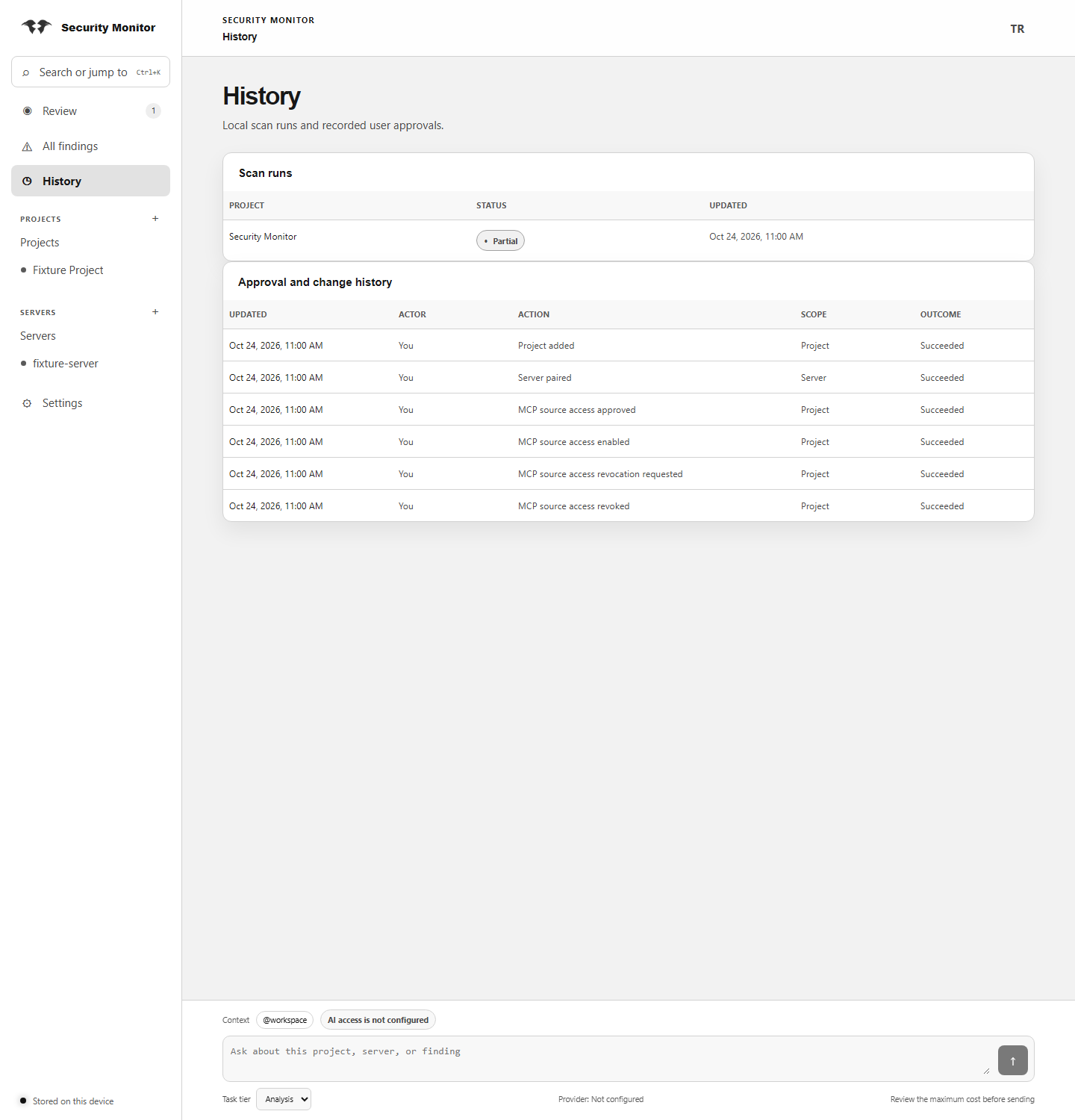 |
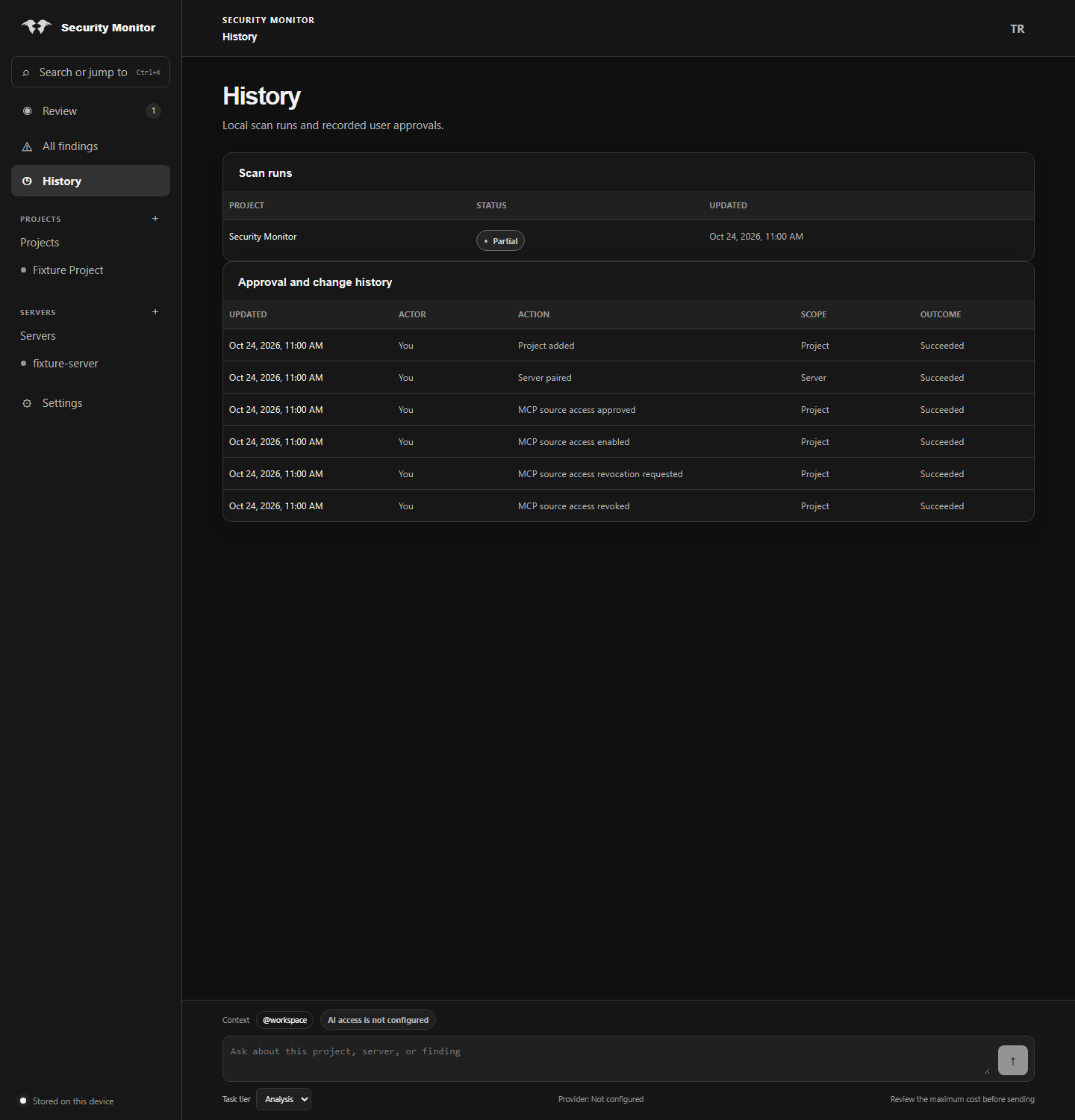 |
| Settings | 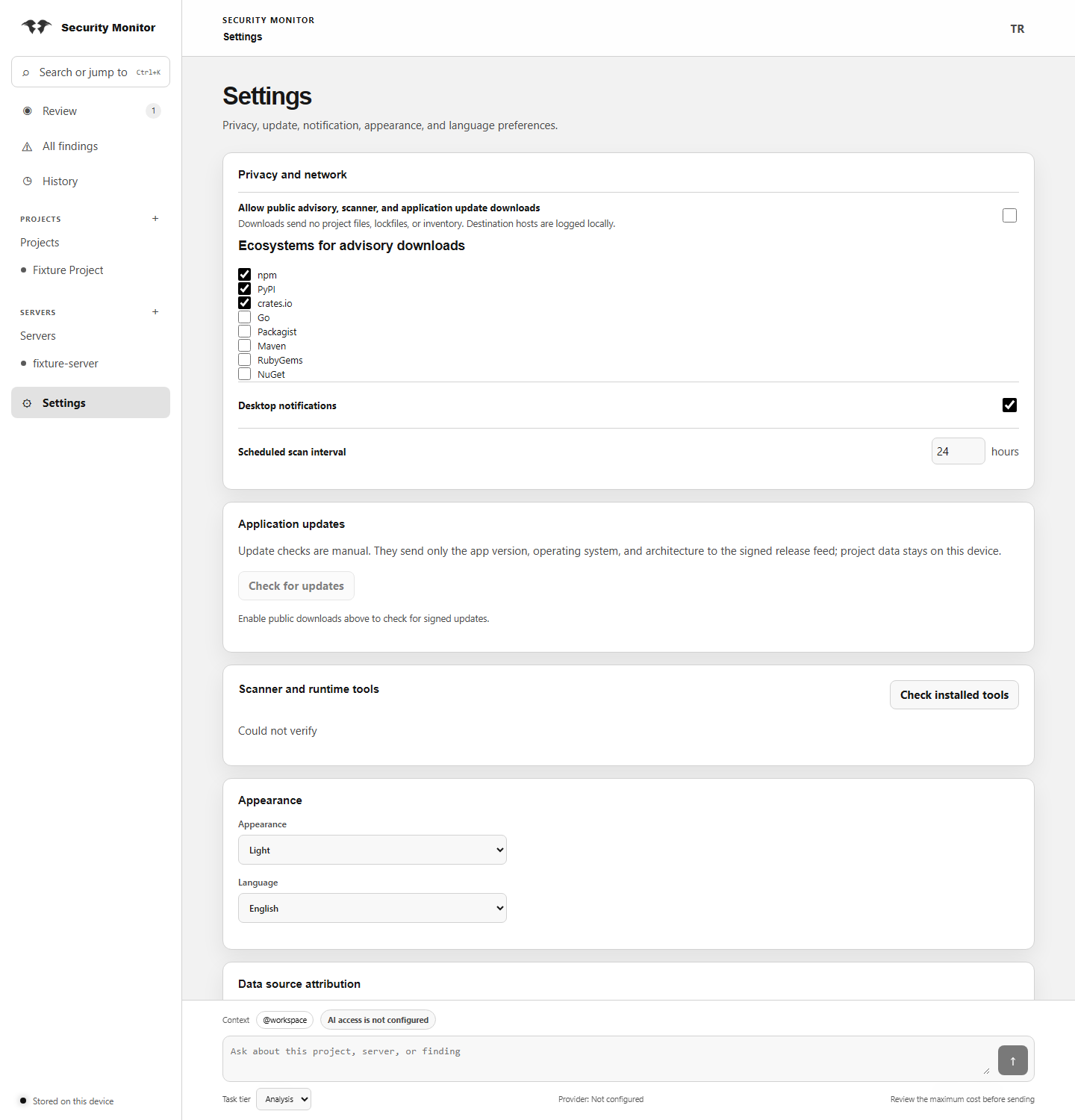 |
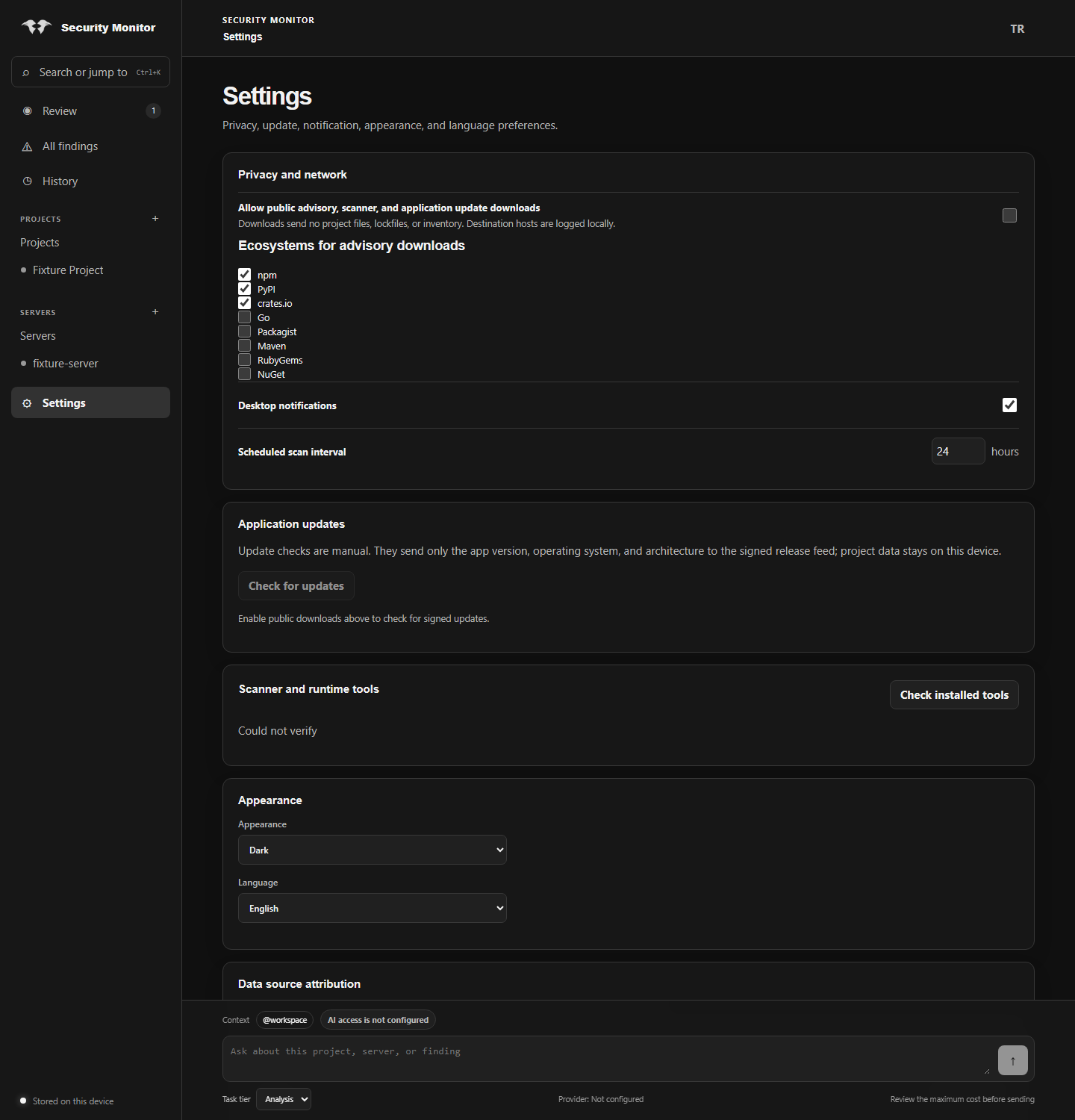 |
Screenshots come from the deterministic test fixture, not a real scan or server.
Documentation
Full documentation: umitaltinozzz.github.io/security-monitor
- Using it: CLI · Linux agent installation · Coding-agent integrations · AI providers · Local MCP · Shared local memory
- How it works: Architecture · Scanner adapters · Finding correlation · Repository-to-production drift · Deploy ID · Scan orchestration and notifications
- Trust: Privacy · Threat model · Data sources · Signed releases and updates · Performance budgets
Contributing and security
Read CONTRIBUTING.md before making changes. Use the issue forms for bugs, feature requests, and false-positive reports, and Discussions for questions, setups, and ideas. Report vulnerabilities privately as described in SECURITY.md, not in a public issue.
License, data, and disclaimer
Source code is licensed under Apache-2.0. Vulnerability and advisory data keep their own source licenses; see Data sources. cve.now summaries are attributed to cve.now under CC BY 4.0. This product uses data from the NVD API but is not endorsed or certified by the NVD.
A missing finding is not proof that software or an environment is secure. Verify results against the original advisory and your own environment before making security decisions.
Reviews (0)
Sign in to leave a review.
Leave a reviewNo results found