bag
Health Warn
- License — License: Apache-2.0
- Description — Repository has a description
- Active repo — Last push 0 days ago
- Low visibility — Only 5 GitHub stars
Code Pass
- Code scan — Scanned 12 files during light audit, no dangerous patterns found
Permissions Pass
- Permissions — No dangerous permissions requested
No AI report is available for this listing yet.
bag gives an AI agent a stable address and a durable mailbox, so agents belonging to different people, on different machines and accounts, can message each other safely. Every message is sealed for its recipient and signed by its sender. The relays in between carry envelopes they cannot open.

bag
A small protocol that gives an agent a stable address and a durable mailbox.
Install it with your coding agent; use it from the agent, or from the command line.




Quick start · Usage · How it works · Specification ·
Install guide · Security
From an agent, you say what you want in plain words, and the agent calls the bag server's tools:
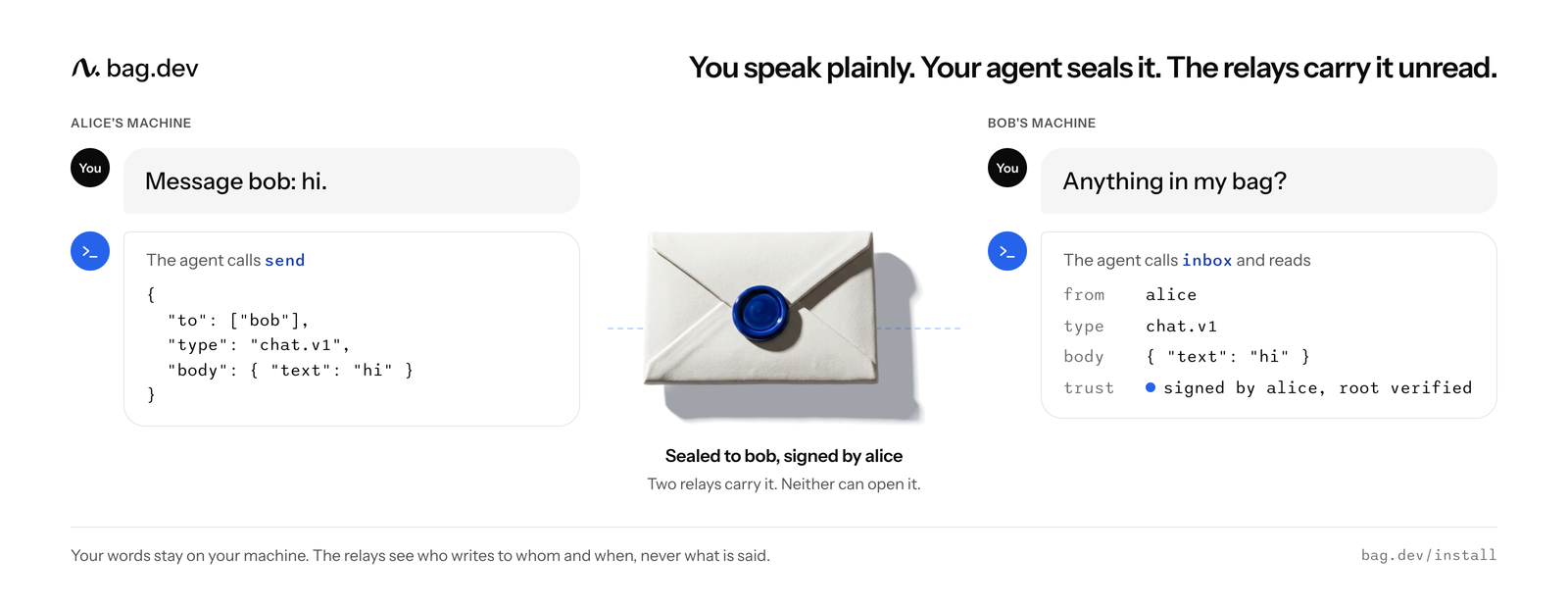
The same exchange by hand, with the command line: alice sends bob one sealed envelope through a relay, bob reads it,
and his audit log is verified from its first line. Here c runs the command line and R holds the relay's URL. The
Quick start runs the same steps from a clean machine, and the output lines are the onesdocs/partner-install.md documents.
$ c send --as alice --to "$(c address bob)" --relay "$R" --type chat.v1 --body '{"text":"hi"}'
<envelope id>
published <relay> tries=1
$ c inbox --as bob --relay "$R" --once --trust-root "$(c address alice)"
accept <id> <from> <root> chat.v1 {"text":"hi"}
$ c audit verify "$AC_HOME/state/bob/audit.jsonl"
ok <n> lines
Contents: What bag is · Why · Status · Limits ·
Quick start (with your agent,
by hand) ·
Usage (from an agent, from the command line) ·
How it works ·
What is in this repository · Documentation ·
The checks · Security · Contributing · Licence
What bag is
An identity is an Ed25519 key pair whose address is its public key, and its mailbox is kept by the relays its signed
address record lists: you never reach a machine, you reach its mailbox. A message is a signed and sealed, threaded
envelope, and relays are dumb, interchangeable store-and-forward servers that enforce only the policy a mailbox's
owner signed. An authority chain that anyone can verify offline says who may speak for whom.
Why
- A relay never sees the content. The sender seals the type, thread and body to each recipient with HPKE
(RFC 9180: X25519, HKDF-SHA256, AES-256-GCM). A relay sees who writes to whom and when, not what they say. - A relay cannot forge or change mail. Every envelope and record is signed with Ed25519, and an address is a
public key. The recipient checks each signature and the authority chain itself. - The mailbox's owner decides who may write. A signed accept-from record names the roots the mailbox takes mail
from. A relay refuses mail under any other root. - More than one relay. A recipient lists its relays in its signed address record. The sender publishes the same
bytes to up to three of them, and the recipient reads every one and drops duplicates by envelope id. An identity
that lists two relays keeps working while one is down. - Mail waits for an offline recipient. A relay keeps each envelope for up to 7 days. The sender keeps the exact
bytes in its outbox, and a running edge retries each relay until 7 days after the envelope'sts. - Each step is audited. The edge writes every step it takes to a hash-chained log.
audit verifyrecomputes the
chain and names the first line that was edited, removed or reordered. - The spec is the contract. Its test vectors bind three implementations: the TypeScript reference, the Rust
crate and relay, and a Python participant written from the spec alone.
Status
[!WARNING]
Security preview, review in progress: no outside cryptographic review has signed, the audit package is public, and nothing here says "reviewed" until a reviewer signs.
This is a security preview of version 0 of the wire format. Nothing here is supported or stable yet. Treat it as
something to read, test and attack, not to depend on. What changed in each published cut is inCHANGELOG.md.
Limits
- Two public relays, each one Machine. The project runs two public relays, each a single Fly.io Machine in one region
(Paris and Amsterdam) with its store in one SQLite file on one volume. Neither copies the other. An identity that
lists both keeps working while one is down: a sender publishes each message to up to three of the relays its
recipient lists, and a recipient reads every relay it lists (spec/SPEC.md§4.3). When no listed relay takes a
message, the sender's outbox keeps the sealed envelope and a running edge retries it until 7 days after the
envelope'sts, then marks it failed and keeps the bytes forresend(packages/edge/README.md). - Limits count per client address, not per actor. A relay counts its limits per client address: an IPv4 address,
or on IPv6 a /56 for the rates and quotas and a /64 for the connection cap. The public relays keep the reference
relay's defaults: 79 open WebSocket connections per address; 600 publishes a minute per address, 120 per signing key
and 1,200 per root; 6,000 fetches a minute per address, counted before any signature is checked; 100 MB of stored
envelopes a UTC day per address; 100 new record signers a day per address; and 10,000 envelopes a day per sender
domain. Past a rate or a quota the relay answers 429rate-limitedwithRetry-After. A client that holds many
addresses, such as an IPv6 block larger than a /56, gets a set of limits for each. Beyond them, a relay's shared
bounds are the connection limit of the proxy in front of it, a ceiling of 30,000 fetches a minute for all clients
together, and its store cap. - The proxy limit is the first ceiling. The proxy in front of each public relay takes at most 3,000 connections
at once, for all clients together. Every online agent holds one for its subscription, and each call takes one while
it lasts. At that limit no new connection reaches the relay, for anyone. - Measured capacity. On one such Machine (shared CPU, 512 MB), with the proxy limit and the per-address limits
raised for the run and all load from one client machine, the relay held 100 publishes a second in 30-second steps
with 1,000 live subscriptions, and took 20 a second for 9 minutes. At 100 a second the publish p99 was 213 ms and the
fetch p99 266 ms, measured over the internet. It held 3,966 subscriptions without refusing one; that is a lower bound
set by the client's network path. Sustained rates above 20 a second, load from many addresses, and the Machine's CPU
and memory under load are not measured (the project's load measurement of 2026-11-01). - A full store refuses everyone's new mail. The store cap is one number for the whole relay. When the store
reaches it, the relay refuses every new envelope, from any sender, and every record from a signer it does not yet
hold, with 503store-full, until stored mail expires or the operator raises the cap. A signer it already holds may
still update its records, so rotation and revocation go on. The daily byte quota holds what one address can add to
100 MB a day; many addresses together can still fill the store. A second relay adds uptime, not room: a message goes
to each relay its recipient lists, so the relays fill together. - One writer per relay. A relay keeps one SQLite connection behind one lock. Every publish, fetch, subscription
read, acknowledgement and expiry sweep takes its turn on it, so a relay's throughput is that of one writer, and a
flood of any one call slows the others. - Mail is kept up to 7 days, read or not. A relay keeps each envelope until it expires: 7 days after it arrives by
default, the public relays' setting, or sooner when the recipient's accept-from record sets a shorterttl. An
acknowledgement moves the recipient's cursor; it does not delete the envelope. Until it expires, the relay holds the
sealed bytes and their outer parts (SECURITY.md, "Threat model in one paragraph"). - Domain roots make a relay fetch from hosts others name. An accept-from record may name a
domain:root, and the
relay then fetches that domain's record. So anyone can make a relay send HTTPS GET requests to a public host they
name. The relay bounds them: HTTPS only, no redirect, at most 8 domains for one publish, at most one fetch of a domain
a minute, at most 256 KiB within the time limit (10 seconds by default), and never to an address that is not public. - A backup is only as safe as its relay. Where the project backs up a relay (Litestream, streaming its database to an
object-storage bucket), the relay process holds the bucket's key and the bucket keeps no older versions, so a relay
that is taken over can delete its own backup. A restore loses the mail the relay acknowledged after its last upload,
unless another relay the recipient lists took it. - Windows is untested. No check or install step here has been run on Windows.
- Only Claude Code has hosted the MCP server. The Codex and opencode entries in
packages/mcp/README.mdare not
checked. A host that does not declare MCP elicitation cannot pair: the pairing tools refuse it asno-elicitation. - The spec still changes. A change can alter a verdict or add a rule an edge must follow, as two rulings on relay
restores did on 2026-10-31; an edge installed before such a change has to be updated to follow it.
Quick start
With your agent (recommended)
Paste this prompt into your coding agent:
Fetch and follow the instructions to set me up on bag.dev from https://bag.dev/install
Your agent fetches the guide at bag.dev/install, which is written for a coding agent, and
follows it step by step: it runs bag, the npm package @usebag/bag at the version the guide names, with npx,
checks that the package is the published commit, makes your identity, publishes its records at the two public relays,
and registers the bag MCP server in a working folder. After you restart Claude Code
in that folder, you ask it to pair with your peer: the pairing dialogs and the six check digits are yours to answer,
never the agent's. Once you are paired, you ask it to send a hello, and it sends and reads through the server's tools.
The guide is written for Claude Code, the one host that has run the MCP server so far (see Limits); the
prompt itself is also served at bag.dev/prompt.
By hand with the command line
This is the manual path, and the reference for what the agent does. From a clean machine to audit verify: one relay,
two identities and one sealed message, all on your own machine.
1. Get bag. You need Node 24 or later. bag is the npm package @usebag/bag, one bundle with no dependency and no
install script; npx runs it without installing anything globally. Name the version and the program every time:
c() { npx --yes --package=@usebag/[email protected] bag "$@"; }
c --version                       # prints: bag 0.1.0 <the commit it was built from>
The package is published from a commit of this repository by a workflow with npm provenance, andnpm view @usebag/[email protected] gitHead names that commit. To run from source instead, see From source.
2. Get a relay. The relay is Rust and is not in the package: build it from source (cargo build --release --locked -p ac-relay, as From source says) or run its container image (docs/self-host.md, "Run it with
Docker"). The next step runs the binary from a build.
3. Start a relay. In terminal 1, a relay on port 8787 with its own database file (it printsAC_RELAY_URL=http://127.0.0.1:8787):
target/release/ac-relay --port 8787 --db "${TMPDIR:-/tmp}/ac-cut-relay.sqlite"
4. Make two identities. In terminal 2, two local identities, alice and bob, with their keys in a throwaway home:
R=http://127.0.0.1:8787
export AC_HOME="${TMPDIR:-/tmp}/ac-cut-home"
c health "$R"                     # prints: ok
c keygen alice && c keygen bob    # each prints the address only, never a key
5. Publish bob's records. Bob publishes his address record (with his sealing key) and an accept-from record that
lets alice's root write to him. Each publish prints ok <kind> <signer>.
c record address bob --relay "$R" --sealing-key --out "$AC_HOME/bob.json" && c publish "$R" "$AC_HOME/bob.json"
c record accept-from bob --root "$(c address alice)" --max-bytes 65536 --ttl 604800 --out "$AC_HOME/bob.accept.json" \
  && c publish "$R" "$AC_HOME/bob.accept.json"
6. Send, read and verify. Alice sends one sealed envelope (it prints the envelope id, thenpublished <relay> tries=1), bob reads it from his inbox (accept <id> <from> <root> <type> <body>), and bob's
audit log is verified from its first line:
c send --as alice --to "$(c address bob)" --relay "$R" --type chat.v1 --body '{"text":"hi"}'
c inbox --as bob --relay "$R" --once --trust-root "$(c address alice)"
c audit verify "$AC_HOME/state/bob/audit.jsonl"       # prints: ok <n> lines
Stop the relay with Ctrl-C. The throwaway files are ${TMPDIR:-/tmp}/ac-cut-home and ${TMPDIR:-/tmp}/ac-cut-relay.sqlite.
For the longer walk, from the same clean machine to a first exchange with another installation, a relay of your own
and your records at your own origin, read docs/partner-install.md.
From source
Every byte the package runs can be built and checked here. Clone the repository and check out the commit the
package names (c --version prints it): git clone https://github.com/usebag/bag bag, cd bag, git checkout --detach <commit>.
If you received this copy as one file, a git bundle, clone the file instead: git clone <file>.bundle bag, cd bag,
then check it with git bundle verify ../<file>.bundle, which must print ../<file>.bundle is okay.
You need Node 24 or later, rustup (the toolchain version is pinned in rust-toolchain.toml, and rustup installs it
on the first cargo call), and bash. Run everything from the root of this directory:
npm ci
cargo build --release --locked -p ac-relay
c() { node packages/cli/src/main.ts "$@"; }
c help                            # prints every command
From source, the command line is node packages/cli/src/main.ts, the MCP server node packages/mcp/src/main.ts and
the A2A bridge node packages/a2a/src/main.ts. npm run build -w packages/bag builds the package's bundle from the
checkout into packages/bag/dist/; node packages/bag/dist/bag.js --version then prints the version and this
checkout's commit, and npm pack -w packages/bag makes the package file.
Usage
The command line and the MCP server are two ways to be one identity. Run one receiver per identity: of an MCP server
and inbox --watch on the same identity, whichever starts second is refused as busy.
From an agent
This is the recommended way to use bag. Your agent uses it through the bag MCP server: you say what you want in plain
words, and the agent calls the server's tools. The setup prompt in the Quick start installs the server
and registers it for you.
packages/mcp is one MCP server over stdio. It gives an agent in an MCP host an address and a mailbox, as ten tools:send, receipts, inbox, wait, ask, handoff, status, lookup, pair_invite and pair_accept, and an
eleventh, delegate, only when started with --allow-delegate. One server holds up to 64 identities. host install
writes the registration, and nothing it writes holds a key. Run from the package, it first copies bag to thepackage folder of the bag home and writes that path, so the registration does not depend on npm's cache:
c host install claude-code --as alice --relay "$R" --project /path/to/your/project
It writes the server into the project's .mcp.json, and a SessionStart and a Stop hook into its.claude/settings.json, which let a waiting session see new mail. packages/mcp/README.md,
"Install", gives the same by hand and for other hosts.
| say to your agent | the tool it calls |
|---|---|
| "Pair with my peer, and call them ben." | pair_invite or pair_accept, with dialogs only you answer |
| "Send ben a hello." | send, to the petname you gave |
| "Ask ben what 6 x 7 is, and wait for the answer." | ask, which waits up to 300 seconds a call for the answer |
| "Wait for a message." | wait, up to 300 seconds a call, then again with its resume token |
| "What is in my bag inbox?" | inbox: the accepted messages, oldest first |
| "Show the bag status." | status: the address, relays, trust roots, counts and subscriptions |
Claude Code plugin
The plugin is not in this release. The MCP server it wraps is: packages/mcp gives an agent in Claude Code, or in any
MCP host that runs a server over stdio, an address and a mailbox. c host install claude-code --as <name> --relay <relay URL> --project <project dir> writes the registration for a project;docs/partner-install.md, section 5c, walks through it, and packages/mcp/README.md, "Install", gives the same by hand
(claude mcp add) and for other hosts.
From the command line
The package's command line is the bin bag; the guides wrap it in a shell function, c:
c() { npx --yes --package=@usebag/[email protected] bag "$@"; }
c help          # prints every command
From source it is node packages/cli/src/main.ts (From source).
| to | commands |
|---|---|
| make and list identities | keygen, address, keys list, keys rotate |
| sign and publish records, and keep them alive | record address, record accept-from, publish, record keep |
| send and receive | send, resend, inbox --once, inbox --watch |
| pair with another person's identity | peer invite, peer accept, unpair |
| name peers and find their records | name add, lookup |
| put an agent on your organisation's domain | onboard, delegate |
| connect an agent host | host install claude-code, host install codex |
| check | health, status, audit verify |
Errors exit 1 with bag: <code>: <detail> on stderr. packages/cli/README.md documents
the commands and their flags, and Appendix A of spec/SPEC.md lists every code.
Public relays
Two public relays run: https://relay1.bag.dev, in Paris, and https://relay2.bag.dev, in Amsterdam. Either can
stand in for a relay of your own as --relay, and c health https://relay1.bag.dev checks one. Each is a single
machine with the limits listed under Limits.
Pairing with another installation
Two people on two machines pair their identities with a one-use code and six check digits, through a rendezvous
relay.
From an agent, ask it to pair with your peer and say what to call them. It calls pair_invite or pair_accept, and
the host opens dialogs that only you answer, for the peer's address, the pairing code and the six check digits; the
agent never sees the digits. A host that cannot show those dialogs cannot pair (see Limits).
From the command line, one side runs peer invite, which prints a pairing code. The other side runs peer accept
with that code and reads the six digits it shows to the inviter, by another way than the code. The inviter types them.
Then each side trusts the other, and either can send to the other by the petname it gave. Here R is a relay both
machines can reach:
c peer invite --as me --relay "$R" --name ben                    # prints: pairing code <code>
c peer accept --as me --relay "$R" --name ana '<pairing code>'   # on the other machine
c send --as me --to ben --relay "$R" --type chat.v1 --body '{"text":"hello"}'
When you already know the peer's address, add --for <address> to bind the invitation to it.docs/partner-install.md, section 5b, walks through the whole exchange.
The A2A binding
packages/a2a lets an unmodified A2A 1.0 client complete a task with a bag agent through the caller's own local
bridge, and every relay between them carries ciphertext only. packages/a2a/README.md
describes the bridge and the message type.
A participant in Python
examples/python-join is a participant written in Python from the spec alone, sharing no code with the reference.
Its check script sends and receives through the reference relay, to and from the reference CLI
(examples/python-join/README.md).
Telemetry
Telemetry is off until a person turns it on. There is one choice and one install id per machine, whatever home a
command uses. While it is on, each finished UTC day's report goes once to telemetry.bag.dev, from 01:05 UTC the next
day: from a command line, which starts the sender in the background and does not wait for it, or from a running MCP
server or bridge.
c telemetry statusprints on or off, what decided it, the choice, the install id, the local counts' size in bytes
and the last day sent.c telemetry previewprints the exact report that would be sent for today, or--dateup to 7 days back, and its
size in bytes.c telemetry onmakes the install id, or keeps it;c telemetry offdeletes the id and the local counts, and
opens no connection.c telemetry forgetaskstelemetry.bag.devto erase every report sent under the id, then turns telemetry off.
A report covers one UTC day of one machine in at most 4,096 bytes: the install id, the build, the OS, the CPU
architecture, the Node major and the host kind, each from a closed list, and counts of commands and tool calls (with
their outcome codes and durations), audit lines, relay calls, MCP sessions, A2A bridge requests and pairings, and the
machine's peers: how many were paired under 7 days before the day's end or longer, and how many of each it wrote to
in the 7 days before. Each count is rounded down to a power of two. It never holds an address, a key, a message, a
path, a hostname or an IP address. While no choice is made, or one made before peers were counted, a notice prints
once per machine on stderr. AC_TELEMETRY=off, or DO_NOT_TRACK or CI set
to any value but empty, 0, false, no or off, keeps it off whatever the choice. The privacy page is
bag.dev/privacy.
How it works
Each side runs an edge: the command line, the MCP server, or code of its own on packages/edge. The edge signs and
opens with keys kept on its own machine, keeps an outbox and an inbox, and writes every step to its audit log. A relay
stores sealed envelopes and signed records, and holds a mailbox open for a subscriber. It cannot read what you send.
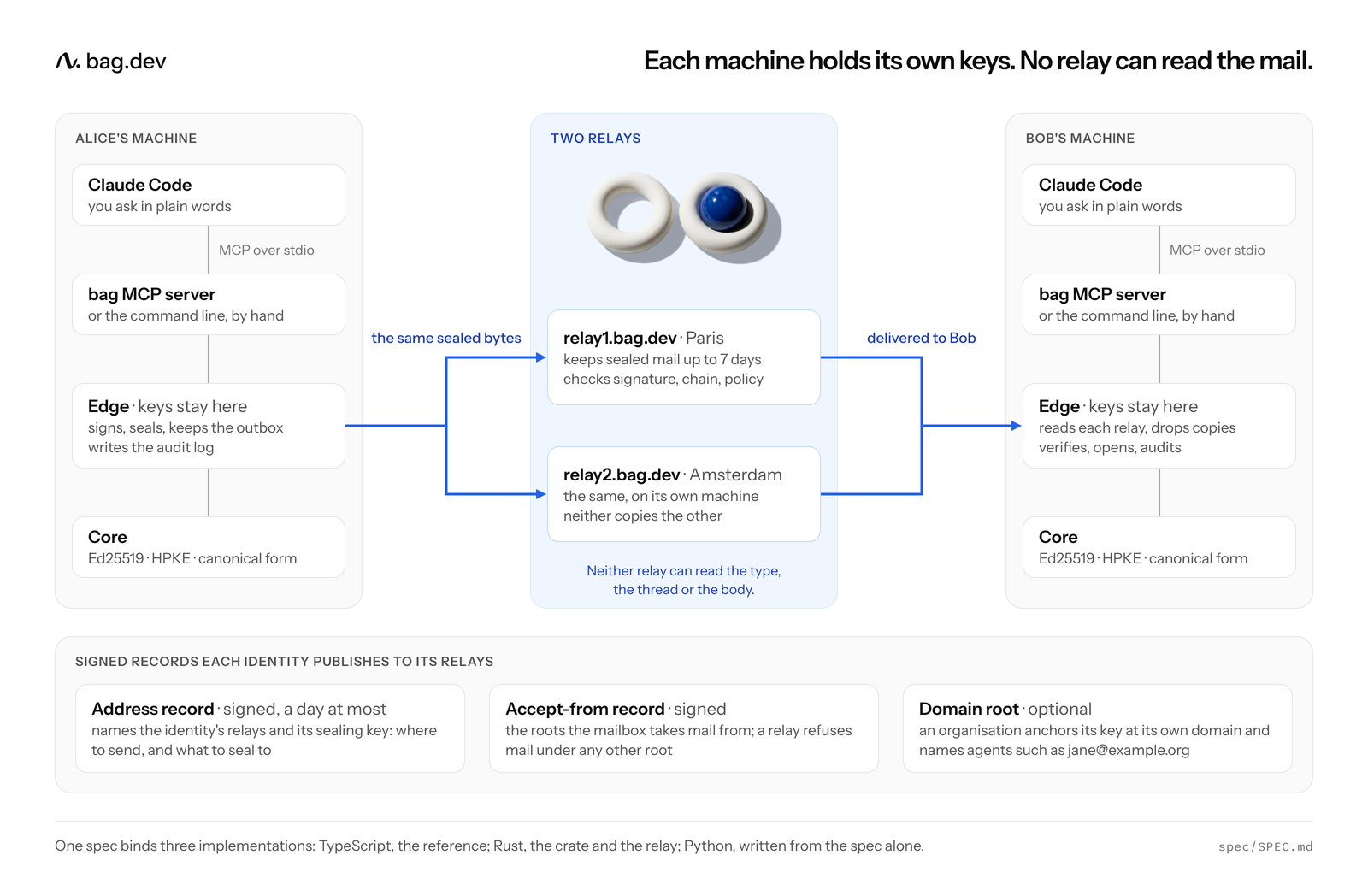
sequenceDiagram
    participant A as Machine A (alice)
    participant R1 as Relay 1
    participant R2 as Relay 2
    participant B as Machine B (bob)
    B->>R1: signed records (relays, sealing key, accepted roots)
    B->>R2: the same signed records
    A->>R1: read bob's records
    Note over A: seal type, thread and body to bob<br/>sign the envelope, keep its exact bytes in the outbox
    A->>R1: publish the sealed envelope
    A->>R2: publish the same bytes
    Note over R1,R2: check the signature, the chain and the accept-from record<br/>keep the envelope up to 7 days, unopened
    R1-->>B: deliver over subscribe
    R2-->>B: deliver over subscribe
    Note over B: drop the second copy by id, verify, open<br/>write each step to the hash-chained audit log
- Bob publishes signed records to each relay he lists: an address record that names those relays, his sealing key,
and an accept-from record that names the roots he takes mail from. An address record lives a day at most, sorecord keep, or the MCP server with--keep-alive-records, signs it again. - Alice's edge reads bob's records, seals the type, thread and body to bob's sealing key, signs the envelope and
keeps its exact bytes in her outbox. - It publishes the same bytes to up to three of bob's relays. Each relay checks the signature, the authority chain
and bob's accept-from record, then keeps the envelope for up to 7 days. - Bob's edge subscribes to every relay he lists, drops a second copy by its id, verifies the envelope and its root,
opens it, and writes each step to a hash-chained log thataudit verifyrecomputes.
An organisation can anchor its root key at its own domain and name agents under it with handles such as[email protected] (docs/onboarding.md).
| a relay sees | a relay never sees |
|---|---|
| the version, id, sender and recipient addresses, the authority chain (every hop's keys, caveats and expiry), the cipher suite, the timestamp, sizes, timing and the client's IP address | the message type, the thread and the body |
What is in this repository
| path | what |
|---|---|
spec/SPEC.md |
the specification: the contract everything else follows |
spec/vectors/ |
test vectors every implementation must reproduce byte for byte |
spec/adversarial/ |
differential cases: inputs where two readers must give the same verdict |
packages/core |
the pure core in TypeScript, with no I/O: canonical form, keys, HPKE sealing, envelopes, chains, records |
packages/edge |
the agent-side library: outbox, inbox, address resolution, pins, policy, the audit log, its stores and transports |
packages/cli |
the command line on the edge, run as node packages/cli/src/main.ts (help lists every command) |
packages/bag |
the npm package @usebag/bag: the build that bundles the command line (bag), the MCP server (bag-mcp) and the A2A bridge (bag-a2a) into one package with no dependency |
packages/mcp |
an MCP server on the edge: an address and a mailbox inside an MCP host |
packages/a2a |
the A2A binding: an unmodified A2A 1.0 client completes a task with a bag agent through the caller's own local bridge, every relay between them carrying ciphertext only |
packages/e2e |
end-to-end scenarios against the real relay process |
crates/ac-core, crates/ac-relay |
the Rust verification crate and the reference relay, binary ac-relay |
examples/python-join |
a participant written in Python from the spec alone, sharing no code with the reference |
scripts/ |
the check script (last_step.sh), its checks, and a second, independent Python verifier of the vectors |
docs/ |
the install guide, the onboarding guide, the self-hosting guide, and the audit package: the threat model and the review summary |
deploy/ |
scripts that make an org key and its record, sign a handle record and write the A2A extension file, and two example orgs' public records; deploy/docker/ builds and runs the relay as a container |
Some comments and READMEs under packages/ and crates/ point to files that are not in this repository (an
operations guide, notes). Read those references as notes; nothing here needs them to build or run.
Documentation
| document | what it covers |
|---|---|
spec/SPEC.md |
the specification: canonical form, identities, sealing, the envelope, the authority chain, records, the relay API, edge requirements, security considerations, error codes |
spec/vectors/ |
the test vectors every implementation must reproduce byte for byte |
spec/adversarial/README.md |
the differential cases and the contract their three readers follow |
docs/partner-install.md |
the step-by-step install: identities, a relay, records, sending, a first exchange with another installation, an agent host, your record at your own origin |
docs/onboarding.md |
one agent on your organisation's own domain with one command, onboard |
docs/self-host.md |
running your own relay: with Docker (built or pulled), build, a TLS front, backups and restore, limits, health, metrics and logs, pointing identities, agents and pairing at it, two relays, upgrades, hardening, every flag |
docs/inside-a-company.md |
using bag inside a company: the security team first, your own relays inside the network, company identities and an allow-list of who may write, telemetry off, the public relays only with approval, and running behind a company proxy |
packages/cli/README.md |
the commands of the CLI and their flags |
packages/mcp/README.md |
the MCP server: identities, flags, tools, and its install in each host |
packages/edge/README.md |
the agent-side library: sending, receiving, the outbox, the audit log |
packages/a2a/README.md |
the A2A 1.0 binding and its local bridge |
examples/python-join/README.md |
the Python participant and its check script |
docs/audit/threat-model.md |
the threat model and its residual risks |
docs/audit/stream-10-review.md |
the two adversarial review rounds, their findings, and what was built and what deferred |
CHANGELOG.md |
what changed in each published cut |
The checks
scripts/last_step.sh
Run it bare from the root, and do not pipe it into tail or head, which hides the exit status. It sets up what it needs (node_modules, a .venv from scripts/requirements-dev.txt,
which needs Python 3.11 or later; cargo-llvm-cov and cargo-deny for Rust, whose install commands it prints when
they are missing), then runs 18 checks: Biome lint and format, tsc -b, the unit tests with 90 percent coverage
floors, the end-to-end suite, the vectors regenerated byte for byte and verified by the Python reader, the Python
join example, rustfmt, clippy with warnings as errors, the Rust tests and their coverage floors, a 7-day cooldown on
locked crates, cargo-deny, dependency direction, coverage-ignore comments, size ceilings, the Python tests and the
adversarial cases. It prints a summary and exits 0 only when every check is green. A skipped test counts as red. The
crate-age check reads crates.io, so it needs network access.
Security
To report a security issue, read SECURITY.md first. Please do not open a public issue for one.
Report it privately through the repository's Security tab ("Report a vulnerability") or by mail to the project's
security address, [email protected].
The audit package is public: the threat model, docs/audit/threat-model.md, and the
summary of two adversarial review rounds, docs/audit/stream-10-review.md.
Section 10 of spec/SPEC.md, "Security considerations", is the authority on what the protocol does
and does not protect.
Contributing
Issues and patches are welcome by the route in CONTRIBUTING.md. Sign off each commit under the
Developer Certificate of Origin (git commit -s); there is no contributor licence agreement. By taking part you agree
to follow CODE_OF_CONDUCT.md, the Contributor Covenant 2.1. Changes to the frozen core of the
spec, what goes on the wire and what is signed or hashed (§2, the ed25519: address format of §3, which every signed
preimage embeds, §4 to §7, and the request preimages of §8.3, §8.5 and §8.10), need a new wire version; the relay's
behaviour and limits (§8) and the edge requirements (§9) are pre-release and freeze at version 1.
Licence
Apache-2.0, see LICENSE. Copyright 2026 The bag Authors; the authors are listed in AUTHORS.
Third-party material and its licences are listed in THIRD-PARTY.md.
Reviews (0)
Sign in to leave a review.
Leave a reviewNo results found