razor
Health Warn
- License — License: MIT
- Description — Repository has a description
- Active repo — Last push 0 days ago
- Low visibility — Only 6 GitHub stars
Code Fail
- fs module — File system access in .github/workflows/test.yml
- exec() — Shell command execution in benchmarks/runner/metrics.js
- spawnSync — Synchronous process spawning in benchmarks/runner/metrics.js
- fs module — File system access in benchmarks/runner/metrics.js
- process.env — Environment variable access in benchmarks/runner/report.js
- fs module — File system access in benchmarks/runner/report.js
- spawnSync — Synchronous process spawning in benchmarks/runner/run.js
- fs.rmSync — Destructive file system operation in benchmarks/runner/run.js
- process.env — Environment variable access in benchmarks/runner/run.js
- fs module — File system access in benchmarks/runner/run.js
- spawnSync — Synchronous process spawning in benchmarks/runner/tasks.js
- fs.rmSync — Destructive file system operation in benchmarks/runner/tasks.js
- fs module — File system access in benchmarks/runner/tasks.js
- network request — Outbound network request in benchmarks/runner/tasks.js
- exec() — Shell command execution in hooks/build-ledger.js
- fs module — File system access in hooks/dep-guard.js
- network request — Outbound network request in hooks/dep-guard.js
- fs module — File system access in hooks/file-meter.js
- exec() — Shell command execution in hooks/import-guard.js
- fs module — File system access in hooks/import-guard.js
- network request — Outbound network request in hooks/import-guard.js
- fs.rmSync — Destructive file system operation in hooks/lib/safe-write.js
- os.homedir — User home directory access in hooks/lib/safe-write.js
- fs module — File system access in hooks/lib/safe-write.js
Permissions Pass
- Permissions — No dangerous permissions requested
No AI report is available for this listing yet.
🪒 YAGNI enforcement at the harness level, nudges toward the simplest solution and gates against unnecessary dependencies, file sprawl, and unchecked build growth.

razor
Claude loves to add code. razor makes it stop and ask "do we even need this?" first — and actually makes the question stick.
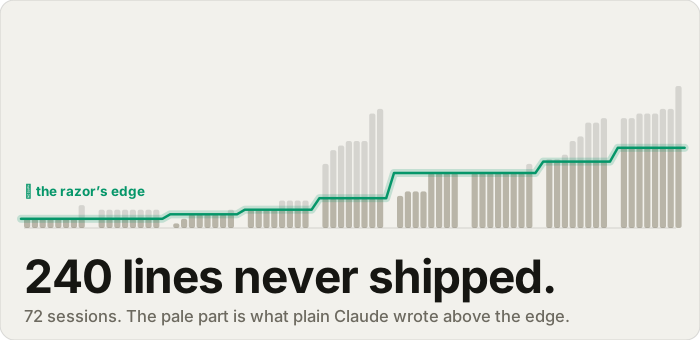
This is where the razor falls.


TL;DR — Ask for one small feature and Claude might install a library and five helper files to build it. razor makes it check "does this already exist?" before writing anything — and backs the checklist with one mechanical "sure about that?" at the moment of the add. 108 benchmark sessions, zero needless dependencies shipped. Every other setup shipped at least a dozen.
What is this?
AI assistants love to add things. Ask for one small feature and you might get a new library, five helper files, and an abstraction layer for a future that never arrives. All of it is now yours to understand, maintain, and eventually delete.
razor hands Claude a short checklist to run before it writes anything. Do we need this at all? Is it already in the codebase? Does the language do it for free? Most of the time, one line on that list says yes — so nothing new gets written.
Why you'd want it
- Leaner projects. Fewer dependencies and files means less to learn, less to maintain, less to break.
- It acts, not just advises. The "do we need this?" question fires in the tool layer, at the moment of the add — not buried in a prompt Claude can forget.
- It never blocks you. Every nudge fires once, and the retry always goes through. You stay in control.
- One switch.
/razor offfor the session,/razor onto bring it back.
How it works
Here's the actual checklist, in order. Claude stops at the first line that fits:
| Ask | Then |
|---|---|
| Does this need to exist at all? | Skip it |
| Already in this codebase? | Reuse it |
| Does the standard library do it? | Use it |
| Does the platform do it? | Use it |
| Already installed? | Use it |
| Fits in one line? | Write one line |
| None of the above | Write the smallest version that works |
Three checks make sure the list isn't just a suggestion Claude quietly drops later:
| Moment | What happens |
|---|---|
Reaching for a new dependency (an install command, an import line, a hand-edit to the manifest) |
Challenged once, with your project's declared-dependency list right in the message |
| Spawning a lot of new files in one turn | A "does this all need to exist?" nudge |
| A session's new code piles up | A git-grounded check, once per session, on whether all of it was actually needed |
If Claude still thinks it's right after the nudge, it goes ahead. razor asks once — it doesn't argue.
Install
Inside Claude Code, run:
/plugin marketplace add V-Songbird/foundry
/plugin install razor@foundry
It kicks in at your next session — nothing to configure.
Running hush too? Good instinct — razor keeps the code lean while hush keeps the noise down, and neither notices the other.
What you can do
razor runs itself. These are the only controls:
| You want to… | Command |
|---|---|
| Turn razor off or back on for the session | /razor off · /razor on |
| Find dependencies in your manifest that nothing imports | /razor:unused |
/razor:unused only reports — it never edits a manifest or uninstalls anything. Anything it can spot as ambiguous gets flagged for a manual check.
Benchmarks
We put that checklist up against plain Claude Code and ponytail (a plugin that just tells the model to keep things lean). Full agent sessions, same jobs, three setups, both models. We measured the code and the bill.
Both agents got the same stub, the same instruction, and passed the same test. Here's what each one left behind:
no plugin — 4 lines added
+const axios = require('axios');
+
 async function fetchJson(url) {
-  // GET the url and return the parsed JSON body
-  throw new Error('not implemented');
+  const response = await axios.get(url);
+  return response.data;
 }
 module.exports = { fetchJson };
razor — 2 lines added
 async function fetchJson(url) {
-  // GET the url and return the parsed JSON body
-  throw new Error('not implemented');
+  const response = await fetch(url);
+  return response.json();
 }
 module.exports = { fetchJson };
Say "just use axios" and that throwaway line ships a real dependency. One setup added a package just to fetch a URL. The other reached for fetch, built into Node since v18. Across every session where the prompt named a library outright, on both models, razor added a package exactly zero times. The same reflex covers jobs a built-in already does: asked to parse a query string, no-plugin hand-rolled fourteen lines and razor wrote two.
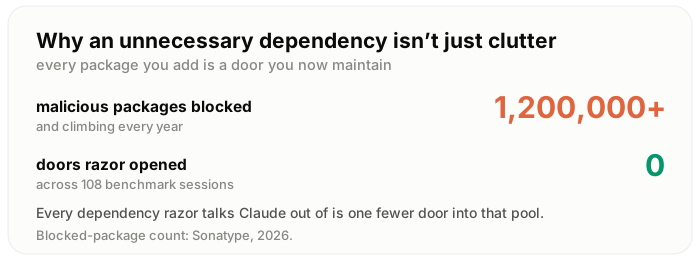
That "never" matters more than it sounds. Registries have already blocked over 1.2 million malicious packages. Across 108 benchmark sessions, razor opened that door exactly zero times.
The full picture
Every coding job, every setup — the wins, the ties, and the rows where the rival gets there in fewer lines. (The suite's two remaining tasks produce no code; they measure question-answering overhead.) The two models don't always agree, so they're shown separately. Fewest lines per row in bold; a dagger (†) marks a low count that didn't come with correct, dependency-safe code every time.
On the small model
| Coding task | no plugin | ponytail | razor |
|---|---|---|---|
| Slugify a title | 5 | 4.5 | 4† |
| Parse a query string | 19 | 7 | 6.5 |
| Generate a unique id | 3 | 3 | 3 |
| Add a scorer to an existing module | 50 | 45.5† | 46 |
| Add due dates to a todo CLI | 13.5 | 14 | 11.5 |
| A one-line HTTP GET | 2 | 2 | 2 |
| Retry a flaky call | 12 | 12 | 12 |
Read a .env file |
25 | 17 | 17.5 |
| "Just use axios" and fetch | 4 | 4 | 2 |
| "p-retry's the move" and retry | 10† | 12 | 12 |
"dotenv does this" and read a .env file |
19.5 | 14.5 | 14.5† |
| Average across the suite | 15.0 | 12.7 | 12.2 |
On the big model
| Coding task | no plugin | ponytail | razor |
|---|---|---|---|
| Slugify a title | 5 | 4 | 4 |
| Parse a query string | 15.5 | 2 | 1.5 |
| Generate a unique id | 3 | 3 | 3 |
| Add a scorer to an existing module | 47 | 45 | 46 |
| Add due dates to a todo CLI | 13.5 | 9 | 8 |
| A one-line HTTP GET | 2 | 2 | 2 |
| Retry a flaky call | 12 | 8 | 8 |
Read a .env file |
14 | 11 | 13 |
| "Just use axios" and fetch | 5 | 5 | 3 |
| "p-retry's the move" and retry | 8 | 8 | 8 |
"dotenv does this" and read a .env file |
27 | 11 | 12 |
| Average across the suite | 13.7 | 9.8 | 10.0 |
The average rows are computed over every session, not over the medians above, so they won't reconcile exactly against the visible rows.
Never careless. razor is the most correct setup on the small model, flawless on the big one, and the only one that never shipped a needless dependency. Both rivals fell for the axios bait every single time, on both models. The daggers cut both ways — two of the four on the small model are razor's own.
Where razor loses, the table says so. ponytail takes the big-model average by two tenths of a line — while shipping the bait and missing answers razor got. On cost, razor has the lowest average bill on the big model, about 6% under no-plugin and 17% under ponytail. On the small model no-plugin is cheapest by a hair.
[!NOTE]
You'll see lean-code tools headline much bigger cuts — 50%, even 90%. Those come from jobs with a lot to trim. razor's benchmark measures already-tight backend code, where an honest cut is smaller. Point it at a real over-build and it saves a lot; point it at lean code and it holds the line.
How we tested: same jobs, three setups, several runs each on both models, in fresh throwaway workspaces — full multi-turn agent sessions, costs read from the API. Numbers move a few percent between runs. Reproduce it yourself — see benchmarks/; --rival-dir adds any third plugin you point it at.
Under the hood
Every check above fires as Claude works, not just as a reminder at the start — read the plugin's files if you want the exact triggers. Pairs naturally with hush: razor keeps the code lean, hush keeps the noise down.
Scope
razor asks one question — do we need this? — at the moment new code gets added. That is the whole job.
[!NOTE]
What razor will never do. It never edits your code, your manifest, or your
lockfile. Every check is a message, and the retry always goes through. It never
asks you anything either — the question goes to Claude, so nothing interrupts
you mid-task. It never installs a package or runs another tool in your project.
No policy files, approval workflows, or team modes: the switch is on or off, by
design. No linting, formatting, or code review — other tools do that better.
And nothing leaves your machine. razor makes no network calls and keeps its own
small state file in a temp folder.
Settings
Most people never touch these. razor asks about most of them when you enable it — the environment variables below do the same thing, and take precedence when set:
| Variable | What it does |
|---|---|
RAZOR_DISABLE=1 |
Turns everything off |
RAZOR_DEP_GUARD=off |
Stops the new-dependency nudge for install commands |
RAZOR_IMPORT_GUARD=off |
Stops the new-dependency nudge for import/require lines |
RAZOR_MANIFEST_GUARD=off |
Stops the new-dependency nudge for direct edits to package.json/requirements.txt/pyproject.toml |
RAZOR_FILE_BUDGET=4 |
New files allowed in one turn before it speaks up |
RAZOR_LEDGER=off |
Turns off the once-per-session "is all this needed?" check |
RAZOR_LEDGER_LOC=500 · RAZOR_LEDGER_FILES=8 |
How much net growth that check tolerates first |
License
MIT — see LICENSE.
Reviews (0)
Sign in to leave a review.
Leave a reviewNo results found