llm-wiki-compiler
Health Warn
- No license — Repository has no license file
- Description — Repository has a description
- Active repo — Last push 0 days ago
- Community trust — 15 GitHub stars
Code Pass
- Code scan — Scanned 12 files during light audit, no dangerous patterns found
Permissions Pass
- Permissions — No dangerous permissions requested
This tool compiles documents, PDFs, and URLs into a structured, interlinked Obsidian wiki using an LLM. It can run as a standalone command-line tool or as a plugin for AI coding assistants.
Security Assessment
The light code audit found no dangerous patterns or hardcoded secrets, but the tool inherently makes external network requests. It requires an OpenRouter API key to function, meaning your input files and documents are sent over the internet to a third-party LLM for processing. It does not appear to request dangerous local permissions or execute hidden shell commands. Because it processes whatever files and URLs you provide, you should avoid feeding it highly sensitive or confidential data. Overall risk: Medium.
Quality Assessment
The project appears active and well-documented, with the last code push occurring today. The concept is based on Andrej Karpathy's established LLM Wiki pattern, and the repository has garnered 15 GitHub stars, indicating a small but growing level of community trust. However, it lacks a software license. The absence of a license means that technically, all rights are reserved by the author, which presents legal restrictions and uncertainties for commercial use or broader redistribution.
Verdict
Use with caution: the code itself appears safe and behaves cleanly, but users must be comfortable sending their document data to a third-party AI provider and using unlicensed software.
Compile documents into a living Obsidian wiki. Any AI agent. Based on Karpathy's LLM Wiki pattern.
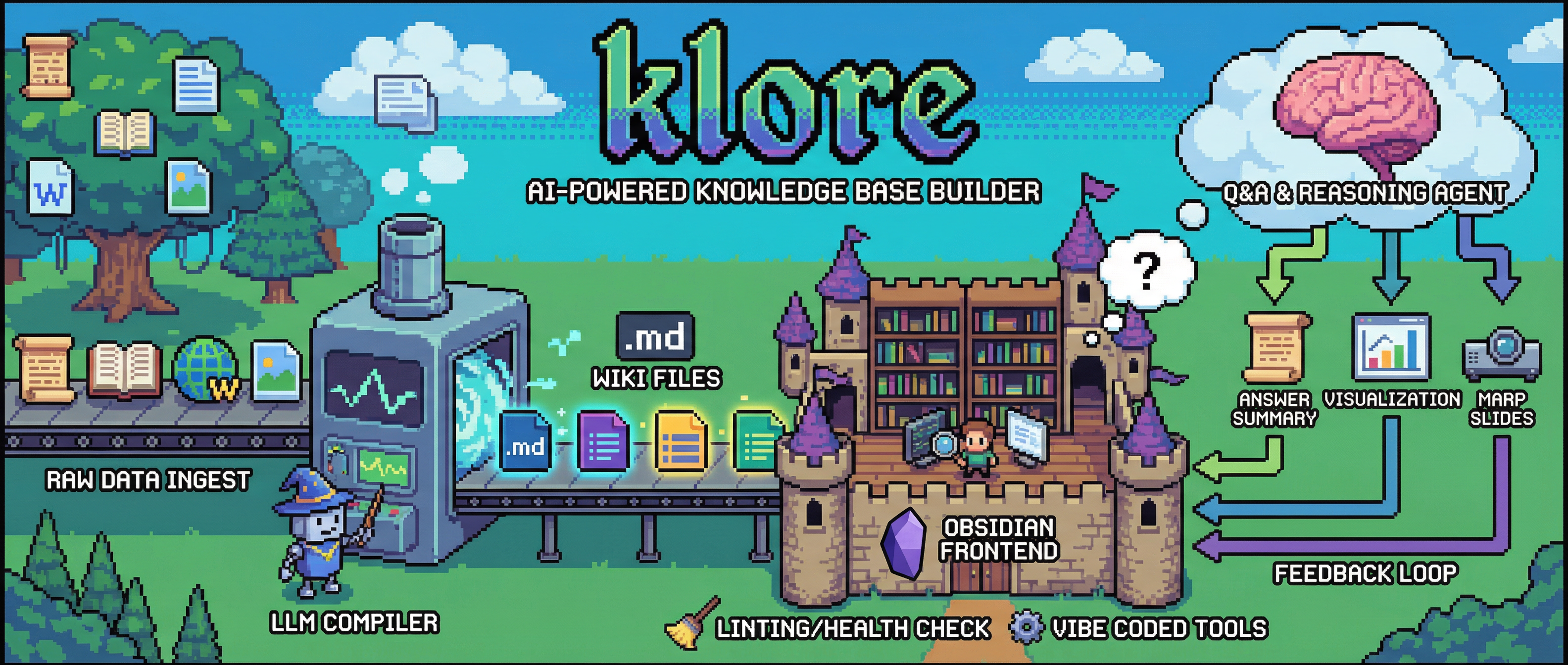
Klore — LLM Wiki Knowledge Compiler
An implementation of Karpathy's LLM Wiki pattern, with autonomous editorial judgment.
Raw sources in, living knowledge base out. Available as a standalone CLI or a Claude Code plugin.
Drop PDFs, articles, and images into a folder. Klore compiles them into a structured, interlinked Obsidian-compatible wiki — then answers your questions using the compiled knowledge, not retrieved fragments.
The thesis: RAG retrieves fragments. Klore compiles knowledge. With 1M+ token context windows, the compiled wiki IS the index.
Based on Andrej Karpathy's LLM Wiki pattern, extended with a three-tier model architecture where a Director model (Opus) replaces the human editorial role — reading each source deeply, deciding what matters, identifying contradictions, and maintaining a living synthesis.
Getting Started
Option A: Claude Code Plugin (recommended)
git clone https://github.com/vbarsoum1/llm-wiki-compiler.git
pip install ./llm-wiki-compiler
claude plugin marketplace add ./llm-wiki-compiler/klore/plugin
claude plugin install klore
Then in Claude Code:
/wiki-init                    # Initialize a knowledge base
/wiki-ingest paper.pdf        # Add a source and compile
/wiki-ask "What are the key findings?"
The plugin auto-injects your wiki's index into every Claude Code session. Your knowledge base becomes ambient context.
Option B: Standalone CLI
git clone https://github.com/vbarsoum1/llm-wiki-compiler.git
cd llm-wiki-compiler
pip install -e .
2. Get an API key
Klore uses OpenRouter for LLM access. Get a free API key at https://openrouter.ai/keys, then:
export OPENROUTER_API_KEY="sk-or-v1-your-key-here"
3. Create a knowledge base
klore init my-research
cd my-research
This creates the directory structure: raw/ for your sources, wiki/ for the compiled output, and .klore/ for config.
4. Add sources
Add any mix of local files and URLs:
# Local files (PDF, markdown, HTML, images, DOCX, etc.)
klore add ~/papers/attention-is-all-you-need.pdf
klore add ~/notes/research-notes.md

# URLs (articles, blog posts, web pages)
klore add https://en.wikipedia.org/wiki/Transformer_(deep_learning_model)
Check what you've added:
klore status
5. Compile the wiki
klore compile
This runs the three-pass compiler: source extraction, tag normalization, concept synthesis, and index generation. You'll see progress output for each pass.
6. Browse the wiki
Open the wiki/ folder in Obsidian as a vault. You'll see:
wiki/sources/— one summary per source with key claims and provenancewiki/concepts/— synthesized concept articles linking multiple sourceswiki/INDEX.md— master index of everything- Graph view shows all the cross-links between concepts and sources
Or just read the markdown files directly — they're plain .md.
7. Ask questions
klore ask "What are the key findings across these sources?"
The answer cites specific sources using [[wikilinks]]. Save an answer to the wiki:
klore ask --save "Compare the approaches described in these papers"
8. Keep it growing
Add more sources anytime. Klore compiles incrementally — only new or changed sources are reprocessed:
klore add another-paper.pdf
klore compile          # only processes the new file
klore lint             # check for contradictions, broken links
klore diff --since 1w  # see what changed in the wiki this week
How it works
Klore runs a director-driven compilation pipeline with three model tiers:
| Tier | Default Model | Role |
|---|---|---|
| Director | anthropic/claude-opus-4.6 |
Editorial judgment — reads sources, decides what matters, reviews quality, maintains the living synthesis |
| Strong | google/gemini-3.1-pro-preview |
Concept synthesis, entity pages, Q&A answers |
| Fast | google/gemini-3-flash-preview |
Source extraction, tag normalization |
The compilation pipeline
Extract (fast, concurrent): Each raw source is converted to markdown.
Editorial Brief (director): The Director reads each source against the current wiki state and produces an editorial brief — what's important, what contradicts existing knowledge, what entities and concepts to create or update.
Tag Normalization (fast): Synonym tags merged into canonical forms.
Build (strong, concurrent): Source summaries, concept articles, and entity pages are written, guided by the Director's editorial briefs.
Review (director): The Director reviews the changes for quality and accuracy.
Index & Log: A single master index is generated. Every operation is appended to
wiki/log.md.Overview (director): The Director updates
wiki/overview.md— a living synthesis of the entire knowledge base.
The wiki is Obsidian-compatible out of the box — [[wikilinks]], backlinks, and graph view all work.
Commands
klore init [name]            # Create a new knowledge base
klore add <file|url>         # Add a source (PDF, HTML, markdown, image, URL)
klore ingest <file|url>      # Add a source and compile in one step
klore compile                # Compile sources into the wiki (incremental)
klore compile --full         # Force full recompilation
klore compile --topic <name> # Recompile a specific concept only
klore ask "question"         # Ask a question against the wiki
klore ask --save "question"  # Ask and save the answer as a wiki report
klore watch                  # Watch raw/ for changes and auto-compile
klore lint                   # Run health checks (contradictions, broken links)
klore diff [--since 2w]      # Show wiki changes over time
klore status                 # Show source/concept counts, compilation state
klore config set <key> <val> # Configure models, API key
Install as Claude Code Plugin
# Clone the repo
git clone https://github.com/vbarsoum1/llm-wiki-compiler.git

# Install the CLI
pipx install ./llm-wiki-compiler   # or: pip install ./llm-wiki-compiler

# Install the Claude Code plugin
claude plugin marketplace add ./llm-wiki-compiler/klore/plugin
claude plugin install klore
Then in Claude Code: /wiki-init, /wiki-compile, /wiki-ingest, /wiki-ask, /wiki-status, /wiki-lint, /wiki-watch.
The plugin auto-injects your wiki's index into every Claude Code session via a SessionStart hook.
Model Configuration
Klore uses OpenRouter for model-agnostic LLM access. One API key, any model.
| Tier | Default Model | Used for |
|---|---|---|
| Director | anthropic/claude-opus-4.6 |
Editorial judgment, quality review, overview synthesis |
| Strong | google/gemini-3.1-pro-preview |
Concept synthesis, entity pages, Q&A, linting |
| Fast | google/gemini-3-flash-preview |
Source extraction, tag normalization |
Override models:
klore config set model.director anthropic/claude-sonnet-4-6
klore config set model.strong openai/gpt-4o
klore config set model.fast google/gemini-2.5-flash
Cost
Klore uses a three-tier model architecture to keep costs low. The expensive Director model (Opus) only handles editorial judgment. The bulk of the work (extraction, synthesis, indexing) runs on cheaper models.
OpenRouter pricing (per million tokens, as of April 2026):
| Tier | Model | Input | Output |
|---|---|---|---|
| Director | Claude Opus 4.6 | $5.00 | $25.00 |
| Strong | Gemini 3.1 Pro | $2.00 | $12.00 |
| Fast | Gemini 3 Flash | $0.50 | $3.00 |
Estimated cost per full compile:
| Sources | LLM Calls | Est. Cost | Per Source |
|---|---|---|---|
| 5 | ~25 | ~$0.60 | ~$0.12 |
| 10 | ~47 | ~$1.25 | ~$0.13 |
| 25 | ~110 | ~$3.00 | ~$0.12 |
| 50 | ~215 | ~$6.00 | ~$0.12 |
Incremental compiles are cheaper. Adding one source to an existing wiki costs ~$0.15-$0.25 (skips unchanged sources, only rebuilds affected concepts).
Where the money goes: For a 10-source compile, roughly 60% goes to the Director (briefs + reviews + overview), 39% to the Strong model (summaries + concepts + entities + index), and <1% to the Fast model (tag normalization).
Budget model: Swap model.director to anthropic/claude-sonnet-4-6 ($3/$15 per M tokens) to cut Director costs by 40%. Swap model.strong to google/gemini-3-flash-preview for another 75% savings on synthesis, with some quality tradeoff.
Architecture
my-research/
├── raw/                     # Your source files (never modified by Klore)
│   ├── paper1.pdf
│   ├── article.md
│   └── diagram.png
├── wiki/                    # Compiled output (Obsidian-compatible)
│   ├── index.md             # Master catalog (no wikilinks — navigation only)
│   ├── log.md               # Append-only chronological record of all operations
│   ├── overview.md          # Living synthesis — Director-maintained thesis
│   ├── sources/             # Per-source summaries
│   ├── concepts/            # Synthesized concept articles
│   ├── entities/            # Named entity pages (people, orgs, tech)
│   ├── reports/             # Filed Q&A answers (feed back into wiki)
│   └── _meta/               # Compilation state, link graph, lint reports
├── .klore/
│   ├── config.json          # Model and API configuration
│   └── agents.md            # Wiki schema — controls how sources are compiled (editable)
└── .git/                    # Auto-initialized, wiki changes tracked
Key design decisions
- Director-driven. A frontier model (Opus) plays the editorial role — deciding what matters, what contradicts, and what to investigate next. This replaces the human-in-the-loop from Karpathy's original pattern.
- No vector database. No embeddings. No RAG. The compiled wiki is loaded directly into the LLM's context window.
- Index-first queries. Q&A reads the index to find relevant pages, then drills in — instead of loading everything. Scales to hundreds of sources.
- Entity pages. Named entities (people, orgs, technologies) get their own pages alongside concept articles, creating a rich relational graph.
- Living synthesis.
wiki/overview.mdis a continuously updated thesis about what the knowledge base means, taken as a whole. - Chronological log. Every operation is logged in
wiki/log.md— parseable withgrep "^## \[" log.md. - Reports compound. Q&A answers filed back into the wiki update concept and entity pages — knowledge compounds.
- Obsidian-native. The wiki is a folder of
.mdfiles with[[wikilinks]]. Open it in Obsidian for graph view, backlinks, and search. - Incremental compilation. Only new or changed sources are reprocessed. Prompt changes trigger automatic full recompile.
- Git-tracked. Every compilation auto-commits the wiki.
klore diffshows how your knowledge base evolved. - Model-agnostic. Any OpenRouter model works. Swap models with one config change.
Inspired by
Andrej Karpathy's LLM Wiki pattern — extended with autonomous editorial judgment via a three-tier model architecture.
License
MIT
Reviews (0)
Sign in to leave a review.
Leave a reviewNo results found