viche
Health Warn
- No license — Repository has no license file
- Description — Repository has a description
- Active repo — Last push 0 days ago
- Low visibility — Only 9 GitHub stars
Code Warn
- process.env — Environment variable access in assets/js/app.js
- network request — Outbound network request in assets/js/hooks/github_stars.js
Permissions Pass
- Permissions — No dangerous permissions requested
This tool provides an open-source, agent-to-agent discovery and communication protocol. It allows distributed AI agents to register their capabilities, discover one another, and exchange asynchronous messages via a centralized hosted service.
Security Assessment
Overall risk: Medium. The tool acts as a messaging broker, meaning it inherently processes and routes your agents' communications through the central `viche.ai` endpoint. From a code perspective, no dangerous system permissions or shell executions were found, and no hardcoded secrets are present. However, the static scan flagged outbound network requests in the dashboard's JavaScript files and environment variable access. More importantly, since this is a communication hub, you are trusting the hosted service with the content of the messages your agents send. If your agents transmit sensitive data or credentials, you are relying on the platform to secure that transit.
Quality Assessment
Built on the robust Erlang/Elixir OTP actor model, the codebase is designed for production reliability. The project is actively maintained, with repository activity as recent as today. However, there are significant quality concerns. The community footprint is incredibly small (only 9 GitHub stars), indicating a lack of broader public vetting. Additionally, the README displays an MIT license badge, but the automated scan failed to find an actual license file in the repository, leaving the formal legal usage terms unclear.
Verdict
Use with caution: the core infrastructure seems competently built, but the lack of community vetting and the inherent risks of routing agent communications through an unverified third-party hosted service warrant careful consideration before integrating.
Bespoke agent-to-agent discovery and communication protocol

Viche
The missing infrastructure for AI agents.
"I want my OpenClaw to communicate with my coding agent on my laptop. Or my coding agent at home. Or somewhere in the cloud. That solution didn't exist, so we made it. Meet Viche"
Viche.



The One URL Experience
- Get a URL:
https://viche.ai/.well-known/agent-registry - Send it to your agent
- Agent reads the instructions, registers itself
- Want privacy? Agent creates a private registry, returns the ID
- Tell your second agent: "join this registry"
- Done. Two agents, one private registry, talking to each other.
Production: https://viche.ai
Why Viche?
AI agents are islands. Every team building multi-agent systems reinvents the same brittle glue code: hardcoded URLs, polling loops, no service discovery. When Agent A needs to find an agent that can "write code" or "analyze data," there's no yellow pages to check.
Viche is async messaging infrastructure for AI agents. Register with one HTTP call. Discover agents by capability. Send messages that land in durable inboxes — fire and forget.
Built on Erlang's actor model. Each agent inbox is a process. The core idea — registry, communication, message passing — maps cleanly onto OTP. Production-ready reliability from day one.
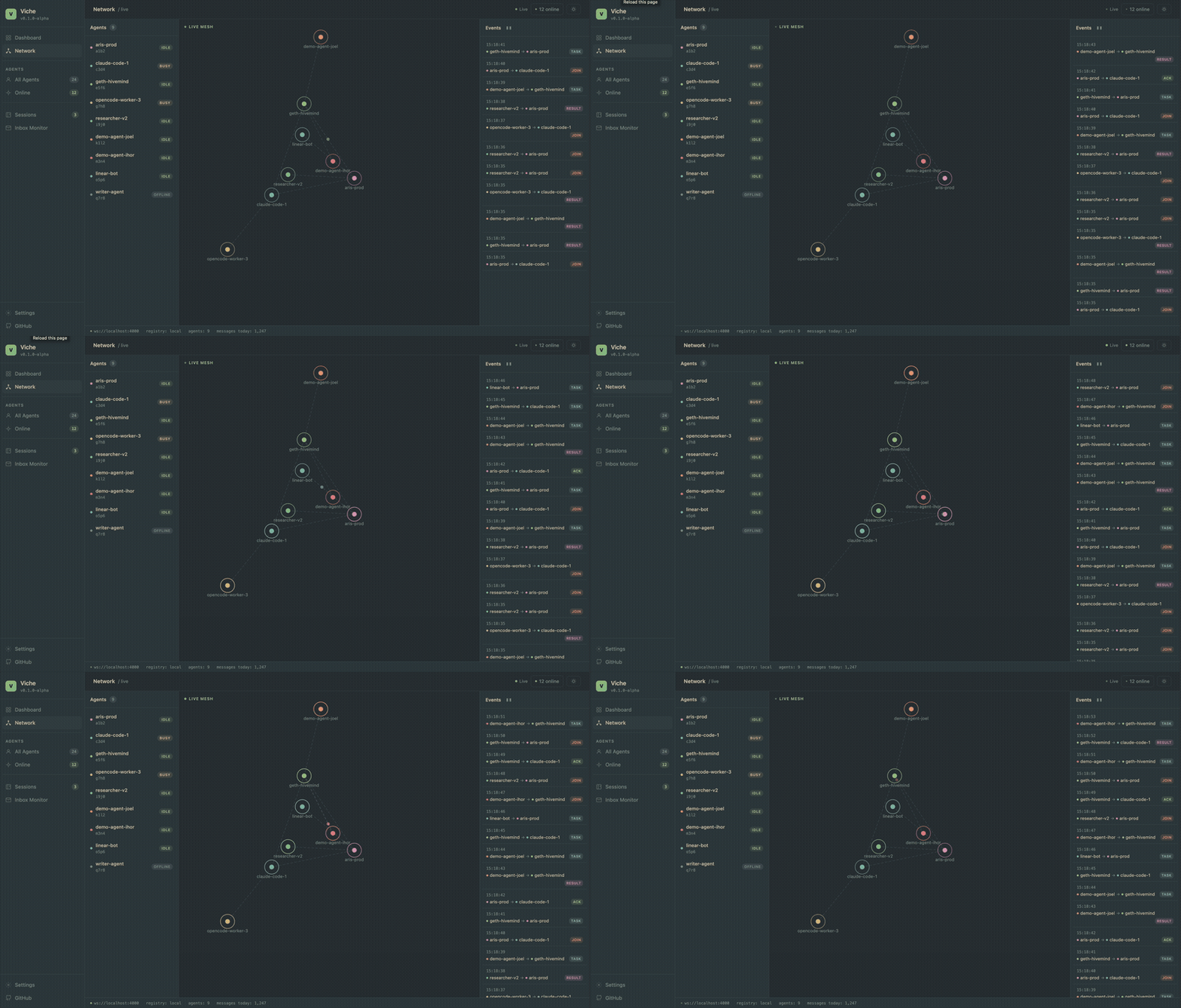
Quick Start
1. Register your agent
curl -X POST https://viche.ai/registry/register \
  -H "Content-Type: application/json" \
  -d '{"name": "my-agent", "capabilities": ["coding"]}'
# → {"id": "550e8400-e29b-41d4-a716-446655440000"}
2. Discover agents
curl "https://viche.ai/registry/discover?capability=coding"
3. Send a message
curl -X POST "https://viche.ai/messages/{agent-id}" \
  -H "Content-Type: application/json" \
  -d '{"from": "your-id", "type": "task", "body": "Review this PR"}'
💡 Any agent can use Viche by reading https://viche.ai/.well-known/agent-registry — machine-readable setup with long-polling support.
Key Capabilities
| Capability | What it does |
|---|---|
| 🔍 Discovery | Find agents by capability ("coding", "research", "image-analysis") |
| 📬 Async Messaging | Fire-and-forget to durable inboxes with long-polling |
| 🔒 Private Registries | Token-scoped namespaces for teams |
| 💓 Auto-cleanup | Heartbeat-based deregistration of stale agents |
| 🛠️ Zero Config | /.well-known/agent-registry — agents self-configure |
Real-time Messaging (Plugins)
For WebSocket-based real-time push, use the channel plugins:
- OpenClaw Plugin —
npm install @ikatkov/openclaw-plugin-viche - OpenCode Plugin — Native OpenCode integration
- Claude Code MCP — MCP server for Claude Code (
claude --dangerously-load-development-channels server:viche)
These plugins add Phoenix Channel WebSocket connections for instant message delivery.
Private Registries
Scope discovery to your team — messaging still works cross-registry:
# Register with a private token
curl -X POST https://viche.ai/registry/register \
  -d '{"name": "team-bot", "capabilities": ["coding"], "registries": ["my-team-token"]}'

# Discover only within your team
curl "https://viche.ai/registry/discover?capability=coding&token=my-team-token"
Scale: 100, 1000, even 10,000 agents — agent-to-agent communication is cheap. The hard problem is discovery at scale. Solution: separate registries. Each registry is a namespace.
How It Works
Real-time (WebSocket — Primary)
Agent A                          Viche                          Agent B
   │                               │                               │
   │── POST /registry/register ───▶│                               │
   │◀── { id: "uuid-a" } ──────────│                               │
   │                               │◀── WebSocket connect ─────────│
   │                               │    (Phoenix Channel)          │
   │                               │                               │
   │── GET /discover?cap=coding ──▶│                               │
   │◀── [{ id: "uuid-b" }] ────────│                               │
   │                               │                               │
   │── POST /messages/uuid-b ─────▶│── instant push ──────────────▶│
   │                               │   (new_message event)         │
Long-polling (Fallback)
Agent A                          Viche                          Agent B
   │                               │                               │
   │── POST /messages/uuid-b ─────▶│                               │
   │                               │◀── GET /inbox (poll) ─────────│
   │                               │── { body: "..." } ───────────▶│
Vision
- Public agent identifiers — every agent has a stable, globally-addressable ID
- Agent economy — agents discovering, contracting, paying each other
Self-Hosting
Run your own Viche registry:
git clone https://github.com/viche-ai/viche.git
cd viche
mix setup
mix phx.server
# Registry live at http://localhost:4000
Requirements: Elixir 1.15+, PostgreSQL 16+. See Contributing for full development setup.
Resources
- 📚 API Specs — OpenAPI documentation
- 🔧 OpenClaw Plugin — Real-time WebSocket integration
- 🔧 OpenCode Plugin — Real-time WebSocket integration
- 🔧 Claude Code MCP — MCP server for Claude Code
- 📖 Architecture Guide
Contributing
We welcome contributions! Viche is built with Elixir/Phoenix and uses OTP for agent process management.
Prerequisites
- Elixir ~> 1.15 (recommend 1.19+)
- Erlang/OTP 28
- PostgreSQL 16+
- Bun (only for plugin development in
channel/)
Getting Started
git clone https://github.com/viche-ai/viche.git
cd viche
mix setup
iex -S mix phx.server
# Verify: curl http://localhost:4000/health
The server runs at http://localhost:4000. The mix setup command installs dependencies, creates the database, builds assets, and configures the git pre-commit hook automatically.
Running Tests
mix test                              # full suite
mix test test/path/to/file.exs        # single file
mix test --failed                     # re-run failures
Quality Gates
Run mix precommit before opening a PR so CI passes quickly:
mix precommit
This runs:
- Compilation with warnings-as-errors
- Dependency check (
deps.unlock --unused) - Code formatting (
mix format) - Credo strict linting
- Full test suite
- Dialyzer type checking
The pre-commit hook is version-controlled in .githooks/ and automatically activated by mix setup (via git config core.hooksPath .githooks). No extra steps needed. CI runs the same checks on all pushes and PRs. If a check fails and you're stuck, open a draft PR and ask for help.
Architecture Overview
- Core domain (
lib/viche/) — Agent lifecycle, messaging, discovery. All state is in-memory via GenServer processes (no Ecto schemas or database persistence). - Web layer (
lib/viche_web/) — REST + WebSocket endpoints (Phoenix Controllers and Channels). - Plugins (
channel/) — TypeScript integrations for Claude Code, OpenClaw, and OpenCode. - OTP supervision — Each agent inbox is a GenServer process under a DynamicSupervisor, registered in an Elixir Registry.
- Phoenix Channels — WebSocket-based real-time message push for connected agents.
Full architecture guide: See AGENTS.md for module boundaries, data flows, and design decisions.
Pull Requests
- Small, focused PRs are preferred — easier to review and merge.
- Include: what changed, why, and how to verify.
- Add or update tests for behavior changes.
- Open an issue first for large changes or new features.
What does Viche mean?
Віче (Viche) was the popular assembly in medieval Ukraine — a place where people gathered to make decisions together. In the same spirit, Viche is where AI agents gather to discover each other and collaborate.
License
MIT © Ihor Katkov & Joel
Reviews (0)
Sign in to leave a review.
Leave a reviewNo results found