second-brain-template
Health Warn
- License — License: MIT
- Description — Repository has a description
- Active repo — Last push 0 days ago
- Low visibility — Only 5 GitHub stars
Code Pass
- Code scan — Scanned 12 files during light audit, no dangerous patterns found
Permissions Pass
- Permissions — No dangerous permissions requested
No AI report is available for this listing yet.
A token-efficient second brain: an Obsidian vault run by any coding agent, where answers cost 30–50× less than loading your notes and nothing is summarised away.
Second Brain
An Obsidian vault that your coding agent runs for you — Claude Code, Codex, or any agent that reads AGENTS.md — built so that answering from your notes costs a few hundred tokens instead of all of them.


What it is
You capture anything — quick notes, a daily log, documents, ideas, drawings —
and your agent compiles it into a knowledge graph of small, linked notes. Every
note leads with a capped answer surface and keeps its full detail below it, and
a generated index lets a question reach the right lines without reading
anything else. Capture can be slow and thorough; answering stays cheap.
The claim it defends: answering costs 30–50× less than loading your notes,
and nothing is summarised away to get there. In the vault this method was
built in, the route-and-card lookup measures a median of about 44× cheaper
than loading its ~16,800 tokens of sources. On the shared fictional benchmark
in bench/, the first scorecard is 27× on an ~11,000-token
corpus, where a smaller corpus lowers the ratio for the same answer.
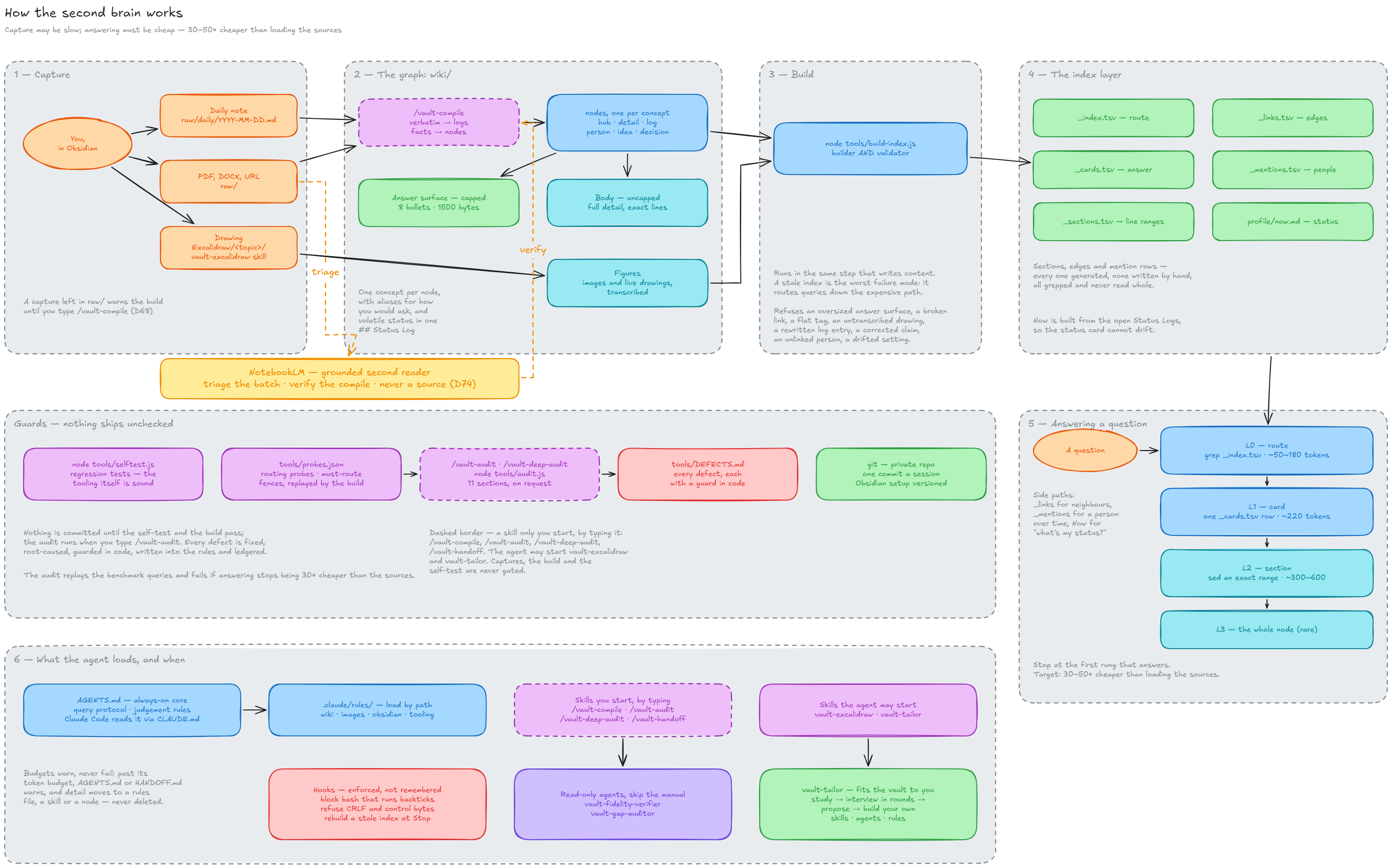
The drawing as text, and what each stage does: docs/architecture.md.
Three ways in
Convert the vault you already have — the usual case. Download or clone
this repository anywhere, open your coding agent in your vault's folder, and say:
Read
<path to this folder>/SETUP.mdand set up my vault.
It backs your vault up first, deletes none of your notes, and works only in
your vault — it never changes this folder.
Start fresh. Click Use this template (or download it), put the folder
where your vault should live, open your coding agent in that folder, and say:
Read SETUP.md and set up my second brain.
Either way the agent first studies how this template works, then interviews you
in rounds about what you need the vault for — every question comes with its
recommended answer — and walks you through every step. The template is a
foundation: from your answers it proposes the skills, subagents and rules
your own use needs (a daily research routine, interview preparation, rules for
a work-only vault) and builds the ones you pick. SETUP.md is written for
the agent; you never need to read it.
Just read about it. docs/how-it-works.md explains
the method without installing anything.
Requirements
- Obsidian
- A coding agent: Claude Code,
which the method was built and measured with, or
Codex or any agent that readsAGENTS.md— see the FAQ - Node.js 20 or newer — the tools need nothing installed beyond it
- git
- The Excalidraw plugin, installed for you by
node tools/install-excalidraw.js - Recommended: the Calendar, Iconize and Templater plugins —
see docs/plugins.md
Your commands
| Command | Does |
|---|---|
/vault-compile |
Compiles what is waiting in raw/ into the knowledge graph |
/vault-audit |
A cheap health check of the vault, then asks which problems to fix |
/vault-deep-audit |
The expensive check, with agents asking questions in your words |
/vault-handoff |
Records the session in HANDOFF.md, so the next session starts where this one ended |
/vault-tailor |
Fits the vault to a new need: studies it, interviews you in rounds, then proposes and builds new skills, subagents or rules |
In Codex, type $vault-compile and so on. Your agent cannot start the first
four on its own — only you do, by typing them: Claude Code and Codex enforce
it, and any other agent is bound by the manual's rule. /vault-tailor runs
once during setup, and again whenever you type it or ask your agent to adapt
the vault.
What the tooling guarantees
- The build is the validator.
node tools/build-index.jsregenerates the
index after every write and refuses anything that breaks a rule: an
oversized answer surface, a broken link, an untranscribed image, a rewritten
log entry, a claim you corrected. - The tooling tests itself.
node tools/selftest.jsruns over 300
regression tests. - Every rule traces to a defect.
tools/DEFECTS.md
records each mistake found while the method was built — what went wrong, why,
and the guard that stops it happening again — with the guard's code citing
its ID.
FAQ
Does this need Claude Code? No. AGENTS.md is the manual every coding
agent reads: Codex, Cursor, Copilot and others read it directly, and
Claude Code reads it through CLAUDE.md, which imports it. The skills, read-only
agents and hooks are written once in .claude/ and generated for Codex and
Gemini CLI (.agents/, .codex/). What each agent enforces, and what it only
reads as a rule, is in SETUP.md § 4C. The
method was built and measured with Claude Code; under another agent it has not
been benchmarked yet — a scorecard is welcome. The
vault itself is plain markdown and stays readable in Obsidian with no agent at
all.
Does anything leave my machine? The tools send nothing anywhere. The only
download is the pinned, checksum-verified Excalidraw plugin. Your agent sends
what it reads to its model provider, as it does in any folder — and the point
of this method is that it reads very little. Details in
SECURITY.md.
What does it cost to run? Answering: a few hundred tokens a question.
Compiling is the expensive part, and it runs only when you type/vault-compile: compiling the 20-source, 44 KB benchmark took about half an
hour and roughly US$15 of API usage.
Can I use it without the drawings? Yes. The Excalidraw plugin must be
installed, because the tools run on its engine, but you never have to draw.
What if I already have an AGENTS.md or a CLAUDE.md? Setup saves yours
as raw/their-previous-AGENTS.md or raw/their-previous-CLAUDE.md, shows you
its rules, and adds the ones you still want to the end of the newAGENTS.md, where every agent reads them.
How the method has improved
Every release that moves the benchmark adds a row.
| Version | Cost | Routing | Fidelity | Orphans | Change |
|---|---|---|---|---|---|
| 1.0.0 | 27× | 66.7% | 69.4% | 0 | baseline |
Contribute an idea
The method is young, and the most valuable contributions make it cheaper or
more faithful. Read the roadmap, then:
- Open an Improvement Proposal
for anything beyond a typo — CONTRIBUTING.md explains how
a proposal is measured. - Fork this repository. Not Use this template: its copy has no link back
here, so a pull request from it cannot reach this repo. - Make the change on a branch of your fork and open a pull request to
main.
Questions go to SUPPORT.md, security reports to
SECURITY.md.
Credit and citation
Designed and built by Vifert, improved by its contributors.
The setup interview is adapted from the grilling skill by
Matt Pocock, MIT licensed — see
THIRD_PARTY_NOTICES.md.
If you use this architecture or build on it, please cite it — GitHub's
Cite this repository button reads CITATION.cff:
Vifert. second-brain-template: a token-efficient Obsidian knowledge graph run
by any coding agent. https://github.com/Vifert/second-brain-template
Released under the MIT licence.
Reviews (0)
Sign in to leave a review.
Leave a reviewNo results found