vivary
Health Warn
- License — License: MIT
- Description — Repository has a description
- Active repo — Last push 0 days ago
- Low visibility — Only 5 GitHub stars
Code Pass
- Code scan — Scanned 12 files during light audit, no dangerous patterns found
Permissions Pass
- Permissions — No dangerous permissions requested
No AI report is available for this listing yet.
Typed memory, search, and gates for AI-agent workspaces. Scaffold plain-Markdown project memory, state, skills, and review gates in one command.
Vivary


Typed memory and gates for AI-agent projects. A standard plus a scaffolder that
wires up a normalized, agent-native workspace from standalone modules — typed project
memory, visible state, reusable skills, private boundaries, and verification gates —
whether the workspace is a second brain, a coding project, knowledge-work bench, or a
writing project.
A vivary is an archaic word for a vivarium: a self-contained world where living
things are kept, in stacked layers. That's the metaphor — your project lives
inside a small, well-formed world with a substrate, an atmosphere, and gates.
Release status: package versions are independent; there is no single "Vivary
0.4.1" release. Use 0.3.1 for the scaffolder (create-vivary/@vivary/create), 0.4.1 forvivary-tropo, 0.2.2 forvivary-exo,
0.2.0 forvivary-ozone, and 0.1.0 for the optionalvivary-memory-cogneeadapter.
This line addstropo map(read-only filesystem inventory), brownfieldcreate-vivary adopt,doctor --trenddrift tracking, and strato integrity
gates in CI.
| Surface | Current | Link |
|---|---|---|
vivary (PyPI, installs the suite) |
0.1.0 | PyPI |
create-vivary (PyPI) |
0.3.1 | PyPI |
@vivary/create (npm) |
0.3.1 | npm |
vivary-tropo |
0.4.1 | PyPI |
vivary-ozone |
0.2.0 | PyPI |
vivary-exo |
0.2.2 | PyPI |
vivary-memory-cognee |
0.1.0 | PyPI |
vivary-core (not published) |
unreleased | in-repo: packages/core/ |
| Docs site | live | vivary.vercel.app |
| CI | ci workflow |
GitHub Actions |
Versions are intentionally independent across the layers and optional adapters: tropo
moved to 0.4.1 for the read-only map filesystem inventory command, create-vivary /@vivary/create move to 0.3.1 for brownfield adopt and doctor --trend drift
tracking, ozone and exo are unchanged in this line, and vivary-memory-cognee
stays at 0.1.0.
Unreleased entries documented on the dev branch are not included in those published
package versions until the release-train PR bumps, publishes, and verifies them.
Public Signals
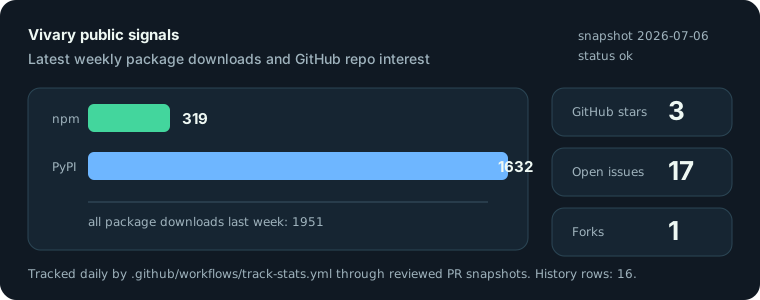
Vivary tracks public npm, PyPI, and GitHub signals through reviewed daily PR
snapshots. The chart is generated from stats/latest.json andstats/history.csv; see docs/SIGNALS.md for
sources and caveats.
tropo (typed knowledge graph + search + storage), strato (agent OS), ozone
(graph-aware review), and exo (coordination) are composed by create-vivary. See
docs/ARCHITECTURE.md for the full model and
docs/WHITE-PAPER.md for the technical argument.
docs/PORTFOLIO.md holds proof and case-study material. The
high-leverage backlog lives in docs/PRODUCT-ROADMAP.md.
Current command surface:
create-vivary init/doctor/wizard/capabilities/adopt/doctor --trendtropo check/graph/find/query/migrate/map/init --packsozone review/impactexo board/conflicts/claim/rolesvivary-cognee doctor/index/recall/forgetfrom the optionalvivary-memory-cogneepackage
For local debugging and bug reports, the core CLIs accept --receipt PATH orVIVARY_RECEIPT_LOG=PATH to append a dependency-free JSONL run receipt. Receipts stay
local and do not capture stdout, stderr, file contents, raw query text, target ids, or
paths. Install the vivary meta package to inspect those logs with vivary logs or
build a local email draft with vivary logs email; Vivary never sends mail or telemetry
by itself.
Quickstart
Scaffold a workspace in one npm command. No Python package install first; the launcher
needs Python 3.11+ and uv or pipx available:
npm create @vivary@latest my-workspace # pick: second brain · coding · knowledge work · writing
Or install the CLIs from PyPI (run on demand with uvx, no install needed):
pip install vivary
create-vivary init my-workspace --preset coding     # interactive wizard on a TTY
create-vivary init my-workbench --preset knowledge-work --memory local
create-vivary init my-codebase --preset coding --active-context cocoindex-code
create-vivary capabilities --preset second-brain --json
create-vivary doctor my-workspace
uvx vivary-tropo check --root my-workspace
uvx vivary-tropo find "where is release truth owned" --root my-workspace --json
tropo check --root my-workspace --receipt .vivary/receipts.jsonl
vivary logs .vivary/receipts.jsonl
vivary logs email .vivary/receipts.jsonl --to [email protected] --out .vivary/support.eml

# Agent-mode — fully non-interactive, outputs JSON:
create-vivary init . --preset coding --auto --size large --yes --json
The scaffolder writes a full workspace shell: AGENTS.md, STATE.md, SOUL.md,
private USER.md/MEMORY.md boundaries, private heartbeat report storage, strato
runtime skills for Claude/Codex-style agents, a tropo.toml, a starter typed graph,
and optional .vivary/storage.toml / .vivary/memory.toml capability config. Generated
modules are directories with index.md routers (modules/<id>/index.md) so agents
load the smallest useful context first. doctor validates the shell, active privacy
ignore rules, graph health, storage backend, semantic-memory status, and module index
coverage after creation.tropo find returns small typed context packets for agents and humans to read first;tropo query provides filtered graph search, tropo query --mode vector adds
dependency-free local typed-vector search when .vivary/storage.toml explicitly
enables it, and tropo migrate handles backend switching. When local vector policy is
enabled, embedded migration stores graph-shaped vectors with source/embedding
fingerprints; --mode vector uses those stored rows when they are current and
falls back to deterministic typed text results when the embedded index is missing,
stale, or partial. On the unreleased dev
branch, tropo query --mode semantic can call an explicitly configured optional
semantic-memory provider while still returning typed Vivary node ids.
For workspaces that explicitly choose Cognee semantic memory, the optionalvivary-memory-cognee package adds vivary-cognee doctor, index, recall, andforget. It indexes privacy-filtered typed Tropo node packets and only accepts recall
hits that map back to known Vivary node ids. It is not part of the default install and
provider writes require explicit approval. tropo query --mode semantic --json uses
that same optional provider bridge after the workspace has been configured and indexed.
For users who only want local typed vector ranking, --mode vector stays inside the
typed graph, reports whether results came from stored or computed vectors, and falls
back to text search when no trustworthy local vector index is present.
For coding workspaces that need richer source retrieval, --active-context cocoindex-code adds optional CocoIndex-code guidance and graph nodes. It does not
auto-install, index, enable MCP, or send source text anywhere; the generated skill asks
before those gates, then gives the approved ccc init / ccc index / ccc search
path. See docs/ACTIVE-CONTEXT.md and the copyable
LLM active-context guide.
python packages/create-vivary/create_vivary.py init sandboxes/coding-demo --preset coding
python packages/create-vivary/create_vivary.py doctor sandboxes/coding-demo
python packages/tropo/tropo.py check --root sandboxes/coding-demo
python packages/tropo/tropo.py find "local ci baseline" --root sandboxes/coding-demo --json
python packages/tropo/tropo.py graph --root sandboxes/coding-demo --json
Agent setup
Already working with Claude Code, Codex, Cursor, or another coding agent? Paste this
prompt and it handles setup — greenfield or brownfield — with your approval at every gate:
Set up Vivary (https://vivary.vercel.app) in this project.

1. Read https://vivary.vercel.app/getting-started/ and https://vivary.vercel.app/commands/ before running anything.
2. You need Python 3.11+ and uv (or pipx). Tell me if something is missing before installing it.
3. If this folder already has content, this is an adoption: run `uvx create-vivary adopt .`, show me the dry-run plan, and apply with `--yes` only after I approve. Adopt only adds files — it never touches existing ones.
   If this folder is new or empty, it is a fresh workspace: ask me which preset fits (coding / second brain / knowledge work / writing), then run `uvx create-vivary init . --preset <choice>`.
4. After an adoption, handle any `.gitignore` privacy follow-ups first: either add the listed lines yourself, or if your installed `create-vivary` supports guided repair, show me `uvx create-vivary doctor . --repair --json` and ask before applying `--repair --yes` for deterministic safe fixes. Then verify with `uvx create-vivary doctor .` and `uvx --from vivary-tropo tropo check --root .` — both must pass; show me the results.
5. Read the generated AGENTS.md, then follow it for all future work here.
The irreducible baseline
Every agent workspace, regardless of stack or task, needs the same small core:
A self-improving loop running over a typed, navigable knowledge graph, with
one visible state surface and human gates.
Everything Vivary ships is a facet of that one sentence. The design law (inherited
from throughline): the framework
must cost almost nothing to load, or it steals the context the work needs.
That means Vivary is deliberately DRY: one fact gets one owner, while AGENTS.md,STATE.md, and module index.md files route to deeper context instead of duplicating
it. Full context management is valuable only when it keeps the active context small.
No lock-in. A workspace is plain Markdown + YAML and a few CLIs — it works in any
editor, or none, and on any agent runtime (Claude Code reads .claude/skills/, Codex
reads AGENTS.md + .agents/). Obsidian, an IDE, a particular agent — all optional.
The visual knowledge graph renders editor-free with tropo view; Obsidian fans get an
opt-in setup (create-vivary init … --obsidian) — see docs/OBSIDIAN.md.
Modules
Standalone Python packages (vivary-* on PyPI), plus the npm scaffolder@vivary/create, composed by create-vivary:
| Package | Layer | Job | Source |
|---|---|---|---|
| tropo | troposphere — the living foundation | typed knowledge graph: what the workspace knows | loam ✓ |
| strato | stratosphere — the stable layer | agent OS: state surface, memory, the loop, gates, self-improvement | throughline + flywheel |
| ozone | the protective filter | review — graph-aware, code and editorial | new ✓ |
| exo | the outermost layer | coordination — conflict detection, work claiming, role contracts | new ✓ |
create vivary → pick a preset (coding · second brain · knowledge work · writing) → it lays
down tropo + strato and whichever optional layers fit. See
Quickstart above to install.
Documentation
Website: vivary.vercel.app — or browse the source in
docs/:
- Getting started — install → workspace → loop
- Command reference — every CLI, flag, and exit code
- How-to recipes · Agent skills · Homepage FAQ · White paper
- Active context · LLM active-context guide
- Architecture · Product roadmap · Semantic memory · Obsidian (optional)
- Release workflow — end-of-update release truth, docs/site sync, and publish checks
- Portfolio proof — shipped surfaces, screenshots, and case-study notes
The value-add (why this isn't another harness)
- The substrate is a typed, validated knowledge graph, not flat memory.
- Every change shows its blast radius — before and after — beyond a text diff.
- It's medium-agnostic: the same graph + review serves code and prose.
- It standardizes the agent workspace — which nobody has done.
- Agents can self-configure from scratch —
--auto --yes --jsongives a zero-prompt, machine-readable setup path for storage, installs, and scaffolding.
License
MIT — see LICENSE.
Reviews (0)
Sign in to leave a review.
Leave a reviewNo results found