pydantic-deepagents
Health Pass
- License — License: MIT
- Description — Repository has a description
- Active repo — Last push 0 days ago
- Community trust — 598 GitHub stars
Code Pass
- Code scan — Scanned 12 files during light audit, no dangerous patterns found
Permissions Pass
- Permissions — No dangerous permissions requested
No AI report is available for this listing yet.
Python Deep Agent framework built on top of Pydantic-AI, designed to help you quickly build production-grade autonomous AI agents with planning, filesystem operations, subagent delegation, skills, and structured outputs—in just 10 lines of code.

Pydantic Deep Agents
From framework to terminal -- autonomous AI agents that plan, code, and ship
Docs · PyPI · CLI · DeepResearch · Examples



Unlimited Context • Subagent Delegation • Persistent Memory • Lifecycle Hooks
Same Architecture as the Best
pydantic-deep implements the deep agent pattern -- the same architecture powering:
| Product | What They Built | |
|---|---|---|
| Claude Code | Anthropic's AI coding assistant | |
| Manus AI | Autonomous task execution | |
| Devin | AI software engineer |
Now you can build the same thing -- or just use the CLI.
Inspired by: LangChain's Deep Agents research on autonomous agent architectures.
pydantic-deep is three things:
- A Python framework for building Claude Code-style agents with planning, filesystem access, subagents, memory, and unlimited context
- A CLI that gives you a terminal AI assistant out of the box
- DeepResearch -- a full-featured research agent with web UI, web search, diagrams, and sandboxed code execution
CLI -- Terminal AI Assistant
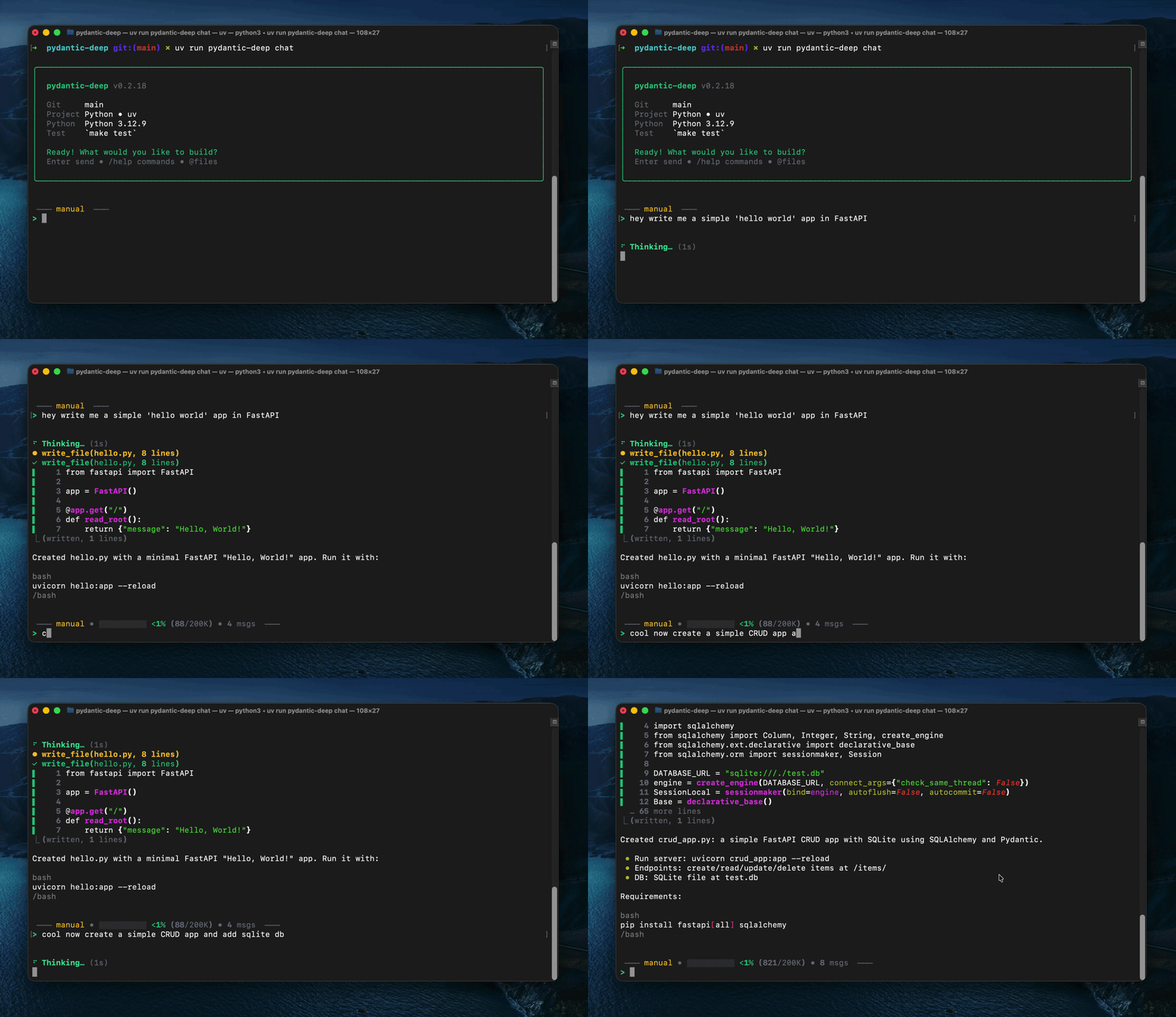
pip install pydantic-deep[cli]
pydantic-deep chat
That's it. You get an interactive AI agent in your terminal with:
- File read/write/edit, shell execution, glob, grep
- Task planning and subagent delegation
- Persistent memory across sessions
- Context compression for unlimited conversations
- Git-aware project context
- Built-in commands:
/commit,/pr,/review,/test,/fix,/explain - Customizable skills, hooks, and output styles
# Interactive mode
pydantic-deep chat

# Run a single task
pydantic-deep run "Fix the failing tests in src/"

# Docker sandbox for isolated execution
pydantic-deep run "Build a web scraper" --sandbox

# Pick a model
pydantic-deep chat --model anthropic:claude-sonnet-4-20250514

# Manage config
pydantic-deep config set model openai:gpt-4.1
See CLI docs for the full reference.
Framework -- Build Your Own Agent
pip install pydantic-deep
Requires pydantic-ai >= 1.71.0.
from pydantic_ai_backends import StateBackend
from pydantic_deep import create_deep_agent, create_default_deps

agent = create_deep_agent()
deps = create_default_deps(StateBackend())

result = await agent.run("Create a todo list for building a REST API", deps=deps)
One function call gives you an agent with planning, filesystem tools, subagents, skills, context management, and cost tracking. Everything is toggleable:
agent = create_deep_agent(
    model="openai:gpt-4.1",
    include_todo=True,          # Task planning
    include_filesystem=True,    # File read/write/edit/execute
    include_subagents=True,     # Delegate to subagents
    include_skills=True,        # Domain-specific skills from SKILL.md files
    include_memory=True,        # Persistent MEMORY.md across sessions
    include_plan=True,          # Structured planning before execution
    include_teams=True,         # Multi-agent teams with shared TODOs
    include_web=True,           # Built-in WebSearch() and WebFetch() capabilities
    context_manager=True,       # Auto-summarization for unlimited context
    cost_tracking=True,         # Token/USD budget enforcement
    include_checkpoints=True,   # Save, rewind, and fork conversations
)
Structured Output
from pydantic import BaseModel

class CodeReview(BaseModel):
    summary: str
    issues: list[str]
    score: int

agent = create_deep_agent(output_type=CodeReview)
result = await agent.run("Review the auth module", deps=deps)
print(result.output.score)  # Type-safe!
Context Management
from pydantic_deep import create_summarization_processor

processor = create_summarization_processor(
    trigger=("tokens", 100000),
    keep=("messages", 20),
)
agent = create_deep_agent(history_processors=[processor])
Hooks (Claude Code-Style)
from pydantic_deep import Hook, HookEvent

agent = create_deep_agent(
    hooks=[
        Hook(
            event=HookEvent.PRE_TOOL_USE,
            command="echo 'Tool called: $TOOL_NAME' >> /tmp/audit.log",
        ),
    ],
)
Cost Tracking
agent = create_deep_agent(
    cost_tracking=True,
    cost_budget_usd=5.0,
    on_cost_update=lambda info: print(f"Cost: ${info.total_usd:.4f}"),
)
Custom Subagents
agent = create_deep_agent(
    subagents=[
        {
            "name": "code-reviewer",
            "description": "Reviews code for quality issues",
            "instructions": "You are a senior code reviewer...",
            "preferred_mode": "sync",
        },
    ],
)
See the full API reference for all options.
DeepResearch -- Reference App
A full-featured research agent with web UI, built entirely on pydantic-deep.
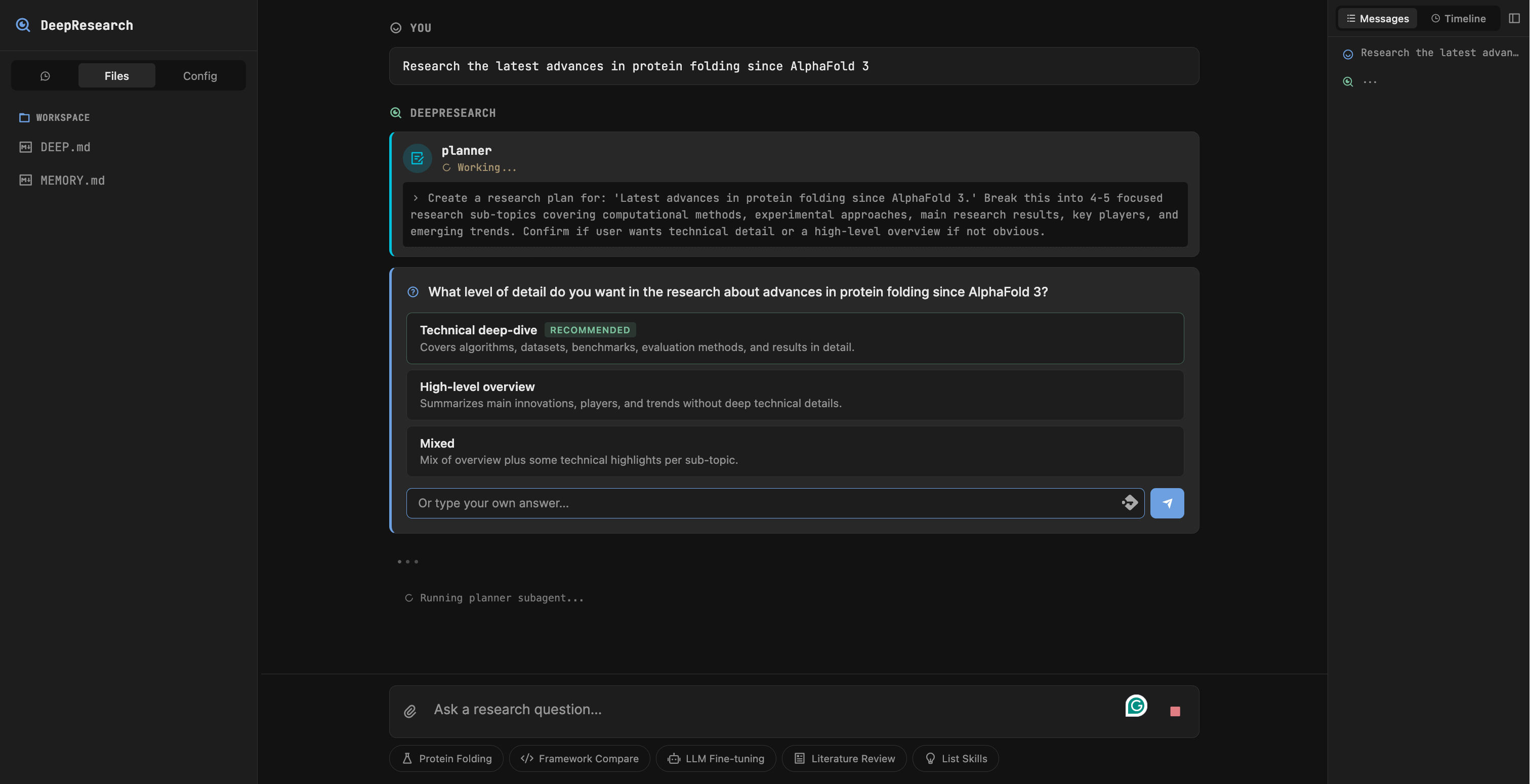
Plan Mode -- planner asks clarifying questions |
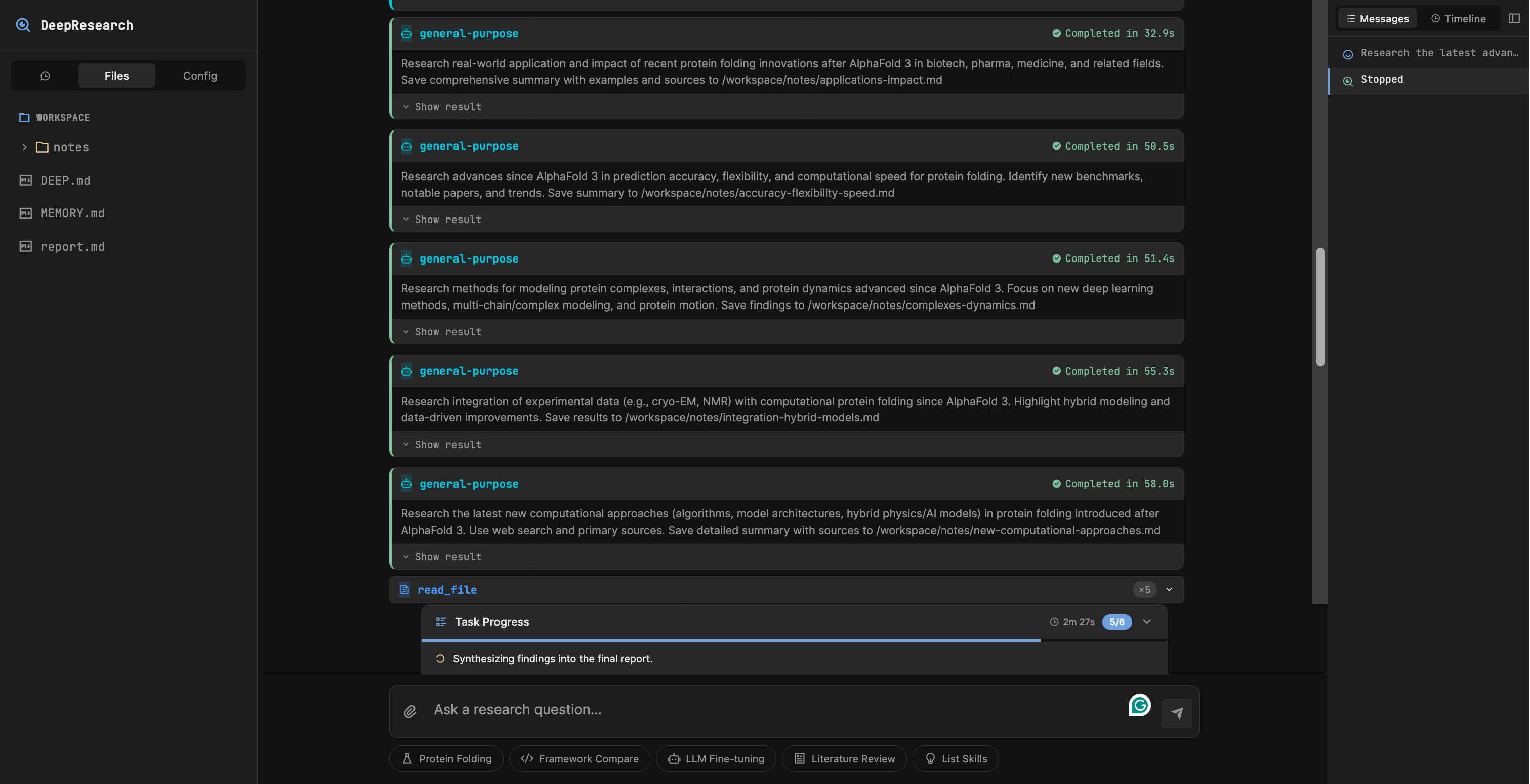
Parallel Subagents -- 5 agents researching simultaneously |
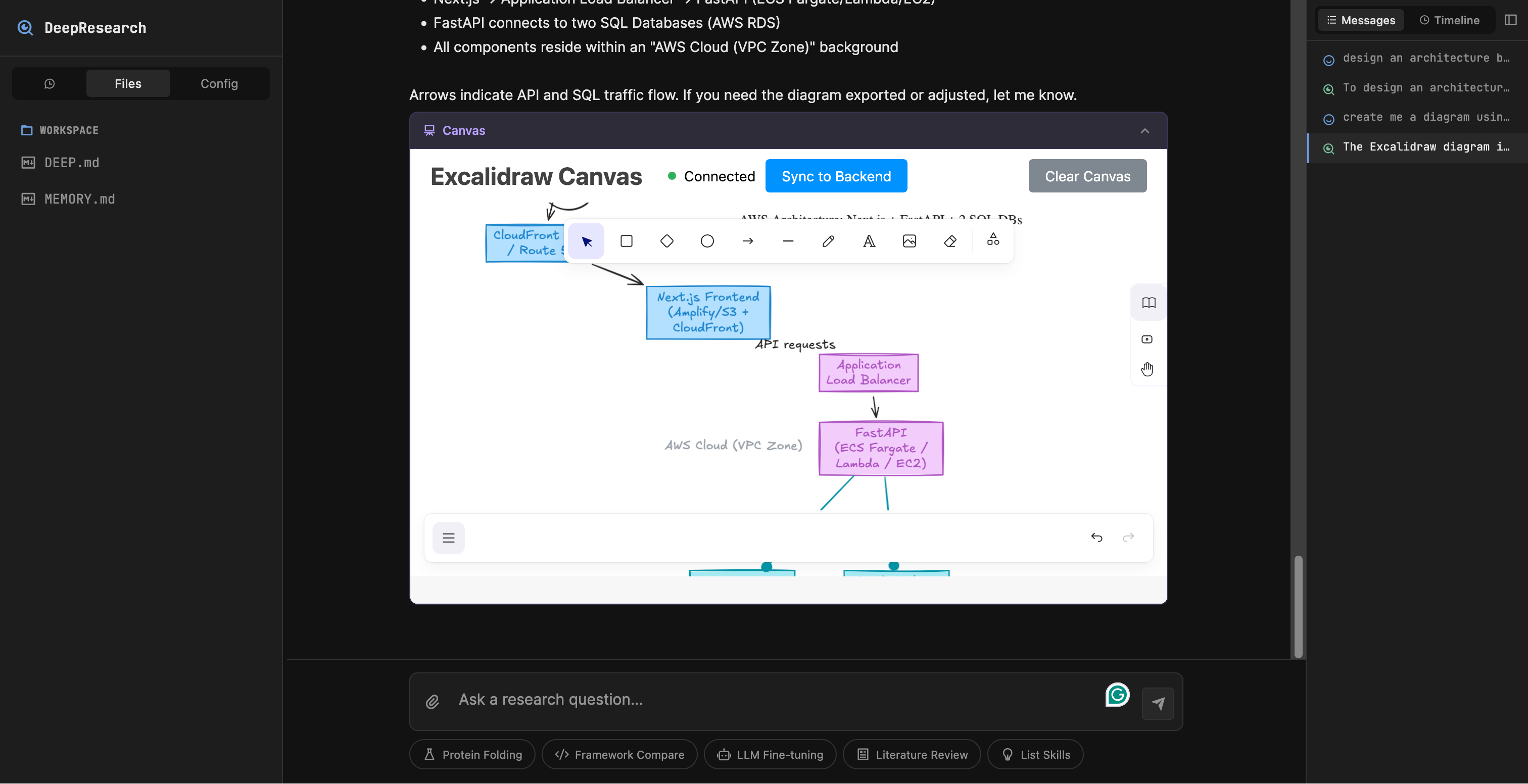
Excalidraw Canvas -- live diagrams synced with agent |
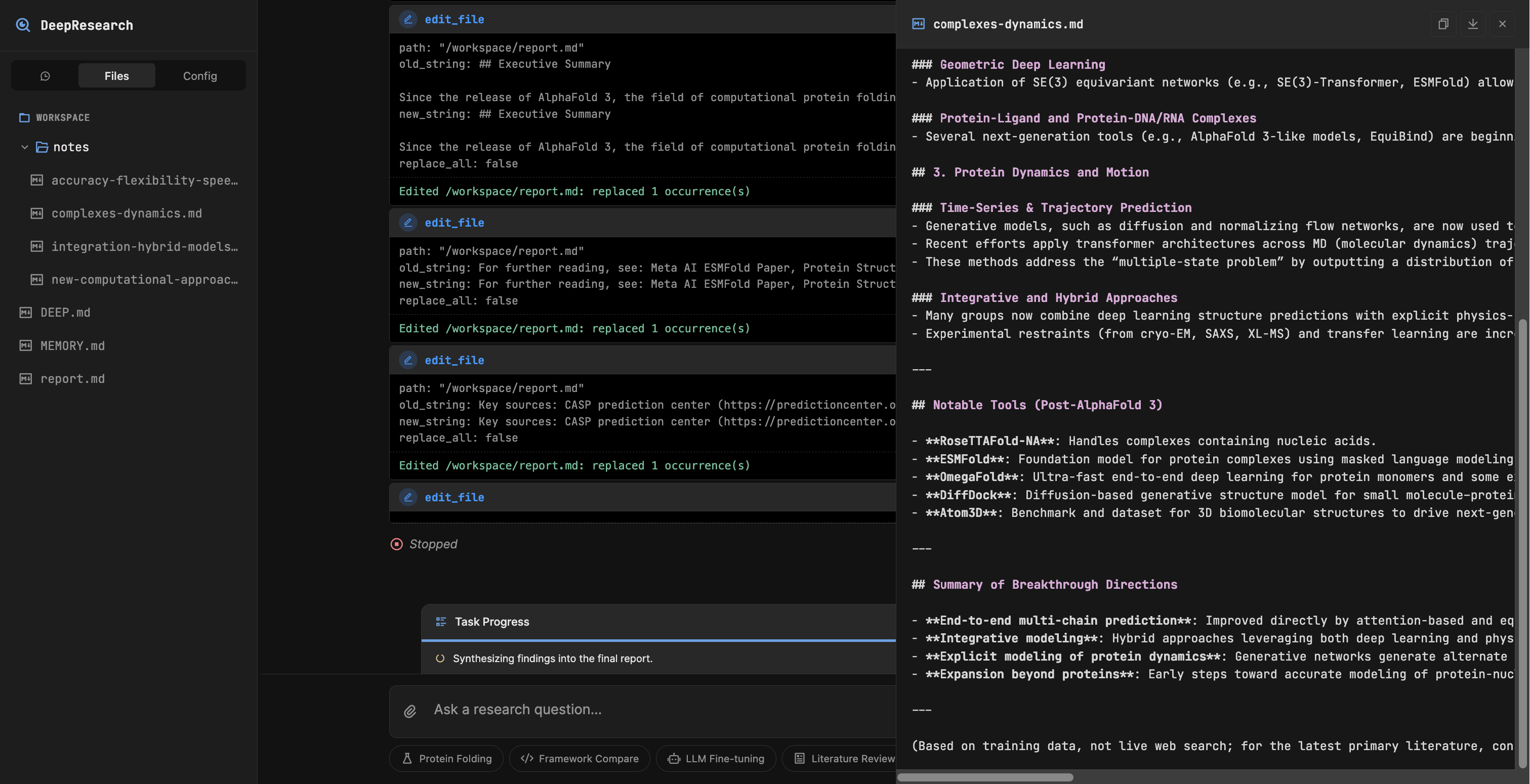
File Browser -- workspace files with inline preview |
Web search (Tavily, Brave, Jina), sandboxed code execution, Excalidraw diagrams, subagents, plan mode, report export, and more.
cd apps/deepresearch
uv sync
cp .env.example .env  # Add your API keys
uv run deepresearch    # Open http://localhost:8080
See apps/deepresearch/README.md for full setup.
Architecture
pydantic-deep v0.3.0 uses pydantic-ai's native Capabilities API (Agent(capabilities=[...])) for all cross-cutting concerns. This replaces the previous middleware wrapping approach and provides a cleaner, more composable architecture.
Capabilities
All lifecycle features are implemented as capabilities that extend AbstractCapability from pydantic-ai:
| Capability | Package | What It Does |
|---|---|---|
| CostTracking | pydantic-ai-shields | Token/USD budget enforcement and real-time cost callbacks |
| ContextManagerCapability | summarization-pydantic-ai | Auto-compression when approaching token budget |
| HooksCapability | pydantic-deep | Claude Code-style lifecycle hooks on tool events |
| CheckpointMiddleware | pydantic-deep | Save, rewind, and fork conversation state |
| WebSearch / WebFetch | pydantic-ai (built-in) | Web search and URL fetching |
pydantic-deep also provides 5 internal capabilities that are automatically wired up when their corresponding include_* flags are set:
| Internal Capability | Activated By | What It Does |
|---|---|---|
| SkillsCapability | include_skills=True |
Domain-specific skills from SKILL.md files |
| ContextFilesCapability | context_files / context_discovery |
Auto-discover and inject DEEP.md, AGENTS.md, CLAUDE.md |
| MemoryCapability | include_memory=True |
Persistent MEMORY.md across sessions |
| TeamCapability | include_teams=True |
Multi-agent teams with shared TODOs and message bus |
| PlanCapability | include_plan=True |
Structured planning before execution |
Component Packages
Every component is modular and works standalone:
| Component | Package | What It Does |
|---|---|---|
| Backends | pydantic-ai-backend | File storage, Docker/Daytona sandbox |
| Planning | pydantic-ai-todo | Task tracking with dependencies |
| Subagents | subagents-pydantic-ai | Sync/async delegation, cancellation |
| Summarization | summarization-pydantic-ai | LLM summaries or sliding window |
| Shields | pydantic-ai-shields | Cost tracking, input/output/tool blocking |
                              pydantic-deep
+---------------------------------------------------------------------+
|                                                                     |
|   +----------+ +----------+ +----------+ +----------+ +---------+   |
|   | Planning | |Filesystem| | Subagents| |  Skills  | |  Teams  |   |
|   +----+-----+ +----+-----+ +----+-----+ +----+-----+ +----+----+   |
|        |            |            |            |            |        |
|        +------------+-----+------+------------+------------+        |
|                           |                                         |
|                           v                                         |
|  Summarization --> +------------------+ <-- Capabilities            |
|  Checkpointing --> |    Deep Agent    | <-- Hooks                   |
|  Cost Tracking --> |   (pydantic-ai)  | <-- Memory                  |
|                    +--------+---------+                             |
|                             |                                       |
|           +-----------------+-----------------+                     |
|           v                 v                 v                     |
|    +------------+    +------------+    +------------+               |
|    |   State    |    |   Local    |    |   Docker   |               |
|    |  Backend   |    |  Backend   |    |  Sandbox   |               |
|    +------------+    +------------+    +------------+               |
|                                                                     |
+---------------------------------------------------------------------+
All Features
Click to expand full feature listCore Toolsets
- Planning -- Task tracking with subtasks, dependencies, cycle detection. PostgreSQL storage. Event system.
- Filesystem --
ls,read_file,write_file,edit_file,glob,grep,execute. Docker sandbox. Permission system. - Subagents -- Sync/async delegation. Background task management. Soft/hard cancellation.
- Summarization -- LLM-based summaries or zero-cost sliding window. Trigger on tokens, messages, or fraction.
Capabilities
- CostTracking -- Token/USD budgets with automatic enforcement and real-time callbacks (from
pydantic-ai-shields). - ContextManagerCapability -- Auto-compression when approaching token budget (from
summarization-pydantic-ai). - HooksCapability -- Claude Code-style lifecycle hooks. Shell commands on tool events. Audit logging, safety gates.
- CheckpointMiddleware -- Save state at intervals. Rewind or fork sessions. In-memory and file-based stores. Extends
AbstractCapability. - WebSearch / WebFetch -- Built-in pydantic-ai capabilities for web search and URL fetching.
- SkillsCapability -- Domain-specific skills loaded from SKILL.md files.
- ContextFilesCapability -- Auto-discover and inject DEEP.md, AGENTS.md, CLAUDE.md, SOUL.md into the system prompt.
- MemoryCapability -- Persistent MEMORY.md across sessions, auto-injected into system prompt.
- TeamCapability -- Multi-agent teams with shared TODO lists, claiming, dependency tracking, and peer-to-peer message bus.
- PlanCapability -- Dedicated planner subagent for structured planning before execution.
Advanced
- Agent Teams -- Shared TODO lists with claiming and dependency tracking. Peer-to-peer message bus.
- Persistent Memory --
MEMORY.mdthat persists across sessions. Auto-injected into system prompt. - Context Files -- Auto-discover and inject
AGENT.mdinto the system prompt. - Output Styles -- Built-in (concise, explanatory, formal, conversational) or custom from files.
- Plan Mode -- Dedicated planner subagent for structured planning before execution.
- Eviction Processor -- Evict large tool outputs to files. Keep context lean while preserving data.
- Patch Tool Calls -- On resume, patch stale tool call results for clean history.
- Custom Tool Descriptions -- Override any tool's description via
descriptionsparameter. - Custom Commands --
/commit,/pr,/review,/test,/fix,/explain. Three-scope discovery: built-in, user, project. - Structured Output -- Type-safe responses with Pydantic models via
output_type. - Human-in-the-Loop -- Confirmation workflows for sensitive operations.
- Streaming -- Full streaming support for real-time responses.
- Image Support -- Multi-modal analysis with image inputs.
Contributing
git clone https://github.com/vstorm-co/pydantic-deepagents.git
cd pydantic-deepagents
make install
make test  # 100% coverage required
make all   # lint + typecheck + test
Star History
License
MIT -- see LICENSE

Reviews (0)
Sign in to leave a review.
Leave a reviewNo results found