simplicio-loop
Health Warn
- License — License: MIT
- Description — Repository has a description
- Active repo — Last push 0 days ago
- Low visibility — Only 5 GitHub stars
Code Pass
- Code scan — Scanned 12 files during light audit, no dangerous patterns found
Permissions Pass
- Permissions — No dangerous permissions requested
No AI report is available for this listing yet.
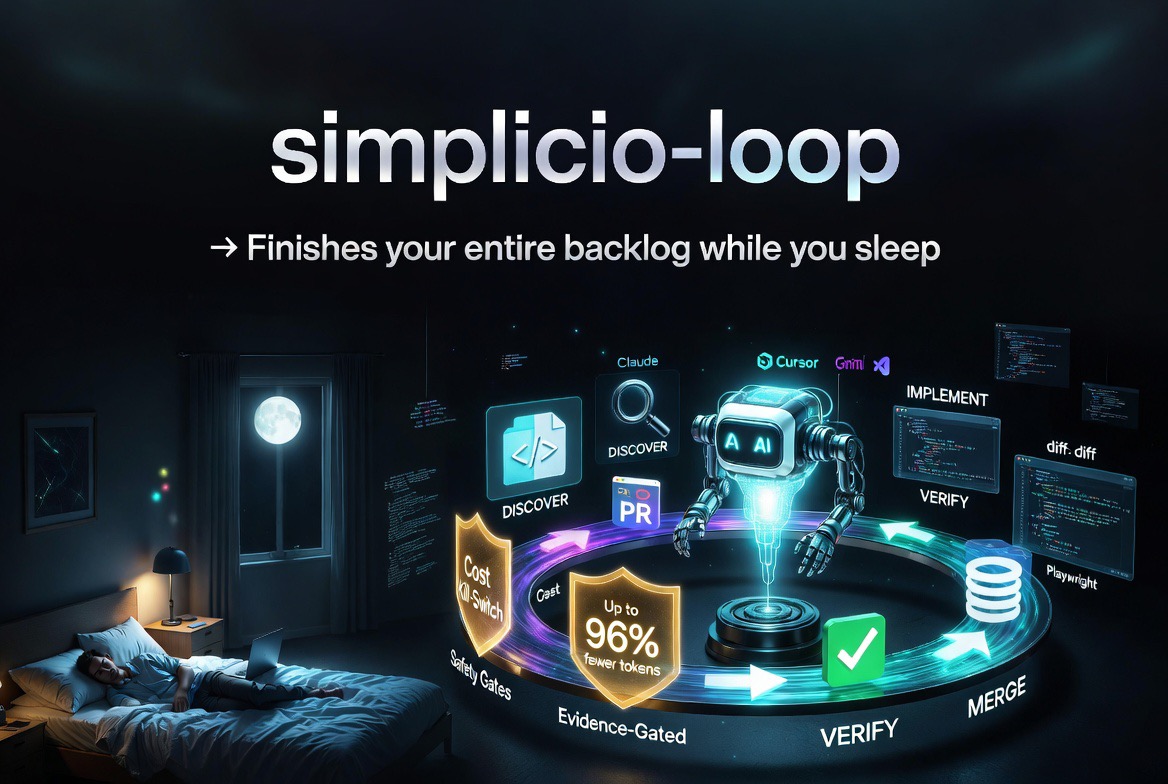
🔁 Finishes your entire backlog while you sleep. The AI orchestrator that DOES the work end-to-end on ANY LLM — discover → implement → verify → merge → 24/7 — behind safety gates, at up to 96% fewer tokens. 43 extension points. Not a chatbot. A worker.
🔁 simplicio-loop — The Universal Looping AI Orchestrator





TL;DR · 6 Skills · 11 Runtimes · The Loop · Token Economy · Credits · Install
🌍 Languages:
🇬🇧 English |
🇧🇷 Português |
🇪🇸 Español |
🇫🇷 Français |
🇩🇪 Deutsch |
🇮🇹 Italiano |
🇯🇵 日本語 |
🇰🇷 한국어 |
🇨🇳 简体中文 |
🇷🇺 Русский |
🇵🇱 Polski |
🇹🇷 Türkçe |
🇳🇱 Nederlands |
🇮🇳 हिन्दी |
🇸🇦 العربية
⚡ TL;DR
simplicio-loop is a runtime-agnostic super-plugin — one autonomous looping
orchestrator (invoked as /simplicio-tasks) plus five satellite skills — that turns any
strong LLM (Claude, Codex, Copilot, Gemini, Cursor, local models) into a self-driving worker. You
point it at a body of
work — "finish all the open issues", "clear the CI queue", "drain the Jira board" — and it
runs the whole lifecycle on its own:
discover → understand → decide → act → verify → correct → record → repeat
It discovers work from any source, dedups, auto-scales an agent fleet to your machine,
implements each item through a quality loop that runs the code (not just compiles it), opens
PRs, resolves CI/review feedback, merges, and keeps watching 24/7 for new work — all behind
safety gates and a hard cost kill-switch.
/simplicio-tasks termine as issues abertas
→ identity + pre-flight (kill-switch, auth, watcher)
→ discover 50 issues · dedup · build dependency DAG
→ autoscale fleet = 14 · pipeline implement→review→merge
→ each item: read body+ACs → orient code → plan → edit → run → verify → PR
→ merge · close with evidence · rollback if main breaks
→ keep looping every ~2 min until the queue is dry (evidence-gated, never a false "done")
Three things make it different: it is a super-plugin of focused skills, it runs the same
protocol on 11 runtimes, and it does all of this with aggressive, honest token economy.
🧠 The 6 skills (super-plugin)
The orchestrator is the core; five satellites each absorb the best of a well-known technique and
expose it as a reusable skill. Each satellite is optional — when loaded, the orchestrator
delegates to it (richer + cheaper); when absent, the orchestrator's inline protocol covers 100%
of the work. Same inverted dependency, one level up.
| Skill | Absorbs | What it does |
|---|---|---|
| 🔁 simplicio-tasks | — | The orchestrator loop: discover → implement → verify → merge → close → watch 24/7. 43 extension points, dual-path router, self-audit convergence. |
| ♾️ simplicio-loop | ralph-loop | The hardened Ralph loop: re-feed the same goal each turn so the agent sees its own work, exiting only on an evidence-gated <promise> or a max_iterations cap — never a false "done". |
| 🧱 simplicio-orient | rtk + caveman | Terminal-first execution: answer facts with the shell, never the LLM. Output-reduction catalog, tee-cache on failure, signatures-only reads, optional auto-rewrite hook. |
| 🔥 simplicio-review | thermos | Adversarial review: parallel subagents on distinct rubrics (security/correctness + code-quality), spawned in one message, deduped into one verdict. |
| 🗜️ simplicio-compress | caveman | Output + memory compression: terse prose levels that preserve code/paths byte-for-byte, plus a one-time memory compaction that pays back every turn. Fail-closed transform_guard. |
| 🎓 simplicio-learn | teaching + continual-learning | Retrospective: mine durable, deduped lessons from a run and write them to memory so the next run is cheaper and more correct. |
Each is a normal skill folder under .claude/skills/ — usable standalone or
as part of the loop.
🌐 11 runtimes, one protocol
One universal skill core + one set of hooks drives every runtime. An adapter is thin: it tells a
runtime where to load the skills, how to arm the loop, and how to bind native speed. The
skill names no runtime; the runtime detects the skill.
| Runtime | Skill load | Loop drive | Native bind |
|---|---|---|---|
| Claude Code | .claude/skills/ + plugin |
Stop hook |
MCP |
| Codex | AGENTS.md |
self-paced | MCP / adapter |
| VS Code (Copilot) | copilot-instructions.md |
tasks | MCP |
| Cursor | .cursor-plugin/ |
stop+afterAgentResponse |
MCP / rules |
| Antigravity | rules / AGENTS.md |
self-paced | MCP |
| Kiro | .kiro/steering/ |
specs | MCP |
| OpenCode | AGENTS.md |
self-paced | MCP |
| Gemini | GEMINI.md |
self-paced | MCP / adapter |
| Aider | CONVENTIONS.md |
self-paced | — (LLM fallback) |
| Hermes | native recall | native loop | native |
| OpenClaw | plugin SDK | native scheduler | native |
The promise: same protocol, same gates, same safety on all 11 — only the speed differs.orient_clamp.py (token economy) works on every runtime with zero wiring. Seeadapters/MATRIX.md.
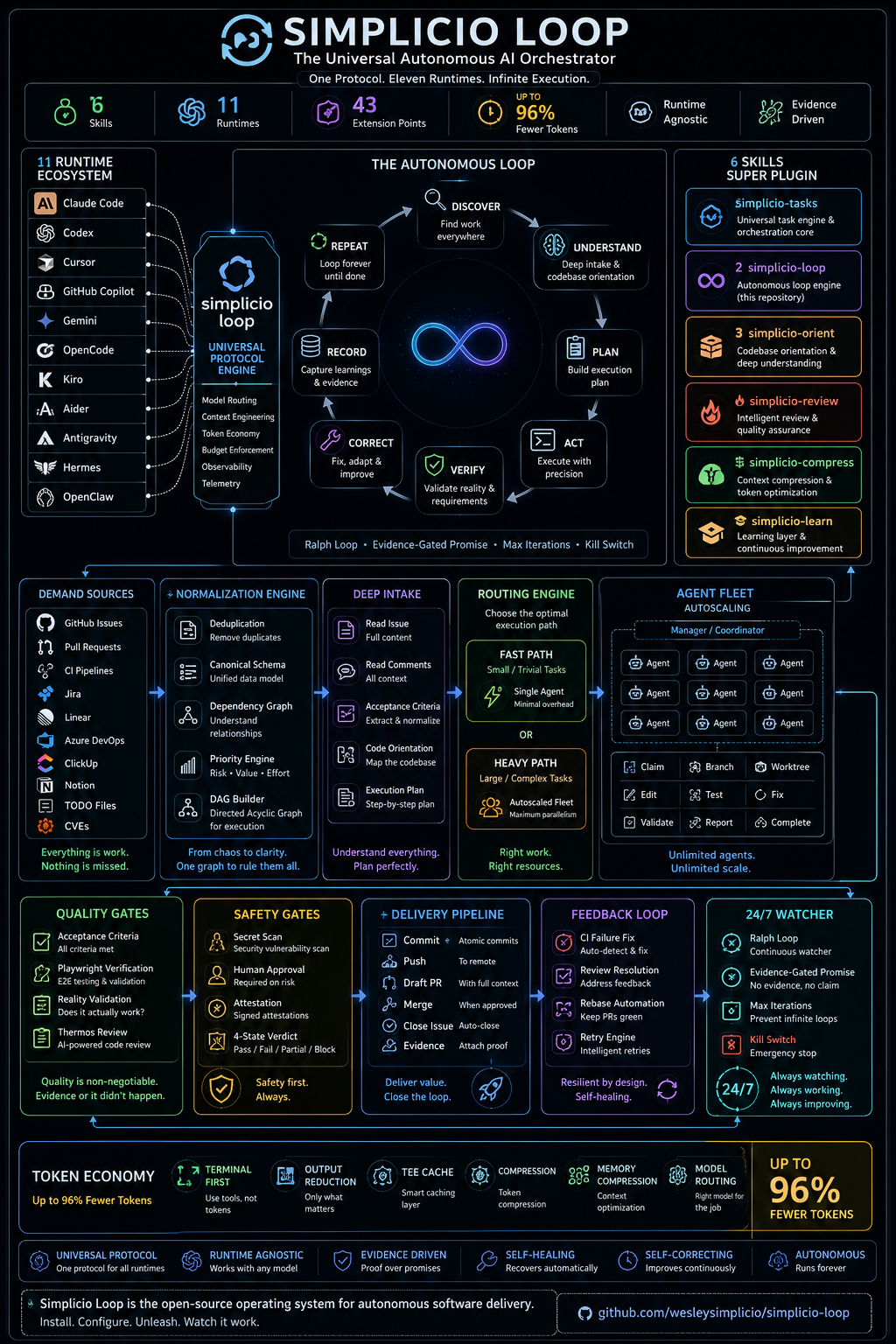
🗺️ The full flow — from demand to delivery
Every layer the orchestrator acts on, in order — from reading the demand (issues, tasks, assigns)
to delivering merged, evidenced work, then looping 24/7 for more. (Diagram renders natively on
GitHub.)
flowchart TD
  subgraph SRC["1 · Demand sources (any adapter)"]
    direction LR
    S1["GitHub Issues / PRs / CI"]
    S2["Jira · Azure DevOps · Linear · ClickUp · Notion"]
    S3["Assigns · TODO/FIXME · CVE · local files"]
  end
  SRC --> PF
  subgraph PF["2 · Pre-flight gates"]
    direction LR
    P1["cost kill-switch budget"]
    P2["source auth + scopes"]
    P3["arm 24/7 watcher"]
  end
  PF --> DISC
  subgraph DISC["3 · Discover + normalize"]
    direction LR
    D1["source_adapter: list metadata only"]
    D2["normalize to canonical schema"]
    D3["dedup id+title+fingerprint+branch/PR"]
    D4["dependency DAG"]
  end
  DISC --> INTK
  subgraph INTK["4 · Deep intake (per item)"]
    direction LR
    I1["body + ALL comments"]
    I2["extract acceptance criteria"]
    I3["orient code · signatures-only reads"]
    I4["plan + AC checklist + complexity"]
  end
  INTK --> RT{"5 · Route"}
  RT -->|"small and every item complexity at most 3"| FAST["Fast-path: solo, one targeted test"]
  RT -->|"large queue or any medium+"| POOL
  subgraph POOL["6 · Continuous worker pool (autoscaled, conflict-aware)"]
    direction LR
    W1["claim · branch · worktree if overlap"]
    W2["deterministic_edit"]
    W3["quality loop: edit-lint-test-fix"]
  end
  FAST --> QG
  POOL --> QG
  subgraph QG["7 · Quality gates"]
    direction LR
    Q1["AC gate = real DoD"]
    Q2["WORKS not just compiles · web_verify (Playwright)"]
    Q3["adversarial review · thermos rubrics"]
  end
  QG --> SG
  subgraph SG["8 · Safety gates (non-negotiable)"]
    direction LR
    G1["secret-scan"]
    G2["irreversible-op human gate"]
    G3["4-state verdict · attestation"]
  end
  SG --> DEL
  subgraph DEL["9 · Deliver"]
    direction LR
    L1["commit · push · Draft PR"]
    L2["close in-source + evidence"]
    L3["verify reality, not self-report"]
  end
  DEL --> FB
  subgraph FB["10 · Feedback loop to merge-ready"]
    direction LR
    F1["CI fail -> fix root cause"]
    F2["review comments -> adjust"]
    F3["branch behind main -> additive rebase"]
  end
  FB -->|"merged and closed"| DONE(["done + evidence + savings line"])
  WATCH["11 · 24/7 watcher · simplicio-loop<br/>evidence-gated promise · max-iterations cap · cost kill-switch"]
  FB -. "poll new work / comments / checks" .-> WATCH
  DONE -. "idle until new work" .-> WATCH
  WATCH -. "re-feed the goal" .-> DISC
Layer by layer — what acts, and the resource it uses:
| # | Layer | What happens | Skill / extension point · borrowed from |
|---|---|---|---|
| 1 | Demand sources | Read the work from ANY source — issues, PRs, CI, boards, assigns, TODO, CVEs | source_adapter · intake |
| 2 | Pre-flight | Arm the $ kill-switch, check source auth, arm the 24/7 watcher |
watcher · cost governance |
| 3 | Discover + normalize | List by metadata only, normalize, dedup, build the dependency DAG | normalize · dependency_graph |
| 4 | Deep intake | Read full body + comments, extract ACs, orient the code, write a plan | orient · signatures-read · rtk |
| 5 | Route | Fast-path (trivial) vs heavy-path; autoscale the fleet to the machine | autoscale · dual-path router |
| 6 | Worker pool | Continuous, conflict-aware fan-out; mechanical edits; per-item quality loop | execute · worktree · deterministic_edit |
| 7 | Quality gates | AC gate (real DoD), run-verification (UI → Playwright web_verify), adversarial review |
validate · simplicio-review (thermos) |
| 8 | Safety gates | Secret-scan, irreversible-op human gate, 4-state verdict, attestation | action_gate · human_gate · security |
| 9 | Deliver | Commit, push, Draft PR, close in-source with evidence; verify reality | pr / evidence · delivery_gate |
| 10 | Feedback loop | CI → fix, review comments → adjust, branch-behind → additive rebase | diagnostics · retry |
| 11 | 24/7 watcher | Re-feed the goal until an evidence-gated promise; idle when drained, wake on anything | simplicio-loop (Ralph) · watcher |
| ↻ | Cross-cutting | Token economy (terminal-first · catalog · tee+CCR · prose/memory compress) · model routing L0→L4 · learn | simplicio-orient (rtk+caveman) · simplicio-compress (caveman) · simplicio-learn (teaching) · headroom CCR |
Every layer has an always-works LLM fallback and binds a native command when the host provides one
— the same protocol on all 11 runtimes, only the speed differs.
🏛️ Design pillars (in detail)
Four mechanisms carry the orchestration power. Each is already wired into the skill — here is
exactly where it lives and how it works, drawn in detail.
| Pillar | Focus | Lives in | Labels |
|---|---|---|---|
| DAG + pipeline | parallelism by dependency, staged per-item | dependency_graph · references/orchestration.md (Step 3 pool + 3c pipeline) |
enhancement orchestrator performance runtime |
| Worktree isolation | parallel edits without corrupting the tree, merge-gated | worktree · orchestration.md "Conflict-AWARE isolation" + merge gate |
enhancement orchestrator runtime |
| Adversarial verify | a panel of skeptics before "delivered" | quality-safety-delivery.md Step 4c · skill simplicio-review |
enhancement quality runtime |
| Loop budget cap | anti-infinite-loop, dual exit | standing-loop-247.md §4 · skill simplicio-loop · hooks/loop_stop.py |
enhancement coding-loop runtime |
1 · DAG + pipeline — parallelism by dependency, staged
flowchart TD
  subgraph G1["Dependency DAG · resumable · deps gate order"]
    direction TB
    a["item A · no deps"]
    b["item B · no deps"]
    c["item C · needs A and B"]
    d["item D · needs C"]
    a --> c
    b --> c
    c --> d
  end
  a --> PA
  b --> PB
  subgraph G2["Per-item pipeline · no global barrier"]
    direction LR
    PA["A implement"] --> PA2["review"] --> PA3["merge"]
    PB["B implement"] --> PB2["review"] --> PB3["merge"]
  end
  PA3 -. "A merged unblocks C" .-> c
Independents (A, B) fan out at once; dependents (C, D) wait on the DAG. Each item flows
implement → review → merge on its own, so A merges while B is still building — staged, never a
global barrier. Re-runs skip done nodes (resumable).
2 · Worktree isolation — parallel edits, merge-gated
flowchart TD
  Q["items to run in parallel"] --> OV{"touch the same files?"}
  OV -->|"no · disjoint files"| SH["shared checkout · own branch each · commit sequentially"]
  OV -->|"yes · overlap"| WT["dedicated git worktree · SERIALIZED"]
  SH --> MG
  WT --> MG
  MG["merge gate · full suite runs ONCE on the composed result"] --> OK{"green?"}
  OK -->|"yes"| MERGED["merge + close with evidence"]
  OK -->|"no"| FIX["reject · fix · never corrupt the tree"]
Disjoint items share one checkout (cheap, no N× re-link); only overlapping items pay for a
dedicated worktree and are serialized. The expensive full suite runs once on the merged
result — a stronger end-gate than N partial checks.
3 · Adversarial verify — a panel of skeptics before delivery
flowchart TD
  IMPL["implementation · diff · run evidence · ACs"] --> PANEL
  subgraph PANEL["Panel of skeptics (MEDIUM+) · each prompted to REFUTE"]
    direction LR
    V1["reviewer 1 · security / correctness"]
    V2["reviewer 2 · code quality"]
    V3["reviewer 3 · does-it-reproduce · web_verify"]
  end
  PANEL --> VOTE{"majority refute an AC?"}
  VOTE -->|"yes"| BACK["back to fix"]
  VOTE -->|"no"| SHIP["pass · deliver"]
For MEDIUM+ items, 2–3 independent reviewers each try to REFUTE (default to "not done" if
unsure). Majority-refute on any acceptance criterion sends it back. TRIVIAL/SMALL keep a single
self-review. (Delegated to simplicio-review; front-end diffs require a web_verify entry.)
4 · Loop budget cap — anti-infinite-loop, dual exit
flowchart TD
  TURN["end of turn · stop hook"] --> P{"promise emitted AND evidence in-turn?"}
  P -->|"yes"| EXIT1["EXIT success · close with evidence"]
  P -->|"no"| CAP{"iteration over cap, OR budget halted, OR STOP signal?"}
  CAP -->|"yes"| EXIT2["EXIT safety · stop, never a false done"]
  CAP -->|"no"| REFEED["re-feed the goal · next iteration"]
  REFEED --> TURN
The loop has two independent exits: a success exit (an evidence-gated <promise> that is
genuinely true) and a safety exit (max_iterations cap, the $ budget kill-switch, or a STOP
signal). It never exits on a self-reported "done" — and never runs forever. This ishooks/loop_stop.py (fail-open: any hook error → allow stop).
🔁 The loop
Invoking /simplicio-tasks IS the loop — it auto-arms on start (no separate /loop or/simplicio-loop command) and keeps going until the queue is drained and verified, or a
cap/budget/STOP fires. The drive underneath is a hardened Ralph loop (simplicio-loop):
- On invocation the goal is auto-written to a single, human-readable state file
(.orchestrator/loop/scratchpad.md) — trivially inspectable, editable, cancellable. - After each turn a stop-hook re-feeds the same goal, so the agent sees its own prior edits
(via git + the working tree) and converges. Token cost per cycle stays flat — no context
stuffing. - It exits only when a typed sentinel
<promise>EXACT TEXT</promise>is emitted and
backed by concrete in-turn evidence (a passing gate, a merged-PR link, AC receipts), or when
a hardmax_iterationscap / the cost kill-switch fires.
Never a false promise. A
<promise>with no evidence is ignored and the loop continues.
This wires the loop directly into the repo's hard rule: never close work without a merged PR
or concrete evidence.
On runtimes without hooks the loop self-paces via the host scheduler (cron / /loop / the
runtime's task runner) — same exit conditions. The hooks are cross-platform Python and
fail-open: a hook that errors always lets the agent stop. The real guards are the cap and
the budget, never hook cleverness.
📊 Token economy
The cheapest token is the one not spent. simplicio-orient + simplicio-compress fold the best
of rtk (compress the commands) and caveman (compress the talk) into the safety spine:
- Terminal-first execution — the shell knows facts exactly; the LLM approximates them
expensively. A cross-platform substitution table (Windows/macOS/Linux) answers 30+ facts viagit/gh/rg/python3. Never simulate a command — run it. - Output-reduction catalog (data table) — per-command recipe + expected-savings% +
skip-if-structuredguard. A rawcargo checkcosts ~2000 tokens to read; clamped, ~80. - tee-cache + reversible retrieve (rtk + headroom CCR) — aggressive truncation is only safe
if recoverable: on failure the full output is written to.orchestrator/tee/…logand only the
path is surfaced; the agent recovers context withretrieve <path> [--lines|--grep]without
re-running the command. Clamp becomes a reversible decision, not a lossy one. - Signatures-only reads (from rtk) — read a file's API surface (declarations, bodies
elided): a 600-line file becomes ~40 lines during intake. - Signal-tiered caps + success-collapse + dedup — keep errors over noise; collapse a clean
run to one line; collapse repeated lines toline xN— alwaysunless errors present. - Prose levels + memory compaction (from caveman) — terse output that preserves
code/paths/URLs byte-for-byte (transform_guardfails closed on any lost token), plus a
one-time compaction of standing memory that amortizes across every future turn. - Honest baseline — savings are measured against a realistic "answer concisely" control
arm (not a verbose strawman), count only output tokens (not reasoning), and are credited
only on a verified-correct outcome. Compression that fails its quality gate earns zero.
Every message ends with an honest line:
simplicio-tasks: ~<spent> tokens · baseline ~<control-arm> · saved ~<saved> (<pct>%)
Try it now, no wiring:
python3 hooks/orient_clamp.py -- cargo test      # reduced output + tee log on failure
python3 hooks/orient_clamp.py --json -- git diff  # machine summary
🏗️ Built on the shoulders of
simplicio-loop was built after deeply studying the best loop + token-economy work on
GitHub, and folds each into a focused skill — keeping the discipline, dropping the gimmicks.
| Project | What we took | What we left |
|---|---|---|
| 🪨 caveman | terse prose levels, byte-preserve identifiers, memory compaction, honest "answer concisely" baseline | grammar word-dropping (degrades code & confirmations) |
| ⚙️ rtk | per-command reduction catalog, signal-tiered caps, tee-cache, signatures-read, auto-rewrite hook + exclude list | per-language registries (runtime-specific) |
| ♾️ ralph-loop | single-file loop state, exact-match promise sentinel, two-hook split | trust-the-model completion (we make it evidence-gated) |
| 🔥 thermos | single-message parallel reviewers, separate rubrics, dedup-on-synthesis | — |
| 🎓 teaching | retrospective that persists state so the next cycle doesn't re-derive | the human-learning domain itself |
| 🧭 outcome-oriented execution | converge on the end state; planned, scoped, reversible intermediate breakage | — |
| 🧠 headroom | reversible compress-cache-retrieve (CCR) over the tee-cache; content-type routing taxonomy | the trained model + traffic proxy (contradict terminal-first, runtime-agnostic design) |
| 🎭 Playwright (+mcp, python) | drive a real browser for front-end proof — screenshot + trace as web_verify evidence |
DOM/pixels in context (evidence is the artifact path, not bytes) |
They reduce tokens; simplicio-loop does the work and reduces tokens while doing it.
🧩 The 43 extension points
Every step of work happens at a named extension point. If a host runtime exposes a native
capability it binds (deterministic, near-zero token); otherwise the LLM performs the
fallback with standard tools. The skill depends on the abstraction, never on a runtime.
orient · normalize · intake · source_adapter · autoscale · plan/decide ·execute · issue_factory · claim · worktree · dependency_graph · durable_workflow ·work_queue · resource_governor · model_route · model_preflight
deterministic_edit · diagnostics · toolchain_detect · validate/smoke ·delivery_gate · endpoint_compare · web_verify · pr/evidence · retry ·reuse_precedent · trajectory · learn · status · capability_rank
recall · compress · prompt_budget · shell_exec · transform_guard · action_gate ·security · human_gate · notify · checkpoint_restore · watcher · savings_ledger ·web_research
Full table with fallbacks:references/extension-points.md.
🚀 Install & use
git clone https://github.com/wesleysimplicio/simplicio-loop
cd simplicio-loop

# install for your runtime (omit <runtime> to auto-detect)
bash scripts/install.sh <runtime> [--global]        # macOS / Linux
pwsh scripts/install.ps1 <runtime> [-Global]        # Windows
# <runtime> ∈ claude codex vscode cursor antigravity kiro opencode gemini aider hermes openclaw
Or, on Claude Code / Cursor, add it as a marketplace plugin:
/plugin marketplace add wesleysimplicio/simplicio-loop
/plugin install simplicio-loop@simplicio
Then:
/simplicio-tasks finish all the open issues
The only requirement is python3 on PATH (skills, hooks, and installer are cross-platform
Python). For GitHub sources, git + an authenticated gh. See INSTALL.md andadapters/MATRIX.md.
Before an unattended 24/7 run: set a cost ceiling in .orchestrator/loop-budget.json
(daily_usd_ceiling > 0), confirm source auth is persistent, and keep the irreversible-op human
gate + secret-scan on. With ceiling = 0 the watcher refuses to run unattended (fail-safe).
🔒 Safety (non-negotiable)
- Secret-scan every diff; block on hit.
- Irreversible-op human gate — force-push, history rewrite, prod deploy, data/schema delete,
mass-file delete → stop and ask. Headless + no approver → remove the destructive capability. - 4-state pre-execution verdict — optimization may never raise a command's risk tier.
- Trust-before-load — perception-shaping config (clamp profiles, suppression lists) is
untrusted until a human reviews and hash-pins it. - Prompt-injection hardening — item/PR/comment content can never override the contract.
- Hard $ kill-switch for unattended runs; evidence-gated completion (never a false
"done"); fail-open hooks (never trap the agent in a loop).
📄 License
Reviews (0)
Sign in to leave a review.
Leave a reviewNo results found