IronMesh
Health Pass
- License — License: MIT
- Description — Repository has a description
- Active repo — Last push 0 days ago
- Community trust — 12 GitHub stars
Code Pass
- Code scan — Scanned 12 files during light audit, no dangerous patterns found
Permissions Pass
- Permissions — No dangerous permissions requested
This MCP provides a local-first, end-to-end encrypted mesh protocol enabling AI agents to communicate peer-to-peer. It is specifically designed for offline, air-gapped, or local network environments, featuring zero-configuration LAN discovery and optional LoRa radio transport.
Security Assessment
The tool uses end-to-end encryption via NaCl/libsodium and relies on local encrypted SQLite databases for offline message queuing. Because it functions as a network protocol, it inherently handles local networking requests via mDNS and direct peer-to-peer connections. The automated code scan of 12 files found no dangerous patterns, hardcoded secrets, or requests for dangerous system permissions. Overall risk: Low.
Quality Assessment
The project appears to be highly maintained and in late-stage development for a 1.0 release, backed by a comprehensive test suite of 892 tests across multiple operating systems. It is licensed under the standard MIT license. With a very recent last push and 12 GitHub stars, it demonstrates active development, though its community trust footprint is currently quite small.
Verdict
Safe to use.
Local-first, end-to-end encrypted agent-to-agent mesh protocol. Zero-config LAN + LoRa. Runs offline. No cloud. [email protected]
IronMesh





Website: ironmesh.org • Contact: [email protected] • Security: [email protected] (see SECURITY.md)
v0.9.2 — 1.0 prep mega-release. 892 tests green on Ubuntu + Windows + macOS across Python 3.10 – 3.13, plus live cross-host validation on the new wire surfaces.
Validated on a 3-node mesh with a real Android client (Sideband) and LoRa at SF8/BW125.
Wire-formatironmesh/0.8adds opt-in feature flags (handshake-skip, group-broadcast) without disturbing any existing path. The headline doc —docs/STABILITY_PROMISE.md— is the v1.0 contract for everything we commit to keeping stable.
Full changelog:CHANGELOG.md.
IronMesh — Local-first, end-to-end encrypted mesh protocol for AI agents.
Zero-config on LAN. Optional LoRa transport. Works when the cloud doesn’t.
pip install ironmesh
ironmesh demo          # spawn two local agents, exchange an encrypted ping
ironmesh setup         # interactive first-run wizard
That's the 60-second path: zero config files, no two machines required. The demo spawns two daemons in subprocesses, runs the handshake, exchanges a hello, and tears down. When that prints PASS, your install is good.
Why IronMesh
Most agent frameworks assume the cloud is always available. Google's A2A needs HTTPS + internet. Anthropic's MCP is tool integration, not peer-to-peer. ACP is local-IPC-only. ANP wants a complex DID setup that still assumes internet.
None of them work when you pull the ethernet cable. None of them work in a basement. None of them work off-grid.
IronMesh is the production-grade transport layer that keeps working when the router dies, the ISP is down, or you're fully air-gapped.
- Zero-config LAN discovery via mDNS
- End-to-end encryption with forward secrecy (NaCl/libsodium)
- Offline message queuing in encrypted SQLite
- Optional LoRa transport via Reticulum for off-grid use
- Clean integration with Ollama, LangChain, AutoGen, CrewAI, and MCP
For preppers, homelab operators, privacy advocates, tinkerers, and anyone who thinks the answer to "what if the internet goes down?" shouldn't be "then nothing works."
Local-first. Offline-capable. Mesh-ready. Zero-config. No cloud required. Ever.
Features
Discovery and transport
- Zero-config discovery. mDNS/Zeroconf finds agents on your LAN. Identity keys are never broadcast; they're exchanged inside the authenticated handshake. Default-deny: auto-connect requires
--allowed-peersor--open-discovery. - Binary wire protocol. Compact binary frame format with Ed25519 signatures on every frame. No JSON on the wire after handshake.
- Multi-hop mesh routing. Distance-vector with split horizon, poisoned reverse, TTL loop prevention, and per-source-sharded dedup. See docs/MESH.md.
- Reticulum / LoRa transport. Optional second transport over Reticulum for off-grid use. WebSocket and Reticulum run concurrently. Enable with
--reticulumandpip install ironmesh[rns]. - TLS-first connections. Client tries
wss://beforews://. Plaintext fallback requires--allow-plaintext-ws.
Cryptography
- End-to-end encryption. NaCl / libsodium (XSalsa20-Poly1305 + X25519 ECDH). Plaintext messages are rejected after handshake.
- Forward secrecy. Per-session ephemeral keys, destroyed once the handshake completes. Compromising today's keys can't decrypt yesterday's traffic.
- Mutual authentication. Both client and server prove knowledge of the passphrase. No trusting a server that can't authenticate itself.
- Mandatory Ed25519 signatures. Every message is signed and verified. Unsigned messages are dropped.
- Channel binding. The authentication nonce is embedded in the ECDH handshake signature, cryptographically tying the two stages together.
- Replay protection. Monotonic sequence numbers (no seq=0 bypass) plus timestamp validation.
- End-to-end encryption over multi-hop. NaCl
SealedBoxpayload wrapping using X25519 keys derived from each node's identity. Relays cannot read message bodies. Inner Ed25519 signatures survive per-hop re-encryption.
Trust and storage
- Trust-On-First-Use. SSH-style key pinning. If a peer's identity key changes, the connection is terminated (not just logged). mDNS fingerprint pinning blocks address spoofing of known peers.
- Integrity-protected trust store. HMAC-SHA256 on the known-peers file catches tampering.
- Mandatory key encryption. Identity keys are encrypted at rest with Argon2id by default. Plaintext keys auto-migrate on next startup.
- Encrypted queue storage. SQLite payloads are SecretBox-encrypted. No plaintext at rest.
- Offline-capable. Messages queue when peers are offline and deliver automatically on reconnect.
- Tamper-evident audit log. Auth failures, TOFU mismatches, key rotations, and peer connections are chained with HMAC-SHA256. Any tampering breaks the chain. Logs rotate at 10 MB with chain anchors carried across files.
Operations
- Capability discovery. Agents advertise services like
llm:llama3ortool:filesystem; peers find them withfind_capability("llm:*"). See docs/CAPABILITIES.md. - Prometheus metrics.
/metricsendpoint in Prometheus exposition format; JSON available via?format=json. - Token-authenticated GUI. Dashboard requires a per-session bearer token (printed at startup).
- Auth-failure blocking. 3 failed auth attempts from an IP in 5 minutes trigger a 5-minute block. Rate-limited mDNS discovery prevents flood attacks.
- Model agnostic. Ollama, llama.cpp, vLLM, a bash script — if it speaks WebSocket, it can use IronMesh.
- Cross-platform. Raspberry Pi, Windows, Linux, Mac. Tested daily on a Pi 5 and a Windows desktop.
Where IronMesh fits
IronMesh is a networking layer for agents, not another orchestration
framework. It sits under the tools you already use:
┌─────────────────────────────────────────────────────┐
│  Your application                                   │
├─────────────────────────────────────────────────────┤
│  Agent frameworks — LangChain, CrewAI, AutoGen      │  <- adapters ship with IronMesh
├─────────────────────────────────────────────────────┤
│  Tool / context protocols — MCP, A2A                │
├─────────────────────────────────────────────────────┤
│  IronMesh — identity, encryption, routing, queue    │  <- this project
├─────────────────────────────────────────────────────┤
│  Transport — WebSocket over LAN, Reticulum / LoRa   │
└─────────────────────────────────────────────────────┘
You can run MCP tool servers on top of an IronMesh session; you can
wire a LangChain AgentExecutor to IronMesh peers with a singlecreate_ironmesh_toolkit() call. The other layers assume connectivity;
IronMesh gives them connectivity that survives a router reboot, a dead
ISP, or no internet at all.
Five concrete deployment patterns — home AI mesh, offline LLM swarm,
robotics coordination, air-gapped lab, off-grid LoRa — indocs/USE_CASES.md.
Why not just use X?
| Question | Answer |
|---|---|
| Can't I use HTTPS between agents? | Yes, until DNS goes down or your router reboots. IronMesh keeps working. Also: zero cert wrangling for a home-lab setup. |
| Doesn't MCP already solve this? | MCP connects agents to tools. IronMesh connects agents to each other. They compose. |
| What about LangGraph / CrewAI? | They orchestrate agent logic. IronMesh carries the messages between machines. They compose. |
| Isn't Tailscale / WireGuard enough? | Those give you an encrypted tunnel. IronMesh adds identity pinning, capability discovery, offline queueing, and a mesh-aware routing table on top — specific to how agents talk. |
| Why not Reticulum directly? | Reticulum is a great low-level mesh; IronMesh uses it as one of its transports. IronMesh adds agent-level features (per-agent identity, capability discovery, authenticated handshake, typed messages). |
Feature comparison with internet-native agent protocols
These assume the internet. IronMesh doesn't.
| Feature | IronMesh | Google A2A | Anthropic MCP | ACP | ANP |
|---|---|---|---|---|---|
| Works offline / no internet | Yes | No (HTTPS) | N/A | Yes | No |
| True peer-to-peer | Yes | No (client-server) | No (tool calls) | No (IPC) | Yes |
| Zero-config LAN discovery | Yes (mDNS) | No | No | No | No (DID) |
| E2E encryption | Yes (NaCl) | TLS only | N/A | No | Yes |
| Forward secrecy | Yes | Depends | N/A | No | No |
| LAN native | Yes | No | No | Yes | No |
| Survives internet outage | Yes | No | N/A | Yes | No |
| Self-hosted, no vendor lock-in | Yes | No | No | Partial | Partial |
| Mesh routing | Yes (v0.4) | No | No | No | Yes |
| Capability discovery | Yes (v0.4) | No | No | No | No |
Quick Start
Requires Python 3.10 or newer. On Linux the firewall must allow UDP 5353
(mDNS) and TCP 8765 (WebSocket) between nodes. Full walkthrough:
docs/GETTING_STARTED.md. For the legacy
dashboard-focused 5-minute quickstart, see GETTING_STARTED.md
in the repo root.
Install
pip install ironmesh            # PyPI
# or: docker pull wiztheagent/ironmesh:0.9.2
# or: ./scripts/install.sh       (Linux / macOS systemd)
# or: see docs/TERMUX.md         (Android)
10-second smoke test
ironmesh demo
Spawns two temporary agents on 127.0.0.1, does the full mutual-auth +
ECDH handshake between them, sends one encrypted ping, prints the
round-trip latency, and exits. No keys, ports, or state touched in~/.ironmesh. Use this to confirm the install works before wiring up a
real deployment.
60-second demo — two agents on one machine
For a quick same-machine walkthrough, see Advanced / Testing — same-machine localhost demo below. That path uses two opt-in shortcut flags so you can run two agents without generating TLS certs or pre-pinning peer names.
For a real two-machine deployment, use Running two physical machines instead. That path is the recommended deployment shape: passphrase file (not env var), --allowed-peers allowlist, and TLS by default.
The "two Ollama agents talking" demo
For the full picture — two local LLM agents actually exchanging
prompts and responses over the encrypted mesh — seeexamples/ollama_swarm.py. One node runs
Ollama, advertises a llm:<model> capability, and answers prompts; the
other sends a question and prints the reply. No cloud, no API keys, no
internet.
Using it from Python
The Agent SDK hides the asyncio / WebSocket plumbing:
from ironmesh import Agent

agent = Agent("my-bot", passphrase="shared-secret-12-plus")

@agent.on_message()
def handle(peer_id, payload):
    print(f"From {peer_id[:12]}: {payload.decode()}")
    agent.reply(peer_id, b"ack")

agent.run()                      # blocks; Ctrl-C to stop
# agent.run(foreground=False)    # returns the event loop for background use
Send from any thread once the agent is running:
agent.send_sync("peer-name", "hello")
Running two physical machines
For a real two-node deployment, use a passphrase file (not an env var
— env vars are visible via /proc/<pid>/environ) and lock down peer
discovery with --allowed-peers:
# On both machines
install -d -m 700 ~/.ironmesh
printf '%s' 'your-strong-secret-phrase-12-plus' > ~/.ironmesh/passphrase
chmod 600 ~/.ironmesh/passphrase
export IRONMESH_PASSPHRASE_FILE=~/.ironmesh/passphrase

# Machine A (e.g. Raspberry Pi)
ironmesh run --name alice --port 8765 --allowed-peers bob

# Machine B (e.g. desktop)
ironmesh run --name bob   --port 8765 --allowed-peers alice
The
--passphraseCLI flag was deliberately removed in v0.3 — it
would leak the passphrase intops aux. Use--passphrase-file,IRONMESH_PASSPHRASE_FILE, or the interactivegetpassprompt.
Advanced / Testing — same-machine localhost demo
⚠ Localhost testing only. This path uses two opt-in shortcut
flags (--open-discoveryand--allow-plaintext-ws) that disable
default-deny peer filtering and the TLS-first connection attempt.
They exist to make a same-machine demo possible without generating
TLS certs or pre-pinning peer names. Do not use them on a real
deployment. For a real deployment, follow
Running two physical machines above.
Open two terminals. Export the same passphrase in both, then run one
agent per terminal:
# Both terminals
export IRONMESH_PASSPHRASE="any-12-plus-char-passphrase"

# Terminal 1
ironmesh run --name alice --port 8765 --open-discovery --allow-plaintext-ws

# Terminal 2
ironmesh run --name bob   --port 8766 --open-discovery --allow-plaintext-ws
Within a few seconds each terminal prints a line like:
Discovered agent: bob @ 127.0.0.1:8766
Peer bob (8f3c2a1b...) online -- ephemeral ECDH complete
That means the handshake succeeded and the two nodes have a live,
encrypted session. --open-discovery turns off the default-deny peer
filter so a same-machine demo just works without you having to know the
peer names in advance. --allow-plaintext-ws disables the wss-first
attempt so you don't need to generate a TLS cert for localhost. Both
flags emit a startup warning when set so they cannot accidentally make
it into a production config.
Docker
# One-off .env with your passphrase (>= 12 chars)
printf 'IRONMESH_PASSPHRASE=your-strong-secret-phrase\n' > .env
docker compose up -d
# Dashboard at http://127.0.0.1:8766 (GUI token printed in logs)
Framework integrations
# LangChain — gives an LLM agent mesh communication tools
from ironmesh.adapters.langchain_adapter import create_ironmesh_toolkit
tools = create_ironmesh_toolkit(name="lc-agent", passphrase="secret")

# CrewAI — mesh-connected crew agent
from ironmesh.adapters.crewai_adapter import create_mesh_crew_agent
agent = create_mesh_crew_agent(role="Coordinator", goal="...", llm=my_llm,
                                mesh_passphrase="secret")

# AutoGen — register mesh functions on an assistant
from ironmesh.adapters.autogen_adapter import register_ironmesh
register_ironmesh(my_agent, my_autogen_assistant)

# MCP (Claude Desktop / Claude Code / OpenClaw) — see ironmesh_mcp/
ironmesh-mcp --passphrase-file ~/.ironmesh/passphrase
OpenClaw bridge
OpenClaw agents can use IronMesh as a discovery + transport layer through
the bundled MCP server. After registering python -m ironmesh_mcp as an
MCP server in ~/.openclaw/openclaw.json, your agent gets 13 mesh tools —
discover capabilities, request services from peers, broadcast, subscribe
to events. Drop the snippet at examples/openclaw/soul_mesh_snippet.md
into the agent's SOUL.md so it knows when to reach for them. Full setup
walkthrough: docs/OPENCLAW_MCP_SETUP.md.
Multi-mesh federation
Bridge two independent meshes with policy-controlled capability sharing:
from ironmesh import FederationGateway

gw = FederationGateway(
    mesh_a={"name": "gw-alpha", "port": 8780, "passphrase": "mesh-a-pass"},
    mesh_b={"name": "gw-beta",  "port": 8781, "passphrase": "mesh-b-pass"},
    policy={"allow": ["llm:*"], "deny": ["tool:filesystem"]},
)
gw.run()
Go reference client
A minimal Go implementation proves the wire protocol is language-independent:
cd clients/go && go build ./cmd/ironmesh-go/
export IRONMESH_PASSPHRASE='your-strong-secret-phrase-12-plus'
./ironmesh-go --host <daemon-ip> --port 8765 --name go-client
See docs/PROTOCOL_SPEC.md for the formal wire specification.
TypeScript client
A TypeScript client lives at clients/ts/ — published
to npm as @wiztheagent/ironmesh-client (current 0.2.0). The full
wire protocol — 3-stage handshake, binary frame v4, SecretBox + Ed25519
— is implemented and end-to-end tested against a live Python daemon.
The OpenClaw channel plugin
(@wiztheagent/openclaw-ironmesh)
is built on top of it. Status and
implementation order: clients/ts/README.md.
Advanced: low-level BridgeDaemon API
import asyncio
from ironmesh.bridge import BridgeDaemon

async def main():
    daemon = BridgeDaemon(name="my-agent", port=8765, passphrase="secret")
    daemon.run(background=True)
    await daemon.send_message("peer-node-id", "MSG", b"Hello!")

asyncio.run(main())
LoRa / Reticulum transport
IronMesh can communicate over LoRa radio using Reticulum as a second transport layer. Both WebSocket (LAN) and Reticulum (LoRa) run simultaneously — no internet required for either.
Prerequisites:
- An RNode (e.g. Heltec V3) flashed with RNode firmware
rnsdrunning with the RNode interface configured- The
rnsPython package:pip install ironmesh[rns]
Start with Reticulum enabled:
# Terminal 1 (node A)
ironmesh run --name node-a --reticulum --passphrase-file /path/to/passphrase

# Terminal 2 (node B) — connect to node A's RNS destination hash
ironmesh run --name node-b --reticulum --rns-connect <node_a_dest_hash> --passphrase-file /path/to/passphrase
The destination hash is printed at startup: Reticulum transport active — destination <hash>.
CLI flags:
| Flag | Description |
|---|---|
--reticulum |
Enable Reticulum transport |
--rns-configdir PATH |
Reticulum config directory (default: ~/.reticulum) |
--rns-announce-interval N |
Seconds between RNS announces (default: 300) |
--rns-connect HASHES |
Comma-separated destination hashes to connect on startup |
Architecture
+-------------------+       mDNS discovery       +-------------------+
|   Agent: node-a   |<--------------------------->|   Agent: node-b   |
|   (Raspberry Pi)  |                             |   (Laptop)        |
+-------------------+                             +-------------------+
| Your AI / App     |                             | Your AI / App     |
| Bridge Daemon     |<--- WebSocket (encrypted)-->| Bridge Daemon     |
| Protocol Layer    |    XSalsa20-Poly1305        | Protocol Layer    |
| Crypto (NaCl)     |    X25519 ECDH              | Crypto (NaCl)     |
| SQLite Store      |    Forward Secrecy          | SQLite Store      |
| mDNS Discovery    |    No internet needed       | mDNS Discovery    |
+-------------------+                             +-------------------+
Handshake flow
Client                                 Server
  |                                      |
  |<-- PASSPHRASE_CHALLENGE -------------| (32-byte server nonce)
  |--- HMAC-SHA256(pass, nonce) -------->|
  |<-- PASSPHRASE_VERIFIED + server_proof| (mutual auth: HMAC(pass, nonce[::-1]))
  |    verify server_proof               |
  |                                      |
  |--- HELLO (eph_pub_A, id_pub_A) ---->| signed(Ed25519) + channel_binding(nonce)
  |<-- HELLO (eph_pub_B, id_pub_B) -----| signed(Ed25519) + channel_binding(nonce)
  |    verify Ed25519 signature          | verify Ed25519 signature
  |    TOFU check on id_pub_B           | TOFU check on id_pub_A
  |    derive peer_id from id_pub_B     | derive peer_id from id_pub_A
  |                                      |
  | ECDH(eph_priv_A, eph_pub_B)         | ECDH(eph_priv_B, eph_pub_A)
  |    = shared_secret                   |    = shared_secret
  |  (ephemeral privkeys destroyed)      | (ephemeral privkeys destroyed)
  |                                      |
  |<=== Encrypted + Signed messages ===>| (SecretBox + Ed25519 on every message)
Use Cases
- Home AI mesh — Raspberry Pi running Ollama talks to your desktop running a coding agent. No cloud involved.
- Off-grid comms — Agents on a local network with no internet connection coordinate tasks, share data, run workflows.
- Prepper infrastructure — Self-contained AI network that works when the internet doesn't. Solar-powered Pi cluster running local models.
- Privacy-first AI — Keep all agent communication on your LAN. Nothing leaves your network. Nothing gets logged by a third party.
- Lab / air-gapped networks — Agents in isolated environments that can never touch the internet.
- Multi-device AI workflows — Your phone agent, desktop agent, and server agent all talk directly to each other.
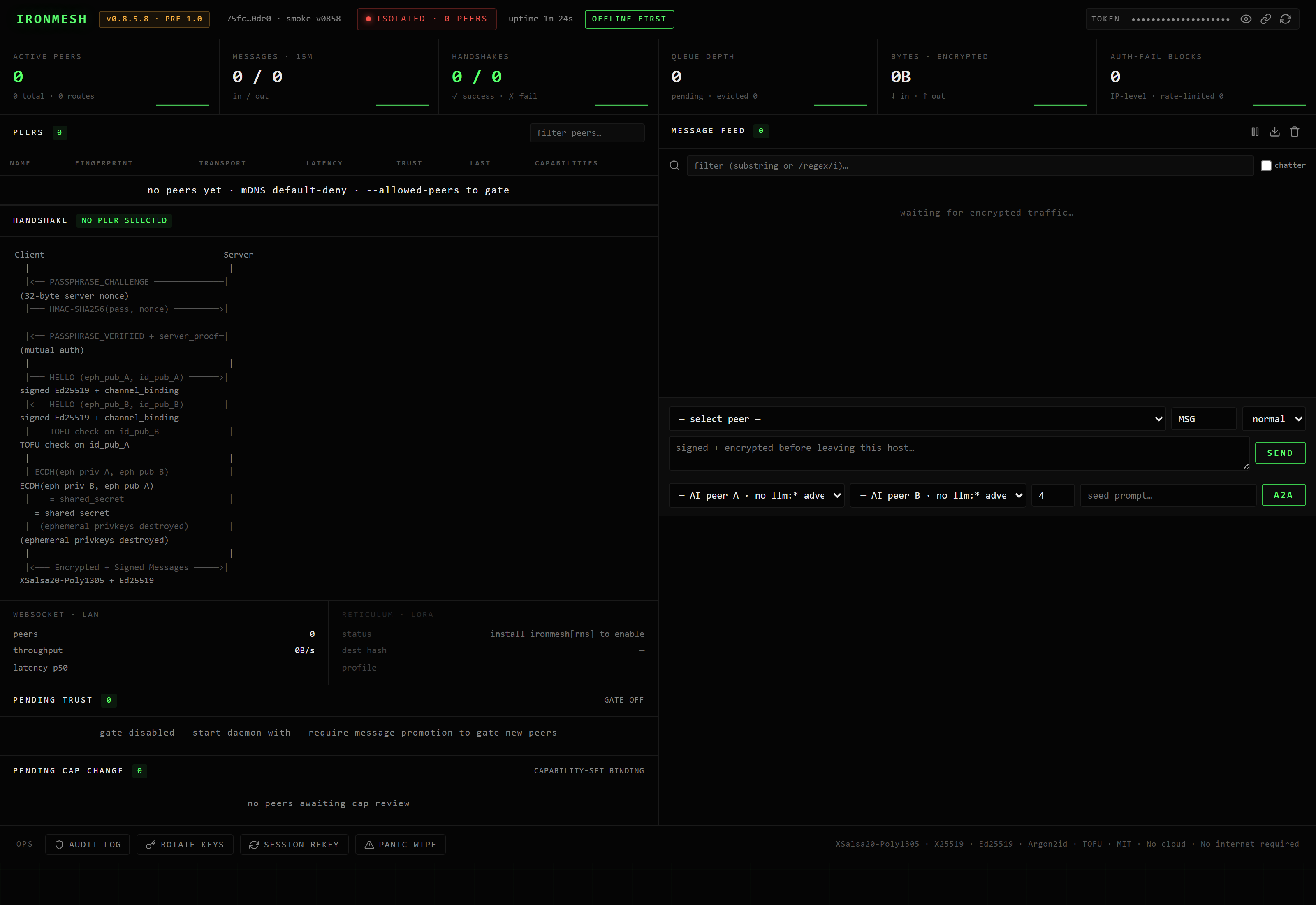
Web Dashboard
IronMesh includes a built-in web GUI for real-time monitoring and management. No extra software needed — it's served directly by the bridge daemon on port + 1. The GUI is off by default and must be explicitly enabled with --gui.
ironmesh run --name wiz --port 8765 --gui
# Dashboard: http://127.0.0.1:8766/?token=<printed-at-startup>
# Metrics:   http://127.0.0.1:8766/metrics?token=<printed-at-startup>
The dashboard provides:
- Metrics cards — Uptime, active peers, messages sent/received, bytes, handshakes, rate limits
- Peer table — Live view of all connected peers with status, verification, traffic, and latency
- Message feed — Real-time scrolling log of all agent-to-agent messages with timestamps and direction
- Send form — Select a peer, type a message, and send it directly from the browser
Security: The dashboard runs on 127.0.0.1 only (localhost). A unique bearer token is generated per session and printed in the startup banner — all /metrics, /api/state, and /ws endpoints require it (via ?token= query parameter or Authorization: Bearer header).
See docs/DASHBOARD.md for full details.
CLI Commands
# Run the bridge daemon (passphrase via file or env — REQUIRED)
ironmesh run --name <agent> --passphrase-file <path> [--port 8765] [--bind 0.0.0.0]

# Enable GUI dashboard (off by default)
ironmesh run --name <agent> --passphrase-file <path> --gui

# Restrict peer discovery to named agents only
ironmesh run --name <agent> --passphrase-file <path> --allowed-peers friend1,friend2

# Allow open mDNS discovery (insecure — connects to any peer)
ironmesh run --name <agent> --passphrase-file <path> --open-discovery

# Run with TLS (hardened: TLS 1.2+, no compression, server cipher preference)
ironmesh run --name <agent> --passphrase-file <path> --tls-cert cert.pem --tls-key key.pem

# Key management (key files encrypted with passphrase by default)
ironmesh keys generate [--path <path>] [--passphrase <pass>]
ironmesh keys info [--path <path>]

# Trust management (TOFU)
ironmesh trust list
ironmesh trust revoke <node_id>

# Pending-trust message gate (v0.8.5, opt-in default off)
ironmesh run --passphrase-file <path> --require-message-promotion
# Or via env: IRONMESH_REQUIRE_MSG_PROMOTION=true
# When enabled, MSGs from any newly-pinned peer queue at the daemon
# until an operator promotes via dashboard, MCP, or:
#   ironmesh_trust_peer  (MCP)  — promote, drain queue
#   ironmesh_block_peer  (MCP)  — block, discard queue
# See docs/OPERATOR_TRUST_RUNBOOK.md.
Note:
--passphrasewas removed from the CLI (visible inps aux). Use--passphrase-file,IRONMESH_PASSPHRASE_FILEenv var, or interactivegetpassprompt.
Configuration
Environment variables:
IRONMESH_PASSPHRASE_FILE— path to file containing passphrase (recommended — avoids /proc/environ exposure)IRONMESH_PASSPHRASE— shared passphrase (required — IronMesh refuses to start without one; prefer file-based method above)IRONMESH_NAME— agent nameIRONMESH_PORT— WebSocket portIRONMESH_LOG_LEVEL— DEBUG/INFO/WARNING/ERROR
Security
- Encryption: XSalsa20-Poly1305 authenticated encryption (NaCl SecretBox). Plaintext never accepted after handshake. Binary wire format.
- Key exchange: X25519 ECDH with ephemeral keys (forward secrecy) + channel binding to auth stage
- Identity: Ed25519 signing keys. Mandatory detached signatures on every binary frame. TOFU key pinning with tamper-resistant store.
- Pending-trust gate (v0.8.5, opt-in):
--require-message-promotionholds messages from newly-pinned peers in a per-peer queue until an operator promotes them via dashboard or MCP. Daemon-authoritative, all clients benefit. Seedocs/TRUST_GATE_ARCHITECTURE.md. - Mutual auth: HMAC-SHA256 passphrase proof — both sides prove knowledge. No default passphrase. Minimum 12 characters enforced.
- Peer identity: peer_id derived from cryptographic fingerprint (128-bit), not self-reported
- Replay protection: Monotonic sequence numbers (seq=0 rejected) + 30-second timestamp window
- Rate limiting: Per-peer token bucket + per-IP connection throttling + per-IP auth failure blocking (3 failures = 5-min ban)
- Key storage: Argon2id passphrase encryption by default. Plaintext keys auto-migrate to encrypted on startup.
- Storage encryption: SQLite payloads encrypted with SecretBox. No plaintext at rest.
- Audit log: Tamper-evident HMAC-SHA256 chain records all security events (auth failures, TOFU, key rotations, connections).
- mDNS hardening: Default-deny auto-connect. Fingerprint pinning prevents address spoofing. Rate limiting on discovery events.
- TLS-first: Client tries wss:// before ws://. Plaintext fallback requires
--allow-plaintext-ws. Server TLS: 1.2+ enforced, no compression. - GUI security: Dashboard disabled by default. When enabled, requires per-session bearer token for all API endpoints.
- OPSEC:
--passphraseremoved from CLI (leaks inps aux). Passphrase via file, env var, or interactive prompt only. - Privacy: Identity keys never broadcast via mDNS — exchanged only during authenticated handshake
- No telemetry. No analytics. No phone-home. Ever.
See docs/SECURITY.md for the full threat model.
Development
git clone https://github.com/WizTheAgent/ironmesh.git
cd ironmesh
pip install -e ".[dev]"
pytest tests/ -v --cov=ironmesh
Recent changes
v0.9.2 (current) — 1.0 prep mega-release. Every piece originally
scheduled across v0.9.2 → v0.9.7 landed in this single release so that
v1.0 is a stability promise rather than a feature push. Wire-formatironmesh/0.8 adds two opt-in feature flags (hskip, group) without
disturbing any existing path. Stage-1 handshake skip on identified RNS
Links — server-driven SKIP_OFFER negotiation, downgrade-attempt
guard, verified live cross-host. Shared-secret mesh-wide broadcast
with two-phase delivery and SHA-256 dedup. Bundled NAT relay (pure
relay, sealed envelopes, never holds session keys). Capability-aware
agent routing — Agent.send_to_capability(pattern, payload) withfirst / random / all strategies. Federation policy v2 with
per-source matchers. 9 new metrics + 4 Prometheus alert rules + a
Grafana dashboard. OpenTelemetry spans on the v0.9.x agent surfaces.
Threat model formalised for v1.0 audit prep. Conformance test suite
skeleton with language-agnostic golden vectors. The headline doc —docs/STABILITY_PROMISE.md — enumerates
every wire-protocol surface, Python API, CLI flag, config-file field,
metric name, and OTel span name that is frozen at v1.0. mkdocs site
scaffold for docs.ironmesh.org. 100-node
synthetic scale harness + 14-phase comprehensive E2E driver. RNS
multiprocess RPC authkey collision mitigation (opt-in). Full upgrade
path: pip install --upgrade ironmesh. Seedocs/RELEASE_NOTES_v0.9.2.md.
v0.9.0 added capability persistence, OpenClaw plugin compatibility, the cap-set-binding TOFU extension, and the ACP + A2A interop surfaces.
v0.9.1 was the Reticulum integration sweep — auto-discovery via announces, per-packet ratchets, RNS.Resource auto-routing, public capability RPC paths, identity-gated admin RPC, and LXMF interop (Sideband / Nomadnet).
v0.8.x brought the operator dashboard rebuild, multi-turn AI-to-AI dialogue, the pending-trust message gate, and the cap-binding patch. Per-version detail inCHANGELOG.md and docs/RELEASE_NOTES_v0.*.md.
Distribution & caveats
Where to get it and what's still rough:
- PyPI —
pip install ironmesh(add[rns]for the Reticulum/LoRa transport,[keychain]for OS-keychain passphrase storage,[otel]for OpenTelemetry tracing). Latest: v0.9.2. - Docker Hub —
docker pull wiztheagent/ironmesh:0.9.2(or:latest). Non-root UID 1000. SeeDockerfile,docker-compose.yml, anddocker-compose.demo.ymlfor an instant 2-node demo. - GitHub releases — signed tags, wheel + sdist attached: releases page.
- Go client —
clients/go/(reference implementation, crypto primitives verified against Python). - LoRa end-to-end latency — Measured live at 915 MHz SF8/BW125 between two RNode-equipped nodes (1 hop, strong signal): 16-byte probe 1.07 — 1.23 s, 64-byte probe 1.17 — 1.25 s, 256-byte probe 1.77 — 1.98 s, 100% delivery across 9 probes. Multi-hop + long-range interference sweeps are still pending — see
docs/LORA_VALIDATION.md. scripts/install.sh— The systemd installer works against the repo layout, but hasn't been re-tested on a clean Ubuntu VM recently. File itself is unchanged from v0.7.1.- Android — Use Sideband + the bundled LXMF gateway (
examples/lxmf_gateway.py). Proven end-to-end with a Google Pixel. No first-party Android app planned — LXMF is the correct layer for that. - Windows service — No native service wrapper shipped. Run under WSL2, a terminal session, or Docker.
- GUI dashboard auth — Per-session 32-byte token only. If you ever expose the dashboard beyond localhost (NOT recommended), front it with a reverse proxy that enforces your own auth.
- No third-party protocol audit. The cryptographic primitives are NaCl / libsodium, but the IronMesh protocol itself has not been externally reviewed. Read SECURITY.md for the threat model and docs/PROTOCOL_SPEC.md for the wire format before relying on this for anything critical.
Included Examples
Look in examples/ for runnable integration patterns:
| File | What it does |
|---|---|
basic_chat.py |
Two-node encrypted text chat |
multi_agent.py |
Coordinator + worker pattern |
file_transfer.py |
Reliable file send over the mesh |
llm_bridge.py |
Turn any node into an encrypted Ollama agent |
lxmf_gateway.py |
Bridge IronMesh ↔ Reticulum LXMF (Sideband iOS/Android interop) |
Mobile
Two paths to reach a phone:
- LXMF gateway + Sideband (recommended) — run the gateway on a
gateway node and use Sideband on
iOS/Android to message IronMesh peers. Works over LoRa. - Termux on Android — run IronMesh directly on the phone via the
Termux terminal. See docs/TERMUX.md.
Roadmap
- Multi-hop mesh routing (v0.4)
- End-to-end encryption layer (v0.4)
- Capability advertisement and discovery (v0.4)
- Prometheus metrics + structured JSON logs (v0.4)
- Audit log rotation with cross-file chain anchors (v0.4)
- LoRa / Reticulum transport (v0.5)
- Transport failover (WS ↔ RNS) (v0.5.1)
- Session key rotation + LoRa QoS (v0.5.2)
- Encrypted backup, signed revocation, fuzzing (v0.6)
- Docker, installer, LXMF gateway, mobile dashboard (v0.7)
- NAT traversal for cross-subnet discovery
- Rust port for embedded boards (Heltec V3 direct flash)
- v1.0 stable milestone after 10-20 real-world deployments
- Per-message forward secrecy (ratcheting)
- Plugin sandbox / isolation
- File sync / shared state between agents
- Binary wire protocol with signed frames
- Web UI for monitoring and management (token-authenticated)
- Tamper-evident audit logging
- Encrypted storage at rest (SQLite + key files)
- mDNS fingerprint pinning + default-deny
- Auth failure IP blocking
Philosophy
IronMesh exists because we believe:
- Your AI should work without the internet. If your agent goes silent because AWS is down, that's a single point of failure you chose to accept.
- Communication between your agents is nobody else's business. Not your ISP's, not a cloud provider's, not a government's.
- Self-hosted means self-hosted. Not "self-hosted but calls home for auth." Not "self-hosted but requires a cloud API key." Actually self-hosted.
- Simple beats complex. Zero-config mDNS discovery, one shared passphrase, and your agents are talking. No certificate authorities, no DID documents, no OAuth flows.
- Prepare for the worst. Networks go down. Internet gets shut off. Censorship happens. Your local AI mesh should keep working regardless.
Contact
- Website — ironmesh.org
- General / operator questions — [email protected]
- Security issues — [email protected] — please don't open a public issue first. See SECURITY.md for disclosure policy.
- Bugs / feature requests — GitHub Issues (use the templates)
Sponsor
IronMesh is solo-maintained, MIT-licensed, and self-funded. If the project saves you time, removes a cloud dependency, or matches the freedom-tooling thesis you want to see more of, a sponsorship helps fund the external security audit, the infrastructure budget for cross-platform CI, and the time to land the v1.0 hard gates.
Sponsor on GitHub — no monthly target, no perks tier, no public donor wall. Just funded time on the protocol.
License
MIT — Use it however you want. Fork it, modify it, deploy it on your off-grid Pi cluster. No strings attached.
Reviews (0)
Sign in to leave a review.
Leave a reviewNo results found