aigent-os
Health Uyari
- License — License: MIT
- Description — Repository has a description
- Active repo — Last push 0 days ago
- Low visibility — Only 5 GitHub stars
Code Basarisiz
- exec() — Shell command execution in daemons/memory-heat/compute-heat.js
- process.env — Environment variable access in daemons/memory-heat/compute-heat.js
- fs module — File system access in daemons/memory-heat/compute-heat.js
Permissions Gecti
- Permissions — No dangerous permissions requested
Bu listing icin henuz AI raporu yok.
An open-source operating system for Claude Code - persistent Obsidian-vault memory, an /open + /close session rhythm, a subagent Pantheon, context hooks, and background daemons. Markdown + shell, no database, no build step. MIT.





The personal operating system that operates itself.
An AI that operates on itself — and a toolbox that manages itself, on top of it.
Quick Start · Architecture · Key Concepts · Customize · Docs
What if your AI remembered everything?
Every priority. Every decision. Every conversation thread left open from last week. What if it knew exactly what it was allowed to decide on its own — and what to bring to you? What if it could delegate to faster, cheaper agents for grunt work while it stayed focused on strategy?
That's aigent-OS. A 15-document kernel (plus extended specs) that turns Claude Code into a persistent operating system.
No database. No server. No build step. Drop the files in, open a session, and your AI boots up knowing who it is, what it's working on, and what matters today. The system is also recursive — aigent-OS uses its own skills to maintain and publish itself. (How this repo maintains itself · Manifesto)
Dependency model: The core kernel is markdown + shell — no build step, no database, no server. Optional features (semantic search, hooks automation) require Node.js 18+ and are installed automatically by the installer if Node is present. Obsidian is optional for visual vault navigation.
You: /open
aigent: 3 open threads from yesterday. Delegation tracker has 2 items pending review.
       Priority 1 is blocked — surfacing now. What do you want to hit?
v0.7 (2026-05-09): Cognitive architecture shipped — runtime consciousness (ACTIVE_STATE computed on every /open and /close), persistent self-model (capabilities, limitations, failure modes), goal stack with success criteria, belief tracking with confidence scores, operational lessons + procedures, /dream offline consolidation, /reconcile cross-system consistency checks, /meta-improve constrained self-modification, eval harness. aigent-OS now models itself, tracks what it believes, detects drift, and proposes its own improvements. See The Cognitive Architecture below.
v0.6 (2026-05-08): Self-learning engine — skill recall + taxonomy search, capability expansion, capsule v2, temporal fact ledger, failure-to-artifact pipeline. See The Self-Learning Engine below.
v0.5 (2026-05-03): Somatic layer shipped — body-check reflection, context capsules, agent fitness tracking, system-check audits. See The Somatic Layer below.
⚡ Quick Start
Install from your downloaded folder:
You've already downloaded and unzipped aigent-OS. Open a terminal in the unzipped folder and run:
bash install.sh
That's it. aigent-OS installs into whatever directory you're in — your existing project, your home folder, wherever you work. No new directory to switch to.
The installer handles everything automatically: copies the kernel files, creates .claude/settings.json with your actual paths substituted, and installs semantic search if Node.js is available.
Optional
--no-deps: If you want to skip the Node.js semantic-search install, runbash install.sh --no-depsinstead.
Start a new Claude Code conversation in the same directory. aigent-OS is live.
Every session works like this:
- Start:
/open— aigent-OS boots with full context from last session - Work: Just talk. aigent-OS handles routing, memory, delegation.
- End:
/close— Saves everything. Next session picks up exactly where you left off.
Optional: Open the vault/ folder in Obsidian to see and navigate your AI's knowledge graph visually.
Full setup walkthrough: Getting Started · Advanced config: Advanced Setup
🗂 Repo Map
system/                            The 15-document operating kernel (00_identity → 15_somatic_layer)
vault/                             Persistent memory and knowledge graph (markdown, Obsidian-native)
vault/agents/                      Instrument roster — 9 named sub-agents (Pantheon Round 4)
skills/                            Claude Code slash-command skills (60+ source templates)
hooks/                             Automation hook scripts (session summary, token tracking, compact nudge)
daemons/                           Background helpers (Caddy, semantic search, memory-heat, runtime state)
daemons/runtime/                   Runtime consciousness daemon (update-active-state.py)
docs/                              Setup guides, doctrine references, architecture roadmaps
memory/                            Ledger templates (SKILL_LEDGER, SKILL_GAPS, SKILL_CHAINS, facts/)
memory/runtime/                    Cognitive layer (ACTIVE_STATE, SELF_MODEL, GOAL_STACK, BELIEF_STATE, LESSONS, PROCEDURES)
memory/runtime/improvements/       Self-improvement archive (candidates, accepted, rejected)
evals/                             Evaluation test definitions (skill-recall, contradiction, capsule-resume)
install.sh                         One-line installer

system/15_somatic_layer.md         Somatic doctrine (body state, lazy compute, organs)
memory/BODY_STATE.json             Current internal-state snapshot
memory/AGENT_FITNESS.md            Per-dispatch fitness ledger
memory/MEMORY_CANDIDATES.md        Staged auto-capture queue
daemons/system-check.sh            Smoke test for skills, daemons, state files
daemons/capsule-compact.py         Chain compaction
daemons/agent-fitness-extract.py   JSONL transcript → fitness classifier
daemons/agent-fitness-report.py    Per-agent calibration report
Skills path note:
skills/in this repo contains source templates. The installer copies them to.claude/skills/in your working directory, which is where Claude Code looks for slash commands at runtime. If you add skills manually, place them in.claude/skills/<name>/SKILL.md.
👀 What a session actually looks like
You: /open

AI:  3 open threads from yesterday.
     - Pricing decision pending (you said you'd think on it overnight)
     - Engineering brief for the auth refactor needs your sign-off
     - Onboarding flow draft ready for your review

     Active priorities:
     1. Close the bridge round (blocked on legal review)
     2. Ship onboarding v2 (in progress, ~70% done)
     3. Hire #5 engineer (interviews scheduled this week)

     Last session you were heads-down on the onboarding flow.
     Want to pick that up, or hit one of the open threads first?

You: pricing first. Going with $49 annual, $59 monthly.

AI:  Locked. I'm writing it to vault/concepts/Pricing Strategy.md and
     logging the decision in DECISION_LOG. Reasoning captured: 17%
     monthly premium is standard SaaS, annual-pre-pay customers
     churn 4× less. Want me to also draft the pricing-page copy
     change for engineering, or is that part of onboarding v2?

You: part of v2.

AI:  Got it. Updating the Onboarding v2 project note. Anything else
     before we move on?

[... 90 minutes of work ...]

You: /close

AI:  Session captured. Summary written to vault/daily/2026-04-25.md.

     What you decided today:
     - Pricing: $49/$59 split. Logged.
     - Onboarding v2: ship Friday, no further scope additions.

     Open threads carrying to next session:
     - Engineering brief still pending sign-off
     - Hire #5 — call back to candidate B by Tuesday

     See you tomorrow.
That's the loop. /open → work → /close. The vault remembers everything. Next session picks up exactly where you left off. See vault/examples/ for what populated content actually looks like.
🎯 Who this is for
aigent-OS is built for principals running complex parallel work — not for developers building agent pipelines.
- Solo founders juggling product, hiring, fundraising, and ops simultaneously.
- Technical leads managing multiple workstreams across teams.
- Operators in any role where the job is to make decisions, route work, and not lose context.
If you've ever closed your laptop on Friday and opened it Monday wondering what the hell you were in the middle of — that's the problem this solves. The AI remembers so you don't have to.
If you're building an agent framework for end-users to consume, you probably want LangChain or CrewAI instead. aigent-OS optimizes for one principal, many threads, persistent context.
🆚 Compared to alternatives
| aigent-OS | Plain CLAUDE.md | MemGPT / mem0 | LangChain / CrewAI | |
|---|---|---|---|---|
| Persistent memory across sessions | ✅ | ❌ | ✅ | depends |
| Human-readable knowledge | ✅ Markdown | ✅ Markdown | ❌ embeddings | ❌ embeddings |
| Authority / autonomy framework | ✅ | ❌ | ❌ | partial |
| Sub-agent routing + delegation | ✅ | ❌ | ❌ | ✅ (different shape) |
| No database / server / build step | ✅ | ✅ | ❌ | ❌ |
| Built for principals, not developers | ✅ | ❌ | ❌ | ❌ |
| Obsidian-native vault | ✅ | ❌ | ❌ | ❌ |
The honest tradeoff: aigent-OS is opinionated. If you want a flexible toolkit you build on, pick LangChain. If you want a memory layer for an existing AI app, pick mem0. If you want your AI to actually run your operating cadence — /open, work, /close, week after week — pick this.
🫀 The Somatic Layer
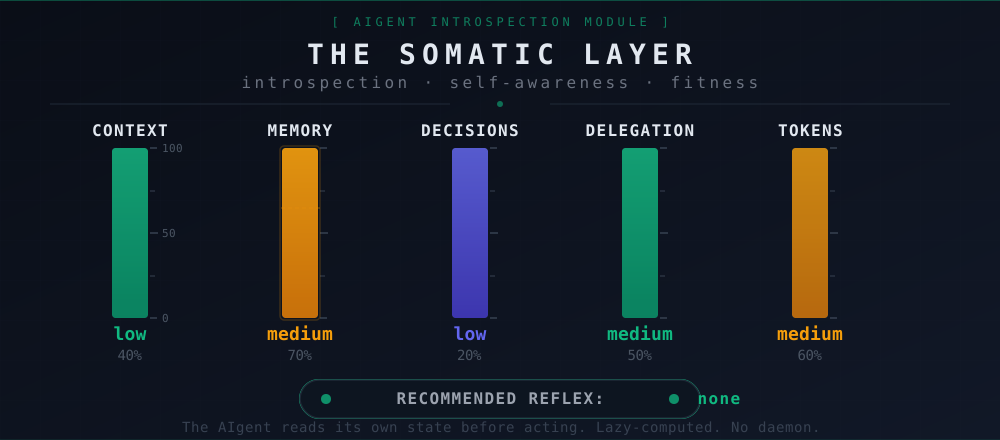
Released 2026-05-03. The somatic layer gives the OS a body — a way to read its own state (context pressure, memory backlog, decision pressure, token usage, attention drift) before acting. Lazy-computed, no daemon. Includes session-resume capsules, agent fitness tracking, and a /system-check reflection organ.
| Skill | When to invoke | What it does |
|---|---|---|
/body-check |
"how am I doing" / pre-action gut-check | Reads pressure signals across vault, surfaces recommended reflex |
/context-capsule |
Context pressure rises OR task completes | Structured state preservation, resume-ready |
/capsule-compact |
Manual, on long capsule chains | Walks chain backward, summarizes oldest 3 once depth ≥ 5 |
/digest |
Review staged memory candidates | Surfaces each with promote/skip/supersede options |
/agent-fitness |
Pre-dispatch agent quality check | Per-agent calibration ratios from JSONL transcripts |
/sweep-now |
On-demand vault hygiene | Dispatches Hestia for stale tracker / heat / wikilink sweep |
/system-check |
Manual diagnostic | Smoke-tests every wired skill, daemon, state file |
🧠 The Self-Learning Engine
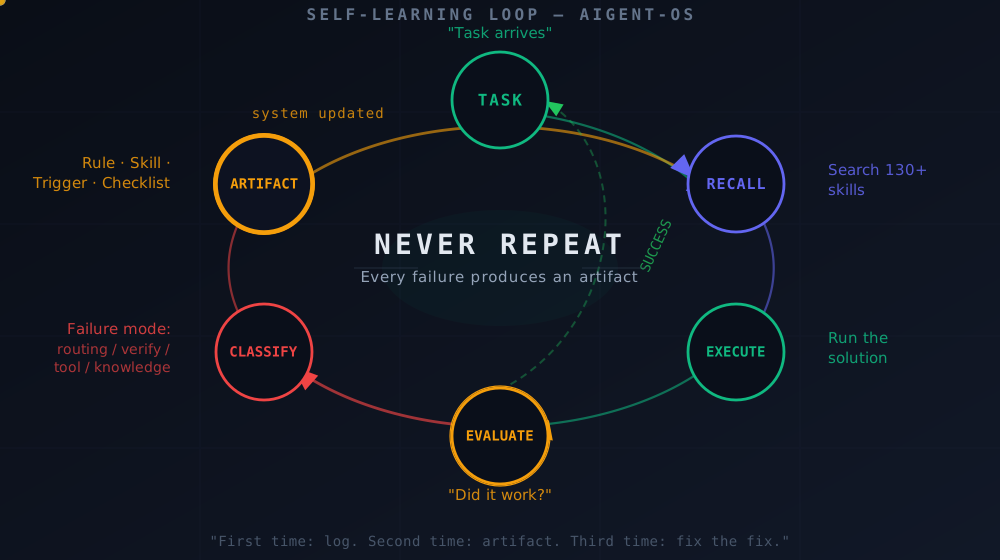
Released 2026-05-08. The self-learning engine makes aigent-OS a system that expands its own capability surface. It never stops at inability — it recalls, hunts, workarounds, learns, and captures every failure as a durable artifact. All of this is automatic. The user only types /open and /close.
Core capabilities
| Capability | What it does | How it fires |
|---|---|---|
| Skill Recall | Searches 64 skills by taxonomy when you describe a task | Caddy auto-fires on every prompt |
| Skill Hunt | Searches GitHub and skill marketplaces for missing capabilities | Auto-fires when recall finds no match |
| Solution Hunt | Finds 3 alternate routes when blocked (direct fix, workaround, replace) | Caddy fires on "stuck", "blocked", "can't do" |
| Learn from Failure | Classifies failures, checks repetition, produces durable artifacts | Caddy fires on "happened again", "same issue" |
| Capsule v2 | Resumable execution state with waiting_on, success_criteria, next_action | /close creates; /open offers resume |
| Temporal Facts | Facts with provenance, validity windows, supersede chains | /close auto-captures new facts |
| Skill Gap Scan | Weekly scan for open gaps older than 7 days | /open auto-runs |
How it works
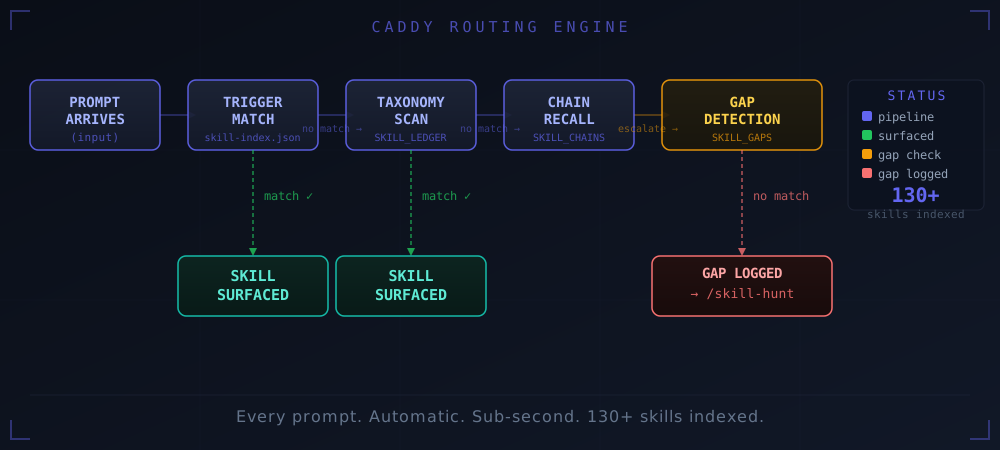
Task arrives → Caddy classifies intent
  → Search skill-index triggers (fast, regex)
  → Search SKILL_LEDGER taxonomy (broader, keyword)
  → Search SKILL_CHAINS for prior successful sequences
  → If all miss: log gap, auto-hunt GitHub

Failure occurs → Classify (routing / verification / tool / knowledge / authority)
  → Check FAILURE_MODES for repetition
  → First time: log and monitor
  → Second time: mandatory artifact (rule, skill, Caddy trigger, checklist)
  → Third time: the artifact itself failed — fix the fix
Key files
| File | Purpose |
|---|---|
memory/SKILL_LEDGER.md |
Taxonomy-structured index of all installed skills |
memory/SKILL_GAPS.md |
Capability gaps discovered during recall |
memory/SKILL_CHAINS.md |
Proven multi-skill sequences |
memory/facts/facts.jsonl |
Temporal fact ledger with provenance |
docs/capability-expansion-doctrine.md |
The expansion loop doctrine |
docs/self-learning-doctrine.md |
Failure-to-artifact pipeline |
docs/capsule-v2-doctrine.md |
Resumable execution state design |
docs/temporal-fact-ledger.md |
Facts with validity windows |
docs/caddy-skill-recall-integration.md |
How Caddy does taxonomy search |
Recommended third-party skills
These are not included in aigent-OS but are tested and recommended. Install with /skill-hunt or manually copy to ~/.claude/skills/<name>/SKILL.md:
| Skill | Source | License | What it does |
|---|---|---|---|
| sql-builder | claude-skills-hub | CC BY 4.0 | Natural language to optimized SQL |
| query-optimizer | claude-skills-hub | CC BY 4.0 | EXPLAIN plan analysis + index recommendations |
| migration-generator | claude-skills-hub | CC BY 4.0 | Zero-downtime database migrations |
| git-workflow | freeman983/git-workflow-skill | MIT | Changelog, release, branch strategy |
| pdf-workflow | claude-skills-hub | CC BY 4.0 | PDF creation, extraction, merge/split |
| data-visualization | claude-skills-hub | CC BY 4.0 | D3/Chart.js chart builder |
| api-docs | claude-skills-hub | CC BY 4.0 | OpenAPI 3.0 spec generation |
| api-design | setmpp/claude-code-skills | MIT | REST/GraphQL resource modeling |
🧬 The Cognitive Architecture
Released 2026-05-09. The cognitive architecture gives aigent-OS a persistent self-model, structured beliefs, goals that survive sessions, and the ability to improve itself through a human-gated dream cycle.
The 4-Level Learning Stack
| Level | What it learns | File |
|---|---|---|
| 1. Facts | What is true? | memory/facts/facts.jsonl |
| 2. Procedures | What works? | memory/runtime/PROCEDURES.jsonl |
| 3. Strategies | How to approach problem classes? | memory/runtime/LESSONS.jsonl |
| 4. Self-modification | How to improve the improver? | /dream + /meta-improve |
Runtime Consciousness
| File | Purpose |
|---|---|
ACTIVE_STATE.json |
Computed live state — mode, objective, pressures, reflexes, blocked items |
SELF_MODEL.json |
Capabilities, limitations, recurring failure modes, learning goals |
GOAL_STACK.json |
Persistent goals with status, success criteria, blockers, dependencies |
BELIEF_STATE.jsonl |
Uncertain assumptions with confidence scores and provenance |
STATE_EVENTS.jsonl |
Nervous system event log — every state transition |
LEARNING_SCORECARD.md |
Meta-learning metrics — did the learning actually prevent recurrence? |
Autonomous Capabilities (all aigent-OS-internal)
| Skill | What it does | When it fires |
|---|---|---|
/reconcile |
Cross-system consistency check — goals vs priorities vs beliefs vs facts | Weekly on /open |
/dream |
Offline consolidation — review sessions, propose improvement candidates | After /close or weekly |
/meta-improve |
Implement approved improvements via branch-test-approve-merge | When /dream candidates are approved |
/status |
12-line operational heartbeat summary | On demand |
Safety Boundary
/dreamproposes./meta-improveimplements on a branch. Only Will approves merges. aigent-OS may never self-approve, self-merge, or expand its own authority.
See docs/meta-aigent-doctrine.md for the full safety framework.
🏗 Architecture
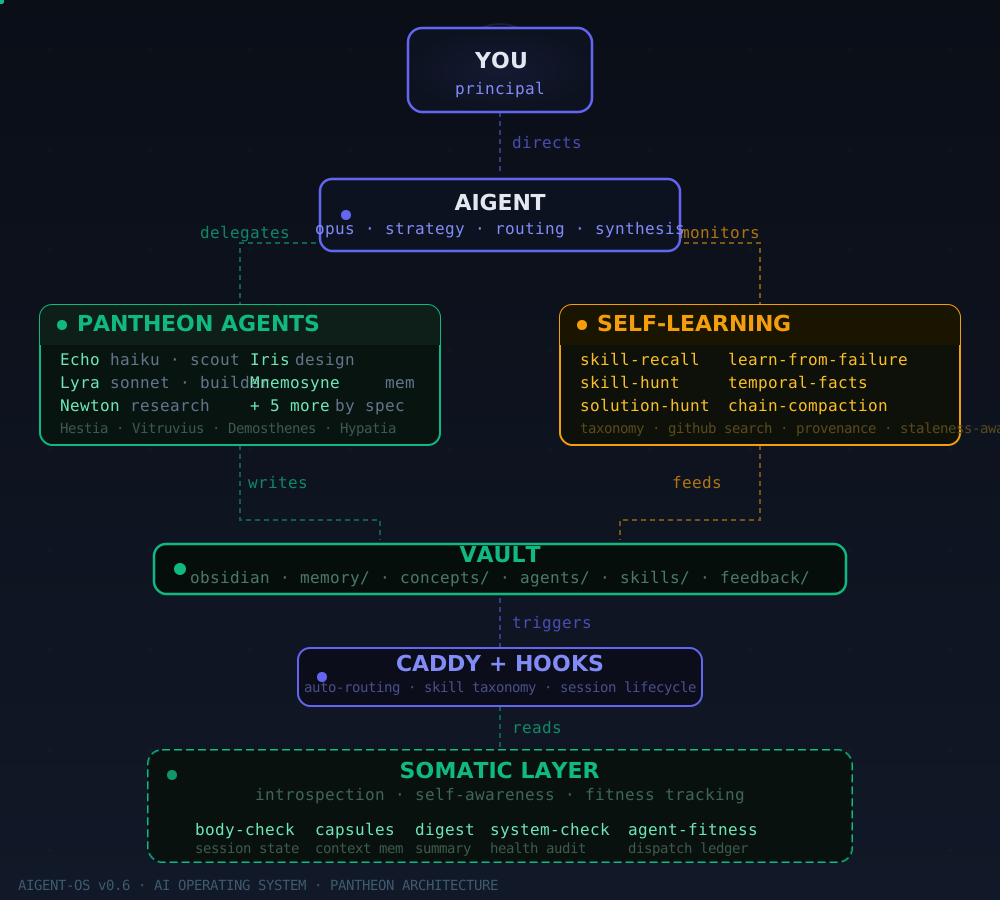
15 System Documents — The Operating Kernel
These aren't prompts. They're a complete operating manual that tells the AI how to think, decide, delegate, remember, and manage your time.
| Document | What It Gives Your AI | |
|---|---|---|
00 |
Identity | Knows who it is and what it optimizes for |
01 |
Ethos | Won't sugarcoat, won't hedge, won't waste your time |
02 |
Operating Standards | 15 rules it follows without being told |
03 |
Roles & Scope | Routes work to the right agent automatically |
04 |
Decision Frameworks | 12 lenses for evaluating any opportunity |
05 |
Delegation Protocol | Structured briefs — no sloppy handoffs |
06 |
Sub-Agent Interface | Clean communication up and down the chain |
07 |
Time Management | Protects your calendar like a chief of staff should |
08 |
Financial Thinking | Revenue, profit, cash flow — not vibes |
09 |
Sub-Agent Manifest | Creates specialists only when it creates leverage |
10 |
Memory & Learning | Gets smarter every session. Tracks patterns. Learns from mistakes. |
11 |
Session Rhythm | /open → work → /close — nothing falls through cracks |
12 |
Authority Matrix | Knows its lane. Asks when it should. Acts when it can. |
13 |
Memory Layer | 4-tier vault architecture with staleness rules |
14 |
Your Decision Logic | YOUR brain encoded — customize this completely |
15 |
Somatic Layer | Internal-state reflection (body, capsules, fitness) |
Hooks — The Nervous System
Runs silently in the background. You don't think about it.
| Hook | What It Does |
|---|---|
| Auto-Capture | Every action logged to your daily note. Automatic. |
| Session Summary | Actions, tools, files touched — stats at session end |
| Token Tracker | Cost per session, cumulative spend, logged to vault |
| Compact Suggest | Nudges context management before you hit limits |
| Close Reminder | Never forgets to commit memory |
Semantic Search — The Recall System
Your vault, searchable by meaning. Not keywords — meaning.
$ node daemons/semantic-search/search-vault.js "what did we decide about pricing"

  1. [0.89] concepts/Pricing Strategy.md — "Freemium with usage-based upgrade..."
  2. [0.76] memory/DECISION_LOG.md — "2026-03-15: Set launch price at $49/mo..."
  3. [0.71] projects/SaaS Launch.md — "Pricing must clear $40 to cover CAC..."
Runs locally. all-MiniLM-L6-v2 on your machine. No API calls. No data leaves your device.
🔑 Key Concepts
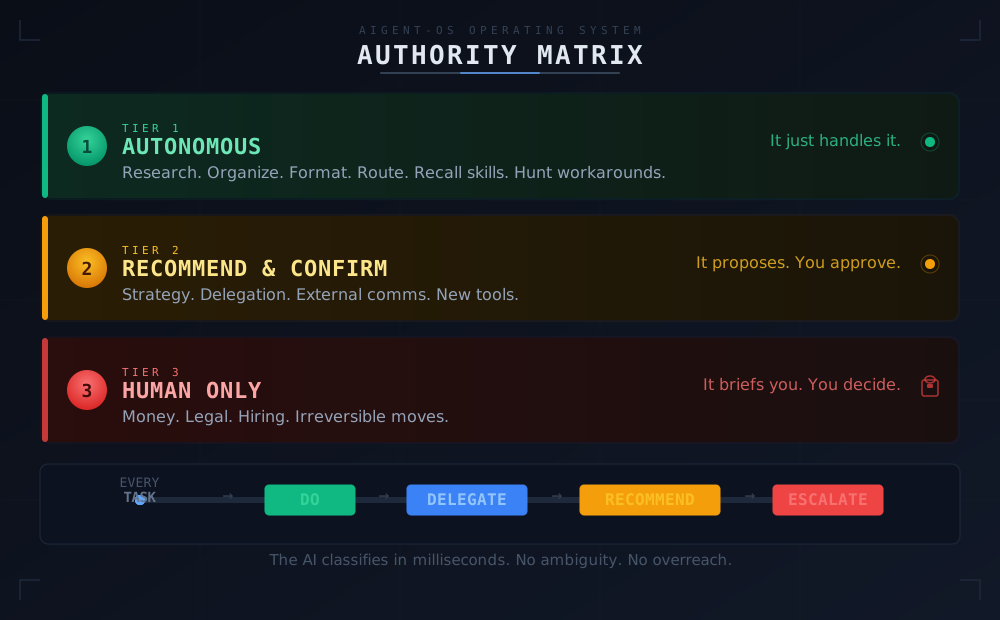
The Authority Matrix
The Caddy Skill Router
The Somatic Layer
The Self-Learning Loop
Vault as Brain
Forget vector databases. Your AI's memory is an Obsidian vault — the same tool you can open, read, search, and navigate yourself.
- Wikilinks create a knowledge graph.
[[Project Alpha]]connects to[[People/Jane]]connects to[[Decision Log]]. The graph IS the intelligence. - Session continuity without magic.
/openreads the vault./closewrites to it. Everything persists. Everything is auditable. - Human-first. You can read every thought your AI has ever had. No hidden embeddings. No opaque database. Markdown files in a folder.
Model Routing — Smart Spend
Why burn frontier tokens on reading a file?
| Task | Model | Cost |
|---|---|---|
| Read files, load context | ⚡ Fast | ~$0.001 |
| Write code, draft content | 🔧 Mid | ~$0.01 |
| Strategy, complex judgment | 🧠 Frontier | ~$0.10 |
aigent-OS routes automatically. Same quality output. 60-80% lower cost.
Caddy — The Skill That Finds the Right Skill
AI frameworks collect skills faster than anyone actually uses them. You write a skill for URL extraction, another for codebase navigation, another for deep research — and three weeks later you're back to using WebFetch, Grep, and WebSearch because you forgot the specialized tools exist.
Caddy fixes this. A non-blocking hook runs on every prompt you submit. It matches your words against a catalog of every skill the framework knows about, and surfaces the one that fits:
You: help me navigate the codebase for the login bug
[CADDY] /graphify - Turn a codebase into a navigable knowledge graph
[CADDY] /codebase-reasoning - Load architectural rules + verification doctrine

Claude: Running /graphify first, then we'll map the auth flow...
Like a golf caddy — hands you the right club for the shot, never blocks the swing. Zero errors, zero false-positive cost. Wrong suggestion? Ignored, move on.
The golf bag stays complete. When a new skill is added (manual drop-in, or cloned from another repo), a PostToolUse hook detects it and emits a nudge to run /caddy-enroll. That command reads the skill's SKILL.md, extracts trigger patterns and use cases, and appends to the index. No maintenance, no drift.
This is one of aigent-OS's defining features — your AI's toolbox actually gets used.
🎨 Make It Yours
aigent-OS is opinionated but built to be forked.
Start here (10 minutes):
system/00_identity.md— Tell it who you aresystem/14_decision_framework.md— Encode how YOU make decisionssystem/12_authority_matrix.md— Set boundaries that match YOUR risk tolerance
Then build over time:
- Add your projects to
vault/projects/ - Add your people to
vault/people/ - Drop concepts into
vault/concepts/ - The vault grows with every session. It compounds.
🧬 Posture — the principal tunes, doesn't consume
Most AI tools are products you use. aigent-OS is a framework you tune.
The relationship the principal has with aigent-OS is closer to bio-hacking than to consuming software. Every intervention has a category — supplements (skills, hooks, doctrine), sleep optimization (the open/close loop, memory decay), stack tracking (token usage, session summaries, decision outcomes), restriction (the legibility constraint, the explicit "what I am not building" list), environmental design (the install path, conversational setup), stacks (the seven-layer architecture), protocols (daily/weekly/monthly cadences).
The framework is an organism being performance-engineered, not a product being used. This isn't aspirational positioning — it's the actual disposition the framework demands. Every existing piece of aigent-OS already implies it; the doctrine notes ([[Bio-hacking Posture]], [[What I Am Not Building]], [[Modern AI Infrastructure Stack]]) make it explicit.
If you install aigent-OS expecting it to "just work," it will disappoint you. If you install it ready to tune, measure, restrict, and iterate — it compounds.
🔁 How this repo maintains itself
The most differentiating thing about aigent-OS isn't a feature — it's that the framework operates on itself.
When the principal's local aigent-OS learns something new — a sharper rule, a doctrine note, a skill that generalizes — aigent-OS is the one that decides what graduates to the public repo, sanitizes the principal-private references out of it, drafts the commit message, and opens the pull request. The publish skill is itself one of aigent-OS's skills. The recursive layer is the actual category claim.
Three pieces make this work:
Per-file privacy classification. Every vault note and skill carries a
private: true | false | reviewflag in its YAML frontmatter. New files default toreview, surfacing them at next publish for explicit classification. No directory-based privacy convention to drift out of sync.Generalization test. Before any skill graduates from local to public, it runs against a single question: "would this be useful for at least three radically different principals — say, a SaaS founder, a non-profit director, and a creative production lead?" If the answer is fewer than three, it stays private.
Publish protocol with secret scanning. Every publish runs gitleaks (or equivalent) on every file before push. Hard fail on hits. A stray API key in a code block is the kind of mistake that kills credibility instantly — sanitization isn't enough.
The release log writes itself. Every aigent-OS-managed release appends to CHANGELOG.md: what shipped, what the sanitizer caught, what was held back and why, principal sign-offs at each authority gate. Institutional memory for the publishing process itself.
You can read it as it happens. Because the protocol is markdown — readable by you, readable by aigent-OS, readable by any other agent or tool — the recursive layer is legible. That's the legibility thesis. (full manifesto)
📏 Measurement layer — calibration over time
Most agent frameworks let the AI talk. Almost none measure how often it lies — in the sense of confident-but-wrong, the kind of failure that doesn't crash anything but slowly erodes trust over months until you can't tell whether the framework is helping or just performing.
aigent-OS measures that. Not as a punishment system — as a calibration system. The longitudinal data is the framework's bloodwork.
Three paired ledgers:
HONESTY_LEDGER.md— every/honesty-checkinvocation writes a structured entry: what was verified, what was inferred, what was guessed, what tradeoffs were made on the principal's behalf, what the agent stopped short of. Doctrine becomes data.TRUST_DECAY.md— two-phase ledger of confident agent claims and their eventual outcomes. Phase 1 captures the claim ("this is fixed"). Phase 2 resolves it later (held / drifted / reversed). The pairing is the whole point. Calibration = (confirmed correct) / (total claims captured), measured over time, by category.FAILURE_MODES.md— auto-built corpus from every verified/diagnoseoutcome. Patterns that recur 3+ times graduate to permanent doctrine. The framework hardens against the failures it has actually had.
Two doctrines that justify the measurement:
vault/concepts/Cost of Confidence.md— every confident claim that turns out wrong is a trust-decay event. Track them. Most frameworks become unreliable in ways nobody can pinpoint because nobody measures.vault/concepts/Reading Agent Output Defensively.md— companion to/honesty-checkfrom the principal's side. 10 patterns of confident-sounding bullshit + the standard push-back move.
Drift detection at session start:
/open runs two reconciliation checks before the normal protocol output:
- Decision aging — for every decision logged 30/60/90 days ago without an outcome captured, surface a one-line prompt. The principal answers in one word; the outcome appends to
DECISION_OUTCOMES.md. - Attention reconciliation — last 7 days of daily notes vs
ACTIVE_PRIORITIES.md. If a Tier 1 project is at <40% of intended share OR a non-priority project consumed >25% of attention, drift is flagged. Forces the principal to either re-prioritize or refocus.
The bet: a framework that measures its own calibration compounds. A framework that doesn't, decays. v0.2.2 shipped the substrate; v0.5 shipped the analyzers — AGENT_FITNESS.md ledger and daemons/agent-fitness-report.py are live. Per-agent calibration ratios populate from real session transcripts automatically via Stop hook.
This is the most credible single claim aigent-OS can make versus other personal-OS frameworks: the first one that measures its own AI's calibration over time.
❌ What This Isn't
Not a chatbot skin. No personality prompts. No "you are a helpful assistant." This is operational infrastructure.
Not a code framework. No npm install. No Python environment. No build step. The kernel is 15 markdown documents (plus a handful of extended specs).
Not a RAG system. The vault is human-readable by design. You don't need an AI to search your AI's memory — just open Obsidian.
Not another agent framework. LangChain and CrewAI are for developers building pipelines. aigent-OS is for principals — founders, executives, operators — who want an AI that actually operates.
🤝 Contributing
PRs welcome. See CONTRIBUTING.md for what lands well, what doesn't, and how to write rules that fit the existing style. Highest-value contribution areas:
- Decision framework lenses for new domains
- Hook scripts for additional Claude Code events
- Vault templates (engineering, legal, consulting, creative)
- Integration guides (Notion, Linear, Slack, n8n, Make)
- Sanitized examples for
vault/examples/
See CHANGELOG.md for release notes.
📄 MIT License — Use it however you want.
Built by Will Gwyn
Battle-tested across multiple ventures. Months of daily use.
This framework emerged from real operational needs — not theory.
If this saves you time, star the repo. That's all the thanks needed.
Yorumlar (0)
Yorum birakmak icin giris yap.
Yorum birakSonuc bulunamadi