jev-opus
Health Warn
- License — License: MIT
- Description — Repository has a description
- Active repo — Last push 0 days ago
- Low visibility — Only 5 GitHub stars
Code Warn
- process.env — Environment variable access in dist/claude/env.js
- process.env — Environment variable access in dist/cli.js
Permissions Pass
- Permissions — No dangerous permissions requested
No AI report is available for this listing yet.
Claude Opus 5.5 with the effort level re-decided every step by the TypeSafe Jev reflex — without breaking the prompt cache. CLI + Claude Code plugin.
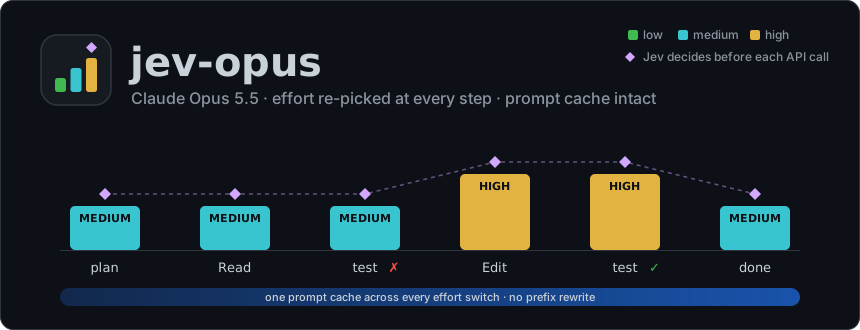
Claude Opus 5.5 with the effort level re-decided at every step, without breaking the prompt cache.


npm install -g jev-opus && jev-opus init && jev-opus claude
jev-opus runs Claude Code on claude-opus-5-5, either your normal interactive claude with an "Opus 5.5 · Jev" entry in /model, or a session it drives itself. The TypeSafe Jev System-1 reflex picks the effort level when a prompt arrives, then again after every tool batch, before Claude's next API call. A failing test raises the next step's effort. Once the same check passes, it steps back down. All of this happens inside one prompt.
A real run in Claude Code 2.1.281, fixing two bugs in a date library (jev-opus audit output):
D-fda4d1c7 · MEDIUM · 1 attempts (completed) · 808 observed output tokens
  difficulty 1.1/4 → low; debugging floor medium
D-aeab8b84 · MEDIUM → HIGH · 1 attempts (completed) · 381 observed output tokens
  failing checks → recovery effort; diagnosing → +1
D-b73cb943 · HIGH → MEDIUM · 1 attempts (completed) · 175 observed output tokens
  failing check now passes → release hold; verifying → -1
Why the cache survives
Normally, changing effort between requests changes the request prefix, which throws away the prompt cache. Opus 5.5 also accepts effort as a per-message statement inside the conversation. jev-opus only ever changes effort that way, and it keeps every statement in place on later requests, so the history the model saw never changes. Two modes, same guarantee:
jev-opus claude(gateway): your normal Claude Code → local gateway → Jev decides → effort statement inserted before the turn it governs → Anthropic API.jev-opus "task"(driver): runs Claude Code headless via the Agent SDK. After each tool batch, a hook callsapplyFlagSettings({ effortLevel }), which Claude Code sends as a per-turn statement.
Install
Requirements:
- Node ≥ 22.18
- Claude Code 2.1.280 or newer, logged in (
claude auth login) - a Jev key, either a TypeSafe key (
apikey_…) or an OpenRouter key (sk-or-…), which reaches the same Jev model through TypeSafe. Without one, jev-opus still works, using local heuristics.
npm install -g jev-opus      # or run anything without installing: npx jev-opus …
jev-opus init       # asks for your Jev key and writes ~/.config/jev-opus/.env (the first `jev-opus` run also asks, if you skip this)
jev-opus doctor     # checks Claude Code, your credential, Jev, and a real Opus 5.5 call
Effort range
jev-opus only moves Claude between the levels you allow. The default is low to high, so xhigh and max are never used unless you raise the ceiling. The levels, weakest to strongest, are low, medium, high, xhigh and max.
jev-opus claude: set the range in ~/.config/jev-opus/.env:
JEV_OPUS_MIN_EFFORT=low
JEV_OPUS_MAX_EFFORT=high
For a single session, put the variable before the command:
JEV_OPUS_MAX_EFFORT=max jev-opus claude
Arguments after jev-opus claude go to Claude Code itself, so this mode takes the range only from these variables.
jev-opus "task" / jev-opus (driver mode): use flags, or commands inside the interactive session:
jev-opus --min medium --max xhigh "fix the failing tests"   # set the range
jev-opus --effort high "…"                                  # pin one level: no adaptive switching
Inside the interactive session:
/bounds low mediumchanges the range on the fly./pin highlocks one level./autoreturns to adaptive switching.
| Range | Good for |
|---|---|
low…high (default) |
Everyday coding; keeps costs in check |
low…medium |
Cheapest; simple tasks |
medium…xhigh |
Harder work; never drops to low |
low…max |
Everything allowed; max is used only for extreme, critical work or after repeated failed fixes |
Within the range, Jev picks the starting level from the task's difficulty, raises it when checks fail, and lowers it once they pass. Running /effort <level> yourself in Claude Code overrides Jev until your next prompt.
Use it in your normal Claude Code: "Opus 5.5 · Jev" in /model
jev-opus claude # any `claude` arguments work: jev-opus claude -c, jev-opus claude -p "…"
This opens the regular interactive Claude Code, the same interface, tools and approvals. It adds a model entry, Opus 5.5 · Jev, and selects it for you. While that model is selected, Jev re-picks the effort before every API call. Pick any other model in /model and requests pass through untouched.
Seeing the effort change
By default (changes mode) you see effort in two places:
- Status line (live). It shows the current prompt's whole path as it happens, and resets at your next prompt:
◆ Jev · MEDIUM · debugging ◆ Jev · medium → HIGH · diagnosing ◆ Jev · medium → high → MEDIUM · verifying - Badges above Claude's text. A badge appears on the first response of each prompt and wherever the level changed, with the reason for the change:
◆ Jev · MEDIUM → HIGH · failing checks
◆ Jev · HIGH → MEDIUM · matching checks passed
If a change happens on a step where Claude writes no text, Claude Code only allows a notice at the tool call, and it adds the prefix PreToolUse:Bash says: itself. Badges show the effort Jev selected; they don't measure how much the model actually reasoned.
Display options, set before the command or in ~/.config/jev-opus/.env:
JEV_OPUS_DISPLAY=changesis the default.every-responsebadges every response, including a notice on every tool-only step.offshows no inline annotations (the status line stays).JEV_OPUS_TOOL_NOTICES=0turns off the tool-call notices.JEV_OPUS_SHOW_DECISION_IDS=1adds shortD-…references to badges, matchingjev-opus audit.JEV_OPUS_NARRATION=1asks Claude for a short line before each tool call. It adds output tokens, and Opus 5.5 often hides these lines, so it's off by default.JEV_OPUS_NO_INLINE_EFFORT=1turns off all badges and notices;JEV_OPUS_NO_STATUSLINE=1turns off the status line. Picking another model in/modelturns the status line off; switching back shows the next Jev decision, never a stale one.
MessageDisplay annotations only change the display; they do not enter the stored model conversation. Tool-only responses do not trigger that hook, so native tool notices are the fallback. Display-message UUIDs differ from provider message IDs: audit records explicitly label text annotations as associated with the latest session decision, while tool annotations use the generating tool ID when available. The returned badge is logged; successful rendering or user visibility is not claimed.
How it works: jev-opus claude starts a small local gateway and points Claude Code at it (ANTHROPIC_BASE_URL, an officially supported setup that keeps your claude.ai login). For each request on the Jev model, the gateway asks Jev and inserts a per-message effort statement at the turn it governs. It replays every earlier insertion byte-identically on later requests, so the cached prefix and preserved-thinking blocks stay valid. Verified live: effort went medium → low → high → high → low inside one prompt, while cache reads grew on every call (24.5k → 29.9k → 30.0k → 31.4k → 32.3k).
- Manual changes win. Running
/effortyourself pauses Jev until your next prompt. - Subagents are routed as their own threads.
- Side requests are never routed: token counting (
/v1/messages/count_tokens), short requests without tools (titles, summaries), and Claude Code's next-prompt suggestion, which reuses the conversation. Their prefix still carries their own branch's inserted statements (from the journal after a restart), so they share the cache and count the same transcript the model sees. They create no decision, journal entry, or status change. If journal recovery fails, the gateway returns an error instead of forwarding a transcript with missing statements.
Other Claude Code surfaces
Start a long-running gateway, then point the surface at it:
jev-opus gateway # http://127.0.0.1:47821, prints the env to use; decisions logged to ~/.config/jev-opus/gateway.log
The standalone gateway prints ANTHROPIC_BASE_URL and ANTHROPIC_CUSTOM_HEADERS for Claude Code. Both are required: the custom header carries a random token that the gateway checks before accepting API traffic. Pass the printed x-jev-gateway-token header with direct HTTP clients, and treat the token as a temporary secret. The gateway also prints the hook settings for inline badges. Merge those into the client's Claude Code settings while that gateway is running. Restarting the gateway generates a new token and hook URL; jev-opus claude wires both up automatically on each launch.
| Surface | How | Works with a claude.ai subscription? |
|---|---|---|
Terminal claude |
jev-opus claude, or export the printed env before claude |
Yes (tested) |
| VS Code extension | put the printed env in claudeCode.environmentVariables |
Yes (same mechanism; not yet tested) |
| JetBrains plugin, Agent SDK apps | set the printed env for the process | Yes (same mechanism; not yet tested) |
| Claude desktop app, Code tab | The app ignores ANTHROPIC_BASE_URL. It only uses gateways in its "Claude Desktop on 3P" mode (Developer → Configure Third-Party Inference → Gateway), which replaces your claude.ai account with an Anthropic API key. |
No. Use jev-opus claude in the app's terminal panel instead. |
| claude.ai web, mobile, cloud sessions | not routable | No |
JEV_GATEWAY_DEBUG=1 logs each request's model and message layout (never credentials).
Or let jev-opus drive the whole session
jev-opus "fix the failing date tests"            # one prompt in the current directory
jev-opus                                          # its own interactive session: /pin high · /auto · /bounds low medium · /status
jev-opus --route-only "design our billing queue"  # see Jev's decision; no Claude call
jev-opus -v -w ../repo "…"                        # routing reasons, every tool result, per-call effort + cache
This mode runs Claude Code headless through the Agent SDK. It switches effort with applyFlagSettings from a hook that runs after every tool batch.
| Flag | Default | Meaning |
|---|---|---|
--min / --max |
low / high |
effort range Jev may use; see Effort range |
--effort <level> |
none | pin one level; no routing |
--no-jev |
off | local heuristics only |
--permission-mode |
acceptEdits |
anything not auto-allowed is asked for in the terminal; --yolo bypasses all prompts |
--settings |
project,local |
Claude Code settings sources to load; add user to load ~/.claude/settings.json |
--json |
off | full report: decisions, effort per API call, usage |
Every run writes a JSONL trace to ~/.config/jev-opus/traces/.
Claude Code plugin
The repo is also a plugin marketplace. In Claude Code (CLI or desktop app):
/plugin marketplace add WXK-AI/jev-opus
/plugin install jev-opus@jev-opus
/jev-opus:jev <task>hands the task to a Jev-steered Opus 5.5 run and reports back the result, the effort path and the cache stats. This works inside any chat, desktop app included./jev-opus:jev-route <task>shows the effort Jev would pick, and why.
A plugin can't retune the chat it runs in. Claude Code hooks can't set effort, and the desktop app refuses to let a session change its own effort. For that, use jev-opus claude.
How the effort is chosen
One controller (src/router/) serves both modes. It estimates the reasoning the next step needs from evidence, not from the last tool's name.
At task start, Jev classifies the task: its type, difficulty (0 to 4) and stakes. That sets the base level:
- difficulty below 1.25 →
low, below 2.25 →medium, below 3.1 →high, above thatxhigh - chat and factual questions cap at
medium - non-trivial debugging and design work starts at least at
medium - high stakes add a level
During the task, a reducer tracks evidence across tool calls:
- What counts as a failure: a tool error (non-zero exit, hook failure, interrupt) always does, including a failed
cmp/diffcomparison. Output text counts only when the command runs a recognized check (tests, type checks, builds, linters,make test,./scripts/test.sh, …), which catches failures a pipeline hides (npm test 2>&1 | tail). Commands are classified from every simple command in the full script, including$(…),bash -c/-lcstrings and heredocs fed to a shell, not the display summary. Because one output mixes every command's text, attribution is conservative: a check's own passing summary (# fail 0) clears stray failure words only when the command runs that one check; when the command also prints files or logs, failure markers are only suspect (a failing summary line still counts unless a log or saved output was read too). Reading source, diffs, or old logs (cat,sed -n,grep,git diff/log/show,docker logs, …) never fails on its text. Suspect evidence, which also covers failure words from an ad-hoc script, goes to the evaluator but never opens or clears an issue. - Unresolved failures are tracked by a stable fingerprint. A later pass of the same command or test clears them, even when rerun with recognized output plumbing such as
npm test 2>&1 | tail. Check identities preserve explicit directories, runner commands, flags, targets, and case; a passing subset or another package cannot clear the original suite. Ambiguous shell commands use conservative command matching. A successful read in between does not. - Recovery history: a repeated failure goes one level above the highest effort already tried on it, up to your ceiling, so
maxis reachable when you allow it. - Environment blockers (network, registry, permissions, credentials, missing commands) hold the current effort instead of raising it.
- Lowering effort needs positive evidence: no unresolved issues and a clearly routine next step. Without that, it holds.
- Anti-flapping: after a raise, the level holds for a step. Bounds are enforced last, so tightening them takes effect at once.
Selective Jev. Jev is asked at task start, and on a step only when its answer could change the decision: a failure, a proposed downgrade, or unclear local evidence. Other steps are decided locally (local in the log). Jev answers are schema-validated: a missing or malformed field keeps the local estimate and never counts as a judgment. Each decision has one 2.5 s deadline (JEV_DEADLINE_MS), and a circuit breaker skips Jev during outages.
This is a policy, not a proven optimum. Whether it beats fixed medium or high on cost at equal quality has to be measured on real tasks; see docs/architecture-review.md.
Transcript integrity (gateway)
Inserted effort statements become part of the history the model has seen, so they must be replayed exactly on every later request:
- Journal: every decision is written to an append-only journal in
~/.config/jev-opus/journal/(owner-only files) before the request is forwarded. - Eviction and restart: after a cache eviction or a gateway restart, the conversation is rebuilt from the journal. Verified live: after a restart, a resumed conversation read 32,181 tokens from cache and wrote 75.
- Retries: identical concurrent requests share one prepared decision.
- Edited history: a request whose earlier content changed is re-routed from the common ancestor.
- Privacy: the journal holds hashes, effort levels and usage numbers, never prompts, tool output or credentials. Usage and stop reason are recorded separately for each request attempt. Decisions also carry routing reasons, source, policy versions, bounds, and evaluator timing.
When Jev is enabled, it receives a summary made of fixed task cues, local difficulty estimates, tool names, and success or failure flags. Raw prompts, commands, assistant notes, and tool results stay out of evaluator requests by default. Set JEV_OPUS_EVALUATOR_CONTENT=full only if you explicitly want the older, more detailed routing context sent to the configured TypeSafe or OpenRouter endpoint. --no-jev keeps all routing local.
Accounting. Driver-mode task costs are differences between Claude Code's cumulative session totals, subagents included. Per-call output tokens in driver mode are the SDK's streamed values and can undercount. Use task totals, or the gateway audit export for observed per-attempt usage. Missing final usage is marked incomplete; it is never silently treated as zero. Legacy journals lack exact retry attribution.
Audit history
jev-opus audit                     # list decisions, attempts, and observed output usage
jev-opus audit D-a3e014f2           # inspect a reference from audit output or debug badges
jev-opus audit D-a3e014f2 --json    # export matching decisions and raw events
jev-opus audit --json              # export all gateway journals
jev-opus audit --holds             # only decisions where open failures kept effort from stepping down
Step decisions record their failure evidence: every open issue with the cause code that opened it (tool-error, check-summary, check-output, …), the originating tool-use ID, its age in steps, the efforts already tried, and what clears it (the same check passing, or the same command succeeding). It also records whether clearing those issues would have allowed a step down after applying routine-evidence requirements, the post-escalation delay, and effort bounds; --holds lists just those decisions, with a summary by cause. For older journals without recorded evidence, holds are inferred from the saved reasons and issues are explained from the router snapshot (cause and tool ID unrecorded); those records cannot provide the same precision. No command or output text is stored.
The owner-only JSONL files in ~/.config/jev-opus/journal/ are the durable source. A decision ID is created before its trace/display metadata; each actual upstream dispatch gets a distinct attempt ID, including retries of a shared decision. Attempt usage is aggregated once per attempt. Exports retain separate timestamps, provider IDs when available, and visual annotations without assistant text. Old records remain readable and are explicitly marked as legacy where attribution is unavailable.
A response is completed only after protocol completion. In-stream errors are failed; streams ending without completion are unknown. Usage coverage is tracked separately. Very large non-streaming JSON bodies that exceed the telemetry parser's 1 MiB bound are forwarded unchanged but marked unknown; streamed content is parsed incrementally.
The prepared decision, which holds the statements the request needs, is flushed to disk before forwarding. If that write fails, the request is not sent. Later records (dispatch, completion, annotations) are telemetry: if they fail to write, a visible degraded-logging notice appears, and they never block a request.
A partial last line, which a crash during a write can leave, is skipped when the journal is read and removed before the next append. A complete JSON record missing only its newline is kept. Corruption anywhere else stops replay for that conversation with an explicit error, rather than silently inventing replacement history. Keep the JSONL files intact when exporting or backing them up.
Credentials and isolation
The Claude Code child process never inherits a parent session's ANTHROPIC_* / CLAUDE_* variables or the Jev/OpenRouter API keys. That matters when jev-opus is launched from inside Claude Code: without this, it would reuse the parent's token and its pinned CLAUDE_CODE_EFFORT_LEVEL. The Claude credential passed to the child is sourced from:
- a
JEV_OPUS_ANTHROPIC_API_KEY/JEV_OPUS_CLAUDE_OAUTH_TOKENsetting (passed under Claude's standard credential name), or - an
ANTHROPIC_API_KEY/CLAUDE_CODE_OAUTH_TOKENwritten in a jev-opus.envfile, or - your
claudelogin.
A plain ANTHROPIC_API_KEY inherited from the launching environment is not used unless you set JEV_OPUS_INHERIT_CREDENTIALS=1. jev-opus doctor shows which source was picked.
The child also skips ~/.claude/settings.json by default, so a proxy configured there can't redirect it, and your claude.ai connectors aren't loaded.
Library
import { JevOpusSession, EffortRouter, JevClient, childEnv } from 'jev-opus';

const router = new EffortRouter({ jev: new JevClient(), bounds: { min: 'low', max: 'high' } });
const session = new JevOpusSession({
  router, cwd: process.cwd(), model: 'claude-opus-5-5', env: childEnv().env,
  permissionMode: 'acceptEdits', settingSources: ['project', 'local'],
});
const report = await session.send('fix the failing tests');
console.log(report.callEfforts, report.usage);
await session.close();
Development
git clone https://github.com/WXK-AI/jev-opus && cd jev-opus && npm install
node src/cli.ts doctor      # runs the TypeScript directly (Node ≥ 22.18)
npm test                    # offline tests, including a scripted fake Claude Code that fires the real hooks
npm run typecheck && npm run build
npm run validate:plugin     # needs the claude CLI
Compare effort modes
evals/run.ts runs each task in a fresh Git worktree at a pinned commit. It compares fixed medium, fixed high, local adaptive routing (heuristic), and Jev routing (jev), then runs the same independent verification commands for each result. Each trial records task success, total agent and evaluator cost, and elapsed time in JSONL. It makes paid Claude calls, and jev needs a configured Jev key.
Create a manifest with representative tasks. For a credible quality comparison, make verify call acceptance tests kept outside the target worktree, so the agent cannot change their expected results. A repository's own npm test is useful for a smoke check but is not sufficient on its own:
{
  "trials": 3,
  "maxTurns": 20,
  "tasks": [{
    "id": "date-parser-regression",
    "repository": "/absolute/path/to/date-library",
    "ref": "the-same-base-commit-for-every-mode",
    "prompt": "Fix the date parser regression described in issue 123",
    "setup": ["npm ci"],
    "verify": ["/absolute/path/to/independent-checks.sh"]
  }]
}
Check the task count and pinned commits with node evals/run.ts manifest.json results.jsonl --dry-run, then run node evals/run.ts manifest.json results.jsonl. The runner rotates mode order across trials and writes results after every run. Failed or missing usage is counted as incomplete coverage, not zero cost. Review the individual records as well as the summary; a small sample is useful for finding failures, not for proving a savings rate.
Releasing:
- Bump
versioninpackage.jsonandplugin/.claude-plugin/plugin.json, runnpm run build, then commit and push. - Run
npm publish --access public; npm asks for two-factor approval in the browser. - Push a matching tag once npm shows the version:
git tag v0.4.1 && git push origin v0.4.1.
The release workflow runs the tests, skips publishing when the version is already on npm, and creates the GitHub release. With npm trusted publishing configured for release.yml, step 2 can be dropped: the workflow then publishes itself, with provenance.
Inspired by miuuyy/Astra-Ares, which brings Jev-chosen reasoning effort to Codex through a patched Codex build. jev-opus gets the same model-picker experience in Claude Code without patching it, through the supported gateway setup.
MIT © WXK-AI. Not affiliated with Anthropic, TypeSafe, or Astra-Ares.
Reviews (0)
Sign in to leave a review.
Leave a reviewNo results found