runner
Health Pass
- License — License: MIT
- Description — Repository has a description
- Active repo — Last push 0 days ago
- Community trust — 148 GitHub stars
Code Pass
- Code scan — Scanned 12 files during light audit, no dangerous patterns found
Permissions Pass
- Permissions — No dangerous permissions requested
No AI report is available for this listing yet.
Where terminal agents work together. Claude Code, Codex, Copilot CLI and pi on the same task, in one mission, each keeping its own TUI in a real terminal.

Runner





English · 简体中文
Where terminal agents work together.
Claude Code, Codex, Copilot CLI and pi on the same task, in one mission. Each agent keeps its own TUI in a real terminal; Runner is what sits between them.
About · Features · Agents · MCP · CLI · Crew example · Download · Contributing
Status: alpha, actively shipping. Native macOS (Apple Silicon) and Windows (x64), with Windows support starting in 0.8.0.
About
Runner is a native desktop app for running CLI coding agents together. Running several at once is already easy — give each one a terminal and they work in parallel, isolated from one another. Runner is for the other thing: one task, different roles, a shared feed, and one lead who pulls you in when the decision is yours. It is opinionated about the workflow and neutral about the provider, so your coder can be Claude Code and your reviewer Codex.
- Role — a reusable agent configuration: runtime, system prompt, working directory.
- Crew — roles composed into named slots with one lead, plus the team conventions every mission inherits.
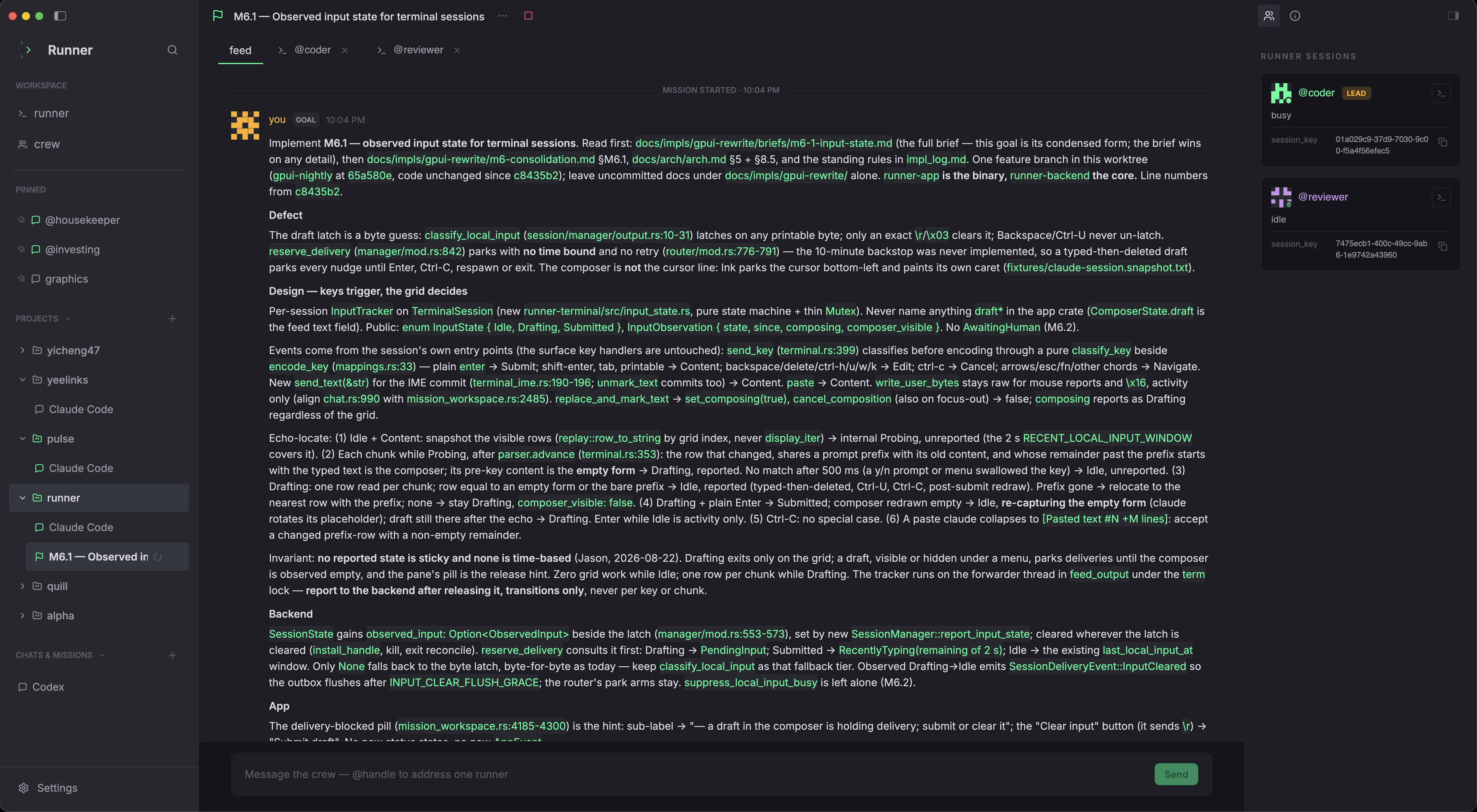
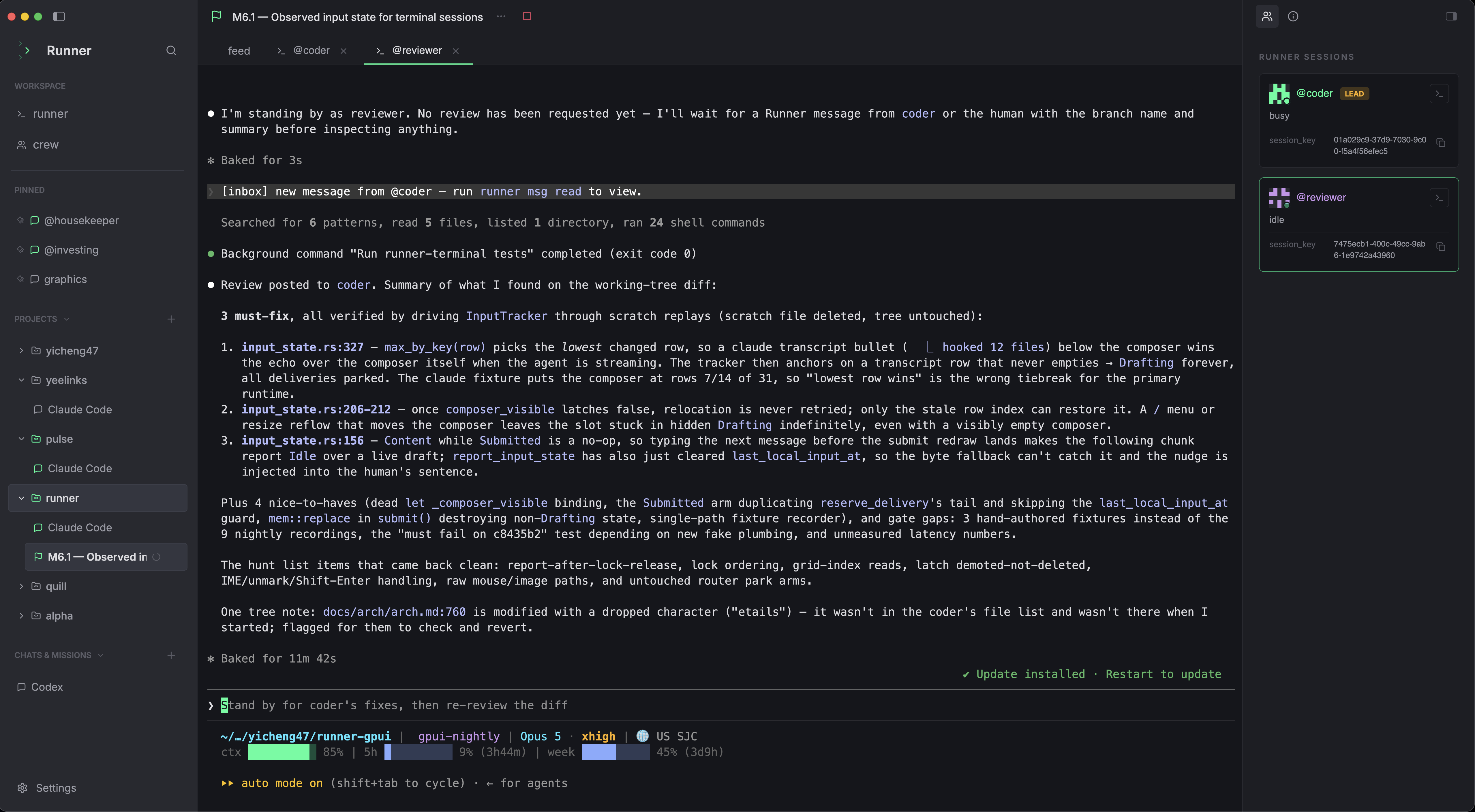
- Mission — a crew working one goal: one live terminal per slot, coordinating over an event feed that persists and replays, with
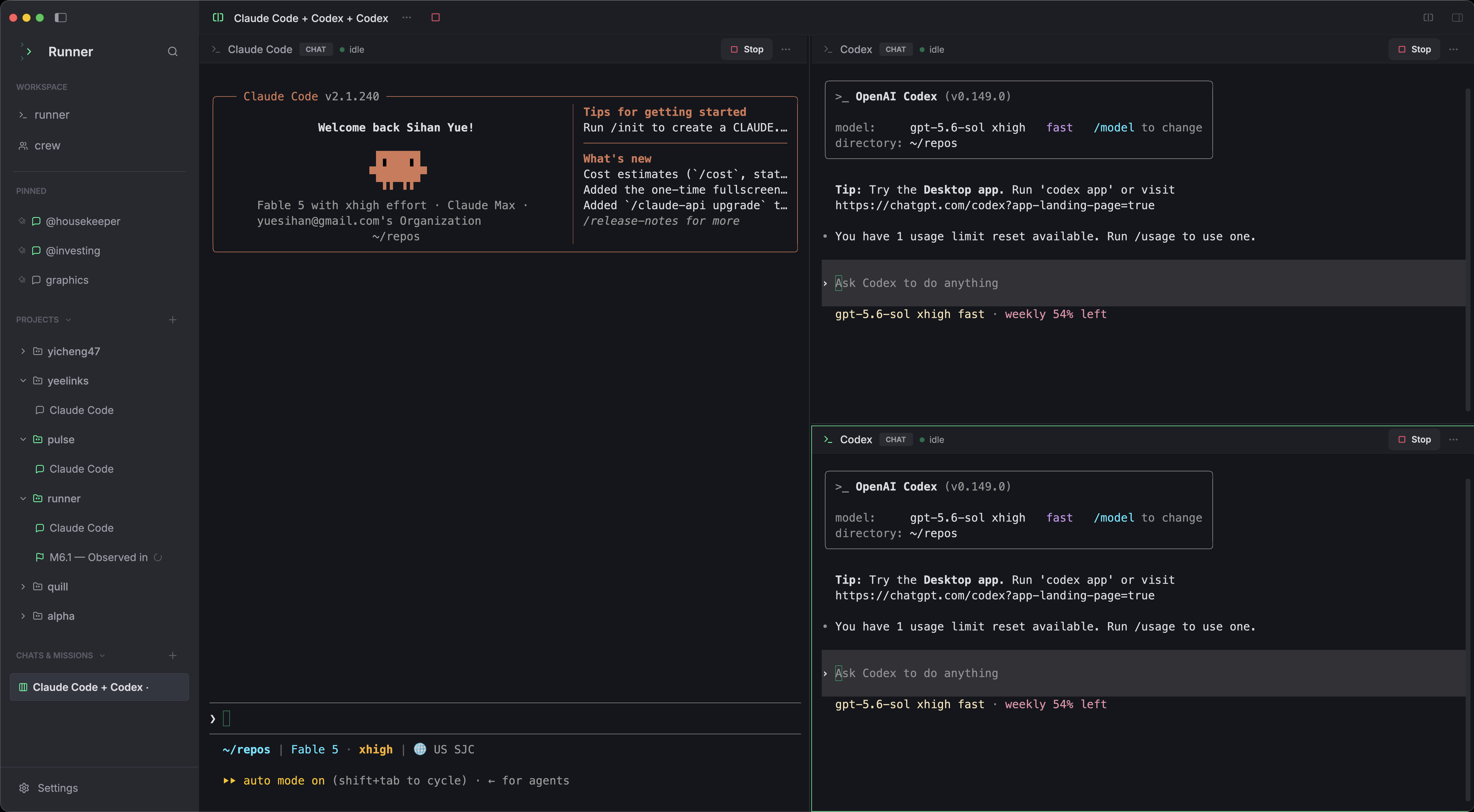
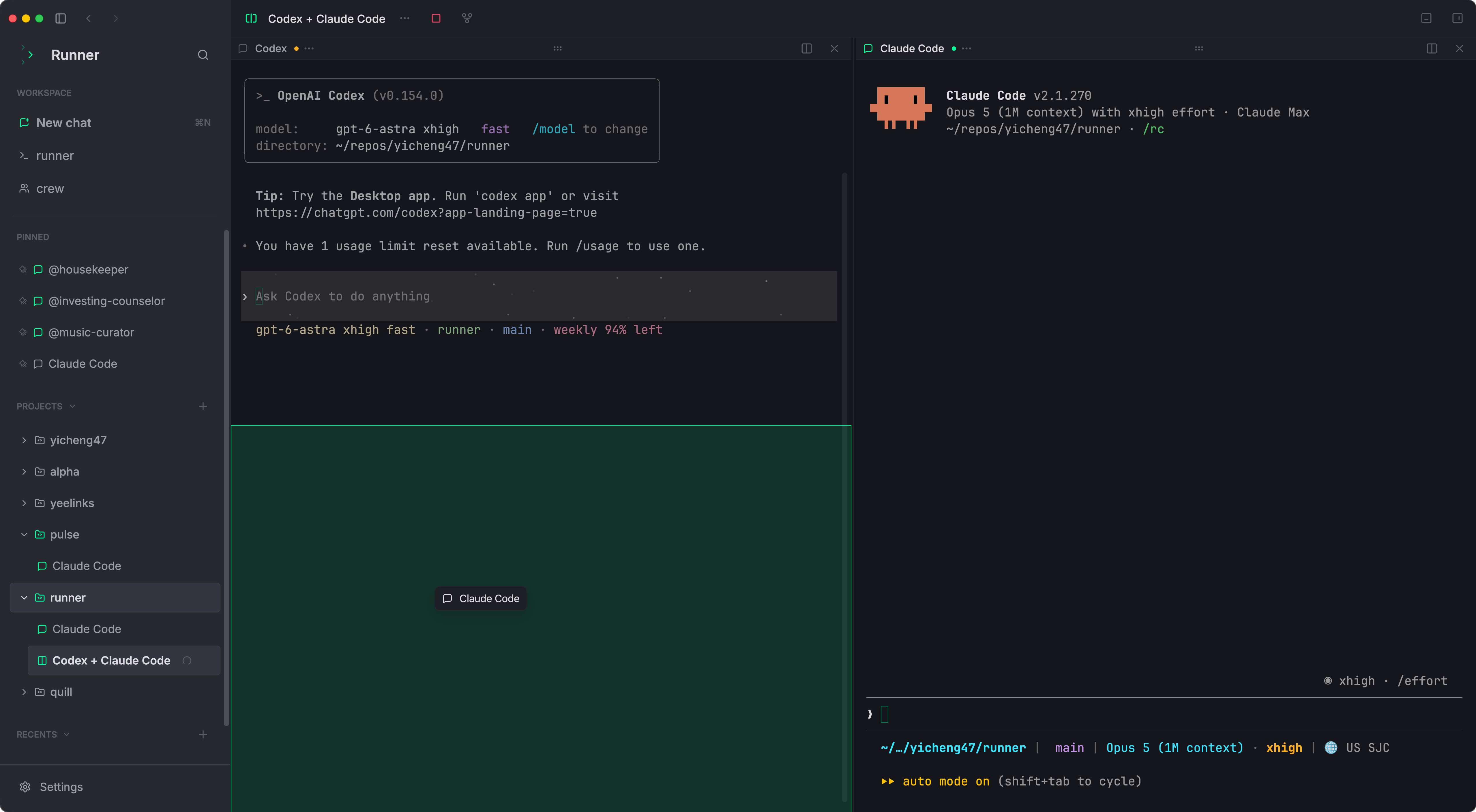
ask_humanwhen a decision is yours. - Chat — a single agent in a real terminal, no mission required; split a tab as far as the window allows.
- CLI — everything above is a command too, so agents, scripts, and people at a terminal can drive Runner themselves.
Written in Rust on gpui-ce, the community fork of Zed's GPUI, with alacritty_terminal for the grid and SQLite for state. No webview. Everything runs and persists on your machine.
Download
Grab the latest build from the releases page: a signed and notarized .dmg for macOS on Apple Silicon, and a signed Runner-Setup-…-x64.exe installer for Windows 10 version 1809 or later. Intel Macs, Windows ARM64, and Linux are not supported.
Both platforms update in place, macOS through Sparkle and Windows through the update icon beside Settings, and keep your settings, chats, and missions. On Windows, SmartScreen may still warn on a fresh release while the certificate builds reputation; More info → Run anyway continues.
Community
- Bugs and feature requests: GitHub Issues.
- 中文用户可以扫码加入 Runner 微信用户群。群二维码 7 天过期,如果扫码提示失效,请提一个 issue 提醒我更新。
Demo
A three-agent crew — two players and a referee — playing a game of tic-tac-toe against each other over the mission feed, from the tic-tac-toe example crew.
https://github.com/user-attachments/assets/fb3669a4-010d-42d0-9555-2a3ba3223c75
Features
|
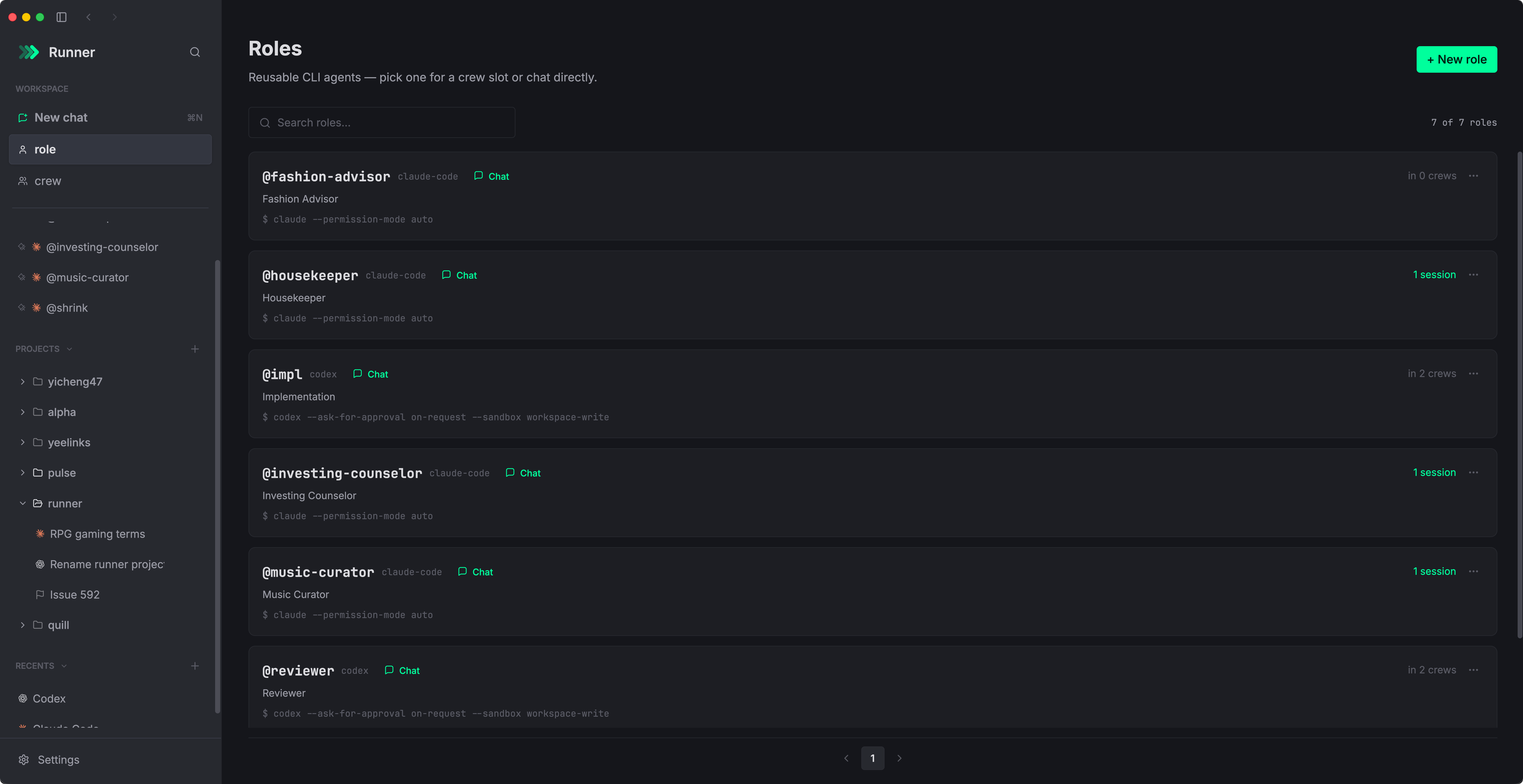
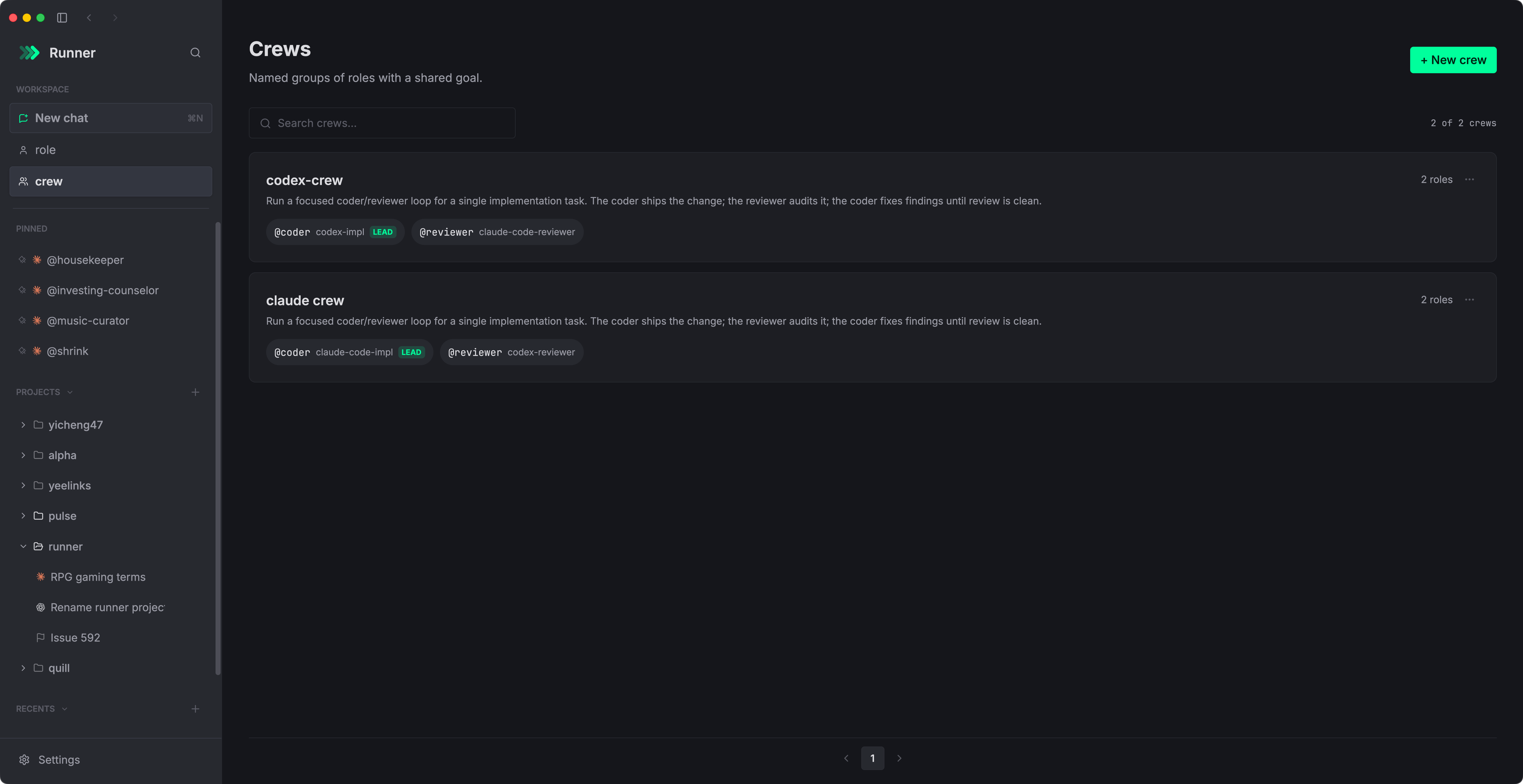
Crews — roles, prompts, one leadA role is a reusable agent configuration: runtime, system prompt, working directory. A crew composes roles into named slots with exactly one lead, plus team conventions and a definition of done that every mission inherits. |
|
Missions — a crew working one goalStarting a mission spawns one live PTY per slot into a tabbed workspace. The feed is where the crew coordinates: an append-only event log, every signal persisted and replayable, so missions survive a quit or crash, and |
|
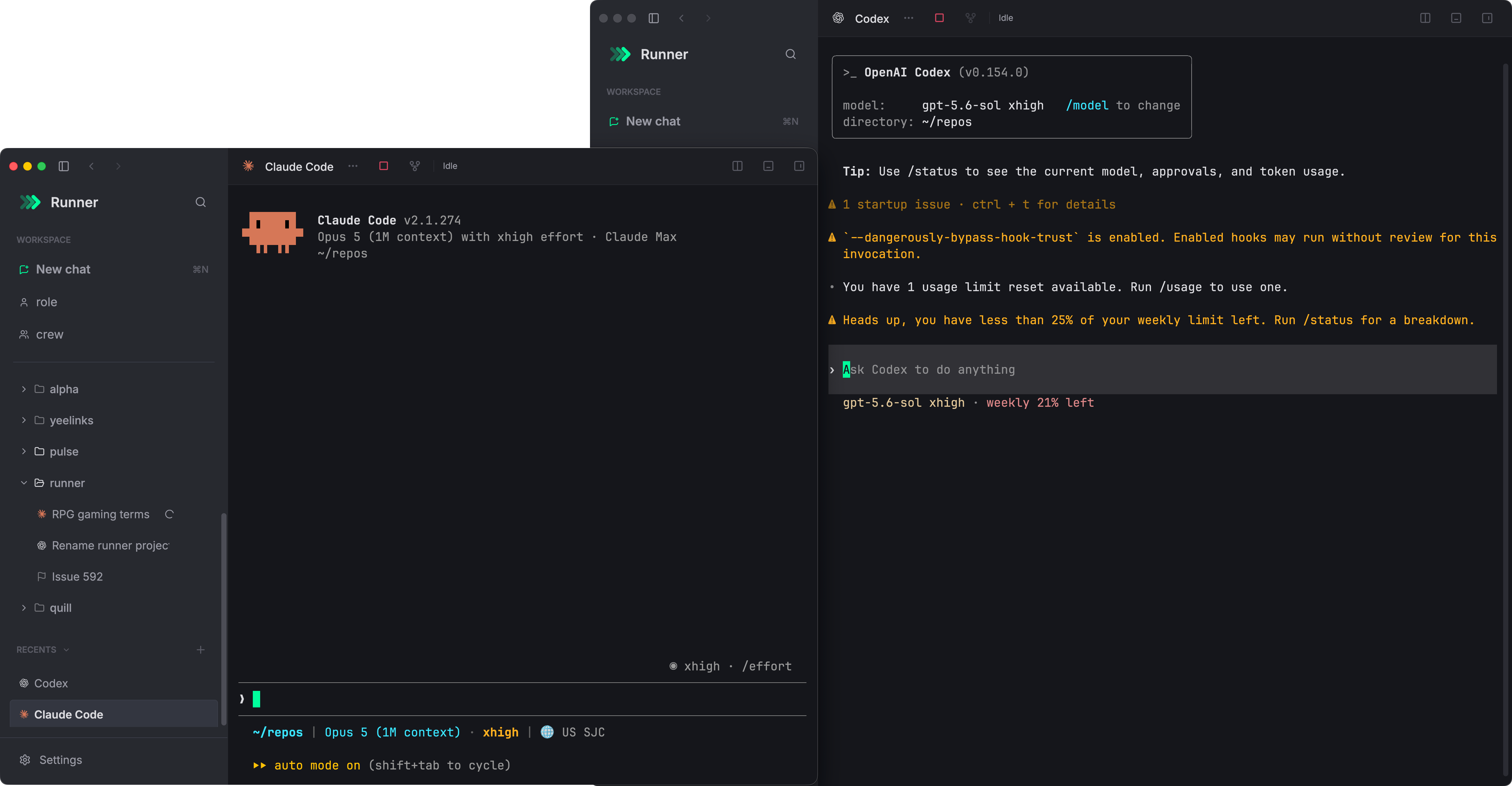
Chats — tabs, split panes, foldersEvery chat is a real 1:1 PTY with a role, no mission required. Split a tab as far as the window allows — right or down from any pane, |
|
Multi-window
|
|
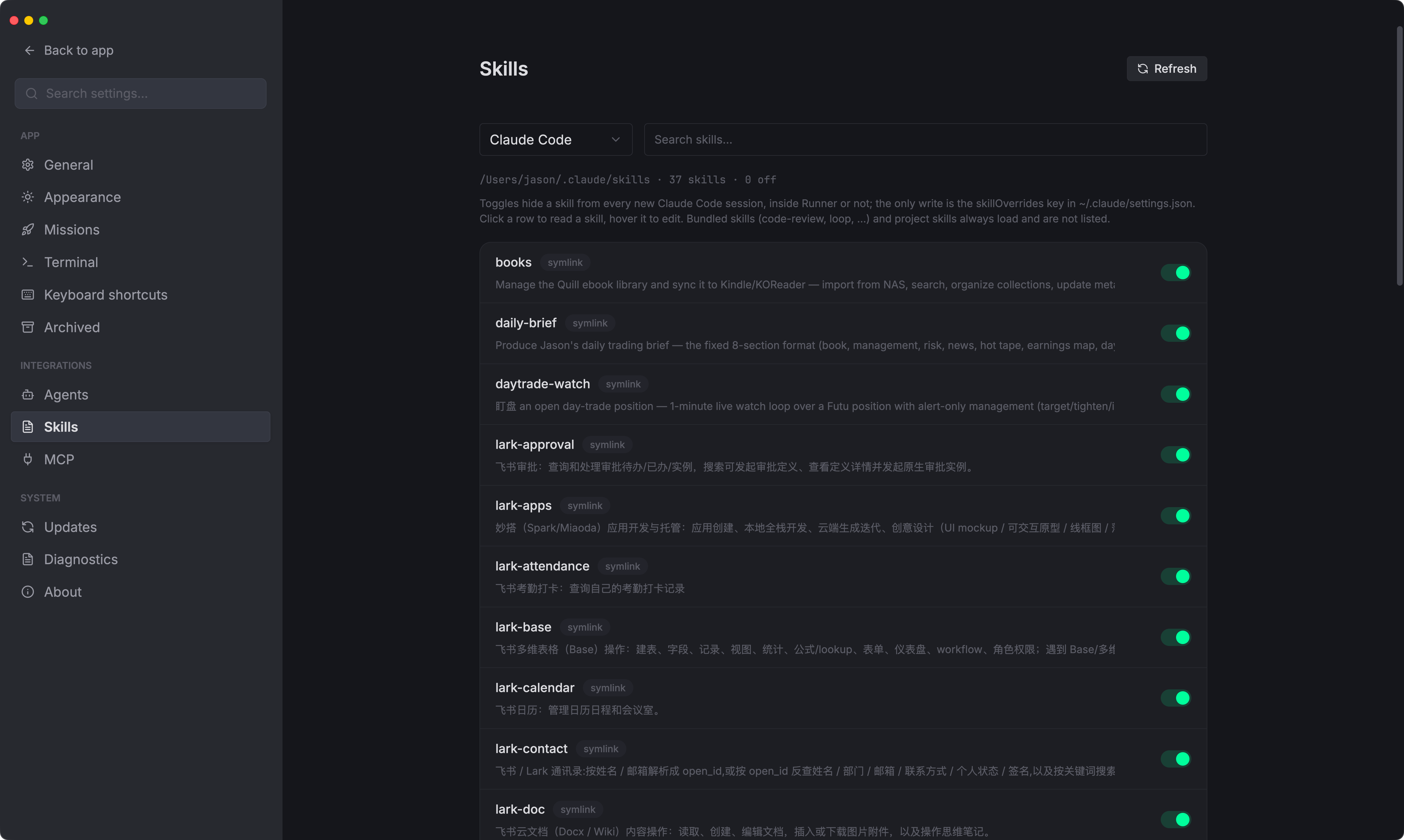
MCP servers and skills, managed in one placeEach agent keeps its MCP servers and its skills in its own config files. Settings → MCP and Settings → Skills read those files and show them as one list per agent: pick Claude Code or Codex, see everything it has, flip a toggle to switch a server or a skill off for that agent's new sessions, click a skill to read it or edit it. Runner changes only the one entry you touched and leaves the rest of the file exactly as you wrote it. |
|
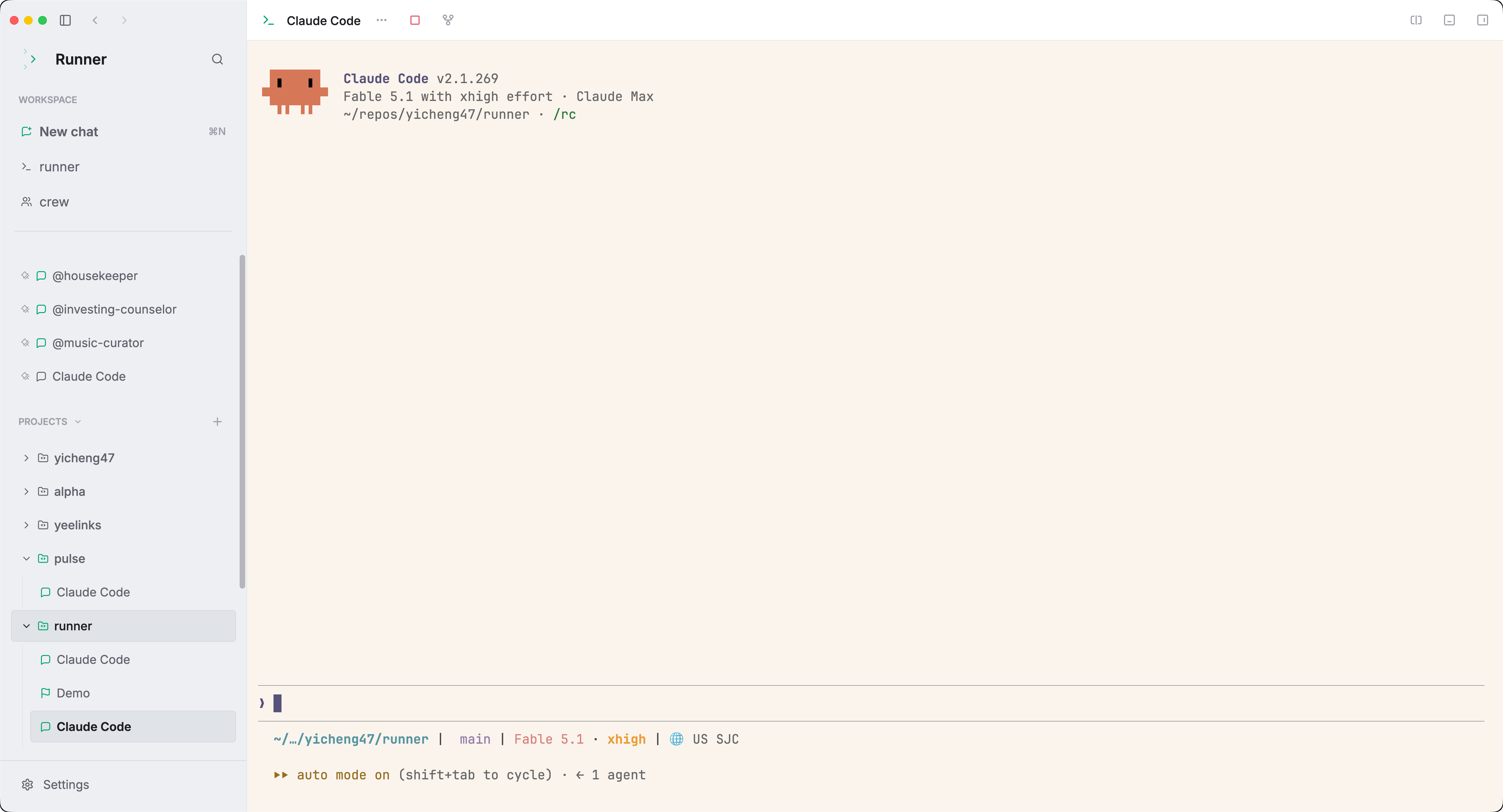
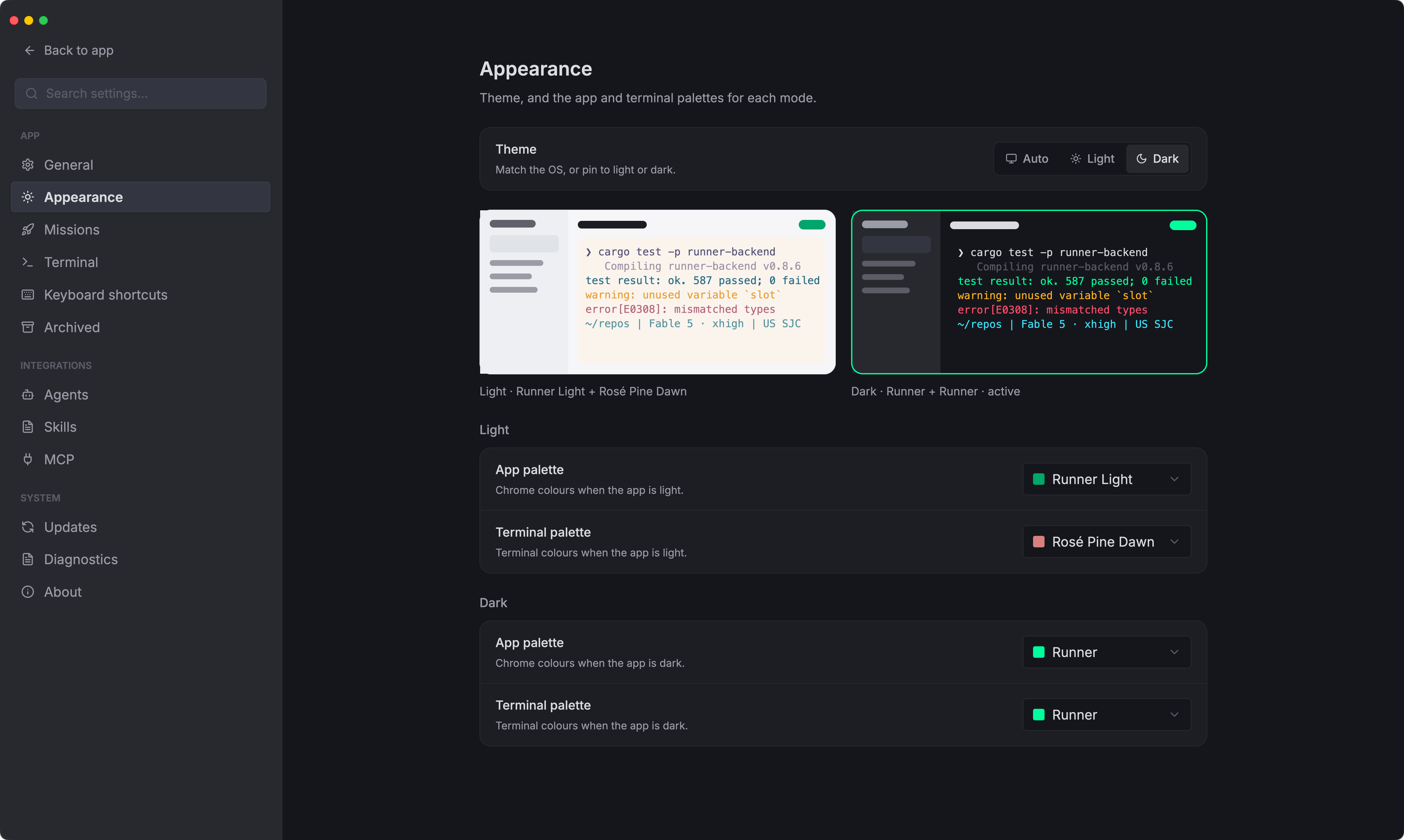
Light and dark, designed for RunnerCarbon and Runner Light are Runner's own themes; Catppuccin Mocha and Latte ride along. Auto follows the OS, Light and Dark pin it, and a Claude Code chat follows the flip the moment it happens, no restart, no A palette per mode, previewedSettings → Appearance picks an app palette and a terminal palette for light and for dark above a live preview of both modes, so a light app gets a light terminal without a second setting. Rosé Pine Dawn is the default light terminal. |
Also in the box
- Sessions that outlive the app — quitting or crashing does not kill your agents; the next launch reattaches to the sessions still running, and a quit while work is in flight asks first.
- Projects — bind a working directory once; chats and missions started inside a project inherit its cwd and stay grouped in their own sidebar section. Agents can create, rename, file into, and delete projects through the CLI too.
- Mission controls — stop, resume, or restart a single slot without restarting the mission; a restarted session comes back fresh with its original brief. Missions run in Bypass permission mode by default, with Accept-edits and Default a setting away, and never stall on an agent's first-run consent dialog.
- Real terminals — every pane is a real PTY on an
alacritty_terminalgrid drawn on the GPU: the agents' own colours, mouse reporting, IME input (Pinyin included), copy, file-path paste, 10,000 lines of scrollback. Click a file path to open it in your editor; select some output and ask about it in a side thread; ⌘+ and ⌘− zoom the app from 60% to 200%. - Terminal drawer — every chat and every mission has a shell beneath it, one shortcut away, opened in the same directory as the agent above: run the tests the agent just wrote, check
git status, tail a log, without leaving the pane or opening another terminal app. Drawers hold as many shells as you need and come back where you left them.
Drive Runner from your agents
The bundled runner command is the one way agents, scripts, and people at a terminal drive the app. Its whole surface fits on a screen:
$ runner help
runner — operate Runner from a shell or a mission session

USAGE
  runner status
  runner project list|show|create|rename|delete
  runner role list|show|create|update|delete
  runner crew list|show|create|update|delete|add|set|remove|lead|order
  runner mission list|show|start|stop|resume|archive|unarchive|rename|pin|unpin|move|feed|answer
  runner chat start
  runner session list|show|stop|archive|resume|restart
  runner msg post|read
  runner signal <type>
  runner ask <question> | runner ask --human <prompt> --choices <a,b,...>
  runner call <tool> [<json>]

OUTPUT
  --json   print the JSON result
  -q       print only result ids

CONTEXT
  Inside a mission, msg post/read, signal, and ask use the event log directly.
  Outside, mission-scoped writes require --mission; --as names a roster handle.
On macOS, the first launch installs it to ~/.local/bin, or a writable /usr/local/bin, when that directory is already on the login PATH; otherwise it is one click in Settings → General → Command line. On Windows, Runner adds its sidecar directory to the user PATH.
Agents need no setup. Runner installs a runner skill for every detected agent into two roots: ~/.claude/skills/ for Claude Code, and ~/.agents/skills/ for Codex, GitHub Copilot CLI, and pi. The skill points the agent at the version-matched runner help agents guide. The same Command line section has the runner command row and the Runner skill for agents switch.
A whole mission, driven from outside the app:
runner crew list --json
mission=$(runner mission start --crew <crew> --goal-file - -q < brief.md)
runner mission feed "$mission" --follow --json
runner mission show "$mission" --json
runner msg post --mission "$mission" --to <lead_handle> "message"
runner mission answer "$mission" <question_id> <choice>
runner mission stop "$mission"
runner mission archive "$mission"
Agents use --json; without it, list and show commands render tables and readable summaries for people. Exit status 0 is success, 1 means Runner refused the operation, 2 is a usage or reference error, 3 means the app is not running, and 5 means a sandbox blocked the local connection. Inside a mission, the same binary takes its mission and handle from the environment and is how crew members message and signal each other. The part that compounds: your daily agent can plan a fix, dispatch a coder and reviewer crew to build it, and keep working, while every session it spawned is still a real terminal you can open and watch.
Supported agents
| Claude Code | Codex | GitHub Copilot CLI | pi | |
|---|---|---|---|---|
| Chats, missions, resume after relaunch | ✓ | ✓ | ✓ | ✓ |
| Runs on Windows | ✓ | ✓ | ✓ ¹ | ✓ ² |
| Fork a chat | ✓ | ✓ | — | ✓ |
| Working / Idle from the agent's hooks | ✓ | ✓ | ✓ | ✓ |
| Needs you: approval and question dialogs shown | ✓ | — | ✓ | from extensions only |
| Model list read from the CLI | ✓ | ✓ | — | ✓ |
| Permission modes | Default · Accept edits · Auto · Bypass | Default · Auto · Bypass | Default · Accept edits · Bypass | — |
| Skills pane | catalog + on/off | catalog + on/off | catalog + on/off | catalog |
| Runner skill installed | ✓ | ✓ | ✓ | ✓ |
| Terminal rendering covered by fixtures | ✓ | ✓ | — | — |
¹ GitHub Copilot CLI runs natively on Windows but has not been smoke-tested there yet.
² pi runs natively on Windows but has not been smoke-tested there yet; its bash tool requires Git for Windows.
Claude Code and Codex are the primary agents, with tuned launch and nudge timing. GitHub Copilot CLI needs a Copilot subscription. pi brings your own configured model provider. Issues are welcome.
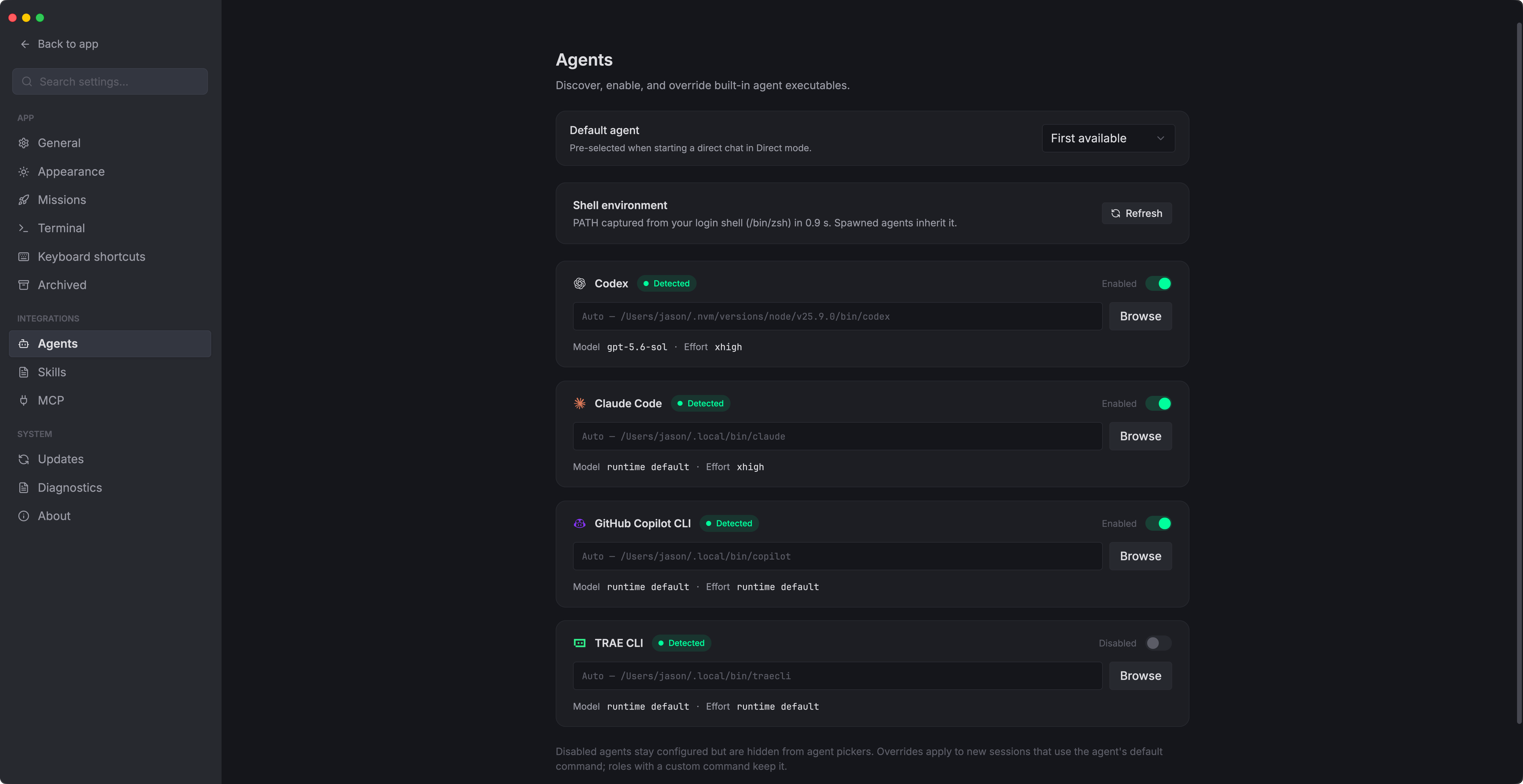
Install the agent CLIs separately. Runner detects them on PATH, with per-agent executable overrides in Settings → Agents. On Windows, Claude Code and pi's bash tool require Git for Windows; npm-based CLI installations require Node.js. PowerShell 7 is optional. Agents run natively on Windows, without WSL.
Example crew
The default Runner shape is a two-role pair-coding loop: one implements, one reviews, and the loop runs on the working-tree diff until the review is clean — no architect, no dispatch overhead, just the tightest loop that still has a second pair of eyes. Runner seeds this crew on first launch; the source lives in examples/pair-coding/.
| Role | Runtime | Responsibility | System prompt |
|---|---|---|---|
| @coder (lead) | codex |
Branches, implements, runs the checks, hands the diff to the reviewer, fixes findings. | coder.md |
| @reviewer | codex |
Reads the working-tree diff, reports must-fix issues with file:line pointers, never edits code. | reviewer.md |
The crew's team conventions — feature branch first, review before any commit, nothing merged unless the human asks — are in team-conventions.md. Both slots ship on codex; switching @coder to claude-code makes it a cross-vendor pair, where each model catches what the other's training glosses over.
More crews
For weirder, more fun crew shapes, peek at examples/:
pair-coding/— the default coder / reviewer pair abovedev-crew/— an architect / impl / reviewer trio: one decomposes, one builds, one auditsdocs-crew/— architect partitions a complex repo, 2+ writers draft per-module docs in parallel, editor harmonizestic-tac-toe/— 2 agents + 1 referee actually playing a game against each otherwerewolf/— 6-player social deduction with a god moderatortomb-raid/— a 4-person heist crew run by a DM
Each is a copy-pasteable handle + system-prompt set you can spawn into a new Crew and hit Start.
Acknowledgements
- GPUI and gpui-ce — the UI is built on gpui-ce, the community fork that keeps Zed's GPU-accelerated UI framework published and usable outside Zed. Thank you to the Zed team for building and open-sourcing the framework, and to the gpui-ce maintainers for carrying it forward; Zed's terminal crates were the architectural reference for Runner's terminal split.
- alacritty_terminal — the terminal grid, parser, and scrollback under every pane.
- xterm.js — the procedural box-drawing glyph table is transcribed from the WebGL addon under its MIT notice (
crates/runner-app/LICENSE.xterm). - Windows Terminal ConPTY — Windows builds bundle Microsoft's
conpty.dllandOpenConsole.exeunder the MIT notice (crates/runner-app/LICENSE.conpty). - Sparkle — the macOS updater.
Author
Runner is written and maintained by Yicheng Wang (Jason Wang, 王逸成) — @yicheng47 on GitHub.
License
MIT. Copyright (c) 2026 Yicheng Wang (Jason Wang). You can use, modify, and redistribute Runner for anything, including at work and inside closed-source products, as long as you keep the copyright notice (see LICENSE). Versions released from 2026-08-22 through 2026-09-22 were published under GPL-3.0-only and remain available under that license.
Reviews (0)
Sign in to leave a review.
Leave a reviewNo results found