universal-examprep-skill
Health Pass
- License — License: MIT
- Description — Repository has a description
- Active repo — Last push 0 days ago
- Community trust — 249 GitHub stars
Code Pass
- Code scan — Scanned 12 files during light audit, no dangerous patterns found
Permissions Pass
- Permissions — No dangerous permissions requested
No AI report is available for this listing yet.
Last-night exam-cram coach as a Claude Agent Skill: turns your slides, notes and past papers into a chaptered knowledge base + quiz bank, teaches only what's in your materials, and never fabricates (measured 100% out-of-scope abstention). Bilingual EN/中文 — the 期末极速备考 skill.

Exam Cram Coach
One night left. You studied nothing. It won't make anything up.
English · 中文


Never fabricates: 100% honest abstention · in-your-materials-not-the-model's-head 11% → ~99% · context −90% · 6 agents
You know him. Night before the exam, hair a mess, eyes wide open, hasn't read a single page of the course. This skill is for him — it doesn't pour in more "knowledge" that it isn't sure about; it teaches only what's actually in your materials, and says "not in the materials" for everything else.
30-second start — clone the repo, then say one line to your agent:
git clone https://github.com/ZeKaiNie/universal-examprep-skill .claude/skills/universal-exam-cram-coach
# In Claude Code / Cursor, say: "use this skill to set up my exam-prep space", then drop in your materials
Before / after
With the skill — every claim carries its source, so you can check it:
[#vis_q1] In the figure, which set relation does the shaded region show?
The intersection of A and B.Question: hw02.pdf p.3 | Answer: hw02_sol.pdf | 🟢 from your materials
Closed-book / plain agent — sounds just as confident, but you can't tell if it's true:
The shaded region is the union. (It's actually the intersection; no source label, nothing to check against — this is where hallucination happens.)
The difference isn't tone. It's whether each claim lands back in your materials.
Numbers
The skill's value is grounding: connecting what's in your materials but not in the model's head — accurately, and never fabricated. Two real measurements (judge: Sonnet):
① In your materials, not in the model — the skill goes from 11% up to 100%. Details mined from course transcripts (the professor's examples, obscure studies, exact numbers) that world knowledge can't answer; closed-book collapses, hand the materials back and it returns:
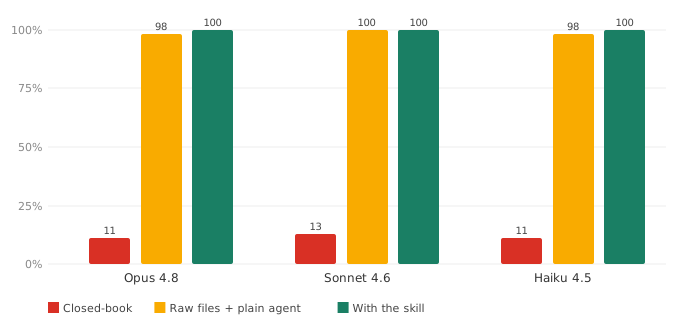
| Course · Model | Closed-book | Raw files + generic agent | With the skill |
|---|---|---|---|
| PSYC 110 · Opus 4.8 | 11% | 98% | 100% |
| PSYC 110 · Sonnet 4.6 | 13% | 100% | 100% |
| PSYC 110 · Haiku 4.5 | 11% | 98% | 100% |
| 6.006 · Haiku 4.5 | 45% | 89% | 91% |
② Not in the materials at all — the skill says "not covered" 100% of the time. On out-of-scope probes, with the skill (and raw files) all three models, both courses, abstain honestly 100%; closed-book only 60%–90% (it fabricates a plausible answer). This is the most direct anti-hallucination measure.
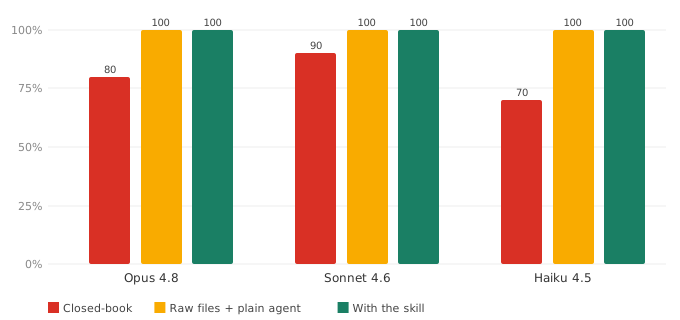
The skill matches a "raw files agent" on accuracy but costs less — it pulls only the compressed relevant chapters instead of re-scanning the whole file pile each question:
Cost per question (same accuracy, less spend)| Cost / question | Closed-book | Raw files agent | With the skill |
|---|---|---|---|
| PSYC 110 | $0.033 | $0.117 | $0.102 |
| 6.006 | $0.034 | $0.066 | $0.063 |
Full method, three-arm design, judge calibration, cost, limitations → test report.
How it works
A ladder of "don't make it up unless you have to":
- Quiz only from the materials — questions come from a
quiz_bank.json, never improvised. - Forced source labels — every claim tagged
🟢 from your materials/🟡 AI-supplemented, may differ from your teacher/⚠️ AI-generated answer, never passed off as the textbook. - If it's not in the materials, say so — abstains honestly on uncovered questions instead of fabricating (100% out-of-scope abstention, measured).
- Draw-it questions run the algorithm first — for binary trees / graph traversal, it runs the real algorithm in the background to get the topology, then renders — no imagining.
- Figure-dependent questions won't be served without the figure — no unanswerable question handed to the student.
- Chapter-sliced knowledge base, loaded on demand — sliced by chapter, loaded by progress, so long chats don't blow up the context. Context −90%.
Study modes · time budget · preferences
The skill adapts how deep it teaches, how fast, and whether it asks you questions — all kept in study_state.json, persistent across chats.
3 study modes (how it teaches):
| Mode | For |
|---|---|
| Teach from scratch | Haven't studied at all — walk every chapter from zero, 7-step walkthrough per key question |
| Start mid-course, shore up weak spots | Know some — start from a chapter you name, target the weak parts |
| Fill the gaps | Mostly covered — just quiz to find blind spots, mistakes first |
4 time budgets (how fast):
| Budget | Behavior |
|---|---|
| ≤ 1 day | All-out sprint — never asks you anything, silently infers defaults (teach-from-scratch), goes straight in |
| 1–3 days | Hits the essentials, compresses the rest |
| 3–7 days | Normal pace, asks which chapters you're solid on |
| > 7 days | Relaxed — for chapters you say you know, it quizzes to verify rather than taking your word |
Preferences (remembers your habits): whether walkthroughs append the "common mistakes" / "3-minute recap" closing blocks, reply language (Chinese / English / bilingual), and per-chapter mastery windows (window-add / window-set-status) — all persisted, changed by a single line anytime. See docs/language-policy.md and docs/skill-architecture.md.
Install
Claude Code
git clone https://github.com/ZeKaiNie/universal-examprep-skill .claude/skills/universal-exam-cram-coach
Works from a project-local .claude/skills/ or global ~/.claude/skills/.
Codex / Cursor / Windsurf / Antigravity
Clone the repo; have the agent read AGENTS.md (a one-screen fallback contract) or load skills/. These tools write files and run scripts directly.
Web (ChatGPT / DeepSeek / Gemini)
Can't write local files — use the drop-in prompt instead: copy prompts/web_prompt.en.md and send it, then paste your materials.
Full load matrix (per-agent support, entry files) in
docs/agent-portability.md. The behavior source of truth isSKILL.md;SKILL.en.mdis its English rendering.
Sub-skills
The monolith is split into 9 single-purpose sub-skills the agent loads on demand:
| Sub-skill | What it does |
|---|---|
exam-cram |
Orchestrator — runs the 4-step workflow + study-mode routing |
exam-ingest |
Builds the workspace from your materials (knowledge base + quiz bank + progress) |
exam-tutor |
Lazy per-chapter teaching (7-step walkthroughs, draw-it-runs-algorithm-first) |
exam-quiz |
Draws & grades from the bank (6 question types: MC / short / draw / fill / T-F / code) |
exam-review |
Mistakes and concept-confusion review |
exam-cheatsheet |
Pre-exam cheat sheet |
exam-audit |
Read-only workspace health check |
exam-help |
One-screen quick reference (workflow / modes / file conventions) |
confusion-tracker |
Logs concept questions as you go into a pre-exam blind-spot list |
All nine live under skills/ (e.g. skills/confusion-tracker/SKILL.md), loaded on demand.
Development
Zero-cost structured checks you can run often (no API spend):
python -m unittest discover -s tests -v          # unit tests (pure stdlib, in CI)
python scripts/validate_workspace.py path/to/ws  # validate a built exam-prep workspace
The real paid benchmark is expensive (tens of dollars / hours per matrix), run manually only — see benchmark/docs/running-real-runs.md and the tiering in benchmark/docs/test_tiers.md. Workspace file format: docs/file-format.md.
FAQ
No Python installed? Fine. When the agent finds no Python it silently switches to "manual write mode", creating the knowledge-base tree itself — no difference to you.
Only photos / scanned PDFs / a recording? First transcribe with any free web multimodal AI ("extract the highlights and questions as plain text, keep the star/underline markers"), paste into a .txt, then have the agent build the workspace; the rest is plain-text and smooth. Recordings: transcribe first, then feed.
Stuck on one quiz question? Just say "this is too hard / I want to skip" — it files the item to your mistake log, lets you through, and revisits it at the end.
How is this different from just dropping a folder at an AI? Similar accuracy, but the skill is cheaper (only the relevant chapters per question, not the whole pile) and helps weaker models more. See the report.
License
MIT. PRs for more subjects' templates or scripts welcome. Good luck on the cram. 🎓
Reviews (0)
Sign in to leave a review.
Leave a reviewNo results found