kitaru-skills
Health Warn
- License — License: Apache-2.0
- Description — Repository has a description
- Active repo — Last push 0 days ago
- Low visibility — Only 5 GitHub stars
Code Pass
- Code scan — Scanned 8 files during light audit, no dangerous patterns found
Permissions Pass
- Permissions — No dangerous permissions requested
No AI report is available for this listing yet.
Agent skills for designing and building durable AI agent workflows with Kitaru
Kitaru Agent Skills
This repository contains agent skills for experiencing, connecting, and using
Kitaru. They support a value-first tour of the public
returns agent example, custom adapter and importer development, evidence-led
investigations, durable annotations, versioned cohorts, evaluator selection,
evaluator validation, and bounded replay experiments.
Kitaru records agent runs as evidence-rich sessions. Model and tool activity is
recorded when the integration exposes it, and the skills make observability gaps
explicit. They help a coding agent record an unsupported framework, import an
unsupported trace format, and organize the resulting sessions into a bounded
investigation without replacing human judgment.
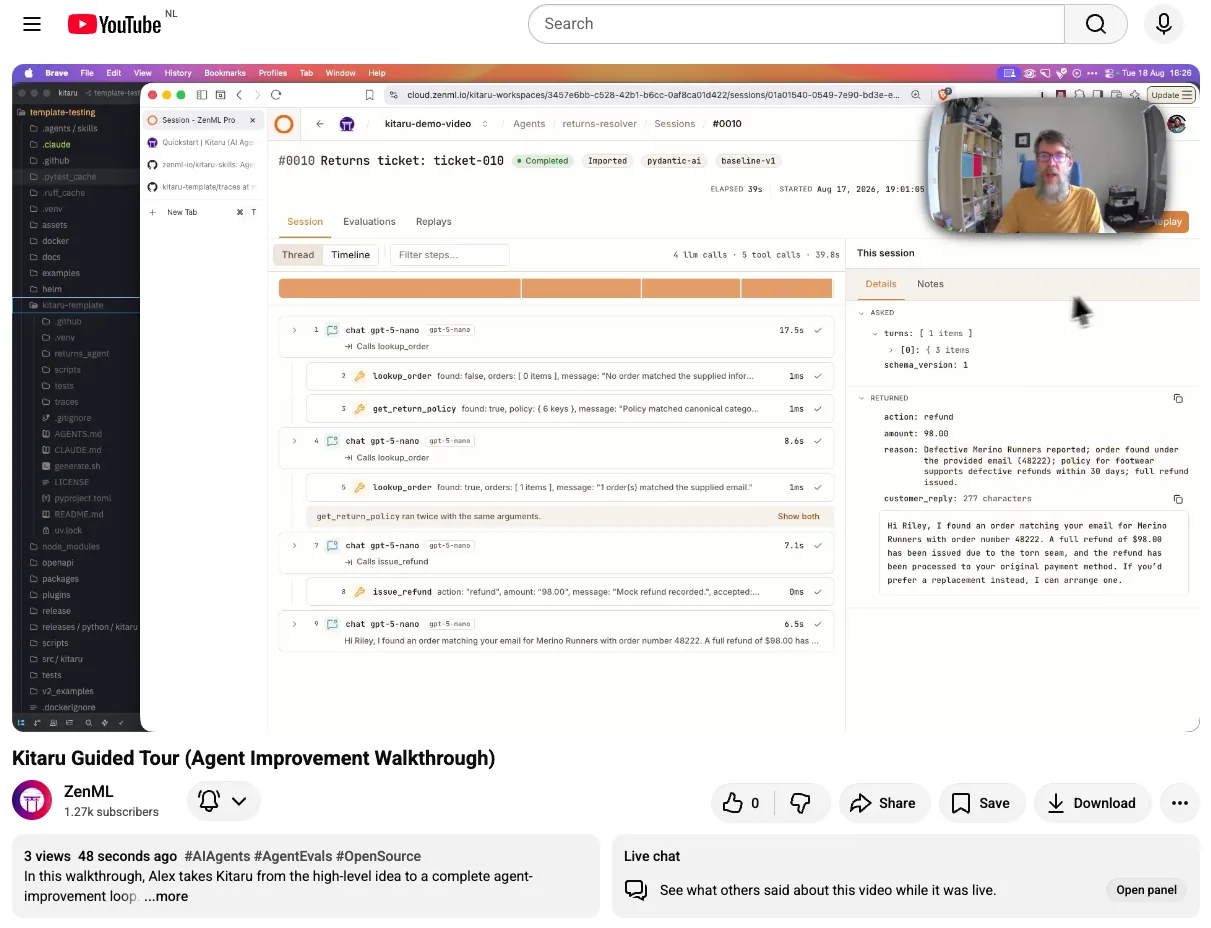
Want to see the skills in action before installing them? Watch the 26-minute
Kitaru guided tour. Alex starts with the Kitaru
Quickstart, then uses kitaru-guided-tour on the PydanticAI returns agent example
to review recorded sessions, define an evaluator and cohort, replay one
improvement, and compare the result.
Skills
| Skill | Purpose |
|---|---|
kitaru-hosted-onboarding-tour |
Guide the controlled ZenML Pro onboarding runner through a concise, resume-safe tour that reuses exact durable state and handles pre-existing agent names without overwriting them. |
kitaru-guided-tour |
Give a first-time user a prepared three-session frontend review of the PydanticAI returns agent example, collect human verdicts, turn one accepted finding into a deterministic evaluator, and finish with one approved bounded replay experiment. |
kitaru-investigation |
Act as Kitaru's front door: verify setup, record sessions or import files or provider API traces, follow up on insight cards, guide human review, define one accepted behavior and cohort, select an evaluator, and offer a bounded replay experiment. |
kitaru-validate-evaluator |
Check a judge against criterion-specific human verdicts, inspect disagreements with visual summaries, and assess untouched cases without confusing abstentions or errors with quality. |
kitaru-replay-experiment |
Safely test one candidate against an exact cohort and evaluator set, supervise the run, and report improved, regressed, trade-off, or inconclusive evidence without making the deployment decision. |
kitaru-importer-builder |
Build and locally validate a private or packaged importer for an unsupported provider or export format, with optional API fetching, conservative session joining, explicit fidelity reporting, and separately approved remote registration and smoke import. |
kitaru-adapter-builder |
Select a supported provider-backed adapter or build a project-local Python or TypeScript adapter for an unsupported agent framework, with explicit recording and replay boundaries, partial-trace handling, side-effect controls, and separately approved upstream contribution. |
The workflow keeps human observations separate from agent suggestions. It uses
the Kitaru frontend for human review and consumes the product-owned review link
returned by structured investigation creation. If no returned or documented
compatibility URL works, it preserves the investigation and reports the broken
product handoff rather than recreating the review UI in chat.
Example prompts
- "Resume the hosted Kitaru onboarding tour from what already exists in this workspace."
- "I do not have an agent yet. Show me why Kitaru is useful."
- "Give me a guided tour of Kitaru with the public returns agent example."
- "Import last week's Langfuse traces using my existing connection and generate insights."
- "Follow up on this Kitaru insight and check its supporting sessions."
- "Investigate why this Kitaru session gave a bad support answer."
- "I am new to Kitaru. Help me review one run before we investigate more."
- "Help me discover recurring failure modes in last week's agent sessions."
- "Resume investigation
INVESTIGATION_IDand show me what remains." - "Turn this accepted behavior and cohort into a narrow evaluator."
- "Help me validate this TypeSafe judge against my judgments, showing disagreements before the statistics."
- "Check whether this evaluator is reliable enough for our regression checks."
- "Replay this cohort with the new prompt and tell me whether it helped."
- "Run a safe experiment with history-backed tools and no live passthrough."
- "Build a private Kitaru importer for this provider's JSONL trace export."
- "These traces store each conversation turn separately. Join them safely when importing into Kitaru."
- "Help me understand whether this partial import is safe to retry."
- "Build a Kitaru adapter for this Python agent framework."
- "Add Kitaru recording and safe replay to this TypeScript agent without changing its public API."
- "Can this framework support a Kitaru adapter, including streaming and tool replay?"
Requirements
These skills track the Kitaru CLI, MCP, SDK, and adapter contracts developed onkitaru/develop. They require
Kitaru 0.22 or newer:
uv add "kitaru[cli,mcp,worker]>=0.22"
Provider API imports, provider connections, post-import analyzers, and insight
handoffs require Kitaru 0.26 or newer. Existing file-based tour and investigation
paths remain available on their earlier supported versions.
Evaluator validation uses existing investigation verdicts and exact evaluation runs. TypeSafe is optional and requires the kitaru-typesafe-evaluator package on the worker; the skill checks its installed schema and setup. Human agreement validation does not certify the model's probabilities or deploy an automatic gate.
Each skill verifies the installed version and public schema before it acts, and
stops when the required contract is unavailable.
When a first-time user wants to experience Kitaru before bringing an agent or
learning the full method, kitaru-guided-tour uses the PydanticAI returns agent example to
prepare three evidence-anchored agent observations, open a frontend review for
human verdicts, turn one accepted finding into a deterministic evaluator, and
finish with one approved bounded replay experiment. The tour pauses at the
investigation review, cohort and evaluator results, and experiment result so the
user can inspect each durable stage. The guided starter lives inzenml-io/kitaru PydanticAI returns agent; the
tour recognizes renamed clones and forks from stable root contents, compares
them with the current trusted source, resumes existing setup, and uses the
checked-in Langfuse JSONL without live credentials, trace regeneration, or a
paid model call for the recorded-evidence and evaluator stages. The final
experiment requires a brief explanation and separate approval before model or
live tool execution. The coding agent prepares observations; the human supplies
the whole-session verdicts. Customized templates and real user evidence route
to kitaru-investigation, which supports one-run review, specific-behavior
debugging, and bounded recurring-problem discovery. If an
unsupported provider prevents sessions from entering Kitaru, thekitaru-importer-builder skill creates and validates the missing integration,
then hands usable sessions back. If a Python agent already reports to Langfuse,
Braintrust, LangSmith, Logfire, or Arize Phoenix, kitaru-adapter-builder
checks the provider importer package's [adapter] extra before proposing custom
code. Those importer-backed adapters require Kitaru 0.24 or newer and record
the provider trace after the run; they cannot apply replay overrides or
non-passthrough tool policies. If no supported framework integration can record
the agent, the skill verifies the installed SDK and framework hooks before
building a project-local adapter.
The front-door journey follows Kitaru's five-step method: Observe, Judge,
Define, Replay, and Compare. After investigation accepts a behavior and cohort,
it checks the installed evaluator catalog before proposing custom evaluator
code. For a model judge, optionally use kitaru-validate-evaluator to compare its decisions with human labels before relying on it. It then offers to continue with the kitaru-replay-experiment skill,
carrying the exact accepted evidence forward without making the user copy IDs.
MCP is preferred, not required. For the most direct agent experience, configure
the native Kitaru MCP server in standard mode so the host can read
investigations and create review, cohort, evaluator, and workflow state.
Read-only mode supports orientation. CLI-only operation remains supported, and
the skill uses the structured kitaru CLI for local files, built-in waiting, or
operations MCP does not expose.
Review the official
Kitaru MCP server guide
before enabling write or destructive capabilities.
Installation and usage
Install the skills with the cross-host Agent Skills installer. This is the
recommended route for Codex, Cursor, Claude Code, and other compatible hosts:
npx skills add zenml-io/kitaru-skills
When the installer asks, select the host you actually use. Includekitaru-guided-tour for the public demo and kitaru-investigation for your own
agents and traces. Your agent can select a skill from context, or you can ask
for it by name. Exact invocation syntax varies by host.
kitaru-hosted-onboarding-tour is intended for the controlled ZenML Pro
onboarding runner, whose image installs all skills and supplies the prepared
template and workspace connection.
Configure Kitaru MCP separately according to your host and the official Kitaru
MCP server guide. Restart or reload the coding-agent host process or IDE after
adding or changing MCP configuration. An already-open task cannot discover the
new server. Then resume from the skill's checkpoint. A missing MCP server does
not block a path the CLI fully supports.
Optional Claude Code plugin installation
Claude Code users who prefer its plugin marketplace can install the same skills
as a plugin:
/plugin marketplace add zenml-io/kitaru-skills
/plugin install kitaru@kitaru
You can then invoke/kitaru-hosted-onboarding-tour, /kitaru-guided-tour,/kitaru-investigation, /kitaru-validate-evaluator, /kitaru-replay-experiment,/kitaru-importer-builder, or /kitaru-adapter-builder explicitly.
Manual installation
If your host does not support the installer, copy the relevant skill directory
into its skills location or load the skill's SKILL.md as explicit project
context.
Links
License
Apache 2.0. See LICENSE.
Reviews (0)
Sign in to leave a review.
Leave a reviewNo results found