maintainer-skills-lab
Health Uyari
- License — License: MIT
- Description — Repository has a description
- Active repo — Last push 0 days ago
- Low visibility — Only 8 GitHub stars
Code Gecti
- Code scan — Scanned 12 files during light audit, no dangerous patterns found
Permissions Gecti
- Permissions — No dangerous permissions requested
Bu listing icin henuz AI raporu yok.
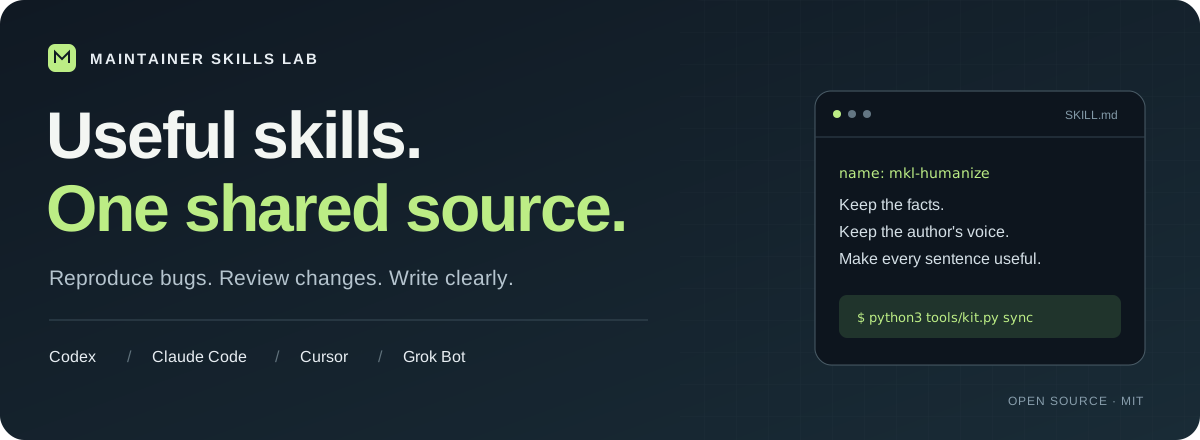
Humanizer, maintainer skills, agents, Git hooks and Skill Watch: a local scraper + MCP server for documentation changes. Shared workflows for Codex, Claude Code, Cursor and Grok Bot.


Try Humanizer · Explore the skills · Download ZIPs · Grok Bot · Hooks · Skill Watch MCP
Maintainer Skills Lab
Make stiff drafts readable. Debug code and ML training with reproducible evidence.
15 skills and 5 agent profiles for Codex, Claude Code, Cursor, and Grok Bot.
The workflows share one Markdown source, with generated versions for each client.
Start with one skill, or get the full library with its agents.
Try Humanizer
The Humanizer skill edits a draft in its original
language, keeping facts, code, quotations, and meaningful caveats intact.
| Before | One possible edit |
|---|---|
We are thrilled to announce that you can now leverage --dry-run to preview changes. Windows has not been tested yet. |
Use --dry-run to preview changes. We haven't tested Windows yet. |
This is an authored illustration. More examples and acceptance checks →
Install one skill
With Node.js 22.20.0+ and Git, run this in the project where you want to use it:
npx [email protected] add 00200200/maintainer-skills-lab --skill mkl-humanize --agent codex --copy
For Claude Code, replace --agent codex with --agent claude-code.
For Cursor, use --agent cursor. This uses the third-party
Vercel Skills CLI to install one skill
locally in the current project. Read the linked skill before installing it.
Then ask your client:
Use mkl-humanize to improve this draft. Preserve its facts, code, and limitations.
Explain any edit that changes the emphasis.
Explicit invocation uses $mkl-humanize in Codex CLI or /mkl-humanize in
Claude Code and Cursor. Installation, removal, and recorded checks →
Prefer Python or downloadable files? Install the full library
or get a ZIP.
Grok Bot uses manual setup recipes.
Find your next useful skill
| You want to… | Start here | What you get |
|---|---|---|
| Keep a consistent writing voice | Match voice | An edit grounded in supplied writing samples |
| Fix a bug with evidence | Reproduce bug → Verify fix | An observed failure and a comparable check of the fix |
| Debug a training run | Debug ML training | Focused PyTorch, Lightning, and TensorFlow/Keras diagnostics with a runnable example |
| Review a pull request | Review PR | Actionable findings with locations and consequences |
| Explain your project | Write README | An introduction and quickstart grounded in the actual repository |
| Work in Polish and English | Localize PL ↔ EN | Natural wording with commands, placeholders, and meaning preserved |
Browse all 15 skills and 5 agents →
Includes tutorials, UX copy, launch posts, maintainer replies, issue triage,
regression tests, and releases. The five agent profiles combine these workflows
for bug investigation, ML training diagnosis, PR review, release editing, and writing.
Catch outdated agent instructions
Skill Watch compares selected source documentation with a saved baseline and
shows which skills, dependent agents, and generated client files need review.
It includes a local scraper, CLI, and optional MCP server, with no model or
API key required.
Try an authored change in a disposable project, without network access:
python3 examples/skill-watch/run.py
-Checkpoints remain enabled during this diagnostic.
+Checkpoints are disabled during this diagnostic.
Checks preserve the saved baseline. Accepting a new source version is explicit.
A changed page is a signal to review the instructions, not proof that they are
wrong. Watch real sources and connect through MCP →
Debug a loss that looks wrong
Your predictions are [[1], [3]], your labels are [1, 3], and the raw mean
squared residual is 2. Why isn't it zero? Broadcasting compares every
prediction with every label. Aligning these scalar regression labels produces
the intended per-example loss of 0.
Debug ML training helps investigate shape
errors, NaNs, missing gradients, and reproducibility problems in PyTorch,
Lightning, and TensorFlow/Keras. The
ML investigator agent combines it with fix
verification. These frameworks are the subject of the task; use the skill in
your existing Codex, Claude Code, Cursor, or Grok Bot setup.
Use mkl-debug-ml-training to investigate this training failure. Keep the
current framework and compare one fixed batch before and after the proposed fix.
Run the CPU example in your framework →
It checks loss, gradients, and an optimizer update against an analytical result.
Start in a minute
Get the full library and native agents with Python 3.11+. The exporter,
installer, and Skill Watch CLI use only the standard library. The optional MCP
server installs its SDK separately.
git clone https://github.com/00200200/maintainer-skills-lab.git
cd maintainer-skills-lab

# The destination must be an existing project. Inspect changes first.
python3 tools/kit.py install --target codex --project /path/to/your/repo --dry-run
python3 tools/kit.py install --target codex --project /path/to/your/repo
Use --target claude or --target cursor for the other coding clients. The installer
adds the full library for one target, preserves unrelated files, and refuses
conflicting local edits. Start with one installation method and target per project;
mixed-client discovery is an untested limitation.
Updates, removal, and ZIPs →
One source, four versions
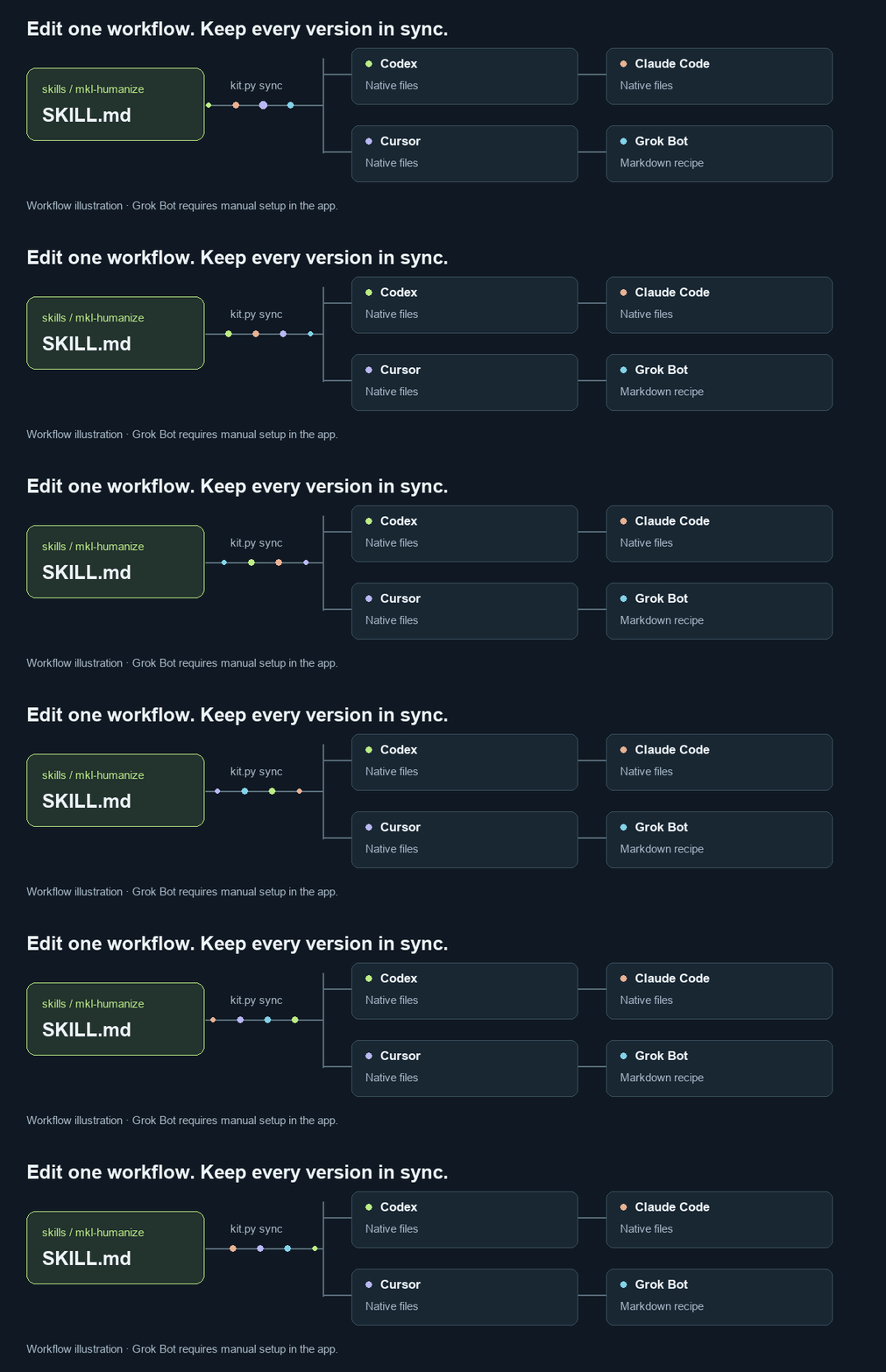
python3 tools/kit.py sync
Editing skills/mkl-humanize/SKILL.md generates:
providers/
├── codex/.agents/skills/mkl-humanize/SKILL.md
├── claude/.claude/skills/mkl-humanize/SKILL.md
├── cursor/.cursor/skills/mkl-humanize/SKILL.md
└── grok-bot/skills/mkl-humanize.md
Agent definitions in agents/*.toml combine shared skills. Their generated
versions embed the workflows they need, so a source edit also updates dependent
agents. CI checks that the checked-in copies match their source.
| Client | Get the files | How to use them |
|---|---|---|
| Codex | Skills + native agents | Project-local installation |
| Claude Code | Skills + native agents | Project-local installation |
| Cursor | Skills + native agents | Project-local installation |
| Grok Bot (SpaceXAI) | Skill + agent recipes | Set up in the Bot, try a task, then save the workflow as a skill |
Grok Bot recipes follow the official x.ai documentation.
They are Markdown instructions for manual setup; copying them does not create a Bot.
Issue Scout and Release Reporter include first-task prompts and optional routines.
Catch incomplete commits with a hook
Changed a skill but forgot to stage its generated versions? The optional
staged export guard catches that before the commit is created.
It checks the exact staged files, so a correct working tree cannot hide stale
provider copies in the index. Unstaged edits are left alone.
python3 -B tools/check_staged.py
For contributors to this library and its forks. Setup, examples, and limits →
Check the evidence
Run a complete local regression example without a model or API key:
python3 examples/bugfix/run.py
Baseline:  assertion-failure
Candidate: pass
Verified for this fixture: True
This checks the bundled example, not agent performance.
The same independent test runs against both implementations in fresh Python
processes. Inspect the fixture and its limits →
Preview status: source/export checks and tool/fixture tests are automated.
Humanizer installation and removal with Skills CLI 1.5.26 were checked for all
three coding-client targets. Live-client discovery, writing quality, and Grok Bot
execution have not yet been evaluated. Native agents inherit model and execution policy from the host.
Compatibility matrix · Evaluation guide
Make it useful for you
Missing a workflow or found a rough edge? Open an issue
with the task and a small example. To contribute a skill, edit one source and
generate the client versions: contribution guide.
If a skill earns a place in your workflow, star the repository to find it again.
To hear about changes, use GitHub's Watch → Custom → Releases.
Community, in numbers
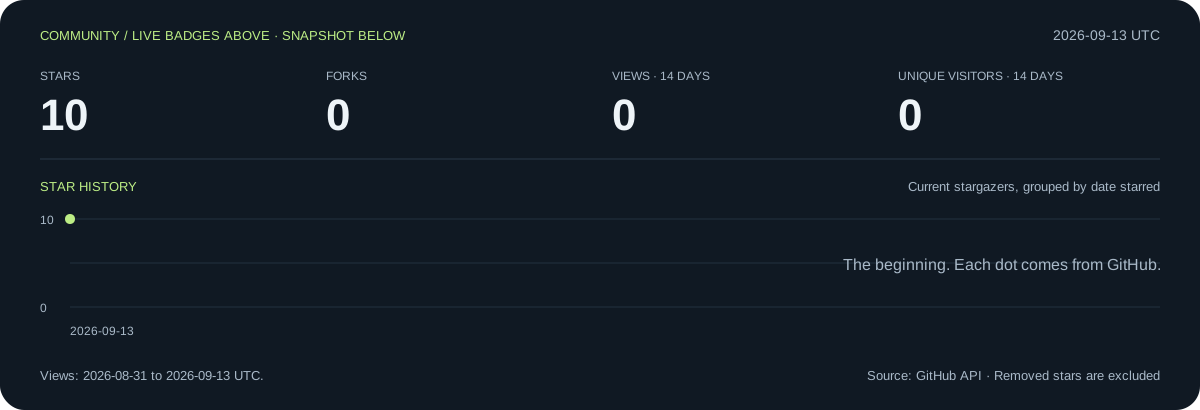
Badges above refresh through Shields and GitHub and may be cached. This chart is a
dated snapshot of GitHub data, refreshed alongside substantive changes. Views and
unique visitors cover GitHub's returned 14-day window. The star chart groups
current stargazers by their original star date; removed stars are excluded.
Aggregate data · How it is generated
python3 tools/kit.py list
python3 tools/kit.py check
python3 tools/kit.py sync --check
python3 -m unittest discover -s tests -v
python3 examples/bugfix/run.py
python3 tools/kit.py build
Builds produce four deterministic ZIPs in dist/. CI checks Python 3.11 and 3.13
on Linux and macOS and uploads archives as run artifacts. Check the linked run
for the revision you intend to use. The checker validates this repository's
small authoring format; it is not a general YAML validator or a live-model benchmark.
Credits and license
blader/humanizer is a related project in the
same problem space. This library's writing workflows and worked examples are authored here.
MIT. Independent community project; not affiliated with or endorsed
by OpenAI, Anthropic, Cursor, or SpaceXAI/xAI.
Yorumlar (0)
Yorum birakmak icin giris yap.
Yorum birakSonuc bulunamadi